
22YM HONDA CB500X
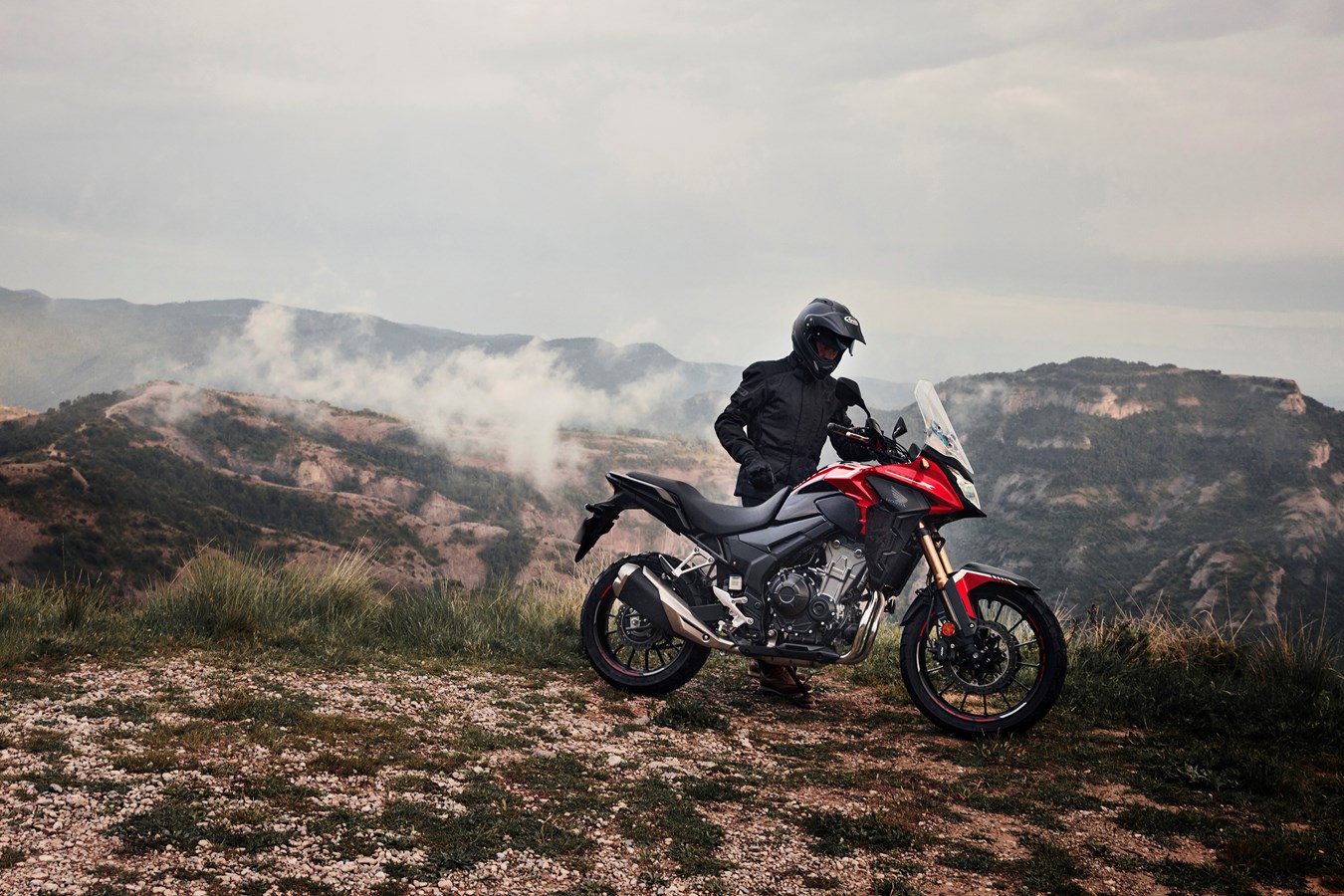
Model updates: Honda’s A2-compatible mini-adventurer receives major performance-focussed improvements led by Showa 41mm Separate Function Fork Big Piston (SFF-BP) USD forks, dual disc front brakes and radial-mount calipers. Handling is further improved by the new swingarm, which is lighter with more lateral flex. The rear shock has new settings to complement the new forks. A redesigned front wheel and lighter radiator save weight and new fuel injection settings improve engine character. More powerful headlight LEDs and front indicator position lights offer greater visibility.
Contents:
1 Introduction
2 Model overview
3 Key features
4 Accessories
5 Technical specifications
- Introduction
The CB500X – originally launched in 2013 alongside the naked CB500F and fully-faired CBR500R – brings crossover adventure style to Honda’s fun-focussed twin-cylinder ‘light middleweight’ trio. It is a motorcycle that, without fanfare, quietly gets on with the job of being supremely competent and adaptable for a wide variety of owners.
The CB500X’s usefulness is down to a straightforward equation – a perky, well-regarded twin-cylinder engine which produces real torque and drive from low rpm, and revs hard up top – plus a chassis that gives a supremely comfortable ride both around town and out on the open highway, all wrapped up in distinctive adventure styling.
It slips between the role of short-hop commuter to weekend tourer effortlessly. Long travel suspension irons out irregular road surfaces, wide handlebars provide leverage and the upright riding position offers both comfort and a wide field of view for the rider. In other words, the CB500X is an all-rounder in every sense of the term.
In 2016, a first upgrade saw the CB500X receive a larger fuel tank, more wind protection and a taller screen. It also gained LED lighting, spring preload-adjustable front forks and adjustable brake lever. Its 2019 evolution delivered more sophisticated adventure style, more engine performance and a number of chassis upgrades, ensuring that while the CB500X remained confident in its wide-ranging abilities, its ‘X’ factor was well and truly amplified. It gained EURO5 compliance in 2020.
Having proved its popularity over nearly a decade, for 2022 year model it receives high-quality front suspension in the form of Showa 41mm SFF-BP USD forks, plus dual front discs, lightweight swingarm, redesigned front wheel and other detail updates including a striking new colour and bold new graphics.
2. Model Overview
Alongside engine changes such as revised fuel injection settings and a new lighter radiator, the chassis benefits from the addition of Showa 41mm SFF-BP USD forks, dual Nissin radial mount two-piston calipers biting 296mm discs, light-weight wheels feature new thinner spokes and redesigned swingarm – for improved rider comfort and handling performance. Compared to the previous model, weight bias also moves fractionally forward for enhanced front tyre grip and feel. Styling is updated with a new front wheel and larger front mudguard.
As before, LCD instruments feature a Shift Up and Gear Position function. All lighting is LED, with optimised high/low headlight beam and addition of front indicator position lights.
The 22YM CB500X will be available in the following colour options:
Grand Prix Red
Matt Gunpowder Black Metallic
Pearl Organic Green **NEW for 2022**
3. Key Features
3.1 Chassis & Styling
- 41mm Showa Separate Function Fork Big Piston (SFF-BP) USD forks
- New dual 296mm discs matched to Nissin two-piston calipers
- New lighter weight front wheel and swingarm
- Revised headlight LEDs for improved high/low beam plus position lights
Light, strong and unchanged for the 2022 year model, the CB500X’s 35mm diameter steel diamond-tube mainframe has a tuned degree of yield that gives plenty of feedback to the rider as road surfaces change. The shape and position of the engine mounts, plus the frame’s rigidity balance, also reduce vibration.
Immediately obvious is a brand-new front end set-up. With the aim to heighten all-round handling performance the 41mm telescopic forks of the previous design have been replaced by spring preload-adjustable Showa 41mm Separate Function Fork Big Piston (SFF-BP) USD forks with 135mm axle travel (150mm cushion stroke), clamped by new top and bottom yokes. By dividing the functions – Big Piston pressure separation damper in one leg, spring mechanism in the other – reaction and ride quality are both improved.
The single-tube rear shock absorber (as found on larger capacity sports bikes) with its large-diameter piston and 135mm axle travel (60mm cushion stroke) ensures excellent response and temperature management; it features 5-stage preload adjustment with newly optimised spring rate and damping settings.
Handling is further improved by the redesigned, lighter swingarm. Now constructed from 2mm steel (rather than 2.3mm), it employs a hollow cross member and is stiffer rotationally, and also more flexible laterally to improve handling. A crisply redesigned chain guard completes the new look.
In line with the dynamic improvements to the chassis and suspension, the braking performance has also been improved. The single 310mm wave-pattern disc and two-piston caliper front brake of the previous design has been replaced by dual 296mm wave-pattern discs and axial mounted Nissin two-piston calipers. The introduction of the smaller discs not only keeps any additional weight gain to a minimum, but also reduces the required pressure on the lever when braking.
The redesigned 19-inch cast aluminium front wheel – lighter thanks to thinner spokes – reduces unsprung weight to aid turning ability. It’s crowned by a tough new mudguard design and heads a 17-inch rear wheel; trail-pattern tyres are sized 110/80-R19 front and 160/60-R17 rear. Weight bias has also been adjusted. with front/rear bias percentage of 48.7/51.3 compared to the previous 48/52. Kerb weight is 199kg. Wheelbase remains 1,445mm with rake and trail of 27.5°/108mm.
The CB500X wears an aggressive, ‘ready for the wild’ adventure style, with the long radiator shrouds and fairing giving a strong three-dimensional texture front to rear, linked by interlocking side covers and fuel tank. But this is a bike as much about function as form; high-pressure air flowing around the fairing and screen (with two available height settings – 1445mm and 1410mm) is managed to improve wind protection for the rider at highway speeds. The sharply-chiselled headlight is now even more piercing with extra-powerful LEDs, plus there’s added visibility from front indicator position lights.
A slim seat profile allows for free movement around the machine and aids easy ground reach. And to help manoeuvrability the steering angle is 38° from centred to full lock.
Gunmetal grey tapered steel handlebar elevate control further still. Seat height is 830mm and the upright riding position is very accommodating, while providing excellent visibility. Overall dimensions are 2155mm x 830mm x 1410mm, with 180mm ground clearance.
LCD instruments – set in a multi-surfaced and textured surround – feature a Gear Position and Shift Up indicator; this is set to a default 8,750rpm but can be adjusted in 250rpm increments between 5-8,750rpm.
The fuel tank holds 17.5L including reserve, and, combined with the engine’s excellent fuel economy of 3.6L/100km (27.8km/l) (WMTC mode), gives a range of 485km.
3.2 Engine
- Lively twin-cylinder powerplant delivers usable power and torque across the rev-range, plus sporty sound from its dual-exit muffler
- New PGM-FI settings improve torque feel and character
- New radiator design more stylish and lighter
- Assist/slipper clutch eases upshifts and manages downshifts
- Homologated for EURO5
The CB500X’s A2-licence friendly 471cc, 8-valve liquid-cooled parallel twin-cylinder layout offers a well-proportioned balance of physical size and willing, enjoyable power output, with an energetic, high-revving character and zappy top end. The 2019 upgrades created faster acceleration through a 4% boost in low-to-mid-range power and torque in the 3-7,000rpm range. It's very much an engine whose overall performance and character belie its relatively small capacity. Peak power of 35kW arrives at 8,600rpm, with 43Nm torque delivered at 6,500rpm.
Feeding the PGM-FI fuel injection is a more-or-less straight shot of airflow through the airbox and throttle bodies and for 2022, new settings improve torque feel and character without compromising performance. The exhaust muffler features dual exit pipes, giving a sporting edge to each pulse, and a rasping high-rpm howl. A new more aesthetically pleasing radiator design contributes a 92g weight saving, with no loss of cooling efficiency
Bore and stroke are set at 67mm x 66.8mm with compression ratio of 10.7:1; the crankshaft pins are phased at 180° and a primary couple-balancer sits behind the cylinders, close to the bike’s centre of gravity. The primary and balancer gears use scissor gears, reducing noise. The crank counterweight is specifically shaped for couple-balance and its light weight allows the engine to spin freely, with reduced inertia.
Acting as a stressed member, the engine complements the frame’s rigidity with four frame hangers on the cylinder head. Internally the cylinder head uses roller rocker arms; shim-type valve adjustment allows them to be light, for lower valve-spring load and reduced friction.
A silent (SV Chain) cam chain has the surface of its pins treated with Vanadium, reducing friction with increased protection against wear. Inlet valve diameter is 26.0mm with exhaust valve diameter of 21.5mm.
Piston shape is carefully designed to reduce piston ‘noise’ at high rpm. Friction is reduced by striations on the piston skirt (a finish that increases surface area, introducing gaps in which oil can flow for better lubrication). The ‘triangle’ proportion of crankshaft, main shaft and countershaft is efficiently compact. The crankcases uses centrifugally cast thin-walled sleeves; their internal design reduces the ‘pumping’ losses that can occur with a 180° phased firing order. A deep sump reduces oil movement under hard cornering and braking; oil capacity is 3.2L.The slick-changing six-speed gearbox is managed by an assist/slipper clutch.
4. Accessories
A range of Genuine Honda Accessories are available for the CB500X. They include:
Centre stand
Side wind deflectors
Knuckle guards
Heated grips
35L top box
Rear carrier
Pannier mounts
Pannier cases
Tubular fairing frames
Fog lights
Tank bag
Seat bag
Charging socket
Smoked screen
Wheel stripe
Tank pad
Cargo net
5. Technical Specifications
|
ENGINE |
|
|
Type |
Liquid-cooled, parallel twin |
|
Displacement |
471cc |
|
Bore and stroke |
67mm x 66.8mm |
|
Compression Ratio |
10.7: 1 |
|
Max. Power Output |
35kW @ 8,600rpm |
|
Max. Torque |
43Nm @ 6,500rpm |
|
Noise Level |
L-urban 74dB L-wot 76.7dB |
|
Oil Capacity |
3.2L |
|
FUEL SYSTEM |
|
|
Carburation |
PGM FI electronic fuel injection |
|
Fuel Tank Capacity |
17.5L (inc reserve) |
|
CO2 Emissions WMTC |
82 g/km |
|
Fuel Consumption (WMTC) |
3.6L/100km / 27.8km/l (WMTC mode) |
|
ELECTRICAL SYSTEM |
|
|
Battery Capacity |
12V 7.4AH |
|
ACG Output |
25A/2000rpm |
|
DRIVETRAIN |
|
|
Clutch Type |
Wet multiplate |
|
Transmission Type |
6 speed |
|
Final Drive |
Chain |
|
FRAME |
|
|
Type |
Steel diamond |
|
CHASSIS |
|
|
Dimensions (L´W´H) |
2155mm x 830mm x 1410mm (Low screen) 1445mm (High screen) |
|
Wheelbase |
1445mm |
|
Caster Angle |
27.5 degrees |
|
Trail |
108mm |
|
Seat Height |
830mm |
|
Ground Clearance |
180mm |
|
Kerb Weight |
199kg |
|
SUSPENSION |
|
|
Type Front |
Showa 41mm SFF-BP USD forks, pre-load adjustable |
|
Type Rear |
Prolink mono with 5 stage preload adjuster, steel hollow cross swingarm |
|
WHEELS |
|
|
Type Front |
Multi-spoke cast aluminium |
|
Type Rear |
Multi-spoke cast aluminium |
|
Rim Size Front |
19 X MT2.5 |
|
Rim Size Rear |
17 X MT4.5 |
|
Tyres Front |
110/80R19M/C (59H) |
|
Tyres Rear |
160/60R17M/C (69H) |
|
BRAKES |
|
|
ABS System Type |
2 channel |
|
Type Front |
Dual 296mm x 4mm disc with Nissin radial-mount two piston calipers |
|
Type Rear |
Single 240mm x 5mm disc with single piston caliper |
|
INSTRUMENTS & ELECTRICS |
|
|
Instruments |
LCD Meter with Speedometer, Bar Graph Tachometer, Dual Trip Meters, Fuel Level and Consumption Gauge, Clock, Water Temp, Gear position, Shift UP Indicator |
|
Headlight |
LED |
|
Taillight |
LED |
|
Security System |
HISS (Honda Intelligent Security System) |
All specifications are provisional and subject to change without notice.
# Please note that the figures provided are results obtained by Honda under standardised testing conditions prescribed by WMTC. Tests are conducted on a rolling road using a standard version of the vehicle with only one rider and no additional optional equipment. Actual fuel consumption may vary depending on how you ride, how you maintain your vehicle, weather, road conditions, tire pressure, installation of accessories, cargo, rider and passenger weight, and other factors.
22YM HONDA CB500F
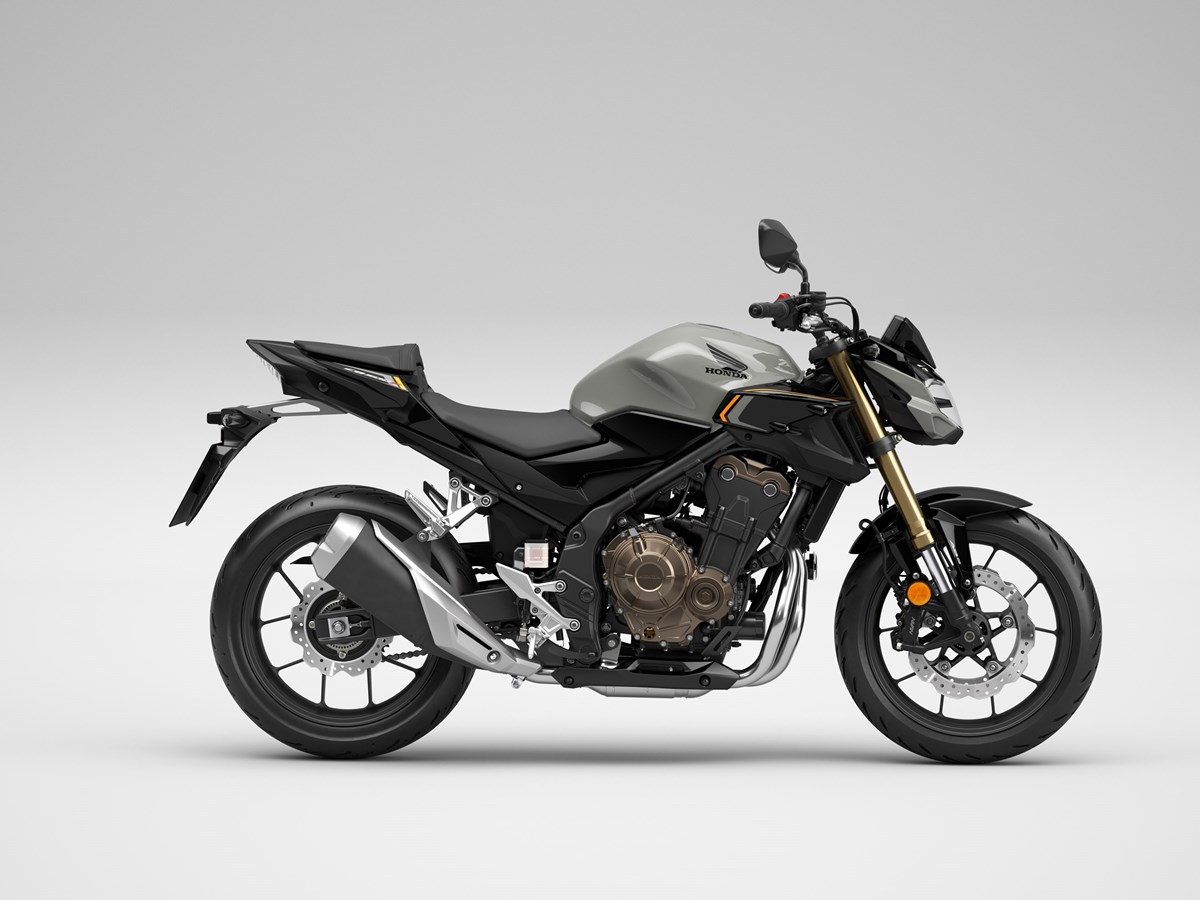
Model updates: Honda’s A2-compatible mini-streetfighter receives major performance-focussed improvements led by new Showa 41mm Separate Function Fork Big Piston (SFF-BP) USD forks, dual disc front brakes and radial-mount calipers. Front tyre grip is heightened with more forward weight bias; handling is further improved by the new swingarm, which is lighter with more lateral flex. The rear shock has new settings to complement the new forks. Redesigned wheels and a lighter radiator save more weight and new fuel injection settings improve engine character. More powerful headlight LEDs and front indicator position lights offer greater visibility.
Contents:
1 Introduction
2 Model overview
3 Key features
4 Accessories
5 Technical specifications
- Introduction
The naked CB500F – originally launched in 2013 alongside the adventure-styled CB500X and fully-faired CBR500R – has quietly proved that one of Honda’s tried-and-trusted formulas for building popular motorcycles has lost none of its relevance.
That formula? An entertaining twin-cylinder engine wrapped in a simple, lightweight, sporty chassis, which is as much fun for an experienced rider as it is for those still building their riding career. And while a 35kW peak power output makes it suitable for A2 licence holders, the CB500F offers so much more than ‘entry level’ performance.
While its compact dimensions and welcoming manners make it an easy machine to manage, ride and learn on, those same attributes also make it a genuine pleasure for those – whether stepping up from a 125 or coming down from a bigger machine – who want to explore just what it can do at the weekend. Sensible running costs, whatever the situation, add strongly to the appeal.
In 2019, the CB500F was redrawn with uncompromising lines that elevated its technical and mechanical aspects and in 2020 it was homologated for EURO5. Having proved its continued popularity, for 2022 it receives high-quality suspension in the form of Showa 41mm SFF-BP USD forks, dual front discs, new lightweight wheels and swingarm and other detail updates including three striking new colours.
2. Model Overview
Alongside engine changes such as revised fuel injection settings and a new lighter radiator, the chassis benefits from the addition of Showa 41mm SFF-BP USD forks, dual Nissin radial mount two-piston calipers biting 296mm discs, lighter-weight 5-spoke wheels and redesigned swingarm – for improved high-speed handling and braking. Weight bias also moves fractionally forward compared to the previous model, for enhanced front tyre grip and feel.
Styling is updated with a new front mudguard, inherited from the CB650R, and sporty aluminium footpegs are now also standard fit. As before, LCD instruments feature a Shift Up and Gear Position function. All lighting is LED, with optimised high/low headlight beam from the new headlight and position lights.
The 2022 CB500F will be available in the following colour options:
Grand Prix Red
Matt Axis Grey Metallic **NEW for 2022**
Pearl Smokey Gray **NEW for 2022**
Pearl Dusk Yellow **NEW for 2022**
3. Key Features
3.1 Chassis & Styling
- New 41mm Showa Separate Function Fork Big Piston (SFF-BP) USD forks
- New dual 296mm discs matched to Nissin radial mount two-piston calipers
- Lighter weight wheels and swingarm, plus aluminium footpegs
- More forward weight bias for enhanced front tyre grip
- Revised LEDs for the headlight for improved high/low beam
Light, strong and unchanged for 2022, the 35mm diameter steel diamond-tube mainframe has a tuned degree of yield that gives plenty of feedback to the rider as road surfaces change. The shape and position of the engine mounts, plus the frame’s rigidity balance, keep vibration to a minimum.
Immediately obvious is a brand-new front end set-up. With the aim to heighten sporty handling performance the 41mm telescopic forks of the previous design have been replaced by Showa 41mm Separate Function Fork Big Piston (SFF-BP) USD forks, clamped by new top and bottom yokes. By dividing the functions – Big Piston pressure separation damper in one leg, spring mechanism in the other – reaction and ride quality are both improved. The four-cylinder CB650R uses the exact same set-up.
In a further effort to improve the ride quality, the 2022 CB500F features new lighter wheels with 5 Y-shaped spokes rather than the 6 of the previous model. The front wheel width remains 3.5inch with a 120/70-ZR17 tyre and the rear 4.5inch with 160/60-ZR17 tyre.
A redesigned swingarm also shaves grams; it’s now constructed from 2mm steel (rather than 2.3mm) and employs a hollow cross member and crisply redesigned chain guard. Stiffer rotationally, the new swingarm is also more flexible laterally to improve handling. The single-tube rear shock absorber (as found on larger capacity sports bikes) with its large-diameter piston ensures excellent response and temperature management; it features 5-stage preload adjustment with spring rate and damping settings optimised to match the forks.
In line with the dynamic improvements to the chassis and suspension, the braking performance has also been improved. The single 320mm and two-piston caliper front brake from the previous model has been replaced by dual 296mm discs and Nissin radial-mount, two-piston calipers. The introduction of the smaller discs not only keeps any additional weight gain to a minimum, but also reduces the required pressure on the lever when braking.
The new CB500F’s kerb weight remains 189kg, but it places more weight on the front wheel than the previous model to promote more nimble handling and improve front end grip: front/rear bias percentage is now 49.7/50.3 (compared to 46.8/53.2). Wheelbase remains 1410mm with rake and trail of 25.5°/102mm.
The naked form exudes aggression. Led by the sharply-chiselled headlight – now even more piercing with extra-powerful LEDs and a new stronger cluster arrangement, plus high-visibility front indicator position lights – the machine’s stance is low-set and ready for action; the side shrouds interlock with the fuel tank and fully emphasize the engine, while the side covers and seat unit continue the theme of muscular angularity. The compact front mudguard is drawn directly from the CB650R.
Tapered handlebars offer intuitive feel and leverage. Seat height is low at 789mm, making the CB500F very easy to manage and its neutral riding position comfortably accommodates riders of any height. More purposeful-looking aluminium footpegs replace the previous rubberised parts; between the pair they save a further 104g. Overall dimensions are 2080mm x 800mm x 1060mm, with 145mm ground clearance.
The fuel tank holds 17.1L including reserve and combined with the engine’s excellent 3.5L/100km (28.6km/litre) fuel economy, gives a range of over 485km.
3.2 Engine
- Lively twin-cylinder powerplant delivers usable power and torque across the rev-range, plus sporty sound from its dual-exit muffler
- New PGM-FI settings improve torque feel and character
- New radiator design more stylish and lighter
- Assist/slipper clutch eases upshifts and manages downshifts
- Homologated for EURO5
The 2022 CB500F’s A2-licence friendly 471cc, 8-valve liquid-cooled parallel twin-cylinder layout offers a well-proportioned balance of physical size and willing, enjoyable power output, with an energetic, high-revving character and zappy top end. The 2019 upgrades created faster acceleration through a 4% boost in low-to-mid-range power and torque in the 3-7,000rpm range. It's very much an engine whose overall performance and character belie its relatively small capacity. Peak power of 35kW arrives at 8,600rpm, with 43Nm torque delivered at 6,500rpm.
Feeding the PGM-FI fuel injection is a more-or-less straight shot of airflow through the airbox and throttle bodies and for the 2022 year model, new settings improve torque feel and character without compromising performance. The exhaust muffler features dual exit pipes, giving a sporting edge to each pulse, and a rasping high-rpm howl. A new more aesthetically pleasing radiator design contributes a 100g weight saving, with no loss of cooling efficiency.
Bore and stroke are set at 67mm x 66.8mm and compression ratio is 10.7:1; the crankshaft pins are phased at 180° and a primary couple-balancer sits behind the cylinders, close to the bike’s centre of gravity. The primary and balancer gears use scissor gears, reducing noise. The crank counterweight is specifically shaped for couple-balance and its light weight allows the engine to spin freely, with reduced inertia.
Acting as a stressed member, the engine complements the frame’s rigidity with four frame hangers on the cylinder head. Internally the cylinder head uses roller rocker arms; shim-type valve adjustment allows them to be light, for lower valve-spring load and reduced friction.
A silent (SV Chain) cam chain has the surface of its pins treated with Vanadium, reducing friction with increased protection against wear. Inlet valve diameter is 26.0mm with exhaust valve diameter of 21.5mm.
Piston shape is carefully designed to reduce piston ‘noise’ at high rpm. Friction is reduced by striations on the piston skirt (a finish that increases surface area, introducing gaps in which oil can flow for better lubrication). The ‘triangle’ proportion of crankshaft, main shaft and countershaft is efficiently compact. The crankcases uses centrifugally cast thin-walled sleeves; their internal design reduces the ‘pumping’ losses that can occur with a 180° phased firing order. A deep sump reduces oil movement under hard cornering and braking; oil capacity is 3.2L.The slick-changing six-speed gearbox is managed by an assist/slipper clutch.
4. Accessories
A range of Genuine Honda Accessories are available for the CB500F. They include:
35L top box
Rear carrier
Tank bag
Seat bag
Smoke windscreen
Heated grips
12V/USB Type-C sockets
Seat cowl
Wheel stripes
Tank pad
Main stand
5. Technical Specifications
|
ENGINE |
|
|
Type |
Liquid-cooled 4 stroke, parallel twin |
|
Displacement |
471cc |
|
No of Valves per Cylinder |
4 |
|
Bore & Stroke |
67mm x 66.8mm |
|
Compression Ratio |
10.7: 1 |
|
Max. Power Output |
35kW @ 8600rpm |
|
Max. Torque |
43Nm @ 6500rpm |
|
Noise Level (dB) |
L-urban 74dB L-wot 76.4dB |
|
Oil Capacity |
3.2L |
|
FUEL SYSTEM |
|
|
Carburation |
PGM FI electronic fuel injection |
|
Fuel Tank Capacity |
17.1L (inc reserve) |
|
CO2 Emissions (WMTC) |
80 g/km |
|
Fuel Consumption (WMTC) |
3.5L/100km (28.6km/litre) |
|
ELECTRICAL SYSTEM |
|
|
Battery Capacity |
12V 7.4AH |
|
ACG Output |
23.4A/2000rpm |
|
DRIVETRAIN |
|
|
Clutch Type |
Wet multiplate, Assisted slipper clutch |
|
Transmission Type |
6 speed |
|
Final Drive |
Chain |
|
FRAME |
|
|
Type |
Steel diamond |
|
CHASSIS |
|
|
Dimensions (L´W´H) |
2080mm x 800mm x 1060mm |
|
Wheelbase |
1410mm |
|
Caster Angle |
25.5 degrees |
|
Trail |
102mm |
|
Seat Height |
789mm |
|
Ground Clearance |
145mm |
|
Kerb Weight |
189kg |
|
SUSPENSION |
|
|
Type Front |
Showa 41mm SFF-BP USD forks, pre-load adjustable |
|
Type Rear |
Prolink mono with 5 stage pre-load adjuster, Steel hollow cross swingarm |
|
WHEELS |
|
|
Type Front |
5Y-Spoke Cast Aluminium |
|
Type Rear |
5Y-Spoke Cast Aluminium |
|
Rim Size Front |
17 x MT3.5 |
|
Rim Size Rear |
17 x MT4.5 |
|
Tyres Front |
120/70ZR17M/C (58W) |
|
Tyres Rear |
160/60ZR17M/C (69W) |
|
BRAKES |
|
|
ABS System Type |
2-channel |
|
Type Front |
Dual 296mm x 4mm disc with Nissin radial-mount two piston calipers |
|
Type Rear |
Single 240mm x 5mm disc with single piston caliper |
|
INSTRUMENTS & ELECTRICS |
|
|
Instruments |
LCD Meter with Speedometer, Bar Graph Tachometer, Dual Trip Meters, Fuel Level and Consumption Gauge, Clock, Water Temp, Gear position, Shift UP Indicator |
|
Headlight |
LED |
|
Taillight |
LED |
|
Security System |
HISS (Honda Intelligent Security System) |
All specifications are provisional and subject to change without notice.
# Please note that the figures provided are results obtained by Honda under standardised testing conditions prescribed by WMTC. Tests are conducted on a rolling road using a standard version of the vehicle with only one rider and no additional optional equipment. Actual fuel consumption may vary depending on how you ride, how you maintain your vehicle, weather, road conditions, tire pressure, installation of accessories, cargo, rider and passenger weight, and other factors.
22YM HONDA CBR500R
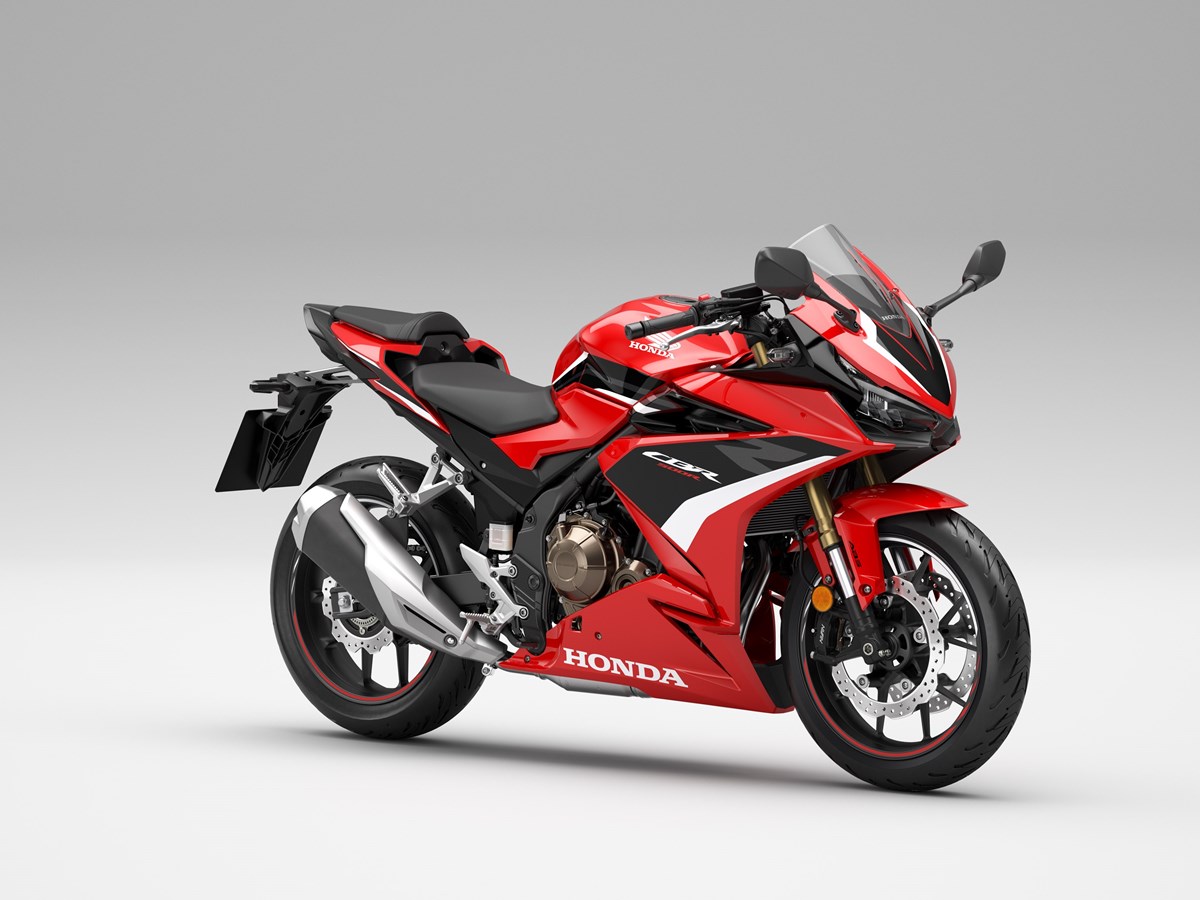
Model updates: Honda’s A2-compatible ‘pocket rocket’ receives major performance-focussed improvements led by Showa 41mm Separate Function Fork Big Piston (SFF-BP) USD forks, dual disc front brakes and radial-mount calipers. Front tyre grip is heightened with more forward weight bias; handling is further improved by the new swingarm, which is lighter with more lateral flex. The rear shock has new settings to complement the new forks. Redesigned wheels and a lighter radiator save more weight and new fuel injection settings improve engine character. More powerful headlight LEDs offer greater visibility.
Contents:
1 Introduction
2 Model overview
3 Key features
4 Technical specifications
- Introduction
Fast, frugal, affordable and – most importantly – fun, Honda’s fully-faired CBR500R, launched in 2013 alongside the naked CB500F and adventure-styled CB500X, injects a genuine sporting energy to its twin-cylinder ‘light middleweight’ trio.
Hugely popular with younger riders looking to move up from a smaller machine with more than 50% of owners under the age of 30, the CBR500R instils the excitement of sports bike ownership into every ride yet also delivers sensible running costs, making it a great bike to both commute through the working week and enjoy at the weekend.
In 2016 the CBR500R assumed sharper styling and LED lighting to go with updated front suspension; in 2019 it got an even more aggressive makeover, with a new form and riding position that outlined a keener sporting intent. Developments were also applied to the engine for stronger performance off the bottom, a distinctive surge through the rev range to the redline and more distinctive exhaust howl. It gained EURO5 compliance in 2020.
Having proved its undoubted star quality alongside its siblings, for its 2022 year model it receives a major suspension upgrade in the form of high-quality Showa 41mm SFF-BP USD forks, plus dual front discs, new lightweight wheels and swingarm and other detail updates including a striking new colour.
2. Model Overview
Alongside engine changes such as revised fuel injection settings and a new lighter radiator, the chassis benefits from the addition of Showa 41mm SFF-BP USD forks, dual Nissin radial mount two-piston calipers biting 296mm discs, lighter-weight 5-spoke wheels and redesigned swingarm – for improved high-speed handling and braking. Weight bias also moves fractionally forward for enhanced front tyre grip and feel.
Styling is updated with a new front mudguard, inherited from the CBR650R, and sporty aluminium footpegs are also now standard fit. As before, LCD instruments feature a Shift Up and Gear Position function and all lighting is premium LED; the new headlight, also inherited from the CBR650R, now spreads a broader beam.
The 2022 CBR500R will be available in the following colour options:
Grand Prix Red
Matt Gunpower Black Metallic **NEW for 2022**
3. Key Features
3.1 Chassis & Styling
- New 41mm Showa Separate Function Fork Big Piston (SFF-BP) USD forks
- New dual 296mm discs matched to Nissin radial mount two-piston calipers
- Lighter weight wheels and swingarm, plus aluminium footpegs
- Weight bias further forward for enhanced front end grip
- New headlight inherited from the CBR650R
Light, strong and unchanged for 2022 the 35mm diameter steel diamond-tube mainframe has a tuned degree of yield that gives plenty of feedback to the rider as road surfaces change. The shape and position of the engine mounts, plus the frame’s rigidity balance, also keep vibration to a minimum.
Immediately obvious is a brand-new front end set-up. With the aim to heighten sports handling performance the 41mm telescopic forks of the previous design have been replaced by Showa 41mm Separate Function Fork Big Piston (SFF-BP) USD forks, clamped by new top and bottom yokes. By dividing the functions – Big Piston pressure separation damper in one leg, spring mechanism in the other – reaction and ride quality are both improved. The four-cylinder CBR650R wears the exact same set-up.
In a further effort to improve the ride quality, the 22YM CBR500R features new lighter wheels with 5 Y-shaped spokes rather than the 6 of the previous model. The front wheel width remains 3.5inch with a 120/70-ZR17 tyre and the rear 4.5inch with 160/60-ZR17 tyre.
A redesigned swingarm also shaves grams; it’s now constructed from 2mm steel (rather than 2.3mm) and employs a hollow cross member and crisply redesigned chain guard. Stiffer rotationally, the new swingarm is also more flexible laterally to improve handling. The single-tube rear shock absorber (as found on larger capacity sports bikes) with its large-diameter piston ensures excellent response and temperature management; it features 5-stage preload adjustment with spring rate and damping settings optimised to match the forks.
In line with the dynamic improvements to the chassis and suspension, the braking performance has also been improved. The single 320mm and two-piston caliper front brake from the previous model has been replaced by dual 296mm discs and Nissin radial-mount, two-piston calipers. The introduction of the smaller discs not only keeps any additional weight gain to a minimum, but also reduces the required pressure on the lever when braking.
The new CBR500R weighs in at 192kg and places slightly more weight on the front wheel to promote more nimble handling and improve front end grip: front/rear bias percentage is now 50.7/49.3, compared to 50.1/49.9 of the previous version. Wheelbase remains 1410mm with rake and trail of 25.5°/102mm.
And nimble responsiveness is what the CBR500R is all about. The view forward from the cockpit is pure sports. The handlebars clip on beneath the top yoke and as a result the riding position is unmistakably aggressive; the fairing is also set low. Purposeful aluminium footpegs replace the previous rubberised parts; between the pair they save 104g and offer maximum support for more spirited riding. The compact front mudguard is drawn from the CBR650R.
New sharply-chiselled dual LED headlights, inherited from the CBR650R, stare menacingly ahead with a wider volume of light emission, matching by LED indicators. LCD instruments feature a Gear Position and Shift Up indicator; this is set to a default 8,750rpm but can be adjusted in 250rpm increments between 5-8,750rpm.
Seat height is low at 785mm, making the CBR500R very easy to manage and its riding position comfortably accommodates riders of any height. Overall dimensions are 2080mm x 760mm x 1145mm, with 130mm ground clearance.
The fuel tank holds 17.1L including reserve and combined with the engine’s excellent 3.5L/100km (28.6km/litre) fuel economy, gives a range of over 485km.
3.2 Engine
- Lively twin-cylinder powerplant delivers usable power and torque across the rev-range, plus sporty sound from its dual-exit muffler
- New PGM-FI settings improve torque feel and character
- New radiator design more stylish and lighter
- Assist/slipper clutch eases upshifts and manages downshifts
- Homologated for EURO5
The 22YM CBR500R’s A2-licence friendly 471cc, 8-valve liquid-cooled parallel twin-cylinder layout offers a well-proportioned balance of physical size and willing, enjoyable power output, with an energetic, high-revving character and zappy top end. The 2019 upgrades created faster acceleration through a 4% boost in low-to-mid-range power and torque in the 3-7,000rpm range. It's very much an engine whose overall performance and character belie its relatively small capacity. Peak power of 35kW arrives at 8,600rpm, with 43Nm torque delivered at 6,500rpm.
Feeding the PGM-FI fuel injection is a more-or-less straight shot of airflow through the airbox and throttle bodies and for the 2022 year model, new settings improve torque feel and character without compromising performance. The exhaust muffler features dual exit pipes, giving a sporting edge to each pulse, and a rasping high-rpm howl. A new more aesthetically pleasing radiator design contributes a 100g weight saving, with no loss of cooling efficiency.
Bore and stroke are set at 67mm x 66.8mm and compression ratio is 10.7:1; the crankshaft pins are phased at 180° and a primary couple-balancer sits behind the cylinders, close to the bike’s centre of gravity. The primary and balancer gears use scissor gears, reducing noise. The crank counterweight is specifically shaped for couple-balance and its light weight allows the engine to spin freely, with reduced inertia.
Acting as a stressed member, the engine complements the frame’s rigidity with four frame hangers on the cylinder head. Internally the cylinder head uses roller rocker arms; shim-type valve adjustment allows them to be light, for lower valve-spring load and reduced friction.
A silent (SV Chain) cam chain has the surface of its pins treated with Vanadium, reducing friction with increased protection against wear. Inlet valve diameter is 26.0mm with exhaust valve diameter of 21.5mm.
Piston shape is carefully designed to reduce piston ‘noise’ at high rpm. Friction is reduced by striations on the piston skirt (a finish that increases surface area, introducing gaps in which oil can flow for better lubrication). The ‘triangle’ proportion of crankshaft, main shaft and countershaft is efficiently compact. The crankcases uses centrifugally cast thin-walled sleeves; their internal design reduces the ‘pumping’ losses that can occur with a 180° phased firing order. A deep sump reduces oil movement under hard cornering and braking; oil capacity is 3.2L.The slick-changing six-speed gearbox is managed by an assist/slipper clutch.
4. Accessories
A range of Genuine Honda Accessories are available for the CBR500R. They include:
35L top box
Rear carrier
Tank bag
Seat bag
High smoke windscreen
Heated grips
12V/USB Type-C sockets
Seat Cowl
Wheel Stripes
Tank Pad
5. Technical Specifications
|
ENGINE |
|
|
Type |
Liquid-cooled 4 stroke, parallel twin |
|
Displacement |
471cc |
|
No of Valves per Cylinder |
4 |
|
Bore & Stroke |
67mm x 66.8mm |
|
Compression Ratio |
10.7: 1 |
|
Max. Power Output |
35kW @ 8600rpm |
|
Max. Torque |
43Nm @ 6500rpm |
|
Noise Level (dB) |
L-urban 74dB L-wot 76.4dB |
|
Oil Capacity |
3.2L |
|
FUEL SYSTEM |
|
|
Carburation |
PGM FI electronic fuel injection |
|
Fuel Tank Capacity |
17.1L (inc reserve) |
|
CO2 Emissions (WMTC) |
80 g/km |
|
Fuel Consumption (WMTC) |
3.5L/100km (28.6km/litre) |
|
ELECTRICAL SYSTEM |
|
|
Battery Capacity |
12V 7.4AH |
|
ACG Output |
23.4A/2000rpm |
|
DRIVETRAIN |
|
|
Clutch Type |
Wet multiplate, Assisted slipper clutch |
|
Transmission Type |
6 speed |
|
Final Drive |
Chain |
|
FRAME |
|
|
Type |
Steel diamond |
|
CHASSIS |
|
|
Dimensions (L´W´H) |
2080mm x 760mm x 1145mm |
|
Wheelbase |
1410mm |
|
Caster Angle |
25.5 degrees |
|
Trail |
102mm |
|
Seat Height |
785mm |
|
Ground Clearance |
130mm |
|
Kerb Weight |
192kg |
|
SUSPENSION |
|
|
Type Front |
Showa 41mm SFF-BP USD forks, pre-load adjustable |
|
Type Rear |
Prolink mono with 5 stage pre-load adjuster, Steel hollow cross swingarm |
|
WHEELS |
|
|
Type Front |
5Y-Spoke Cast Aluminium |
|
Type Rear |
5Y-Spoke Cast Aluminium |
|
Rim Size Front |
17 x MT3.5 |
|
Rim Size Rear |
17 x MT4.5 |
|
Tyres Front |
120/70ZR17M/C (58W) |
|
Tyres Rear |
160/60ZR17M/C (69W) |
|
BRAKES |
|
|
ABS System Type |
2-channel |
|
Type Front |
Dual 296mm x 4mm disc with Nissin radial-mount two piston calipers |
|
Type Rear |
Single 240mm x 5mm disc with single piston caliper |
|
INSTRUMENTS & ELECTRICS |
|
|
Instruments |
LCD Meter with Speedometer, Bar Graph Tachometer, Dual Trip Meters, Fuel Level and Consumption Gauge, Clock, Water Temp, Gear position, Shift Up Indicator |
|
Headlight |
LED |
|
Taillight |
LED |
|
Security System |
HISS (Honda Intelligent Security System) |
All specifications are provisional and subject to change without notice.
** Please note that the figures provided are results obtained by Honda under standardised testing conditions prescribed by WMTC. Tests are conducted on a rolling road using a standard version of the vehicle with only one rider and no additional optional equipment. Actual fuel consumption may vary depending on how you ride, how you maintain your vehicle, weather, road conditions, tire pressure, installation of accessories, cargo, rider and passenger weight, and other factors.
Honda’s trio of A2 licence-friendly 500cc machines receive strong performance-focused updates for 2022 year model
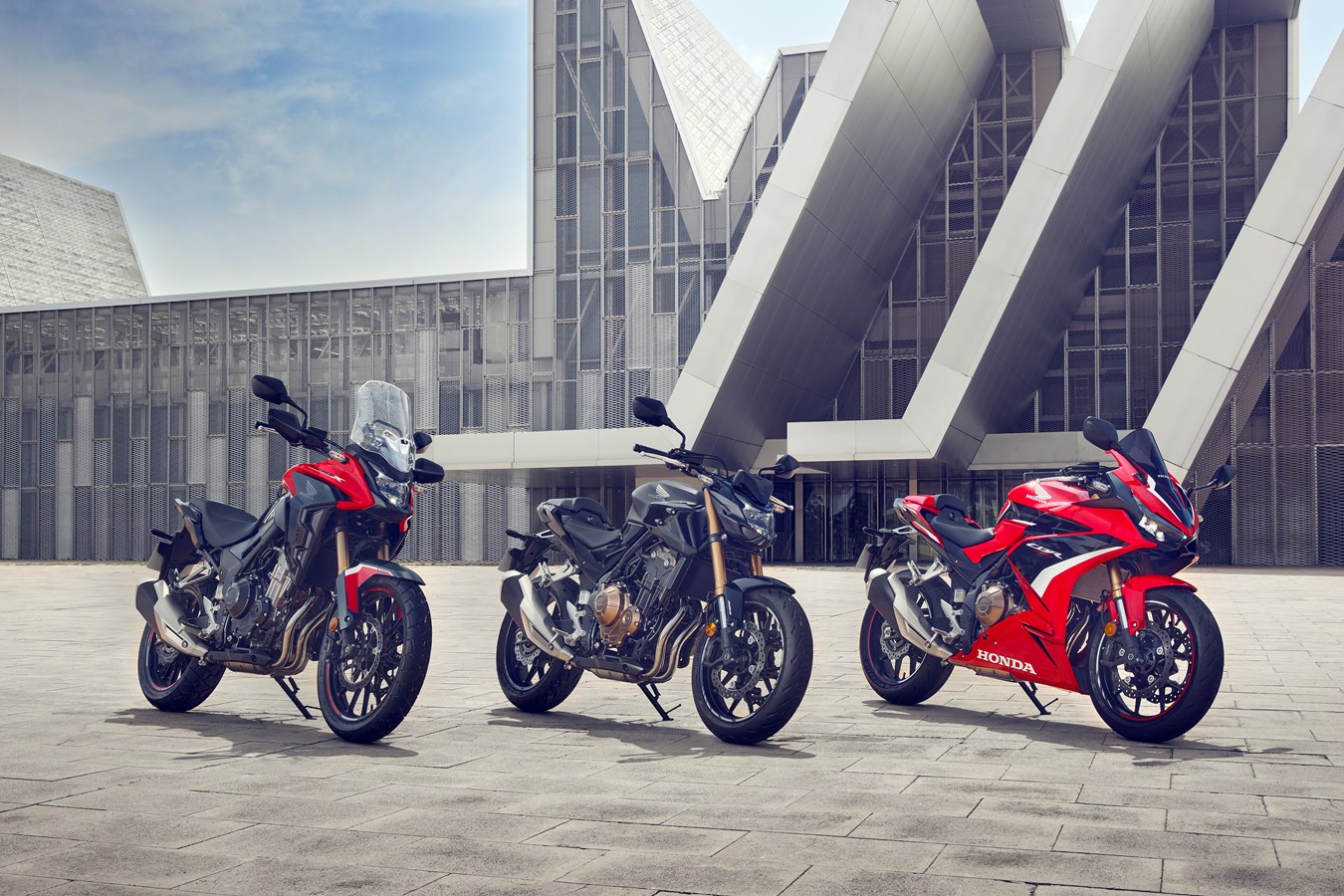
- Honda’s 500cc trio, the CB500F, CBR500R and CB500X all updated for 2022
- Chassis upgrades include Showa 41mm SFF-BP USD forks, a new lighter swingarm, lighter wheels and new dual 296mm front brake discs
- New fuel injection settings improve torque character and feel
- Updated styling with new colours and graphics
Honda’s hugely popular CB500F, CBR500R and CB500X trio all receive engine and chassis upgrades for their 2022 year model versions, further enhancing their broad appeal with new and experienced riders alike.
Inherited from the four cylinder CB650R and CBR650R middleweights, new Showa 41mm SFF-BP USD forks are the highlights of the new front end set up, delivering improved handling and ride quality. These are now matched to lighter Y spoke aluminum wheels on the CB500F and CBR500R, complete with new dual 296mm wavy front discs and radial mounted Nissin calipers. The adventure focused CB500X shares the same new brake and suspension updates as its siblings and also features longer front suspension travel and a lighter, larger 19in front wheel.
All three fun, frugal machines feature a new lighter swingarm, stiffer rotationally, but more flexible laterally to improve handling and cornering performance. The punchy 500cc engine at the heart of each machine still produces the maximum 35kW allowed for the A2 licence holder, but for 2022 it now features new PGM-FI settings to further enhance both torque feel and overall character.
For 2022 the naked CB500F gains three new vibrant colours: Pearl Smoky Gray, Mat Axis Gray Metallic and Pearl Dusk Yellow, while the sporty CBR500R will be available in new Mat Gunpowder Black Metallic, also benefitting from striking new graphics to highlight its racetrack heritage. The CB500X adventure machine receives two new colours for 2022: Mat Gunpowder Black Metallic and Pearl Organic Green. All three bikes will also be available in Honda’s classic Grand Prix Red colour scheme.
While their compact dimensions and welcoming manners make Honda’s 500cc trio easy machines to manage, ride and learn on, those same attributes also make them a genuine pleasure for those – whether stepping up from a 125, coming down from a bigger machine or returning to the market – who want to explore just what they can do at the weekend, whatever the type of ride they choose.
Honda have sold over 106,000 units of the CBs and CBR across Europe since their introduction in 2013. Each take their own place in a distinct world within Honda’s rich product line-up. The CB500F ‘roadster’ accounts for nearly half of the sales, the ‘race’ world representative CBR500R 18%, and the adventure world CB500X, 35% of the total.
Honda’s research of a representative sample of customers shows the breadth of appeal of the three machines across different rider demographics. Figures show that 45% of CB500F and 37% of CBR500R owners are new riders, with 45% and 60% respectively under the age of 34, illustrating how instrumental they have been in bringing new young riders to the world of two wheels.
Conversely, over 75% of CB500X owners are experienced riders, with a further 15% having been drawn back to motorcycling by the all-round appeal offered by the compact adventurer with its rugged styling, long travel suspension and upright riding position.
Honda’s iconic Africa Twin and Africa Twin Adventure Sport receive striking new looks and updates for 2022.
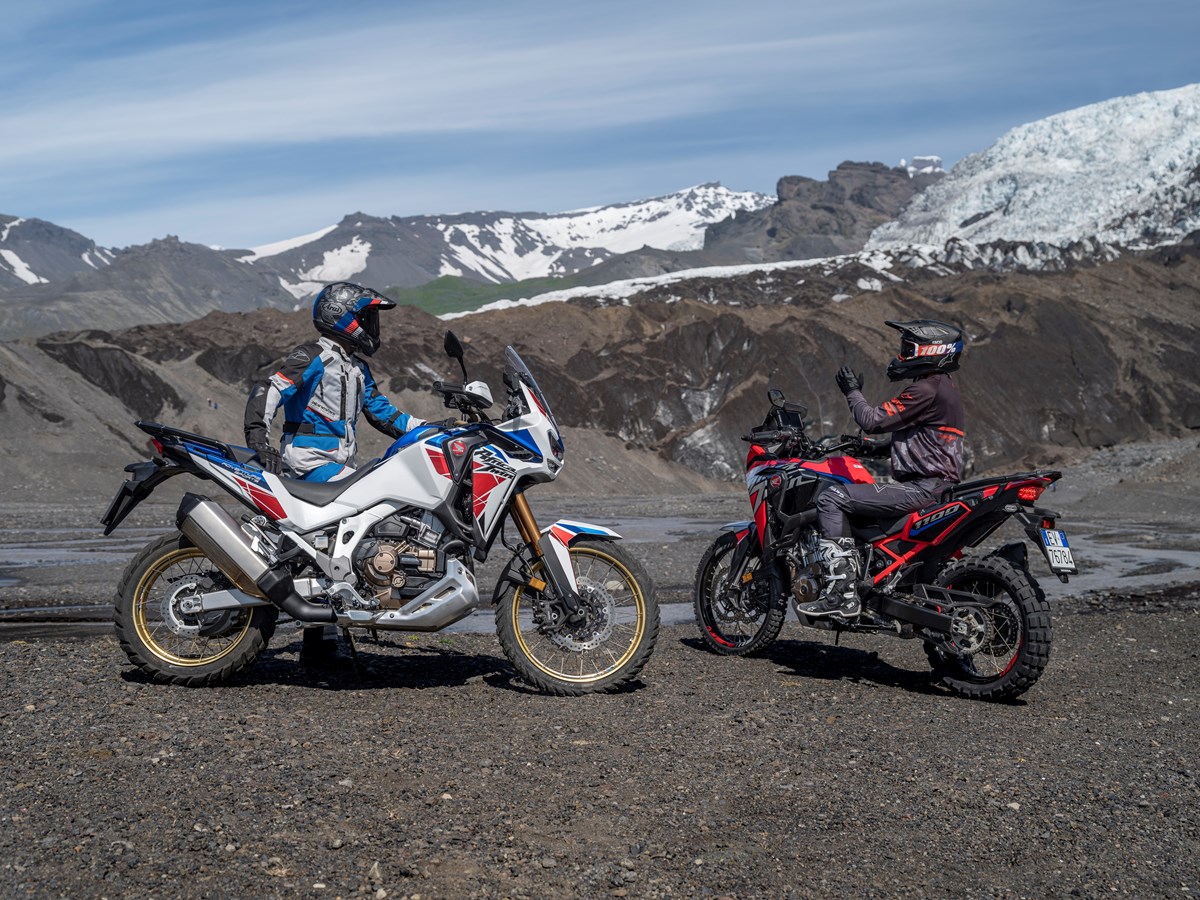
- Refined DCT settings for smoother handling in the first two gears
- CRF1100L Africa Twin features an aluminum rear carrier as standard
- New lower 5-way adjustable screen on the CRF1100L Africa Twin Adventure Sports improves visibility
- Striking new look with new ‘Big Logo’ and new ‘Cracked Terrain’ graphics on the Africa Twin and Africa Twin Adventure Sports respectively
Over three decades after first rolling into Europe, the Honda Africa Twin is a name that is still synonymous with history and adventure. For 2022 the CRF1100L Africa Twin and its continent- crossing sibling, the CRF1100L Africa Twin Adventure Sports, both feature new practical upgrades, refined Dual Clutch Transmission (DCT) settings and striking new looks.
For 2022 both the Africa Twin and Africa Twin Adventure Sports receive updates to further increase their daily practicality. The CRF1100L Africa Twin now features an aluminum rear carrier as standard, and the CRF1100L Africa Twin Adventure Sports benefits from a new 110mm lower 5-stage adjustable screen that improves visibility and doesn’t compromise on weather protection.
Both DCT versions of the Africa Twin and Africa Twin Adventure Sports are updated for 2022, with new refined settings to deliver even smoother handling in the first two gears from a standing start and at low speeds. Honda have sold over 200,000 DCT equipped motorcycles across Europe since the system was first introduced on the VFR1200F in 2009, a testament to its broad appeal and acceptance in the marketplace.
To complete the 2022 upgrades, both models receive striking new colour and graphic updates. The CRF1100L Africa Twin Adventure Sports features new ‘Cracked Terrain’ graphics and the
The CRF1100L Africa Twin now features a new ‘Big Logo’ design with revised colour schemes that feature all-new black aluminum side covers and a bold red rear subframe.
22YM CRF1100L AFRICA TWIN ADVENTURE SPORTS
Model updates: Updates for the 2022 year model of the continent-crossing ‘Adventure Sports’ version of Honda’s definitive full-sized adventurer include a shorter adjustable screen, striking new ‘Cracked Terrain’ graphics and updated DCT settings.
The fundamentals of the enduringly popular package remain: a lightweight chassis and torque-heavy 1084cc engine; a full electronics package using a six-axis Inertial Measurement Unit to manage riding modes and HSTC as well as Cornering ABS, Wheelie Control, Rear Lift Control, plus cornering detection functionality on the DCT version; standard fit cruise control, heated grips, USB port and ACC charger; a full colour 6.5-inch TFT touchscreen that incorporates Apple CarPlay®, Android Auto® and Bluetooth connectivity; dual LED headlights that feature Daytime Running Lights (DRL) technology and Cornering Lights; the option of Showa Electronically Equipped Ride Adjustment (Showa EERA™). And unmistakeable Africa Twin design and styling.
Contents:
1 Introduction
2 Model overview
3 Key features
4 Technical specifications
- Introduction
It’s been over three decades since the Honda XRV650 Africa Twin first rolled into Europe and while the motorcycle that now bears its name – launched in 2016 as the CRF1000L Africa Twin – was a brand-new motorcycle from the wheels up, it fully inherited the essence and spirit of what made the original so popular.
It was the balance between power and weight that was at the heart of the original bike’s appeal, just as it was for the new model. With its unique, athletic appearance, an enjoyable, usable engine and capable, comfortable chassis, the CRF1000L Africa Twin proved itself a true modern-day all-rounder and has been hugely popular with round-the-world adventurers, around-town commuters and weekend tourers alike.
2018 saw the Africa Twin, in both manual transmission and Dual Clutch Transmission (DCT) form, receive Throttle By Wire (TBW) control plus 4 riding modes, expanded Honda Selectable Torque Control (HSTC) options, as well as intake and exhaust development for improved engine response and sound. The platform also expanded: the Africa Twin Adventure Sports – with the same updates but featuring improved wind protection, greater tank range and longer-travel suspension – extended the machine even further into long-range off-road territory.
For 20YM, the introduction of a bigger capacity, longer stroke 1084cc engine marked another landmark in the evolution of the Africa Twin. The CRF1100L Africa Twin* itself was comprehensively redrawn with an aggressive, compact rally style and even sharper off-road focus. Meanwhile, the touring comfort, technology and ability of the CRF1100L Africa Twin Adventure Sports were also further enhanced – including the option of the cutting-edge Showa Electronically Equipped Ride Adjustment (Showa EERA™) suspension.
*See separate CRF1100L Africa Twin Press Kit.
2. Model Overview
The CRF1100L Africa Twin Adventure Sports shares the frame, engine and riding position of the off-road focussed CRF1100L Africa Twin, but has a role very much of its own: to offer riders real continent-crossing long-haul ability and practicality both on and off-road. This comes in the shape of a large 24.8L fuel tank, extensive wind protection (from both the fairing and fairing side panels), height-adjustable screen, large engine sump guard, aluminium rear carrier plus tubeless wheels and tyres. ACC charger and heated grips are also standard fit.
The 20YM change made it smaller, slimmer, lower and 5kg lighter than the previous 998cc model, and offered stronger performance with changes to the engine that produced 7% more peak power, 6% more peak torque and much greater strength everywhere in the rev-range. It was also Honda’s first EURO5 compliant engine. The frame too was completely revised and featured a new bolt-on aluminium subframe. The aluminium swingarm was based on that of the CRF450R moto-crosser.
At the centre of the Africa Twin Adventure Sports, a six-axis Inertial Measurement Unit (IMU) controls not only the 7-level HSTC but also 3-level Wheelie Control, Cornering ABS (with off-road setting), Rear Lift Control and DCT cornering detection. There are four default riding modes: URBAN, TOUR, GRAVEL and OFF-ROAD.
For optimum suspension damping front and rear the Africa Twin Adventure Sports is also available with Showa EERA™ as an option. Four default modes – SOFT, MID, HARD and OFF-ROAD – cover every type of riding situation, and there’s a USER mode for further fine-tuning. Rear spring preload can also be adjusted while stationary.
Tailored for complete control, the riding position features a slim-section seat and high-set handlebars. Dual LED Daytime Running Lights (DRL) feature three-stage Cornering Lights – that automatically adjust the field of illumination depending on the lean angle, giving optimum visibility, improving safety. Cruise control and heated grips are standard-fit. A full colour Multi Information Display (MID) 6.5-inch TFT touch screen brings immersive engagement with the machine’s systems, plus Apple CarPlay® and Bluetooth connectivity, with Android Auto® functionality introduced in early 2021.
For 22YM, the CRF1100L Africa Twin Adventure Sport now features refined Dual Clutch Transmission (DCT) settings for even smoother handling in 1st and 2nd gears, a new shorter adjustable screen, and striking new ‘Cracked Terrain’ graphics.
3. Key Features
3.1 Styling & Equipment
- Protective bodywork with a *new* shorter height-adjustable screen
- *New* ‘Cracked Terrain’ graphics
- 8L fuel tank, aluminium insert panels, rear rack and engine bash plate
- Daytime Running Lights (DRL) with Cornering Lights
- Cruise control, heated grips and ACC charger
- Multi Information Display (MID) 6.5-inch TFT touch screen
- Apple CarPlay® and Android Auto® allow use of a smartphone through the MID
Designed for the long-haul, the Africa Twin Adventure Sports has an extensive front fairing that for 22YM features a new 110mm shorter 5-level adjustable screen, improving visibility but still offering plenty of wind and weather protection. Sharing the 850-870mm seat height of the Africa Twin, the 1182mm handlebars give an upright, high-visibility riding position and comfortable control, whether standing or seated.
The tail section is extremely slim and the narrow seat is carefully contoured to allow easy back and forth movement as well as good ground reach. Holding 24.8L, the fuel tank offers a potential range of over 500km, thanks to fuel economy of 4.9L/100km (20.4km/L) MT and 4.8L/100km (20.8km/L) DCT (WMTC mode). A large engine sump guard and aluminium rear carrier are included in the specification.
Dual LED headlights are set high, delivering a penetrating beam and also feature Daytime Running Lights (DRL) that automatically adjust to ambient light intensity, improving safety, no matter the conditions. For additional security, the CRF1100L Africa Twin Adventure Sports features three-stage right/left Cornering Lights that use speed and lean angle (controlled by the IMU) to automatically adjust the area illuminated when cornering.
Large knuckle guards are standard.
The full colour Multi Information Display (MID) 6.5-inch TFT touch screen keeps the rider in control of all of the Africa Twin’s systems, with each of the riding modes selectable through the top left of the screen. The MID can also be customised to show various levels of information relative to the riding mode chosen and is easy to use even when wearing gloves.
It also incorporates Apple CarPlay® and Android Auto®, allowing use of a smartphone through the touchscreen. Navigation apps can also be accessed and displayed and via a Bluetooth helmet headset calls can be made or received. The smartphone itself plugs into a USB charging port on the right of the MID. Hands-free wireless Bluetooth connectivity is also an option and all control inputs are made from the left-hand switchgear.
The front and rear indicators have an Emergency Stop Signal function. When braking suddenly over 50kph the hazard lights flash to warn other road users a hard stop is in process. The indicators include an auto-cancel function; rather than using a simple timer, the system compares front and rear wheel speed difference and calculates when to cancel the indication relative to the situation. The auto-cancel feature can be switched off using the MID. Standard-fit cruise control eases long-distance highway travel.
The CRF1100L Africa Twin ‘Adventure Sports’ will be available in the following colours:
Pearl Glare White Tricolour
Matte Ballistic Black Metallic
New for 2022 is the new ‘Cracked Terrain’ design and revised colour schemes which now feature new all-black aluminium side covers and aluminium rear carrier.
3.2 Engine
- 1,084cc engine gives 75kW peak power and 105Nm peak torque
- In addition to extra capacity, the 20YM updates included a new cylinder head, valve timing and lift, throttle body and exhaust
- The variable Exhaust Control Valve (ECV) offers an engaging low-rpm sound and high-rpm performance
The SOHC 8-valve parallel-twin engine’s essential architecture remained unchanged for the 20YM update, but displacement increased to 1,084cc, up from 998cc. As a result, peak power increased from 70kW to 75kW @ 7,500rpm and peak torque from 99Nm to 105Nm @ 6,250rpm. Significantly, the obvious increase in both power and torque made itself felt from 2,500rpm all the way through to the redline.
To create the larger capacity, bore remained at 92mm but stroke was lengthened to 81.5mm (from 75.1mm) with a compression ratio of 10.1:1. Aluminium cylinder sleeves saved weight. Thanks to other detailed weight savings in the transmission and elsewhere, the manual transmission version of the 1084cc engine shaved 2.5kg from the previous 998cc power unit, and the DCT version 2.2kg. The cylinder head was also completely revised, and new 46mm throttle bodies introduced. The bore and cylinder pitches were aligned to create a smooth air intake profile, the ECU setting updated and injector angle modified to deliver a more direct spray into re-shaped twin-spark combustion chambers.
Other changes included optimised valve timing and increased inlet (from 9.2 to 10.1mm) and exhaust (from 8.6 to 9.3mm). To match and deal with the uprated intake efficiency and gas flow, the exhaust end-can featured a new variable Exhaust Control Valve (ECV) very similar to the unit fitted to the Fireblade. It offers enhanced engine performance and efficiency as it opens at higher rpm and gives a pleasing exhaust note ‘pulse’ at lower rpm.
The engine’s fundamentals remained unchanged. Honda’s SOHC Unicam valve train is a feature of the MX competition-specification CRF450R and the low-set position of the cast camshaft contributes to the compact nature of the cylinder head and entire engine package.
The 270° phased crankshaft and uneven firing interval create its distinctive ‘throb’.
The crankcases are split vertically; the water pump is housed efficiently within the clutch casing with a thermostat integrated into the cylinder head. Manual and DCT versions of the engine share common crankcases with only minor external differences; the water and oil pumps are both driven by the engine’s balancer shafts.
It’s a semi-dry sump design with in-tank lower crankcase oil storage. This allows a lower pan depth that keeps overall engine height low. As the pressure-fed pump is located within the tank where it delivers its oil from, there is no need for a pressure-feed passage. Secondary vibrations are neutralised by the mutually reciprocating motion of the pistons, while primary inertial and coupling vibrations are cancelled by the use of biaxial balance shafts.
The aluminium clutch centre and pressure plate use ‘assist’ cams to ease upshifts and ‘slipper’ cams for deceleration and downshifting; for 20YM the clutch diameter was reduced in size compared to the previous design, and spring tension reduced for lighter lever feel. The six-speed manual gearbox uses the same shift-cam design as found on the CRF450R to ensure positive changes. For 22YM, improved settings for the optional Quickshifter offer even smoother changes in the lower gears.
3.3 Engine & Chassis Management Electronics
- IMU-managed HSTC intervention levels have focus on off-road use
- Wheelie Control features 3 levels and IMU management
- Four riding modes: TOUR, URBAN, GRAVEL and OFF-ROAD
- Two USER modes allow for complete riding modes customisation
The Africa Twin Adventure Sports engine received the benefits of Throttle By Wire (TBW) control in 2018, allowing much finer management of engine output and character as well as expanded Honda Selectable Torque Control (HSTC) for rear tyre grip; for 2020 the system evolved to work in conjunction with a six-axis IMU*.
The electronics system offers 4 levels of power and 3 levels of engine braking. There are seven levels of HSTC with each level’s amount of intervention being optimised to work with real-time input (yaw/roll angle and rate) from the IMU. The spacing of the levels has been optimised to allowing the rider a finer choice of the amount of rear tyre slide for off-road riding. HSTC can also be turned off completely.
Wheelie Control is another feature that was introduced in 2020. Again, with the IMU measuring pitch angle and rate, and controlling engine torque via TBW, the rider can choose between 3 levels of input. Level 1 allows for intended wheel lift but suppresses any sudden movement. Level 3 stops any front wheel elevation and level 2 is mid-way between the two. Wheelie Control can also be turned off completely.
There are four default riding mode settings: TOUR, URBAN, GRAVEL and OFF-ROAD to cover most riding conditions and situations, plus two customisable USER settings. Even within the default riding modes, it’s possible to change some parameters – HSTC between levels 1-7 (plus off), Wheelie Control between levels 1-3 (plus off) and DCT S mode shift pattern levels 1-3.
TOUR employs the highest level of Power (1), for touring loaded with pillion and luggage plus mid-range Engine Braking (2) with active on-road Cornering ABS.
URBAN suits wide-ranging riding requirements and uses mid-level Power (2) and Engine Braking (2) with active on-road Cornering ABS.
GRAVEL delivers the lowest level of Power (4) and Engine Braking (3). Cornering ABS is active with an off-road setting; in this setting, the rear brake ABS cannot be switched off.
OFF-ROAD uses lower-mid level Power (3) and the lowest amount of Engine Braking (3). Cornering ABS is active with an off-road setting; the rear brake ABS can be switched off.
USER 1 & 2 modes offer the rider a choice of two distinct personalized setups – choosing between Power levels 1-4 and Engine Braking 1-3, plus HSTC, Wheelie Control and ABS (on-road/off-road) parameters. USER 1 starts out with level 2 Power and Engine Braking, USER 2 uses level 4 Power and 3 Engine Braking.
*See the Chassis section 3.5 of this press kit.
3.4 Dual Clutch Transmission
- ‘Easy and direct’ system offers super-fast gear changes in either Manual Transmission (MT) or Automatic D and S modes
- S mode (with 3 levels) revs higher and downshifts sooner than D, for more aggressive riding
- G switch improves rear wheel traction when off-road
- Incline detection adapts shift pattern depending on gradient
- IMU allows corning detection function for improved shift timings
- For 22YM, revised timings allow smoother handling at pull-away and in lower gears
Honda has sold over 200,000 DCT-equipped motorcycles across Europe since the system first appeared as an option on the VFR1200F in 2009. Testament to its acceptance in the marketplace, in 2020 DCT versions of the Africa Twin (including Adventure Sports version) accounted for 47% of the model’s sales.
The unique DCT system delivers consistent, super-fast seamless gear changes, and very quickly becomes second nature in use. It uses two clutches: one for start-up and 1st, 3rd and 5th gears: the other for 2nd, 4th and 6th, with the mainshaft for each clutch located inside the other for compact packaging.
Each clutch is independently controlled by its own electro-hydraulic circuit. When a gear change occurs, the system pre-selects the target gear using the clutch not currently in use. The first clutch is then electronically disengaged as, simultaneously, the second clutch engages.
The result is a consistent, fast and seamless gear change. Furthermore, as the twin clutches transfer drive from one gear to the next with minimal interruption of the drive to the rear wheel, any gear change shock and pitching of the machine is minimised, making the change feel direct as well as smooth.
The extra benefits of durability (as the gears cannot be damaged by missing a gear), impossibility of stalling, low stress urban riding, reduced rider fatigue and greater ability to focus on cornering lines and braking points add to DCT’s appeal.
Three modes of operation are available. MT mode gives full manual control, allowing the rider to shift with the handlebar trigger control buttons. Automatic D mode is ideal for city and highway riding, and achieves optimum fuel efficiency. Automatic S mode offers three levels of sportier riding, as the ECU lets the engine rev a little higher before shifting up, and shifts down sooner when decelerating for extra engine braking.
In either D or S mode, DCT offers immediate manual intervention if required – the rider simply selects the required gear using the up and down shift triggers on the left handlebar. At an appropriate time, DCT seamlessly reverts back to automatic mode, depending on throttle angle, vehicle speed and gear position.
DCT for the Africa Twin is also fully equipped to operate in an adventure environment, with off-road functionality enhanced by the G switch accessed via the TFT touch screen display. Activating the G switch in any riding mode improves the feel for available traction and machine control by reducing the amount of clutch slip during gear changes.
Further functionality for the DCT system comes in the form of incline detection, by means of which the gear shift pattern is adapted depending on the grade of an incline to provide optimum control.
A new feature for the CRF1100L Africa Twin’s DCT system for the change to the 1084cc model for 2020 was cornering detection. When the IMU recognises the bike is cornering, the system subtly adjusts the shifting programme for the most natural gear changes.
For 2022, the DCT settings have been further optimised in first and second gears to allow smoother handling from a standing start and at very low speeds.
3.5 Chassis
- Light frame, with bolt-on aluminium subframe and light rigid CRF450R-style swingarm for outstanding rear wheel traction and feel
- A six-axis Inertial Measurement Unit is housed in the centre of the machine
- Cornering ABS provides sure-footed feel and features an off-road setting
At the very heart of the Africa Twin Adventure Sports’ elevated on and off-road performance is a Bosch MM7.10 six-axis Inertial Measurement Unit (IMU) tucked away at the centre of the machine, that measures – in real-time – roll angle/rate, pitch angle/rate and yaw angle/rate. It manages rear wheel traction via TBW and HSTC, front braking grip through Cornering ABS, front wheel lift through Wheelie Control and also adds Rear Lift Control.
In conjunction with the addition of IMU control, for its 2020 evolution the strength and rigidity balance of the steel semi-double cradle frame was completely re-examined by Honda’s development engineers reinforcing its all-round on-road manners and boost off-road ability. Rigidity around the steering head was optimised to enhance feel for front end grip; the main spars were made slimmer and straighter and did away with the front cross pipe. A bolt-on aluminium subframe replaced the integral steel structure of the previous design to reduce width by 40mm to 195mm – crucial for easier ground reach. The lighter aluminium swingarm – taking its direction from the design used by the CRF450R – improved rigidity improves rear wheel traction and rider feel.
To tailor damping force front and rear – and spring preload to suit load and riding conditions – Showa Electronically Equipped Ride Adjustment™ (Showa EERA™) is an option on the Africa Twin Adventure Sports. Showa EERA™ adjusts damping force relative to riding mode selected and aims to deliver high-quality suspension reaction in diverse and opposite conditions – riding comfort at slower speeds and stability at higher speeds.
Input is gathered from stroke sensors plus Inertial Measurement Unit (IMU). There are three road settings: SOFT has the lowest damping force for smoothest reaction, versatile MID operates as an all-round setting with HARD, using the highest damping force through low-to-high stroke speed, designed for sportier riding.
There is an OFF-ROAD setting that gradually raises front fork damping force as stroke speed rises and uses higher damping settings for the rear shock.
Rear spring preload can be electronically adjusted while stationary, through four default settings; 1) riding solo, 2) riding solo with luggage, 3) riding two-up and 4) riding two-up with luggage. A USER option allows for fine-tuning of damping force front and rear and 24 points of rear spring preload.
The Africa Twin Adventure Sports is also available with standard Showa suspension. With stroke length of 230mm, the 45mm cartridge-type inverted front fork offers long-travel bump absorption and features revised internal settings to improve all-round performance. Rebound and compression damping are fully adjustable. A cast aluminium top yoke and forged bottom yoke – with a hollow aluminium stem shaft – clamp the fork legs with two bolts each top and bottom.
Matching the front suspension, the Showa rear shock delivers 220mm axle travel and features a 46mm cylinder and remote reservoir for stable damping control under extreme off-road riding conditions. Spring preload can be adjusted via a dial on the shock body; rebound and compression damping are also fully adjustable.
The swingarm pivot points’ inner plates use 600MPa high-strength steel and the upper cross tube that connects them acts as the rear shock upper mount (through a pillow-ball joint) improving feel for rear wheel traction.
The IMU takes in lean angle, deceleration (from front/rear wheel speed sensors) and incorporates the slip rate of the front and rear wheels to manage braking pressure through the ABS; likewise if it detects sudden rear wheel lift, it finely controls brake force to maintain stability. When stationary the rear ABS can be cancelled for off-road riding.
Compact two-piece radial-mount four-piston calipers work dual 310mm ‘wave’ floating discs through sintered pads. The rear 256mm ‘wave’ disc features hole punching and shaping. 21/18-inch front rear (stainless steel) spoked wheels wear 90/90-21 and 150/70-18 tyres. Block pattern tyres (Continental 90/90-21M/C 54S and 150/70B 18M/C 70Q, rated at 180km/h and 160km/h respectively) are approved for fitment.
Ground clearance is 250mm, with wheelbase of 1575mm and rake and trail of 27.5°/113mm. Wet weight is 238kg, with DCT at 248kg. The Showa EERATM adds a further 2kg in both Manual and DCT guises.
To make puncture repair easier when on tour the 21/18-inch front and rear (stainless steel) spoked wheels wear tubeless Bridgestone Battlax Adventurecross Tourer AX41T or Metzeler Karoo Street tyres, sized 90/90-21M/C 54H and 150/70R18 M/C 70H. Block pattern tyres (Continental 90/90-21M/C 54S and 150/70B 18M/C 70Q are also approved for fitment).
4 Accessories
The range of Honda Genuine Accessories for the Africa Twin Adventure Sports includes premium aluminium top box (42L) and panniers (37L left / 33L right) plus large plastic top box (58L) and panniers (40L left / 30L right), two seat heights (a lower 825-845mm and taller 870-895mm option), screen extender and deflector set, 4.5L tank bag, side tank pads, engine guards, radiator grill, side pipes and LED fog lights and centre stand.
Accessories are available in both a Super Pack and a Travel Pack for convenience.
5 Technical Specifications
|
ENGINE |
|
|
Type |
SOHC liquid-cooled 4-stroke 8-valve parallel twin with 270° crank and Uni-cam |
|
Displacement |
1084cc |
|
Bore & Stroke |
92mm x 81.5mm |
|
Compression Ratio |
10.1:1 |
|
Max. Power Output |
75kW at 7500rpm |
|
Max. Torque |
105Nm at 6250rpm |
|
Noise Level |
L-urban73.2dB, L-wot78.9dB – MT; |
|
Oil Capacity |
4.8/4.3 (5.2/4.7 DCT) |
|
FUEL SYSTEM |
|
|
Carburation |
PGM-FI |
|
Fuel Tank Capacity |
24.8L |
|
CO2 Emissions |
112g/km MT 110g/km DCT |
|
Fuel Consumption |
4.9L/100km (20.4km/L) MT 4.8L/100km (20.8km/L) DCT |
|
ELECTRICAL SYSTEM |
|
|
Starter |
Electric |
|
Battery Capacity |
12V-6Ah Li-ion battery (20hr) |
|
ACG Output |
0.49kW/5000rpm |
|
DRIVETRAIN |
|
|
Clutch Type |
Wet, multiplate with coil springs, aluminium cam assist and slipper clutch DCT – 2 wet multiplate clutches with coil springs |
|
Transmission Type |
6 speed manual (6 speed DCT) |
|
FRAME |
|
|
Type |
Semi double cradle |
|
CHASSIS |
|
|
Dimensions (L´W´H) |
2330mm x 960mm x 1490mm (1545mm with screen in uppermost position) |
|
Wheelbase |
1575mm |
|
Caster Angle |
27.5° |
|
Trail |
113mm |
|
Seat Height |
850/870mm (low seat option 825mm, high seat option 895mm) |
|
Ground Clearance |
250mm |
|
Kerb Weight |
238kg (DCT 248kg) With Showa EERATM 240kg MT (DCT 250kg) |
|
SUSPENSION |
|
|
Type Front |
Showa 45mm cartridge-type inverted telescopic fork with dial-style preload adjuster and damping adjustment, 230mm stroke
EERATM – Showa Telescopic inverted fork with an inner tube diameter of 45mm, and Showa EERATM with compression and rebound dumping adjustments, 230mm stroke
|
|
Type Rear |
Monoblock aluminium swing arm with Pro-Link with Showa gas-charged damper, hydraulic dial-style preload adjuster and rebound damping adjustments, 220 mm rear wheel travel.
EERATM – Monoblock aluminium swing arm with Pro-Link with Showa gas-charged damper, hydraulic remote control preload adjuster and electric control unit with compression and rebound damping adjustments, 220 mm rear wheel travel |
|
WHEELS |
|
|
Type Front |
21M/C x MT2.15 wire spoke with aluminium rim |
|
Type Rear |
18M/C x MT4.00 wire spoke with aluminium rim |
|
Rim Size Front |
21″ |
|
Rim Size Rear |
18″ |
|
Tyres Front |
90/90-21M/C 54H (tubeless type) Bridgestone Battlax Adventurecross Tourer AX41T |
|
Tyres Rear |
150/70R18M/C 70H (tubeless type) Bridgestone Battlax Adventurecross Tourer AX41T |
|
BRAKES |
|
|
ABS System Type |
2 channel with IMU |
|
Type Front |
310mm dual wave floating hydraulic disc with aluminium hub and radial fit 4-piston calipers and sintered metal pads |
|
Type Rear |
256mm wave hydraulic disc with single piston caliper and sintered metal pads. 2-Channel with rear ABS off mode. |
|
INSTRUMENTS & ELECTRICS |
|
|
Instruments |
LCD Meter, TFT 6.5inch touch panel multi information display |
|
Security System |
Immobiliser, security alarm (optional) |
|
Headlight |
LED |
|
Taillight |
LED |
|
Electrics |
Daytime running lights, Bluetooth audio and Apple CarPlay®, Android Auto®, USB socket, auto turn signal cancel, cruise control, emergency stop signal, IMU, HSTC, cornering lights, wheelie control |
** Please note that the figures provided are results obtained by Honda under standardised testing conditions prescribed by WMTC. Tests are conducted on a rolling road using a standard version of the vehicle with only one rider and no additional optional equipment. Actual fuel consumption may vary depending on how you ride, how you maintain your vehicle, weather, road conditions, tire pressure, installation of accessories, cargo, rider and passenger weight, and other factors.
22YM CRF1100L AFRICA TWIN
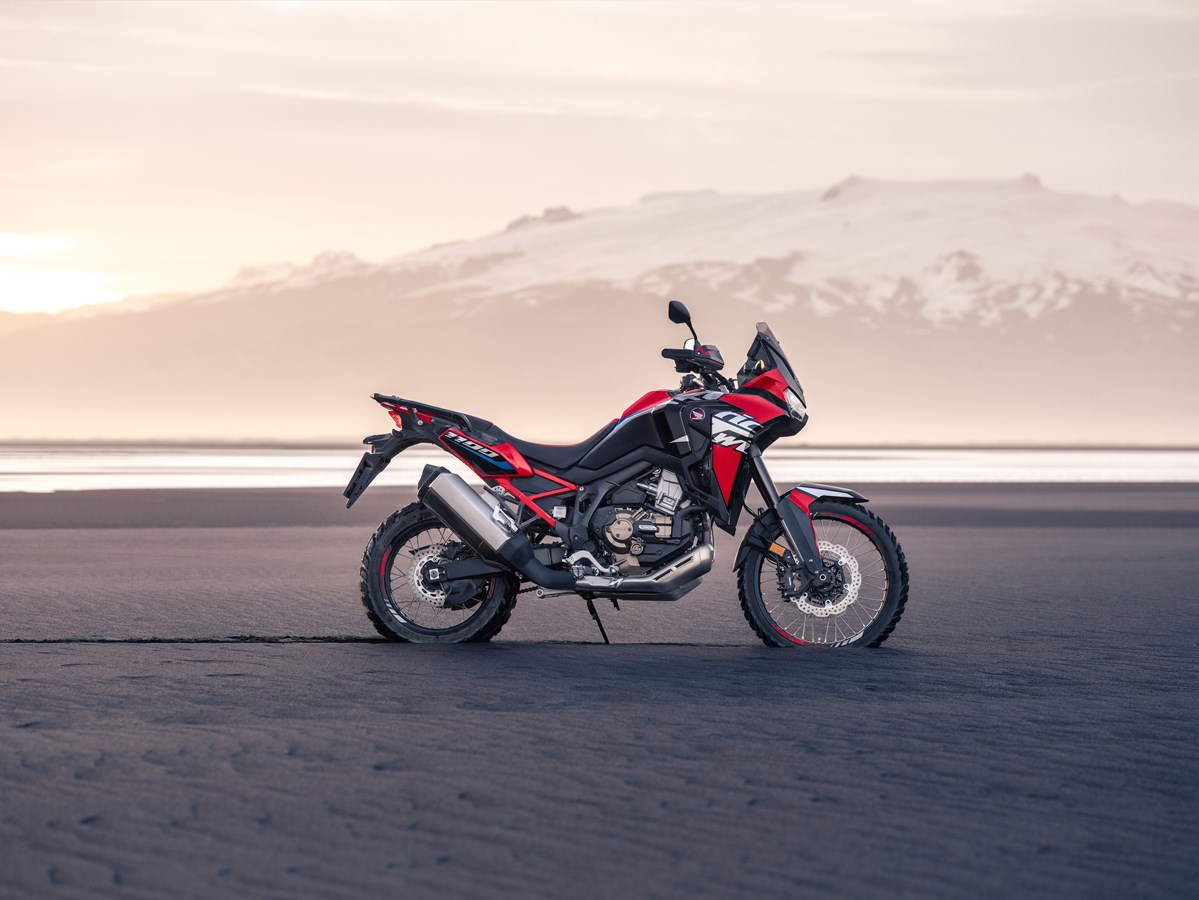
Model updates: Updates for the 2022 year model of Honda’s definitive full-sized adventurer include standard-fit rear carrier, new ‘Big Logo’ graphics and revised settings for the DCT version.
The fundamentals of the enduringly popular package remain: hard-edged off-road performance from an athletic, lightweight chassis with slim rally-style bodywork and characterful, torque-heavy 1084cc engine; a full electronics package using a six-axis Inertial Measurement Unit to manage riding modes and HSTC as well as Cornering ABS, Wheelie Control, Rear Lift Control, plus cornering detection functionality on the DCT version; USB port, standard fit cruise control; a full colour 6.5-inch TFT touchscreen that incorporates Apple CarPlay® and Bluetooth connectivity. And unmistakeable Africa Twin design and styling.
Contents:
1 Introduction
2 Model overview
3 Key features
4 Technical specifications
- Introduction
It’s been over three decades since the Honda XRV650 Africa Twin first rolled into Europe and while the motorcycle that now bears its name – launched in 2016 as the CRF1000L Africa Twin – was a brand-new machine from the wheels up, it fully inherited the essence and spirit of what made the original so popular.
It was the balance between power and weight that was at the heart of the original bike’s appeal, just as it was for the new model. With its unique, athletic appearance, an enjoyable, usable engine and capable, comfortable chassis, the CRF1000L Africa Twin proved itself a true modern-day all-rounder and has been hugely popular with round-the-world adventurers, around-town commuters and weekend tourers alike.
2018 saw the Africa Twin, in both manual transmission and Dual Clutch Transmission (DCT) form, receive Throttle By Wire (TBW) control plus 3 riding modes, expanded Honda Selectable Torque Control (HSTC) options, as well as intake and exhaust development for improved engine response and sound. The platform also expanded: the new Africa Twin Adventure Sports – with the same updates but featuring improved wind protection, greater tank range and longer-travel suspension – extended the machine even further into long-range territory.
For the 2020 year model, the introduction of a bigger capacity, longer stroke 1084cc engine marked another landmark in the evolution of the Africa Twin. The touring comfort, technology and ability of the CRF1100L Africa Twin Adventure Sports* were further enhanced – adding the option of Showa Electronically Equipped Ride Adjustment (SHOWA EERA™) and the CRF1100L Africa Twin itself was comprehensively redrawn with an aggressive, compact rally style and even sharper off-road focus. Alongside the increase in power and torque from the new engine, it was also significantly lighter – in keeping with the first principles set out all those years ago.
*See separate CRF1100L Africa Twin Adventure Sports Press Kit.
2. Model Overview
The 20YM CRF1100L Africa Twin came with a sharply-renewed focus on off-road core ability, that brought with it the look – and feel – of a true rally machine.
The 20YM change made it smaller, slimmer, lower and 4kg lighter than the previous 998cc model, and offered stronger performance with changes to the engine that produced 7% more peak power, 6% more peak torque and much greater strength everywhere in the rev-range. It was also Honda’s first EURO5 compliant engine. The frame too was completely revised and featured a new bolt-on aluminium subframe. The aluminium swingarm was based on that of the CRF450R moto-crosser.
At the centre of the Africa Twin Adventure Sports, a six-axis Inertial Measurement Unit (IMU) controls not only the 7-level HSTC but also 3-level Wheelie Control, Cornering ABS (with off-road setting), Rear Lift Control and DCT cornering detection. There are four default riding modes: URBAN, TOUR, GRAVEL and OFF-ROAD.
Tailored for complete control, the riding position features a slim-section seat and high-set handlebars. Dual LED Daytime Running Lights (DRL) give optimum visibility, improving safety. Cruise control is standard-fit. A full colour Multi Information Display (MID) 6.5-inch TFT touch screen brings immersive engagement with the machine’s systems, plus Apple CarPlay® and Bluetooth connectivity, with Android Auto® functionality introduced in early 2021.
For 2022, the CRF1100L Africa Twin now features refined Dual Clutch Transmission (DCT) settings for even smoother handling in 1st and second gears, standard fitment for the aluminium rear carrier, and striking ultra-modern ‘Big Logo’ graphics.
3. Key Features
3.1 Styling & Equipment
- Compact body style designed for off-road, with slim seat and high handlebars
- Multi Information Display (MID) 6.5-inch TFT touch screen
- Apple CarPlay® and Android Auto® allow use of a smartphone through the MID
- Bluetooth connectivity, Daytime Running Lights (DRL) and cruise control
- New ‘Big Logo’ graphics
Aggressive and compact. Two words that sum up the Africa Twin’s taut rally-style bodywork. And it’s for a reason – to work better off-road. The fixed screen is short to allow for easy scanning of the trail ahead and, with a seat height of 850-870mm, the high handlebars (increased by 22.5mm in height for 20YM) give an upright, high-visibility riding position and comfortable control, whether standing or seated. The tail section is extremely slim and the narrow seat carefully contoured to allow good ground reach and easy back and forth movement.
Dual LED headlights are set high, delivering a penetrating beam and also feature Daytime Running Lights (DRL) that automatically adjust to ambient light intensity, improving safety, no matter the conditions. Knuckle guards are standard.
The full colour Multi Information Display (MID) 6.5-inch TFT touch screen keeps the rider in control of all of the Africa Twin’s systems, with each of the riding modes selectable through the top left of the screen. The MID can also be customised to show various levels of information relative to the riding mode chosen and is easy to use even when wearing gloves.
It also incorporates Apple CarPlay® and Android Auto®, allowing use of a smartphone through the touchscreen. Navigation apps can also be accessed and displayed and via a Bluetooth helmet headset calls can be made or received. The smartphone itself plugs into a USB charging port on the right of the MID. Hands-free wireless Bluetooth connectivity is also an option and all control inputs are made from the left-hand switchgear.
The front and rear indicators have an Emergency Stop Signal function. When braking suddenly over 50kph the hazard lights flash to warn other road users a hard stop is in process. They also auto-cancel; rather than using a simple timer, the system compares front and rear wheel speed difference and calculates when to cancel the indication relative to the situation. The auto-cancel feature can be switched off using the MID. Standard-fit cruise control eases long-distance highway travel.
New for 2022 is the new ‘Big Logo’ design and revised colour schemes which now feature all-black aluminium side covers. An aluminium rear carrier is now also standard fit.
The CRF1100L Africa Twin will be available in the following colours:
Pearl Glare White Tricolour
Grand Prix Red
Matte Ballistic Black
3.2 Engine
- 1,084cc engine gives 75kW peak power and 105Nm peak torque
- In addition to extra capacity, the 20YM updates included a new cylinder head, valve timing and lift, throttle body and exhaust
- The variable Exhaust Control Valve (ECV) offers an engaging low-rpm sound and high-rpm performance
The SOHC 8-valve parallel-twin engine’s essential architecture remained unchanged for the 2020 update, but displacement increased to 1,084cc, up from 998cc. As a result, peak power increased from 70kW to 75kW @ 7,500rpm and peak torque from 99Nm to 105Nm @ 6,250rpm. Significantly, the obvious increase in both power and torque made itself felt from 2,500rpm all the way through to the redline.
To create the larger capacity, bore remained at 92mm but stroke was lengthened to 81.5mm (from 75.1mm) with a compression ratio of 10.1:1. Aluminium cylinder sleeves saved weight. Thanks to other detailed weight savings in the transmission and elsewhere, the manual transmission version of the 1084cc engine shaved 2.5kg from the previous 998cc power unit, and the DCT version 2.2kg. The cylinder head was also completely revised, and new 46mm throttle bodies introduced. The bore and cylinder pitches were aligned to create a smooth air intake profile, the ECU setting updated and injector angle modified to deliver a more direct spray into re-shaped twin-spark combustion chambers.
Other changes included optimised valve timing and increased inlet (from 9.2 to 10.1mm) and exhaust (from 8.6 to 9.3mm). To match and deal with the uprated intake efficiency and gas flow, the exhaust end-can of featured a new variable Exhaust Control Valve (ECV) very similar to the unit fitted to the Fireblade. It offers enhanced engine performance and efficiency as it opens at higher rpm and gives a pleasing exhaust note ‘pulse’ at lower rpm.
The engine’s fundamentals remained unchanged. Honda’s SOHC Unicam valve train is a feature of the MX competition-specification CRF450R and the low-set position of the cast camshaft contributes to the compact nature of the cylinder head and entire engine package.
The 270° phased crankshaft and uneven firing interval create its distinctive ‘throb’.
The crankcases are split vertically; the water pump is housed efficiently within the clutch casing with a thermostat integrated into the cylinder head. Manual and DCT versions of the engine share common crankcases with only minor external differences; the water and oil pumps are both driven by the engine’s balancer shafts.
It’s a semi-dry sump design with in-tank lower crankcase oil storage. This allows a lower pan depth that keeps overall engine height low. As the pressure-fed pump is located within the tank where it delivers its oil from, there is no need for a pressure-feed passage. Secondary vibrations are neutralised by the mutually reciprocating motion of the pistons, while primary inertial and coupling vibrations are cancelled by the use of biaxial balance shafts.
The aluminium clutch centre and pressure plate use ‘assist’ cams to ease upshifts and ‘slipper’ cams for deceleration and downshifting; the clutch diameter was reduced in size compared to the previous design, with reduced spring tension for lighter lever feel. The six-speed manual gearbox uses the same shift-cam design as found on the CRF450R to ensure positive changes. A quickshifter remains available as an optional extra.
3.3 Engine & Chassis Management Electronics
- IMU-managed HSTC intervention levels have focus on off-road use
- Wheelie Control features 3 levels and IMU management
- Four riding modes: TOUR, URBAN, GRAVEL and OFF-ROAD
- Two USER modes allow for complete riding modes customisation
The Africa Twin’s engine received the benefits of Throttle By Wire (TBW) control in 2018, allowing much finer management of engine output and character as well as expanded Honda Selectable Torque Control (HSTC) for rear tyre grip; for 2020 the system evolved to work in conjunction with a six-axis IMU*.
The electronics system offers 4 levels of power and 3 levels of engine braking. There are seven levels of HSTC with each level’s amount of intervention being optimised to work with real-time input (yaw/roll angle and rate) from the IMU. The spacing of the levels has been optimised to allowing the rider a finer choice of the amount of rear tyre slide for off-road riding. HSTC can also be turned off completely.
Wheelie Control is another feature that was introduced in 2020. Again, with the IMU measuring pitch angle and rate, and controlling engine torque via TBW, the rider can choose between 3 levels of input. Level 1 allows for intended wheel lift but suppresses any sudden movement. Level 3 stops any front wheel elevation and level 2 is mid-way between the two. Wheelie Control can also be turned off completely.
There are four default riding mode settings: TOUR, URBAN, GRAVEL and OFF-ROAD to cover most riding conditions and situations plus two customisable USER settings. Even within the default riding modes, it’s possible to change some parameters – HSTC between levels 1-7 (plus off), Wheelie Control between levels 1-3 (plus off) and DCT S mode shift pattern levels 1-3.
TOUR employs the highest level of Power (1), for touring loaded with pillion and luggage plus mid-range Engine Braking (2) with active on-road Cornering ABS.
URBAN suits wide-ranging riding requirements and uses mid-level Power (2) and Engine Braking (2) with active on-road Cornering ABS.
GRAVEL delivers the lowest level of Power (4) and Engine Braking (3). Cornering ABS is active with an off-road setting; in this setting, the rear brake ABS cannot be switched off.
OFF-ROAD uses lower-mid level Power (3) and the lowest amount of Engine Braking (3). Cornering ABS is active with an off-road setting; the rear brake ABS can be switched off.
USER 1 & 2 modes offer the rider a choice of two distinct personalized setups – choosing between Power levels 1-4 and Engine Braking 1-3, plus HSTC, Wheelie Control and ABS (on-road/off-road) parameters. USER 1 starts out with level 2 Power and Engine Braking, USER 2 uses level 4 Power and 3 Engine Braking.
*See the Chassis section 3.5 of this press kit.
3.4 Dual Clutch Transmission
- ‘Easy and direct’ system offers super-fast gear changes in either Manual Transmission (MT) or Automatic D and S modes
- S mode (with 3 levels) revs higher and downshifts sooner than D, for more aggressive riding
- G switch improves rear wheel traction when off-road
- Incline detection adapts shift pattern depending on gradient
- IMU allows corning detection function for improved shift timings
- For 22YM, revised timings allow smoother handling at pull-away and in lower gears
Honda has sold over 200,000 DCT-equipped motorcycles across Europe since the system first appeared as an option on the VFR1200F in 2009. Testament to its acceptance in the marketplace, in 2020 DCT versions of Africa Twin (including Adventure Sports version) accounted for 47% of the model’s sales.
The unique DCT system delivers consistent, super-fast seamless gear changes, and very quickly becomes second nature in use. It uses two clutches: one for start-up and 1st, 3rd and 5th gears: the other for 2nd, 4th and 6th, with the mainshaft for each clutch located inside the other for compact packaging.
Each clutch is independently controlled by its own electro-hydraulic circuit. When a gear change occurs, the system pre-selects the target gear using the clutch not currently in use. The first clutch is then electronically disengaged as, simultaneously, the second clutch engages.
The result is a consistent, fast and seamless gear change. Furthermore, as the twin clutches transfer drive from one gear to the next with minimal interruption of the drive to the rear wheel, any gear change shock and pitching of the machine is minimised, making the change feel direct as well as smooth.
The extra benefits of durability (as the gears cannot be damaged by missing a gear), impossibility of stalling, low stress urban riding, reduced rider fatigue and greater ability to focus on cornering lines and braking points add to DCT’s appeal.
Three modes of operation are available. MT mode gives full manual control, allowing the rider to shift with the handlebar trigger control buttons. Automatic D mode is ideal for city and highway riding, and achieves optimum fuel efficiency. Automatic S mode offers three levels of sportier riding, as the ECU lets the engine rev a little higher before shifting up, and shifts down sooner when decelerating for extra engine braking.
In either D or S mode, DCT offers immediate manual intervention if required – the rider simply selects the required gear using the up and down shift triggers on the left handlebar. At an appropriate time, DCT seamlessly reverts back to automatic mode, depending on throttle angle, vehicle speed and gear position.
DCT for the Africa Twin is also fully equipped to operate in an adventure environment, with off-road functionality enhanced by the G switch accessed via the TFT touch screen display. Activating the G switch in any riding mode improves the feel for available traction and machine control by reducing the amount of clutch slip during gear changes.
Further functionality for the DCT system comes in the form of incline detection, by means of which the gear shift pattern is adapted depending on the grade of an incline to provide optimum control.
A new feature for the CRF1100L Africa Twin’s DCT system for the change to the 1100cc model for 2020 was cornering detection. When the IMU recognises the bike is cornering, the system subtly adjusts the shifting programme for the most natural gear changes.
For 2022, the DCT settings have been further optimised in first and second gears to allow smoother handling from a standing start and at very low speeds.
3.5 Chassis
- Light frame, with bolt-on aluminium subframe and light rigid CRF450R-style swingarm for outstanding rear wheel traction and feel
- A six-axis Inertial Measurement Unit is housed in the centre of the machine
- Cornering ABS provides sure-footed feel and features an off-road setting
- Optimised damping and spring rates for the front and rear Showa suspension
At the very heart of the Africa Twin’s elevated on- and off-road performance is a Bosch MM7.10 six-axis Inertial Measurement Unit (IMU) tucked away at the centre of the machine, that measures – in real-time – roll angle/rate, pitch angle/rate and yaw angle/rate. It manages rear wheel traction via TBW and HSTC, front braking grip through Cornering ABS, front wheel lift through Wheelie Control and also adds Rear Lift Control.
In conjunction with the addition of IMU control, for its 2020 evolution the strength and rigidity balance of the steel semi-double cradle frame was completely re-examined by Honda’s development engineers to boost off-road ability – at the same time reinforcing its all-round on-road manners. Rigidity around the steering head was optimised to enhance feel for front end grip; the main spars were made slimmer and straighter and did away with the front cross pipe. A bolt-on aluminium subframe (finished in red) replaced the integral steel structure of the previous design to reduce width by 40mm to 195mm – crucial for easier ground reach. The lighter aluminium swingarm – taking its direction from the design used by the CRF450R – improved rigidity improves rear wheel traction and rider feel.
With stroke length of 230mm the 45mm Showa cartridge-type inverted front fork offers long-travel bump absorption and features revised internal settings to improve both on- and off-road performance. Rebound and compression damping are fully adjustable. A cast aluminium top yoke and forged bottom yoke – joined by hollow aluminium stem shaft – clamp the fork legs with two bolts each top and bottom.
Matching the front suspension, the Showa rear shock delivers 220mm axle travel and features a 46mm cylinder and remote reservoir for stable damping control under extreme off-road riding conditions. Spring preload can be adjusted via a dial on the shock body; rebound and compression damping are also fully adjustable.
The swingarm pivot points’ inner plates use 600MPa high-strength steel and the upper cross tube that connects them acts as the rear shock upper mount (through a pillow-ball joint) improving feel for rear wheel traction.
The IMU takes in lean angle, deceleration (from front/rear wheel speed sensors) and incorporates the slip rate of the front and rear wheels to manage braking pressure through the ABS; likewise if it detects sudden rear wheel lift, it finely controls brake force to maintain stability. When stationary the rear ABS can be cancelled for off-road riding.
Compact two-piece radial-mount four-piston calipers work dual 310mm ‘wave’ floating discs through sintered pads. The rear 256mm ‘wave’ disc features hole punching and shaping. 21/18-inch front rear (stainless steel) spoked wheels wear 90/90-21 and 150/70-18 tyres. Block pattern tyres (Continental 90/90-21M/C 54S and 150/70B 18M/C 70Q, rated at 180km/h and 160km/h respectively) are approved for fitment.
Ground clearance is 250mm, with wheelbase of 1574mm and rake and trail of 27° 30’/113mm. Wet weight is 229kg (DCT 240KG)
4 Accessories
The range of Honda Genuine Accessories for the Africa Twin includes premium (42L) aluminium top box and panniers plus large (58L) plastic top box and panniers, two seat heights (a lower 825-845mm and taller 870-895mm option), touring screen, radiator guards, engine guards and side pipes, knuckle guard extensions, heated grips and an ACC charging socket.
5 Technical Specifications
|
ENGINE |
|
|
Type |
SOHC Liquid-cooled 4-stroke 8-valve Parallel Twin with 270° crank and Uni-cam |
|
Displacement |
1084cc |
|
Bore x Stroke |
92mm x 81.5mm |
|
Compression Ratio |
10.1:1 |
|
Max. Power Output |
75kW at 7,500rpm |
|
Max. Torque |
105Nm at 6,250rpm |
|
Noise Level |
L-urban73.5dB, L-wot79.2dB – MT; |
|
Oil Capacity |
4.8/4.3 (5.2/4.7 DCT) |
|
FUEL SYSTEM |
|
|
Carburation |
PGM-FI |
|
Fuel Tank Capacity |
18.8L |
|
CO2 Emissions |
112g/km MT 110g/km DCT |
|
Fuel Consumption |
4.9L/100km (20.4km/L) MT 4.8L/100km (20.8km/L) DCT |
|
ELECTRICAL SYSTEM |
|
|
Starter |
Electric |
|
Battery Capacity |
12V-6Ah Li-ion BATTERY (20Hr) |
|
ACG Output |
0.49 kW / 5000rpm |
|
DRIVETRAIN |
|
|
Clutch Type |
Wet, multiplate with coil springs, aluminium cam assist and slipper clutch DCT – 2 wet multiplate clutches with coil springs |
|
Transmission Type |
6 Speed Manual (6 Speed DCT) |
|
Final Drive |
Semi Double Cradle |
|
FRAME |
|
|
Type |
Semi Double Cradle |
|
CHASSIS |
|
|
Dimensions (L´W´H) |
2,330mm x 960mm x 1,395mm |
|
Wheelbase |
1,575mm |
|
Caster Angle |
27.5° |
|
Trail |
113mm |
|
Seat Height |
850/870mm (low seat option 825mm, high seat option 895mm) |
|
Ground Clearance |
250mm |
|
Kerb Weight |
229kg (DCT 240kg) |
|
SUSPENSION |
|
|
Type Front |
Showa 45mm cartridge-type inverted telescopic fork with dial-style preload adjuster and DF adjustments, 230mm stroke. |
|
Type Rear |
Monoblock aluminium swing arm with Pro-Link with SHOWA gas-charged damper, hydraulic dial-style preload adjuster and rebound damping adjustments, 220 mm rear wheel travel. |
|
WHEELS |
|
|
Type Front |
21M/C x 2.15 wire spoke with aluminium rim |
|
Type Rear |
18M/C x 4.00 wire spoke with aluminium rim |
|
Rim Size Front |
21″ |
|
Rim Size Rear |
18″ |
|
Tyres Front |
90/90-21M/C 54H (tube type) (Bridgestone BATTLAX ADVENTURECROSS TOURER/ AX41T Metzler KAROO STREET) |
|
Tyres Rear |
150/70R18M/C 70H (tube type) (Bridgestone BATTLAX ADVENTURECROSS TOURER/ AX41T Metzler KAROO STREET) |
|
BRAKES |
|
|
ABS System Type |
2 channel with IMU |
|
Type Front |
310mm dual wave floating hydraulic disc with aluminium hub and radial fit 4-piston calipers and sintered metal pads |
|
Type Rear |
256mm wave hydraulic disc with single piston caliper and sintered metal pads. |
|
INSTRUMENTS & ELECTRICS |
|
|
Instruments |
LCD meter, TFT 6.5inch touch panel multi information display |
|
Security System |
Immobiliser, security alarm (optional) |
|
Headlight |
LED |
|
Taillight |
LED |
|
Electrics |
Daytime running lights, Bluetooth audio and Apple Carplay®, Android Auto®, USB Socket, auto turn signal cancel, cruise control, emergency stop signal, IMU, HSTC, wheelie control |
** Please note that the figures provided are results obtained by Honda under standardised testing conditions prescribed by WMTC. Tests are conducted on a rolling road using a standard version of the vehicle with only one rider and no additional optional equipment. Actual fuel consumption may vary depending on how you ride, how you maintain your vehicle, weather, road conditions, tire pressure, installation of accessories, cargo, rider and passenger weight, and other factors.
Radical customs showcase the Dual Personality of the Honda CMX1100 Rebel
- Two custom CMX1100 Rebels originally scheduled to appear at the Wheels & Waves festival
- The CMX ‘Sport’ adds an aggressive racing edge while maintaining usability
- The CMX ‘Bobber’ heightens the classic minimalism with classy detailing
- Built in collaboration with French custom house FCR Original
Honda Motor Europe are celebrating the dual personality of the CMX1100 Rebel, the new big sibling to the CMX500 (Europe’s second best-selling custom motorcycle in 2020), with two radical builds by French custom house ‘FCR Original’. Both projects were originally scheduled to appear alongside ten dealer-built custom CB650Rs at this year’s Wheels and Waves festival in Biarritz.
The CMX ‘Sport’ and CMX ‘Bobber’ have been designed to appeal to different sensibilities, but both clearly show the custom potential of the CMX1100 Rebel that is hiding just under the skin.
CMX SPORT – “This one is for sport, but to ride every day.”
FCR Original wanted to highlight the practical and playful side of the Rebel, but make it more sporty, muscular and aggressive. They were also inspired by the mechanical beauty and performance of the DCT, which is so good for daily use by riders of all ages. After roughing out sketches of the finished bike, the team went to work. A swingarm modification allowed fitment of a pair of black Öhlins rear shocks, as well as 17-inch CB500F rear wheel and Dunlop D212 190/55-ZR17 tyre. The front mudguard is scratch-built and 25mm lower; oversize handlebars add leverage while the speedo has been moved to the top yoke.
Stunning in its simplicity, the bodywork is result of a complete 3D scan and consists of custom polyester-carbon fuel tank (with aluminium filler) and rear seat unit with LED lighting and Alcantara seat. Hand-built footrests add a racing feel while the red/black paint and detailing pays subtle homage to classic Honda imagery. The engine is stock, but breathes through an FCR Original stainless steel exhaust.
CMX BOBBER – “Reinforcing the custom spirit while maintaining a fun, playful character…”
Inspired by the ‘elemental’ design of the CMX1100 Rebel, this interpretation has a more custom feel, pushing it even further toward the bobber style. The swingarm and suspension are stock, but lowered 25mm at the front while custom-built black-spoke wheels wear fat Bridgestone tyres.
Building on the bobber vibe are aluminium handlebars, leather seat with perforated leather ribbing, simple aluminium front mudguard (with Mirrachrome finish) and painted headlight surround. Mini-Bates FCR Original LED indicators tuck neatly away and like the CMX Sport a 3D scan produced the custom polyester-carbon fuel tank – with Mirrachrome/blue satin finish – and aluminium filler. A ceramic-coated FCR Original exhaust is the finishing touch, highlighting the mechanical beauty of the bike.
22YM HONDA SUPER CUB 125
Model updates: After its welcome return to European streets in 2018 as the Super Cub 125, the world’s best-selling motor vehicle gains EURO5 compliance for 2021 with a new, more powerful and efficient air-cooled engine. A pillion pad and footpegs are now standard-fit, while new suspension settings improve ride comfort.
Contents:
1 Introduction
2 Model overview
3 Key features
4 Super Cub facts
4 Technical specifications
- Introduction
The very first Super Cub C100 was introduced in 1958, Honda’s 10th year of existence. Created by Soichiro Honda and his long-time business partner Takeo Fujisawa, its stated aim was straightforward: ‘to provide the joy of playing a useful part in people’s lives’.
Nearly 60 years later, in 2017, the 100 millionth Super Cub was built, cementing its status as the most popular motor vehicle the world has ever seen. Along the way the Super Cub’s simple attributes of unique styling, reliability, frugality and sheer usability have never gone out of fashion. And it has quietly achieved exactly what Soichiro and Takeo wanted: to get people mobile and keep them mobile.
Up to late 2018 the Super Cub series had only been available in Japan, where it has long been popular with business users including the Japanese Post Office, and in South East Asia, where it retains an important role in people’s lives as private transport. Well aware of the number of urban European riders – across a wide range of age demographics – who look for credible retro-inspired machinery and head-turning style, Honda unveiled the Super Cub 125 in 2018 as a modern evolution of the legendary name, marking a new chapter in its long history.
For the 2022 year model, the Super Cub 125 receives further advances for its European audience. The timeless look is unchanged, but a brand-new EURO5-compliant engine and host of improvements drive it on, just as Soichiro and Takeo would have wanted.
2. Model Overview
A new air-cooled SOHC engine design, with ECU setting, intake and exhaust to match, gains the Super Cub 125 EURO5 compliance. It produces slightly more power, and is more efficient, returning fuel economy of 1.5 litres/100km (WMTC mode). The ACG output is also uprated.
The classic styling is unchanged, and standard-fit pillion seat and footpegs are now added. Revised spring rates for front and rear suspension smooth the ride on rougher city streets.
3. Key Features
3.1 Engine
- Completely new engine is smoother, more powerful and more efficient
- Revised ECU settings, intake and exhaust for EURO5 compliance
- Alternating Current Generator (ACG) gains uprated output
Efficient and durable, the Super Cub 125’s new 124cc air-cooled engine combines the bottom-end (with re-designed crankcases) of the current Japanese-market C110 with the SOHC two-valve cylinder head and top-end of the latest MSX Grom. Bore is set at 50mm, stroke at 63.1mm with compression ratio of 10.0:1. Peak power of 7.2kW (a 0.1kW increase) arrives @ 7,500rpm, with peak torque of 10.4Nm @ 6,250rpm.
Smoothing airflow on the clean side, the new airbox, designed to match the new engine, is smaller and combines with the new connecting tube and new injector position to improve driveability.
The outward appearance of the muffler – one of the many elements of the Super Cub’s ‘mythology’ – stays the same while the internals are re-worked; two catalysers were in place on the previous engine but, with the gain in combustion efficiency for EURO5 compliance, a single, more efficient catalyser is used. The ECU has new programming to maximise performance and efficiency and the Alternating Current Generator (ACG) output increased.
The gearbox remains a 4-speed unit (with neutral at the bottom) and – in true Super Cub tradition – is operated via ‘automatic’ centrifugal clutch, without the need for a clutch lever. At standstill the rider simply selects the gear required with the left hand foot lever and, as the throttle is opened, the clutch operates automatically and does so through each ratio change, up or down. Final drive ratio is 2.50 with 14T drive and 35T driven sprockets. A helical primary gear reduces ‘mechanical’ noise.
The Super Cub C125 engine returns amazing fuel economy – 1.5litres/100km (66.7km/l) (WMTC mode) giving a range of approx. 250km from the 3.7 litre fuel tank.
3.2 Styling & Chassis
- Evocative styling unchanged; pillion pad and footpegs now standard-fit
- New springs for fork and rear shock absorbers improve ride quality
- As before, all lighting is LED and Smart Key operation comes as standard
The Super Cub 125’s time-tested, evocative styling – defined instantly by the leg-guards and fully enclosed mechanical parts – remains unchanged, and is a design with one word in mind: ‘universality’. In other words, it has to be easy for a wide range of people to use. A key part of this ethos is the laid-forward ‘S-shaped silhouette’ which runs from the step-through space to rear mudguard, making access on and off easy. New for the 2022 year model is the addition of a pillion seat and foot pegs as standard equipment.
Also instantly recognisable as Super Cub is the ‘unit’ steering, which unifies the separate elements – forks, handlebars and leg shields – into one cohesive whole. On the original machine the handlebars, shaped to be like the wings of a bird, were a tactile and welcoming sales point and the modern day Super Cub C125 with its forged, tapered handlebar wrapped in curvaceous moulded resin incorporating the switchgear and instruments, pays loyal homage to the original.
The grips are placed in a natural, easy-to-hold position and complement the straight-backed riding position, which gives excellent all-round visibility. Aiding comfort, the seat uses thick, high-density urethane foam. It is also cut back on both sides up front, helping ground reach.
All lighting is contemporary LED while the instruments highlight the depth of the overall design with two lenses separated by dual chrome rings. The outer ring houses the sweep of the analogue speedometer’s needle plus warning lights; the inner an understated digital display.
A modern finishing touch is the Honda Smart Key which also controls the immobiliser as an extra theft deterrent, and is equipped with an ‘answer back’ function whereby the indicators will ‘blink’ at the push of a button to make finding the vehicle easy in busy parking areas. And, with a nod to its forebears (and underlining its place in Honda’s history) a historical 3D ‘Classic Wing’ logo crowns the Smart Key fob.
Fun, easy handling has always been another Super Cub strength. To this end, the tubular steel ‘backbone’ frame has a rigidity balance carefully tuned around the headstock and between the engine mounting points, to optimise performance for the 124cc engine; the redesigned engine crankcases have new mounting hangers. Both handlebars and seat are rubber mounted and the footpegs also feature rubber inserts.
Rake and trail are set at 26.5°/71mm with wheelbase of 1,245mm. Wet weight is 110kg. 100mm travel telescopic forks feature new springs improving control; the twin rear shocks (matched to body colour) also use new springs and bump-stop material for a smoother ride on bumpy roads, while elegant 17-inch die-cast aluminium wheels (with machined rims and spokes) add stability and steering precision. Tubeless tyres are fitted, sized 70/90-17 front and 80/90-17 rear.
A 220mm front disc brake and single-piston caliper are matched by a 110mm rear drum.
4. Super Cub facts
Unsurprisingly, over six decades of production, the Super Cub has some remarkable stories and achievements behind it. Here are just fifteen:
- The first prototype wasn’t drawn out on paper, but using a clay model, into which Mr. Honda himself had strong input, using some ideas from a fact-finding trip to Europe in 1956.
- The first 1958 Super Cub C100’s low-floor backbone frame (for easy step-through), large leg shields (for protection from dust from unpaved roads), fully ‘enclosed’ bodywork (to hide the engine and harnesses), seagull-inspired handlebar shape and sky-inspired blue fairing laid down a universal template for decades to come.
- The size 17 inch wheels (relatively large in order to handle Japan’s uneven road surfaces) were designed and made exclusively for the Super Cub.
- It has always used a four stroke engine – even from its first 1958 incarnation.
- It had to avoid the need for a clutch lever so a delivery rider could ride one-handed with a stack of Soba noodle boxes on his left shoulder.
- Honda’s Suzuka factory was built in 1960 to help meet the demand for the hit product.
- The Super Cub has been produced in 16 factories across 15 different countries, and sold in 160 different countries.
- The Super Cub went on sale in the USA in 1959, with a sticker price of just $295. It took west coast surfing youth by storm and paved the way for much bigger things for Honda in America.
- The first European production of Super Cub started in Honda Belgium (the second ‘overseas’ factory to product the vehicle).
- It also starred in the ‘You meet the nicest people on a Honda’ ad campaign that changed the American perception of motorcycles away from being vehicles associated mainly with ‘biker gangs’.
- The Beach Boys made it even more famous in 1964 with their song ‘My Little Honda’.
- Also introduced to South Asia in 1964 the Super Cub became prized family transport that neatly dealt with the overwhelming traffic of the ever-growing major cities.
- The Japanese Patent Office awarded it a 3D trademark registration in 2014, recognising its shape and design as an iconic Honda product, and making it the first vehicle to achieve this status.
- Original sales were projected to be possibly 30,000 a month, which was amazing at the time as total motorcycle production in Japan was around 40,000 units a month, but something of an underestimate in the end.
- In typical, low-key Super Cub way on October 29th, 2017 a commemorative ceremony was held at Honda’s Kumamoto factory to mark worldwide production of 100 million units.
5. Technical specification
|
ENGINE |
|
|
Type |
Air-cooled SOHC 4-stroke 2-valve |
|
Displacement |
124cc |
|
Bore x Stroke |
50 x 63.1mm |
|
Compression Ratio |
10.0:1 |
|
Max. Power Output |
7.2kW @ 7,500rpm |
|
Max. Torque |
10.4Nm @ 6,250rpm |
|
Oil Capacity |
1.1 litres |
|
FUEL SYSTEM |
|
|
Carburation |
PGM-FI electronic fuel injection |
|
Fuel Tank Capacity |
3.7 litres |
|
Fuel Consumption |
1.5L / 100km (WMTC mode) |
|
ELECTRICAL SYSTEM |
|
|
Battery |
12V-3.5AH |
|
DRIVETRAIN |
|
|
Clutch Type |
Wet multi plate clutch and automatic centrifugal clutch |
|
Transmission Type |
4 speed |
|
FRAME |
|
|
Type |
Mono-backbone steel frame |
|
CHASSIS |
|
|
Dimensions (LxWxH) |
1,915 x 720 x 1,000mm |
|
Wheelbase |
1,245mm |
|
Caster Angle |
26.5° |
|
Trail |
71mm |
|
Seat Height |
780mm |
|
Ground Clearance |
125mm |
|
Kerb Weight |
110kg |
|
SUSPENSION |
|
|
Type Front |
26mm telescopic fork |
|
Type Rear |
Twin shock |
|
WHEELS |
|
|
Type Front |
Cast aluminium |
|
Type Rear |
Cast aluminium |
|
Tyres Front |
70/90-17M/C 38P |
|
Tyres Rear |
80/90-17M/C 50P |
|
BRAKES |
|
|
ABS type |
Single Channel ABS |
|
Type Front |
Single 220 mm hydraulic disc |
|
Type Rear |
110mm drum brake |
|
LIGHTING |
|
|
Headlight |
LED |
|
Taillight |
LED |
All specifications are provisional and subject to change without notice
Please note that the figures provided are results obtained by Honda under standardised testing conditions prescribed by WMTC. Tests are conducted on a rolling road using a standard version of the vehicle with only one rider and no additional optional equipment. Actual fuel consumption may vary depending on how you ride, how you maintain your vehicle, weather, road conditions, tire pressure, installation of accessories, cargo, rider and passenger weight, and other factors.
THE ‘RC30 FOREVER’ REPLACEMENT PARTS SCHEME COMES TO EUROPE
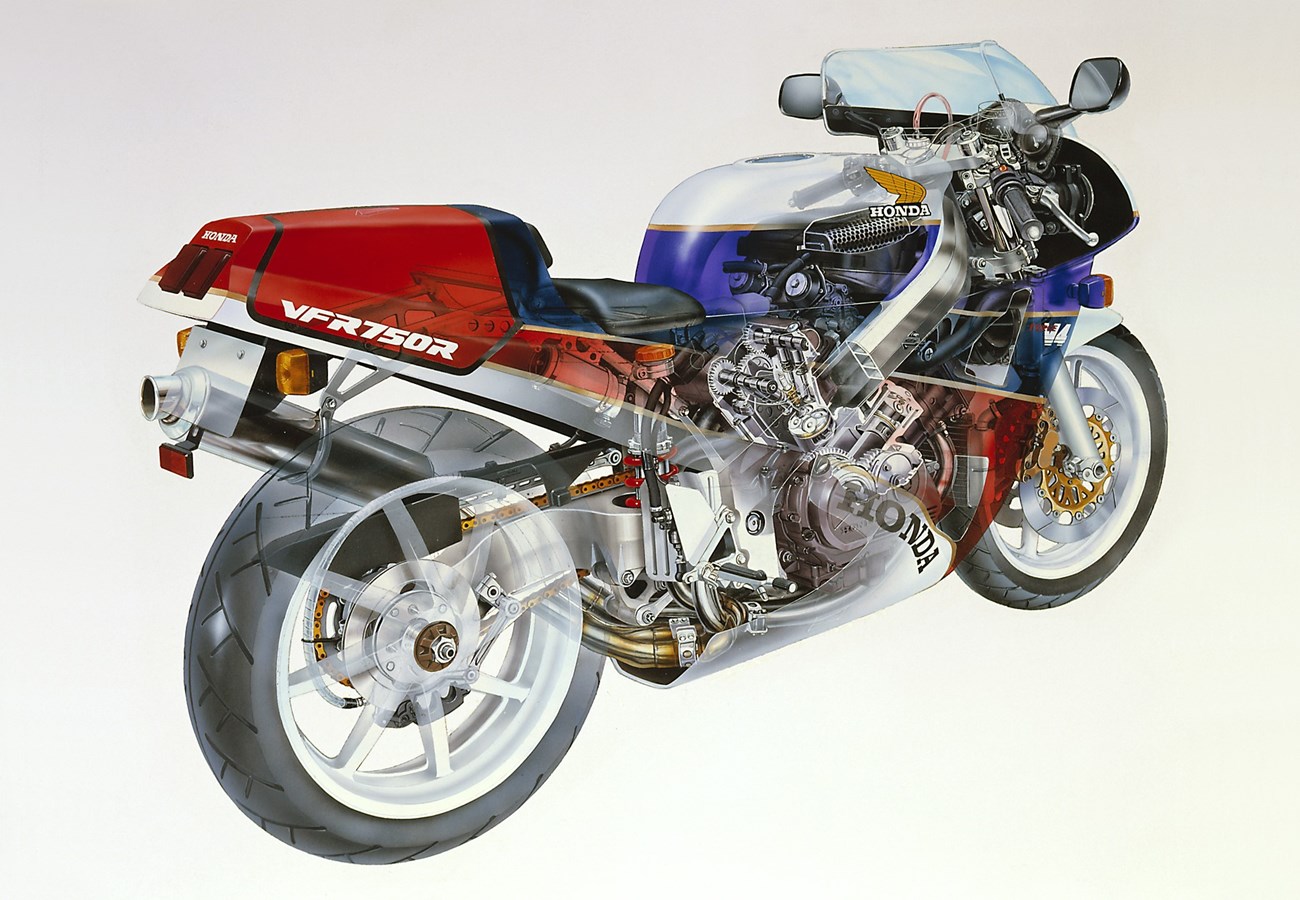
- ‘RC30 Forever’ scheme comes to Europe, having launched in Japan in 2020
- Approximately 150 genuine parts will be available for the legendary RC30, for order through the Honda dealer network
- Parts will be produced using newly-made moulds
- Parts list created following meetings between Honda and well-established owners’ clubs in Japan and Europe
- The VFR750R (RC30) was first launched in 1987 in accordance with World Superbike homologation rules
Honda will be bringing the ‘RC30 Forever’ genuine replacement parts scheme to Europe following its successful introduction in Japan last year.
Honda started the ‘RC30 Forever’ programme after meetings with well-established RC30 owners’ clubs in Japan and Europe, during which the owners expressed their strong desire to keep these iconic bikes on the road and in the best condition by using genuine Honda spare parts. The key focus of the programme is keeping these owners riding safely and with confidence.
Under the scheme, Honda produces approximately 150 genuine replacement parts for the RC30 that cover the engine, chassis, bodywork and electronics. These have been chosen based on owners’ requests and the experience of experts within Honda’s R&D and manufacturing facilities.
Parts will be available to order through dealerships across Europe from May* 2021.
Background to the ‘RC30 Forever’ scheme
At the beginning of the ‘RC30 Forever’ project, an investigation through the RC30 archives undertaken in 2017 revealed that none of the original wooden models or moulds for the RC30 had been retained. It was clear that the original drawings would be needed to move the project forward. Like all motorcycles produced at the time, the manufacture of the RC30 was based on 2D hand-drawn wireframe blueprints, from which models and moulds were created. Compared with modern methods of 3D computer modelling and digital drawings, these blueprints contain far fewer specific details, which complicated the reproduction of the new parts.
The blueprints available were digitised, enlarged to a 1:1 scale and compared with existing parts borrowed from the remaining RC30s within the Honda family and owners’ clubs to ensure their accuracy. Despite this, there were still clear and obvious gaps in the detailed information needed to produce the quality of parts required for the scheme. To ensure the parts met these very high standards, it was vital to involve the original team members, many of whom were in their 60s, to share their knowhow, passion and experience when the project team re-created the new wooden models and moulds from scratch.
It is this combination of tangible elements like new digitised drawings and available parts, with longstanding unquantifiable factors like the experience of returning members of the Honda family, that ultimately led to the successful creation of the scheme in Japan.
The VFR750R (RC30)
The legendary RC30 was first revealed at the Tokyo Motor Show in 1987, making its way to Europe in 1988. Limited to approximately 5,000 units worldwide, it was created to comply with the homologation rules required to compete in the newly formed World Superbike Championship.
Hand-built in the Hamamatsu factory, the RC30 was powered by a liquid-cooled 748cc 90° V4 and featured cutting edge race technology of the time – an approach unheard of hitherto. Honda’s development engineers made maximum use of exotic materials like carbon fibre, Kevlar and magnesium throughout the bike. The engine featured titanium connecting rods and a slipper clutch, that worked together with the tall race machine-style gearing. Wheels and brakes featured quick release mountings and the suspension was fully adjustable front and back. The bike prominently featured an unmistakable single-sided Pro-arm swingarm designed to help with rapid rear wheel changes during races.
The legacy of the RC30 was cemented when it won the World Superbike Championship in both 1988 and 1989 with Fred Merkel. It also notched up victories in multiple national and international races, including wins on the Isle of Man in the hands of celebrated riders like Joey Dunlop, Carl Fogarty, Steve Hislop and Philip McCallen.
* Sales start will vary depending on the part, and any updates will be added to the Honda website. Sales will be subject to limited stock availability for all parts.
2022 HONDA CRF450R
Model updates: After a major evolutionary leap in 21YM the CRF450R receives further refinements for 22YM, offering smoother drivability from new ECU settings, plus a re-valve for the Showa suspension to improve damping balance between front and rear. The frame remains unchanged, and is the exact same frame used on the CRF450RW piloted to back-to-back MXGP World Championships by Tim Gajser in 2019 and 2020.
Contents:
1 Introduction
2 Model overview
3 Key features
4 Technical specifications
- Introduction
The Honda CRF450R has been the benchmark motocrosser since its introduction in 2002. Its package has always aimed to offer its rider – whether amateur enthusiast or pro-racer – total control through balance and agility. Plus, of course, it’s built with the quality, durability and longevity that Honda has long been famed for.
And it’s a race bike that has constantly evolved. In 17YM, under a development concept of ‘ABSOLUTE HOLESHOT!’, Europe’s favourite open-class MX machine was given a ground-up redesign, with completely new chassis and a major top end power boost from a brand-new engine. Standard-fit electric start was a convenient addition in 18YM and, for 19YM, an HRC-developed cylinder head upped power and torque considerably; HRC launch control was also added. For 20YM the CRF450R gained Honda Selectable Torque Control (HSTC).
Aside from the wheels and fundamental engine architecture, for 21YM the CRF450R was effectively a totally new machine, drawing heavily on developments from the 2019 MX GP championship-winning CRF450RW. And, while the 2020 MXGP championship was a challenge for a variety of reasons, Gajser and HRC secured the title for a second year in a row at the 18th round in Trentino, Italy in November 2020.
Backed up by this continued proof of its top level racing pedigree, the 22YM CRF450R features further refinements to engine and suspension. And it remains, at its core, an HRC racer it is possible to buy.
2. Model Overview
The redesigned 21YM CRF450R was based on the development theme of ‘RAZOR-SHARP CORNERING’, centred around stronger low/mid-range torque, ultra-accurate handling and rider-friendly ergonomics. The new (2kg lighter) frame and swingarm’s rigidity balance were combined with a tighter chassis geometry and heightened ground clearance to target peak cornering performance. HRC’s engine knowhow delivered strong low- to mid-range torque and the revised decompressor system gave more consistent off-the-bottom driveability. A new hydraulic clutch and comprehensive electronics package ensured that the new bike’s ergonomics made it easier for the rider to go consistently fast throughout a race – helping not only MXGP riders but also MX enthusiasts of all ability levels to constantly post optimal lap times.
Building on these solid fundamentals from the new 21YM model, for 22YM the CRF450R receives an ECU update boosting drive plus extensive re-valve of the front and rear Showa suspension, elevating damping performance.
3. Key Features
3.1 Chassis
- For 22YM, firmer suspension damping creates more balanced suspension performance
- HRC input running through frame, swingarm, rigidity balance and geometry combines for outstanding cornering ability and ease of use, lap after lap
- Compact narrow plastics aid rider freedom
For 22YM the CRF450R’s chassis is unchanged aside from internal adjustments to the front and rear Showa suspension. The aim for the 22YM evolution is to deliver noticeably improved ‘hold up’ – raising the compression damping ride height of the stroke both front and rear in use – optimising balance between the front and rear of the machine.
The Showa 49mm USD coil spring AF2 fork is based on the ‘factory’ unit supplied to MX race teams in the Japanese championship. Through the 21YM update the fork received 5mm more stroke, to 310mm, and increased rigidity for its axle clamps. For 22YM the low-speed shim-stack has been re-valved to generate firmer settings for both compression and rebound damping. Oil volume reduces 8cc to 380cc; there are now 13 adjustment positions (rather than 15) for rebound with 15 for compression, as before.
A complete re-valve of the Showa MKE AF2 rear shock’s low-mid- and high-speed shim stack delivers a firmer overall setting for compression damping. There are now 11 adjustment positions for rebound (from the 8 of the previous iteration) and 6 for high and low-speed compression (from 12). Oil volume increases 1cc to 422cc.
The 21YM evolutionary leap saw the cycle parts and ergonomics greatly improved. Thanks to narrower main spars the weight of the main frame was reduced by 700g, while the redesigned subframe also saved 320g. The chassis dynamic was also new; with torsional rigidity maintained, lateral rigidity reduced 20% to increase corner speed, traction and steering accuracy. Both top and bottom yokes were redesigned for greater flex, for quicker steering and improved feel, and the aluminium Pro-Link swingarm given a rigidity balance tuned to match the frame.
To aid movement around the machine the seat was made shorter, lighter and 10mm lower at the rear compared to the previous design. It was also made easier to remove and install, and maintenance was simplified with only four 8mm bolts securing the bodywork each side.
Designed with Computational Flow Dynamics (CFD) for maximum through-flow of air, the radiator shrouds are constructed from one piece of plastic and include a lower vent while the radiator grills are optimised for airflow. The titanium fuel tank holds 6.3L.
Standard-fit, lightweight Renthal Fatbar flex for optimal comfort; the top yoke features two handlebar-holder locations for moving the handlebar rearward and forward by 26mm. When the holder is turned 180°, the handlebar can be moved an additional 10mm from the base position, resulting in four unique riding positions.
Up front, the twin-piston brake caliper employs 30 and 27mm diameter pistons and 260mm wave-pattern disc; along with low-expansion rate brake hose it gives both a strong feel and consistent staying power. The single-piston rear caliper is matched to a 240mm wave-pattern disc.
DID aluminium rims, with directly attached spoke pattern layout are finished in black; the front is a 21 x 1.6in, the rear a 19 x 2.15in. The rear wheel was made both stronger and lighter for 21YM and Dunlop’s MX33F/MX33 soft-terrain tyres are fitted as standard equipment.
Rake and trail remain at 27.1°/114mm with 1481mm wheelbase and 336mm ground clearance. Dry weight is 105.8kg.
The striking all-red graphic treatment complements the 22YM CRF450R’s aggressive lines.
3.2 Engine
- Revised ECU mapping for 22YM enhances smoother power delivery
- Hydraulic clutch gives consistent and light lever feel
- Decompressor system delivers improved stall resistance
22YM sees the 449.7cc four-valve Unicam engine unchanged, except for updated ECU mapping further promotes linear throttle control enhancing the boost that it received in 21YM.
Those changes for 21YM were very significant. An increase (up to 0.6kW) in peak power above 5,000rpm – accompanied by a stronger low-rpm torque feel – was the result of an extra 1.8L volume (to 4.1L) on the ‘clean’ side. The injector angle, too went from 30° to 60°, spraying fuel all the way back to the butterfly to improve intake efficiency, cooling of the charge and all-important throttle feel. The decompression system was also new: its counterweight moved from the right of the camshaft to the left, giving more stable operation at low rpm with increased stall-resistance.
The biggest change was to the twin exhaust ports: like the CBR1000RR-R Fireblade their exit became oval rather than round in shape for improved efficiency. The downpipe was also tucked in 74mm closer to the centre line while the single muffler featured twin resonators to reduce noise while boosting power.
Drawn directly from Gajser’s bike was the 8-plate hydraulic clutch. This gives outstanding control and feel at the lever as well as delivering consistent lever clearance under arduous riding conditions. Slippage was also reduced by 85% at peak power.
Bore and stroke is set at 96 x 62.1mm with compression ratio of 13.5:1. A gear position sensor allows the use of three specific ignition maps for 1st and 2nd, 3rd and 4th, and 5th. Rock-solid reliability has always been a big factor in the CRF450R’s success and a 5-hole piston oil jet and dual 12mm drum scavenge pump manage all-important lubrication.
3.3 Electronics
- Honda Selectable Torque Control (HSTC) with 3 riding modes (plus OFF)
- HRC Launch Control offers 3 start options
- Engine Mode Select Button (EMSB) features 3 maps to adjust output character
- HRC Setting tool tailors Aggressive and Smooth modes
The CRF450R’s HSTC works to minimise rear wheel spin (thus wasted forward drive) and maximise traction. It doesn’t use a wheel speed sensor, and critically maintains feel at the throttle while managing power; ignition timing is retarded and the PGM-FI controlled when the rate of change of rpm is detected to have gone over a set amount.
The three Modes differ in drive management level for different riding conditions:
Mode 1 intervenes most lightly, and after the longest time – useful for reducing wheelspin and maintaining control in tight corners.
Mode 3 has the system intervene more quickly and strongly, and is therefore useful in more slippery, muddy conditions.
Mode 2 naturally offers a mid-point between 1 and 3 in terms of speed and strength of intervention.
The Launch Control indicator, EFI warning, HSTC and EMSB mode button, and LED indicator are sited on the left handlebar. Pressing and holding the HSTC button for 0.5s will cycle the system to the next mode, with a green LED indication – 1 blink for Mode 1, 2 for Mode 2 and 3 for Mode 3 – to confirm selection.
The HSTC system can also be switched off completely. When the engine is turned on, the system uses the last-selected setting.
HRC Launch Control gives any rider the best option for a strong start and also has 3 modes to choose from:
Level 3 – 8,250rpm, muddy conditions/novice.
Level 2 – 8,500rpm, dry conditions/standard.
Level 1 – 9,500rpm, dry conditions/expert.
Activating HRC Launch Control is easy: to turn on, pull in the clutch and push the Start button on the right. The purple LED will blink once for Level 1 selection. Push the Start button again, for 0.5s or longer, and the LED will blink twice for Level 2. Repeat the process and the LED will blink 3 times, indicating that Level 3 has been chosen.
The Engine Mode Select Button (EMSB) alters the engine’s character and three maps are available to suit riding conditions or rider preference:
Mode 1 – Standard.
Mode 2 – Smooth.
Mode 3 – Aggressive.
The LED also displays mode selected, but with a blue light.
The HRC Setting Tool can deliver an ECU map with a much more easy-going Smooth mode, with gentler throttle response for less experienced riders. It can also inject Aggressive mode with a hyper-sensitive throttle reaction and engine response for race conditions.
4. Technical Specifications
|
ENGINE |
|
|
Type |
Liquid-cooled 4-stroke single cylinder uni-cam |
|
Displacement |
449.7cc |
|
Bore ' Stroke |
96.0mm x 62.1mm |
|
Compression Ratio |
13.5 : 1 |
|
FUEL SYSTEM |
|
|
Carburation |
Fuel injection |
|
Fuel Tank Capacity |
6.3 litres |
|
ELECTRICAL SYSTEM |
|
|
Ignition |
Digital CDI |
|
Starter |
Self-Starter |
|
DRIVETRAIN |
|
|
Clutch Type |
Wet type multi-plate |
|
Transmission Type |
Constant mesh, 5-speed,manual |
|
Final Drive |
Chain |
|
FRAME |
|
|
Type |
Aluminium twin tube |
|
CHASSIS |
|
|
Dimensions (L'W'H) |
2,182 x 827 x 1,267mm |
|
Wheelbase |
1,481mm |
|
Caster Angle |
27.1° |
|
Trail |
114mm |
|
Seat Height |
965mm |
|
Ground Clearance |
336mm |
|
Weight |
Dry 105.8kg – wet 110.6kg |
|
SUSPENSION |
|
|
Type Front |
Showa 49mm USD fork |
|
Type Rear |
Showa monoshock using Honda Pro-Link |
|
WHEELS |
|
|
Type Front |
Aluminium, spoke |
|
Type Rear |
Aluminium, spoke |
|
Tyres Front |
80/100-21-51M Dunlop MX33F |
|
Tyres Rear |
120/80-19-63M Dunlop MX33 |
|
BRAKES |
|
|
Front |
Single 260mm disk |
|
Rear |
Single 240mm disk |
All specifications are provisional and subject to change without notice
Please note that the figures provided are results obtained by Honda under standardised testing conditions prescribed by WMTC. Tests are conducted on a rolling road using a standard version of the vehicle with only one rider and no additional optional equipment. Actual fuel consumption may vary depending on how you ride, how you maintain your vehicle, weather, road conditions, tire pressure, installation of accessories, cargo, rider and passenger weight, and other factors.
SUMMARY OF HONDA GLOBAL CEO INAUGURAL PRESS CONFERENCE
TOKYO, Japan, April 23, 2021 — Honda Motor Co., Ltd. President and Representative Director Toshihiro Mibe held an inaugural press conference at 3:00 pm today (Japan time).
Following is a summary of his formal remarks:
Powered by Honda
Honda is a mobility company that offers a wide range of products which, in total, makes Honda the world's largest power unit manufacturer. Since its founding and through our wide array of power units, Honda has always been contributing to the advancement of mobility and people’s daily lives by providing the “power” which enables people to take action.
By becoming the “power” that supports people who are trying to do things through their own initiative, including those who are trying to make changes to the society they live in and others who strive to enhance the quality of people’s daily lives, we will help people expand their own potential.
What Honda wants to achieve/direction of our initiatives
Honda will work comprehensively to address challenges in the areas of the environment and safety. At the same time, for the future, Honda will strive to lead advancements which will be made in the areas of mobility, the power unit, energy and robotics.
Moreover, to have a firm footing in working toward our environmental and safety goals, we will remain committed to ensure the attainment of our goal to “solidify our existing businesses”.
- Environmental Initiatives
1-1. Three initiatives in pursuit of “zero environmental impact”
Honda will strive to realize carbon neutrality for all products and corporate activities Honda is involved in by 2050. Striving for “zero environmental impact” of not only our products but the entire product lifecycle including our corporate activities, Honda will focus on the following areas as the “three-pillars” of our initiatives:
– Carbon neutrality
– Clean energy
– Resource circulation
? In addition to the electrification of our motorcycle and automobile products, we will expand the range of electrified products with our Honda Mobile Power Pack swappable battery and expand utilization of renewable energy by enabling infrastructure-linked smart power operations.
? For the further expansion of the use of renewable energy, we will be proactive in promoting the utilization of hydrogen. We will strive to realize a “multi-pathway of energy,” which is a concept of utilizing a wide variety of energy sources including carbon-neutral fuels, which will be effective in all areas, including where electrification is difficult, such as with aircraft.
? Including more effective ways to reuse and recycle batteries, Honda is pursuing research on material recycling and will take on the challenge of developing products made from 100% sustainable materials.
? We also will continue to work on the concept of “Honda eMaaS” through which Honda will contribute to the “freedom of mobility” and “expanded use of renewable energy” by connecting electrified mobility products and energy service. Honda eMaaS will be steadily pursued while focusing on the following three core areas:
– Expansion of the utilization of Mobile Power Packs
– Utilization of large-capacity batteries for electrified vehicles
– Application and implementation of fuel cell systems.
1-2. Electrification of automobile products
In order to achieve our carbon-free goal on a “tank-to-wheel” basis, as the responsibility of an automaker, Honda will strive to increase the ratio of battery-electric vehicles (EVs) and fuel cell electric vehicles (FCVs) within overall unit sales in all major markets of electrification combined to 40% by 2030, to 80% by 2035, and then to 100% globally by 2040. These are challenging targets, and to attain them, we must put forth a collective effort of our entire value chain. However, we decided to set high goals so that all of us share the vision of what we are trying to accomplish and take on challenges toward the realization of our goals.
¦North America
? In North America, we will strive for an EV/FCV unit sales ratio of 40% by 2030, 80% by 2035 and 100% by 2040. Leveraging the alliance with GM as one of our strategic pillars, we will pursue electrification in North America efficiently while taking advantage of the respective strengths of both companies
? Honda and GM are jointly developing two large-sized EV models using GM’s Ultium batteries, and we are planning to introduce these models to the North American market as model year 2024 vehicles, one from Honda brand and the other from the Acura brand.
? Starting from the second half of the 2020s, Honda will launch a series of new EV models which adopt e:Architecture, a completely new EV platform led by Honda. These EV models will first be introduced to the North American market, and then to other regions of the world.
¦China
? In China, we will strive for an EV/FCV unit sales ratio of 40% by 2030, 80% by 2035 and 100% by 2040.
? In China, we have been introducing EV models while utilizing local resources, and we will further accelerate this approach from here forward. We will introduce 10 Honda-brand EV models within five years. As the first of the 10 models, the mass-production model based on the Honda SUV e:prototype is scheduled to go on sale in spring 2022.
? We will further pursue the utilization of local resources, which includes strengthening our collaboration with CATL for the supply of batteries, which are core components for electrified vehicles.
¦Japan
? In Japan, we will strive for an EV/FCV unit sales ratio of 20% by 2030, 80% by 2035 and 100% by 2040. Also, including hybrid-electric vehicles, we will strive to electrify 100% of our automobile unit sales in Japan by 2030.
? Including the first introduction of an EV model in the K-car segment in 2024, we will continue making progress in the electrification of our mini-vehicles with both hybrid and EV models.
? For the procurement of batteries, we will strive to realize a “local production and local procurement” approach in Japan, which also will contribute to the growth of domestic industries in Japan.
? In the area of mobility services (MaaS), we are aiming to introduce the Cruise Origin, an electric self-driving vehicle Honda is currently developing jointly with GM and Cruise, in the Japanese MaaS market in the mid-2020s. With this aim, we will be starting development for testing in Japan from this year.
In order to secure the high competitiveness of our EVs of the future, Honda is conducting independent research on all-solid-state batteries as the next generation batteries which will realize high capacity and low cost. We will undertake the verification of production technology using a demonstration line, starting this fiscal year. We will begin accelerating this research with an aim to make all-solid-state batteries available for our new models to be introduced in the second half of the 2020s.
Honda has a track record of offering customers “creative movers,” products in Japan such as Odyssey and StepWGN that help create better daily lives for people. This stance will not change in the world of EVs. By combining digital technologies with Honda’s existing strengths, such as unique creativity and original designs, we will continue to add unique value only Honda can offer to our EVs.
1-3. Electrification of motorcycle products
Honda will strive to lead the motorcycle industry at the forefront of its environmental initiatives with an approach which will include not only electrification but also the improvement of the fuel efficiency of gasoline engines, utilization of biofuels and other strategies.
? The key to successful electrification of motorcycle products is to consider the battery, which is still expensive, separately from the motorcycle. In developed countries, where electrification is in strong demand by society, we will pursue electrification utilizing Mobile Power Pack, targeting our B-to-B (business-to-business) and B-to-G (business-to-national/local governments) customers.
? For personal-use customers, we must not only enhance our product lineup but also make a large number of battery-swapping stations available and ensure convenience to users by making them compatible with EVs of other makers. To this end, Honda has established a consortium with other motorcycle OEMs in Japan and Europe, respectively, to develop technology standards for swappable batteries. Honda has a vision to expand Mobile Power Pack applications beyond motorcycles to power products and micro-mobility products. With this vision, we have begun demonstration testing in India using “rickshaw” type tricycle taxis.
? To accommodate the diverse needs of our customers, in addition to introducing GYRO e: and GYRO CANOPY e: in the area of business-use bikes, scheduled for this year, we are going to introduce three new EV models in the area of personal use, in classes with engine sizes of below 50cc and below 125cc., by 2024. We also will introduce new products in the “FUN” area as well.
1-4. Fuel cell
Hydrogen is expected to be popularized as a renewable energy source. Honda has a long history of researching, developing and commercializing FC technologies.
While continuing our collaboration with GM, Honda will strive to reduce costs and realize a “hydrogen society” by expanding our lineup of FCVs and also by using FC systems for a wide range of applications, including commercial trucks as well as both stationary and movable power sources.
- Safety Initiatives
Honda will strive for zero traffic collision fatalities involving Honda motorcycles and automobiles globally by 2050. The major challenge we will face as we work toward this goal is how to eliminate motorcycle collision fatalities, especially in emerging countries. As a company that has both motorcycle and automobile businesses, we will continue to strengthen our research on safety technologies that enable motorcycles and automobiles to safely coexist and lead the way in realizing a collision-free society from the standpoint of both hardware and software.
? Since many motorcycle collision fatalities involve automobiles, we will strive to apply our omnidirectional ADAS (advanced driver-assistance system) to all new automobile models we introduce in developed countries by 2030.
? By leveraging the knowledge and know-how we have amassed through research and development of our Level 3 automated driving technologies, we will further enhance the intelligence of ADAS, which increases the percentage of collision patterns covered by our ADAS.
? Particularly in emerging countries, there are many collisions that can be prevented through traffic safety education activities and by approaching the issue from the perspective of infrastructure and government policies. Therefore, Honda will focus also on such areas including strengthening of educational programs and government/industry relations activities.
- Research & Development Initiatives
In order for Honda to keep making progress in its environmental and safety initiatives, it becomes essential for us to invest aggressively in the area of research and development. Therefore, regardless of fluctuations in our sales revenue, Honda will invest a total of approximately 5 trillion yen as R&D expenses over the next six years.
In the field of research and development, including the system and capability for the development of digital technologies which needs to be further strengthened, we will take necessary measures, including alliances, as quickly as possible.
Moreover, we also will take proactive measures to build a strong value chain from the perspective of electrification.
- Preparations for the future
I believe that the “unique characteristics of Honda” are represented by the “value we derive by thinking through the very essence of things” and our “originality.” Honda is a company with a group of individuals who have the strong desire to be original. We value people's dreams and continue taking on challenges toward ambitious targets. In so doing, we want to be a company that will always pursue the very essence of things and originality.
As of last fiscal year, we enabled Honda R&D to focus on the research of advanced technologies, and we are conducting research on leading-edge environmental and safety technologies for the realization of a society that aims for zero environmental impact and a collision-free society. Also, we are making progress with research on technologies which will expand mobility into the 3rd and 4th dimensions, into the skies, the ocean, outer space and the area of robotics. We will strengthen our original research of technologies by ensuring optimal allocation of resources into the area of advanced and cutting-edge technologies.
Moreover, in order to actively create and deliver new value for our customers, we have started the “New Business Creation Program” where the dreams and ideas of Honda associates become the starting point of each project.
Closing
My hope is to hear people saying, “We are glad Honda exists” or “Honda will definitely do it.” Honda wants to continue to be a company that people want to exist. That is what we want to achieve.
To this end, we will establish a business structure which has resilience against changes in our business environment and speedily implement large-scale action plans. We will continue to work aggressively, while always asking ourselves what it means to maintain the unique characteristics of Honda, which is to pursue the very essence of things and to be original.
HONDA REVEALS FINANCE CAMPAIGN FOR HALO GOLD WING, AFRICA TWIN AND FIREBLADE MODELS
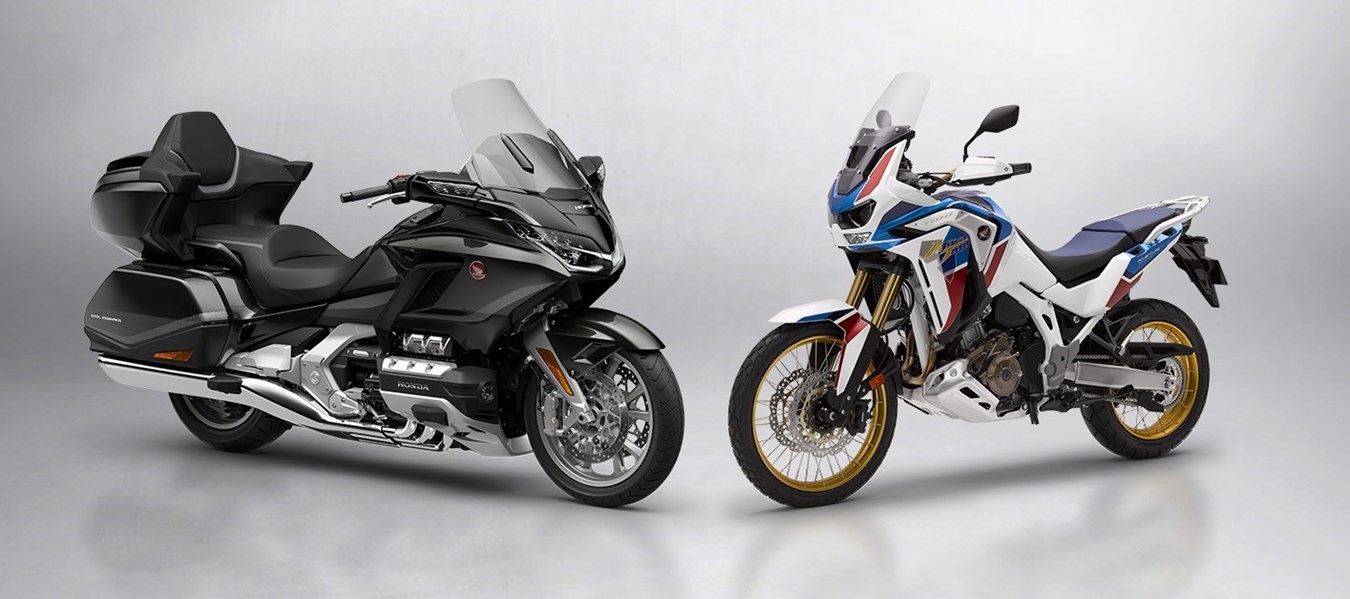
Honda reveals finance campaign for halo Gold Wing, Africa Twin and Fireblade models
Set Yourself Three, a comprehensive finance package, brings a suite of aftersales extras alongside preferential finance rates and a test-ride incentive to the touring rider itching to tackle the open road on a brand-new Gold Wing or Africa Twin. The Fireblade also enjoys a finance boost, amongst a number of other models.
Honda UK’s new Set Yourself Three finance package has been designed to encourage riders to tour with complete peace of mind thanks to a variety of complimentary aftersales extras, all brought with the added affordability of reduced finance rates and a test-ride based incentive. Prospective buyers can take advantage on all CRF1100L Africa Twin and CRF1100L Africa Twin Adventure Sports variants as well as the Gold Wing and Gold Wing Tour. Honda’s Super Sport flagship CBR1000RR-R Fireblades are also even more accessible than before along with a raft of other models.
Three is the magic number for iconic duo
Those taking up the well-appointed aftersales and finance package will benefit from no less than three complimentary services; a one-year extended guarantee, one year extended European Roadside Assistance plus a one-year complimentary Datatool subscription for the advanced anti-theft technology.
Injecting value and even greater appeal to the Gold Wing and Africa Twin line-ups are the finance terms of the Set Yourself Three, three-year finance deal. A borrowing rate of 4.9% APR wrapped in with a £500 incentive courtesy of a pre-purchase test-ride makes any specification of the Tour or Adventure models very attractive.
For added flexibility, those customers looking to purchase outright, a £500 incentive courtesy of a pre-purchase test-ride plus a complimentary year’s subscription to Datatool’s advanced anti-theft technology is also available.
Representative Finance Examples:
| Model | OTR | Deposit | Test Ride | Amount of Credit | 36 Payments of | Final Payment | Final Payment inc Option Fee | Total Amount Payable | APR | Option to Purchase Fee | Annual Contracted Mileage | Excess Mileage Charge |
| GL1800B GOLD WING [Bagger] 19YM | £22,399.00 | £4,774.13 | £500.00 | £17,124.87 | £189.00 | £12,496.72 | £12,506.72 | £24,584.85 | 4.9% | £10.00 | 4,000 | £0.12 |
| GL1800B GOLD WING [Bagger] DCT 20YM | £23,999.00 | £5,497.12 | £500.00 | £18,001.88 | £199.00 | £13,124.31 | £13,134.31 | £26,295.43 | 4.9% | £10.00 | 4,000 | £0.12 |
| GL1800 GOLD WING TOUR 19YM | £27,899.00 | £5,525.01 | £500.00 | £21,873.99 | £249.00 | £15,668.55 | £15,678.55 | £30,667.56 | 4.9% | £10.00 | 4,000 | £0.12 |
| GL1800 GOLD WING TOUR ABS DCT & AIRBAG 19YM | £30,699.00 | £6,433.64 | £500.00 | £23,765.36 | £259.00 | £17,470.36 | £17,480.36 | £33,738.00 | 4.9% | £10.00 | 4,000 | £0.16 |
| GL1800 GOLD WING TOUR ABS DCT & AIRBAG 20YM | £30,999.00 | £6,398.79 | £500.00 | £24,100.21 | £269.00 | £17,470.36 | £17,480.36 | £34,063.15 | 4.9% | £10.00 | 4,000 | £0.18 |
| GL1800 GOLD WING 21YM | £22,849.00 | £4,889.36 | £500.00 | £17,459.64 | £199.00 | £12,496.72 | £12,506.72 | £25,060.08 | 4.9% | £10.00 | 4,000 | £0.12 |
| GL1800 GOLD WING DCT 21YM | £24,229.00 | £5,392.25 | £500.00 | £18,336.75 | £209.00 | £13,124.31 | £13,134.31 | £26,550.56 | 4.9% | £10.00 | 4,000 | £0.12 |
| GL1800 GOLD WING TOUR 21YM | £28,349.00 | £5,975.08 | £500.00 | £21,873.92 | £249.00 | £15,668.55 | £15,678.55 | £31,117.63 | 4.9% | £10.00 | 4,000 | £0.12 |
| GL1800 GOLD WING TOUR DCT & Airbag 21YM | £31,449.00 | £6,513.77 | £500.00 | £24,435.23 | £279.00 | £17,470.36 | £17,480.36 | £34,538.13 | 4.9% | £10.00 | 4,000 | £0.18 |
| Model | OTR | Deposit | Test Ride | Amount of Credit | 36 Payments of | Final Payment | Final Payment inc Option Fee | Total Amount Payable | APR | Option to Purchase Fee | Annual Contracted Mileage | Excess Mileage Charge |
| CRF1100L Africa Twin 20YM PLUS | £15,849.00 | £3,263.88 | £500.00 | £12,085.12 | £149.00 | £8,213.68 | £8,223.68 | £17,351.56 | 4.9% | £10.00 | 4,000 | £0.09 |
| CRF1100L Africa Twin DCT 20YM PLUS | £16,749.00 | £3,512.35 | £500.00 | £12,736.65 | £159.00 | £8,579.94 | £8,589.94 | £18,326.29 | 4.9% | £10.00 | 4,000 | £0.09 |
| CRF1100L Africa Twin Adventure Sports 20YM PLUS | £17,449.00 | £4,108.66 | £500.00 | £12,840.34 | £149.00 | £9,087.78 | £9,097.78 | £19,070.44 | 4.9% | £10.00 | 4,000 | £0.10 |
| CRF1100L Africa Twin Adventure Sports DCT 20YM PLUS | £18,649.00 | £3,561.01 | £500.00 | £14,587.99 | £189.00 | £9,560.33 | £9,570.33 | £20,435.34 | 4.9% | £10.00 | 4,000 | £0.10 |
| CRF1100L Africa Twin Adventure Sports ES 20YM PLUS | £18,849.00 | £3,760.98 | £500.00 | £14,588.02 | £189.00 | £9,560.33 | £9,570.33 | £20,635.31 | 4.9% | £10.00 | 4,000 | £0.10 |
| CRF1100L Africa Twin Adventure Sports ES DCT 20YM PLUS | £20,149.00 | £3,990.96 | £500.00 | £15,658.04 | £199.00 | £10,411.15 | £10,421.15 | £22,076.11 | 4.9% | £10.00 | 4,000 | £0.11 |
| CRF1100L Africa Twin 20YM | £13,049.00 | £3,059.82 | £500.00 | £9,489.18 | £119.00 | £6,371.45 | £6,381.45 | £14,225.27 | 4.9% | £10.00 | 4,000 | £0.07 |
| CRF1100L Africa Twin DCT 20YM | £13,949.00 | £3,255.57 | £500.00 | £10,193.43 | £129.00 | £6,798.89 | £6,808.89 | £15,208.46 | 4.9% | £10.00 | 4,000 | £0.07 |
| CRF1100L Africa Twin Adventure Sports 20YM | £14,649.00 | £3,109.48 | £500.00 | £11,039.52 | £139.00 | £7,390.74 | £7,400.74 | £16,014.22 | 4.9% | £10.00 | 4,000 | £0.08 |
| CRF1100L Africa Twin Adventure Sports DCT 20YM | £15,849.00 | £3,648.97 | £500.00 | £11,700.03 | £139.00 | £8,155.38 | £8,165.38 | £17,318.35 | 4.9% | £10.00 | 4,000 | £0.09 |
| CRF1100L Africa Twin Adventure Sports ES 20YM | £16,049.00 | £3,440.23 | £500.00 | £12,108.77 | £149.00 | £8,241.02 | £8,251.02 | £17,555.25 | 4.9% | £10.00 | 4,000 | £0.09 |
| CRF1100L Africa Twin Adventure Sports ES DCT 20YM | £17,349.00 | £3,773.33 | £500.00 | £13,075.67 | £159.00 | £8,972.73 | £8,982.73 | £18,980.06 | 4.9% | £10.00 | 4,000 | £0.10 |
*See bottom of release for financial Terms and Conditions
Fireblade access
Similarly, the latest CBR1000RR-R Fireblades benefit from the same improved, 4.9% finance rate over a three-year contract. Representing the cutting-edge of litre performance bikes, the 215bhp road-racer also weighs in with a £1,000 enhancement after a test ride. Furthermore, one year of the Datatool tracking service is also included. Better yet, this offer applies to both standard and SP models of Fireblade.
For added flexibility, those customers looking to purchase outright, a £1,000 incentive courtesy of a pre-purchase test-ride plus a complimentary year’s subscription to Datatool’s advanced anti-theft technology is also available.
Representative Finance Examples:
| Model | OTR | Deposit | Test Ride | Amount of Credit | 36 Payments of | Final Payment | Final Payment inc Option Fee | Total Amount Payable | APR | Option to Purchase Fee | Annual Contracted Mileage | Excess Mileage Charge |
| CBR1000RR-R FIREBLADE ABS CBR1000STL 20YM | £19,999.00 | £5,005.67 | £1,000.00 | £13,993.33 | £169.00 | £9,647.23 | £9,657.23 | £21,746.90 | 4.9% | £10.00 | 4,000 | £0.09 |
| CBR1000RR-R FIREBLADE SP ABS CBR1000SPL 20YM | £23,499.00 | £6,180.00 | £1,000.00 | £16,319.00 | £179.00 | £11,951.63 | £11,961.63 | £25,585.63 | 4.9% | £10.00 | 4,000 | £0.10 |
*See bottom of release for financial Terms and Conditions
Offers for Street family
Honda’s most powerful Street model, the CB1000R, can be purchased on a reduced finance package rated at 5.9% APR. Bolstered by a deposit contribution of up to £750, Honda’s premium sports naked that underwent a significant refresh for 2021 is the ideal choice for riders looking for an impressive mix of performance and a classic aesthetic. A £750 deposit contribution is available to 20YM and older NC750Xs, making the frugal and do-it-all model the perfect 365-day bike.
Middleweights in the shape of the 20YM and older Super Sport CBR500R and Street CB500F have also been tagged with a deposit contribution of £500 alongside a finance package of 6.9% APR.
19YM and older 125s also receive support with deposit contributions of £200 and two-year finance packages rated at 4.9% APR, which allows new riders to take their first step into the motorcycling world affordably, aboard an MSX125, Super Cub or CB125F.
Representative Finance Examples:
| Model | OTR | Deposit | HUK Contribution | Dealer Contribution | Amount of Credit | 36 Payments of | Final Payment | Final Payment inc Option Fee | Total Amount Payable | APR | Option to Purchase Fee | Annual Contracted Mileage | Excess Mileage Charge |
| CB1000R ABS 20YM | £11,649.00 | £1,603.47 | £375.00 | £375.00 | £9,295.53 | £139.00 | £5,603.02 | £5,613.02 | £12,970.49 | 5.9% | £10.00 | 4,000 | £0.06 |
| CB1000R PLUS 20YM | £12,749.00 | £2,040.05 | £375.00 | £375.00 | £9,958.95 | £149.00 | £5,999.69 | £6,009.69 | £14,163.74 | 5.9% | £10.00 | 4,000 | £0.07 |
| CB1000R PLUS 21YM | £12,999.00 | £1,959.80 | £375.00 | £375.00 | £10,289.20 | £159.00 | £5,999.69 | £6,009.69 | £14,443.49 | 5.9% | £10.00 | 4,000 | £0.07 |
| Model | OTR | Deposit | HUK Contribution | Amount of Credit | 36 Payments of | Final Payment | Final Payment inc Option Fee | Total Amount Payable | APR | Option to Purchase Fee | Annual Contracted Mileage | Excess Mileage Charge |
| NC750X ABS 20YM | £7,249.00 | £1,026.11 | £750.00 | £5,472.89 | £89.00 | £3,017.18 | £3,027.18 | £8,007.29 | 5.9% | £10.00 | 4,000 | £0.03 |
| NC750X ABS DCT 20YM | £7,949.00 | £1,077.33 | £750.00 | £6,121.67 | £99.00 | £3,396.52 | £3,406.52 | £8,797.85 | 5.9% | £10.00 | 4,000 | £0.03 |
| Model | OTR | Deposit | HUK Contribution | Amount of Credit | 36 Payments of | Final Payment | Final Payment inc Option Fee | Total Amount Payable | APR | Option to Purchase Fee | Annual Contracted Mileage | Excess Mileage Charge |
| CB500F ABS 18YM | £5,599.00 | £499.72 | £500.00 | £4,599.28 | £79.00 | £2,481.28 | £2,491.28 | £6,335.00 | 6.9% | £10.00 | 4,000 | £0.05 |
| CBR500R ABS 19YM | £6,149.00 | £720.54 | £500.00 | £4,928.46 | £89.00 | £2,485.44 | £2,495.44 | £6,919.98 | 6.9% | £10.00 | 4,000 | £0.04 |
| Model | OTR | Deposit | HUK Contribution | Amount of Credit | 24 Payments of | Final Payment | Final Payment inc Option Fee | Total Amount Payable | APR | Option to Purchase Fee | Annual Contracted Mileage | Excess Mileage Charge |
| CB125F 19YM | £2,949.00 | £428.02 | £200.00 | £2,320.98 | £49.00 | £1,317.77 | £1,327.77 | £3,131.79 | 4.9% | £10.00 | 4,000 | £0.01 |
| CUB 125 | £3,449.00 | £274.03 | £200.00 | £2,974.97 | £69.00 | £1,533.26 | £1,543.26 | £3,673.29 | 4.9% | £10.00 | 4,000 | £0.02 |
| MSX125 19YM | £3,499.00 | £343.56 | £200.00 | £2,955.44 | £69.00 | £1,516.24 | £1,526.24 | £3,725.80 | 4.9% | £10.00 | 4,000 | £0.01 |
*See bottom of release for financial Terms and Conditions
Scooter value
The SH300i scooter has a customer saving of £300 for 20YM and older. A considerable sum that will buy plenty of miles of riding thanks to the fuel-sipping, one-cylinder engine.
Representative Finance Examples:
*See bottom of release for financial Terms and Conditions
| Model | OTR | Deposit | Amount of Credit | 36 Payments of | Final Payment | Final Payment inc Option Fee | Total Amount Payable | APR | Option to Purchase Fee | Annual Contracted Mileage | Excess Mileage Charge |
| SH300I ABS 19YM | £4,949.00 | £909.97 | £4,039.03 | £69.00 | £2,193.98 | £2,203.98 | £5,597.95 | 6.9% | £10.00 | 4,000 | £0.03 |
Terms & Conditions
CRF1100L Africa Twin (all variants)
PCP Terms and Conditions: New retail CRF1100L Africa Twin ABS and DCT (all variants) orders from 1 April 2021 to 3 August 2021 and registered by 3 August 2021. Subject to model and colour availability. *OTR may be subject to change due to actual or unexpected changes in tariffs, duties taxes or other costs which may affect importation or other costs of supply. The complimentary first three services, one-year extended guarantee, one year extended European Roadside Assistance, one-year Datatool subscription and £500 test ride are available when your vehicle is financed through a Hire Purchase, Vehicle Purchase Loan or Personal Contract Purchase agreement with Honda Finance Europe. The minimum balance to finance is £5000 with minimum agreement term of 24 months for Hire Purchase and Vehicle Purchase Loan and 25 months for Personal Contract Purchase. You can settle your finance agreement at any time, however, if you withdraw from your finance agreement within the first 14 days, the complimentary first three services, extended guarantee and European roadside assistance will be cancelled. Offers applicable at participating dealers and are at the promoter's absolute discretion (excluding Channel Islands). Representative example based on 3 years 4.9% PCP. **£500 Honda UK Test Ride available. Excess mileage rate applies. Final payment includes £10 option to purchase fee. At the end of the agreement, there are three options: i) Retain: Pay the optional final payment to own the vehicle, ii) Return: Return the vehicle, or iii) Renew: Part exchange your Honda for a new one. You do not have to pay the Final Payment if you return the bike at the end of the agreement and you have paid all other amounts due, the bike is in good condition and has been serviced in accordance with the Honda service book and the maximum annual mileage of 4,000 has not been exceeded. Excess mileage rate applies should this be exceeded. Indemnities may be required in certain circumstances. Finance is only available to persons aged 18 or over, subject to status. All figures are correct at time of publication but may be subject to change. Honda Franchise Dealers are credit brokers, not lenders. As the dealer offers products from a limited number of carefully selected finance providers, they are not independent financial advisors. We may or may not make a payment and / or reward to the dealer if you enter into an agreement with us. Credit provided by Honda Finance Europe Plc. Cain Road, Bracknell, Berkshire RG12 1HL. Honda Financial Services is a trading name of Honda Finance Europe Plc. a company registered at Companies House No 03289418. Honda Finance Europe plc is authorised and regulated by the Financial Conduct Authority, Financial Services Register number 312541.
One Year Datatool subscription and £500 test ride contribution are available to eligible cash customers also.
Gold Wing (all variants)
“PCP Terms and Conditions: New retail Gold Wing (all variants) orders from 1 April 2021 to 3 August 2021 and registered by 3 August 2021. Subject to model and colour availability. *OTR may be subject to change due to actual or unexpected changes in tariffs, duties taxes or other costs which may affect importation or other costs of supply. The complimentary first three services, one-year extended guarantee, one year extended European Roadside Assistance, one-year Datatool subscription and £500 test ride are available when your vehicle is financed through a Hire Purchase, Vehicle Purchase Loan or Personal Contract Purchase agreement with Honda Finance Europe. The minimum balance to finance is £5000 with minimum agreement term of 24 months for Hire Purchase and Vehicle Purchase Loan and 25 months for Personal Contract Purchase. You can settle your finance agreement at any time, however, if you withdraw from your finance agreement within the first 14 days, the complimentary first three services, extended guarantee and European roadside assistance will be cancelled. Offers applicable at participating dealers and are at the promoter's absolute discretion (excluding Channel Islands). Representative example based on 3 years 4.9% PCP. **£500 Honda UK Test Ride available. Excess mileage rate applies. Final payment includes £10 option to purchase fee. At the end of the agreement, there are three options: i) Retain: Pay the optional final payment to own the vehicle, ii) Return: Return the vehicle, or iii) Renew: Part exchange your Honda for a new one. You do not have to pay the Final Payment if you return the bike at the end of the agreement and you have paid all other amounts due, the bike is in good condition and has been serviced in accordance with the Honda service book and the maximum annual mileage of 4,000 has not been exceeded. Excess mileage rate applies should this be exceeded. Indemnities may be required in certain circumstances. Finance is only available to persons aged 18 or over, subject to status. All figures are correct at time of publication but may be subject to change. Honda Franchise Dealers are credit brokers, not lenders. As the dealer offers products from a limited number of carefully selected finance providers, they are not independent financial advisors. We may or may not make a payment and / or reward to the dealer if you enter into an agreement with us. Credit provided by Honda Finance Europe Plc. Cain Road, Bracknell, Berkshire RG12 1HL. Honda Financial Services is a trading name of Honda Finance Europe Plc. a company registered at Companies House No 03289418. Honda Finance Europe plc is authorised and regulated by the Financial Conduct Authority, Financial Services Register number 312541.
One Year Datatool subscription and £500 test ride contribution are available to eligible cash customers also.”
CBR1000RR-R Fireblade (all variants)
“PCP Terms and Conditions: New retail CBR1000RR-R Fireblade ABS 20YM (all variants) orders from 1 April 2021 to 3 August 2021 and registered by 3 August 2021. Subject to model and colour availability. *OTR may be subject to change due to actual or unexpected changes in tariffs, duties taxes or other costs which may affect importation or other costs of supply. Finance customers are eligible for 1 year Datatool subscription and £1000 test ride when your vehicle is financed through a Hire Purchase, Vehicle Purchase Loan or Personal Contract Purchase agreement with Honda Finance Europe. The minimum balance to finance is £5000 with minimum agreement term of 24 months for Hire Purchase and Vehicle Purchase Loan and 25 months for Personal Contract Purchase. Offers applicable at participating dealers and are at the promoter's absolute discretion (excluding Channel Islands). Representative example based on 3 years 4.9% PCP. **£1000 Honda UK Test Ride available. Excess mileage rate applies. Final payment includes £10 option to purchase fee. At the end of the agreement, there are three options: i) Retain: Pay the optional final payment to own the vehicle, ii) Return: Return the vehicle, or iii) Renew: Part exchange your Honda for a new one. You do not have to pay the Final Payment if you return the bike at the end of the agreement and you have paid all other amounts due, the bike is in good condition and has been serviced in accordance with the Honda service book and the maximum annual mileage of 4,000 has not been exceeded. Excess mileage rate applies should this be exceeded. Indemnities may be required in certain circumstances. Finance is only available to persons aged 18 or over, subject to status. All figures are correct at time of publication but may be subject to change. Honda Franchise Dealers are credit brokers, not lenders. As the dealer offers products from a limited number of carefully selected finance providers, they are not independent financial advisors. We may or may not make a payment and / or reward to the dealer if you enter into an agreement with us. Credit provided by Honda Finance Europe Plc. Cain Road, Bracknell, Berkshire RG12 1HL. Honda Financial Services is a trading name of Honda Finance Europe Plc. a company registered at Companies House No 03289418. Honda Finance Europe plc is authorised and regulated by the Financial Conduct Authority, Financial Services Register number 312541.
One year Datatool subscription and £1000 test ride are available to both cash and finance customers.”
CB1000R (all variants)
PCP Terms and Conditions: New retail CB1000R 21YM and older (all variants) orders from 1 April 2021 to 3 August 2021 and registered by 3 August 2021. Subject to model and colour availability. *OTR may be subject to change due to actual or unexpected changes in tariffs, duties taxes or other costs which may affect importation or other costs of supply. Offers applicable at participating dealers and are at the promoter's absolute discretion (excluding Channel Islands). Representative example based on 3 years 5.9% PCP. **£375 Honda UK deposit contribution available; additional £375 dealer contribution available at participating dealers only. Excess mileage rate applies. Final payment includes £10 option to purchase fee. At the end of the agreement, there are three options: i) Retain: Pay the optional final payment to own the vehicle, ii) Return: Return the vehicle, or iii) Renew: Part exchange your Honda for a new one. You do not have to pay the Final Payment if you return the bike at the end of the agreement and you have paid all other amounts due, the bike is in good condition and has been serviced in accordance with the Honda service book and the maximum annual mileage of 4,000 has not been exceeded. Excess mileage rate applies should this be exceeded. Indemnities may be required in certain circumstances. Finance is only available to persons aged 18 or over, subject to status. All figures are correct at time of publication but may be subject to change. Honda Franchise Dealers are credit brokers, not lenders. As the dealer offers products from a limited number of carefully selected finance providers, they are not independent financial advisors. We may or may not make a payment and / or reward to the dealer if you enter into an agreement with us. Credit provided by Honda Finance Europe Plc. Cain Road, Bracknell, Berkshire RG12 1HL. Honda Financial Services is a trading name of Honda Finance Europe Plc. a company registered at Companies House No 03289418. Honda Finance Europe plc is authorised and regulated by the Financial Conduct Authority, Financial Services Register number 312541.
NC750X (all variants 20YM and older)
PCP Terms and Conditions: New retail NC750XA 20YM and older (all variants) orders from 1 April 2021 to 3 August 2021 and registered by 3 August 2021. Subject to model and colour availability. *OTR may be subject to change due to actual or unexpected changes in tariffs, duties taxes or other costs which may affect importation or other costs of supply. Offers applicable at participating dealers and are at the promoter's absolute discretion (excluding Channel Islands). Representative example based on 3 years 5.9% PCP. **£750 Honda UK deposit contribution available. Excess mileage rate applies. Final payment includes £10 option to purchase fee. At the end of the agreement, there are three options: i) Retain: Pay the optional final payment to own the vehicle, ii) Return: Return the vehicle, or iii) Renew: Part exchange your Honda for a new one. You do not have to pay the Final Payment if you return the bike at the end of the agreement and you have paid all other amounts due, the bike is in good condition and has been serviced in accordance with the Honda service book and the maximum annual mileage of 4,000 has not been exceeded. Excess mileage rate applies should this be exceeded. Indemnities may be required in certain circumstances. Finance is only available to persons aged 18 or over, subject to status. All figures are correct at time of publication but may be subject to change. Honda Franchise Dealers are credit brokers, not lenders. As the dealer offers products from a limited number of carefully selected finance providers, they are not independent financial advisors. We may or may not make a payment and / or reward to the dealer if you enter into an agreement with us. Credit provided by Honda Finance Europe Plc. Cain Road, Bracknell, Berkshire RG12 1HL. Honda Financial Services is a trading name of Honda Finance Europe Plc. a company registered at Companies House No 03289418. Honda Finance Europe plc is authorised and regulated by the Financial Conduct Authority, Financial Services Register number 312541.
CBR500R (20YM and older)
PCP Terms and Conditions: New retail CBR500RA 20YM and older (all variants) orders from 1 April 2021 to 3 August 2021 and registered by 3 August 2021. Subject to model and colour availability. *OTR may be subject to change due to actual or unexpected changes in tariffs, duties taxes or other costs which may affect importation or other costs of supply. Offers applicable at participating dealers and are at the promoter's absolute discretion (excluding Channel Islands). Representative example based on 3 years 6.9% PCP. **£500 Honda UK Deposit Contribution available. Excess mileage rate applies. Final payment includes £10 option to purchase fee. At the end of the agreement, there are three options: i) Retain: Pay the optional final payment to own the vehicle, ii) Return: Return the vehicle, or iii) Renew: Part exchange your Honda for a new one. You do not have to pay the Final Payment if you return the bike at the end of the agreement and you have paid all other amounts due, the bike is in good condition and has been serviced in accordance with the Honda service book and the maximum annual mileage of 4,000 has not been exceeded. Excess mileage rate applies should this be exceeded. Indemnities may be required in certain circumstances. Finance is only available to persons aged 18 or over, subject to status. All figures are correct at time of publication but may be subject to change. Honda Franchise Dealers are credit brokers, not lenders. As the dealer offers products from a limited number of carefully selected finance providers, they are not independent financial advisors. We may or may not make a payment and / or reward to the dealer if you enter into an agreement with us. Credit provided by Honda Finance Europe Plc. Cain Road, Bracknell, Berkshire RG12 1HL. Honda Financial Services is a trading name of Honda Finance Europe Plc. a company registered at Companies House No 03289418. Honda Finance Europe plc is authorised and regulated by the Financial Conduct Authority, Financial Services Register number 312541.
CB500F (20YM and older)
PCP Terms and Conditions: New retail CB500F 20YM and older (all variants) orders from 1 April 2021 to 3 August 2021 and registered by 3 August 2021. Subject to model and colour availability. *OTR may be subject to change due to actual or unexpected changes in tariffs, duties taxes or other costs which may affect importation or other costs of supply. Offers applicable at participating dealers and are at the promoter's absolute discretion (excluding Channel Islands). Representative example based on 3 years 6.9% PCP. **£500 Honda UK Deposit Contribution available. Excess mileage rate applies. Final payment includes £10 option to purchase fee. At the end of the agreement, there are three options: i) Retain: Pay the optional final payment to own the vehicle, ii) Return: Return the vehicle, or iii) Renew: Part exchange your Honda for a new one. You do not have to pay the Final Payment if you return the bike at the end of the agreement and you have paid all other amounts due, the bike is in good condition and has been serviced in accordance with the Honda service book and the maximum annual mileage of 4,000 has not been exceeded. Excess mileage rate applies should this be exceeded. Indemnities may be required in certain circumstances. Finance is only available to persons aged 18 or over, subject to status. All figures are correct at time of publication but may be subject to change. Honda Franchise Dealers are credit brokers, not lenders. As the dealer offers products from a limited number of carefully selected finance providers, they are not independent financial advisors. We may or may not make a payment and / or reward to the dealer if you enter into an agreement with us. Credit provided by Honda Finance Europe Plc. Cain Road, Bracknell, Berkshire RG12 1HL. Honda Financial Services is a trading name of Honda Finance Europe Plc. a company registered at Companies House No 03289418. Honda Finance Europe plc is authorised and regulated by the Financial Conduct Authority, Financial Services Register number 312541.
MSX125 (19YM and older)
PCP Terms and Conditions: New retail MSX125 19YM and older (all variants) orders from 1 April 2021 to 3 August 2021 and registered by 3 August 2021. Subject to model and colour availability. *OTR may be subject to change due to actual or unexpected changes in tariffs, duties taxes or other costs which may affect importation or other costs of supply. Offers applicable at participating dealers and are at the promoter's absolute discretion (excluding Channel Islands). Representative example based on 2 years 4.9% PCP. **£200 Honda UK deposit contribution available. Excess mileage rate applies. Final payment includes £10 option to purchase fee. At the end of the agreement, there are three options: i) Retain: Pay the optional final payment to own the vehicle, ii) Return: Return the vehicle, or iii) Renew: Part exchange your Honda for a new one. You do not have to pay the Final Payment if you return the bike at the end of the agreement and you have paid all other amounts due, the bike is in good condition and has been serviced in accordance with the Honda service book and the maximum annual mileage of 4,000 has not been exceeded. Excess mileage rate applies should this be exceeded. Indemnities may be required in certain circumstances. Finance is only available to persons aged 18 or over, subject to status. All figures are correct at time of publication but may be subject to change. Honda Franchise Dealers are credit brokers, not lenders. As the dealer offers products from a limited number of carefully selected finance providers, they are not independent financial advisors. We may or may not make a payment and / or reward to the dealer if you enter into an agreement with us. Credit provided by Honda Finance Europe Plc. Cain Road, Bracknell, Berkshire RG12 1HL. Honda Financial Services is a trading name of Honda Finance Europe Plc. a company registered at Companies House No 03289418. Honda Finance Europe plc is authorised and regulated by the Financial Conduct Authority, Financial Services Register number 312541.
Super Cub (19YM and older)
PCP Terms and Conditions: New retail Cub 125 19YM and older (all variants) orders from 1 April 2021 to 3 August 2021 and registered by 3 August 2021. Subject to model and colour availability. *OTR may be subject to change due to actual or unexpected changes in tariffs, duties taxes or other costs which may affect importation or other costs of supply. Offers applicable at participating dealers and are at the promoter's absolute discretion (excluding Channel Islands). Representative example based on 2 years 4.9% PCP. **£200 Honda UK deposit contribution available. Excess mileage rate applies. Final payment includes £10 option to purchase fee. At the end of the agreement, there are three options: i) Retain: Pay the optional final payment to own the vehicle, ii) Return: Return the vehicle, or iii) Renew: Part exchange your Honda for a new one. You do not have to pay the Final Payment if you return the bike at the end of the agreement and you have paid all other amounts due, the bike is in good condition and has been serviced in accordance with the Honda service book and the maximum annual mileage of 4,000 has not been exceeded. Excess mileage rate applies should this be exceeded. Indemnities may be required in certain circumstances. Finance is only available to persons aged 18 or over, subject to status. All figures are correct at time of publication but may be subject to change. Honda Franchise Dealers are credit brokers, not lenders. As the dealer offers products from a limited number of carefully selected finance providers, they are not independent financial advisors. We may or may not make a payment and / or reward to the dealer if you enter into an agreement with us. Credit provided by Honda Finance Europe Plc. Cain Road, Bracknell, Berkshire RG12 1HL. Honda Financial Services is a trading name of Honda Finance Europe Plc. a company registered at Companies House No 03289418. Honda Finance Europe plc is authorised and regulated by the Financial Conduct Authority, Financial Services Register number 312541.
CB125F (19YM and older)
PCP Terms and Conditions: New retail CB125F 19YM and older (all variants) orders from 1 April 2021 to 3 August 2021 and registered by 3 August 2021. Subject to model and colour availability. *OTR may be subject to change due to actual or unexpected changes in tariffs, duties taxes or other costs which may affect importation or other costs of supply. Offers applicable at participating dealers and are at the promoter's absolute discretion (excluding Channel Islands). Representative example based on 2 years 4.9% PCP. **£200 Honda UK deposit contribution available. Excess mileage rate applies. Final payment includes £10 option to purchase fee. At the end of the agreement, there are three options: i) Retain: Pay the optional final payment to own the vehicle, ii) Return: Return the vehicle, or iii) Renew: Part exchange your Honda for a new one. You do not have to pay the Final Payment if you return the bike at the end of the agreement and you have paid all other amounts due, the bike is in good condition and has been serviced in accordance with the Honda service book and the maximum annual mileage of 4,000 has not been exceeded. Excess mileage rate applies should this be exceeded. Indemnities may be required in certain circumstances. Finance is only available to persons aged 18 or over, subject to status. All figures are correct at time of publication but may be subject to change. Honda Franchise Dealers are credit brokers, not lenders. As the dealer offers products from a limited number of carefully selected finance providers, they are not independent financial advisors. We may or may not make a payment and / or reward to the dealer if you enter into an agreement with us. Credit provided by Honda Finance Europe Plc. Cain Road, Bracknell, Berkshire RG12 1HL. Honda Financial Services is a trading name of Honda Finance Europe Plc. a company registered at Companies House No 03289418. Honda Finance Europe plc is authorised and regulated by the Financial Conduct Authority, Financial Services Register number 312541.
SH300i (20YM and older)
PCP Terms and Conditions: New retail SH300 20YM and older (all variants) orders from 1 April 2021 to 3 August 2021 and registered by 3 August 2021. Subject to model and colour availability. *OTR may be subject to change due to actual or unexpected changes in tariffs, duties taxes or other costs which may affect importation or other costs of supply. Offers applicable at participating dealers and are at the promoter's absolute discretion (excluding Channel Islands). Representative example based on 3 years 6.9% PCP. £300 Honda UK Customer Saving available. Excess mileage rate applies. Final payment includes £10 option to purchase fee. At the end of the agreement, there are three options: i) Retain: Pay the optional final payment to own the vehicle, ii) Return: Return the vehicle, or iii) Renew: Part exchange your Honda for a new one. You do not have to pay the Final Payment if you return the bike at the end of the agreement and you have paid all other amounts due, the bike is in good condition and has been serviced in accordance with the Honda service book and the maximum annual mileage of 4,000 has not been exceeded. Excess mileage rate applies should this be exceeded. Indemnities may be required in certain circumstances. Finance is only available to persons aged 18 or over, subject to status. All figures are correct at time of publication but may be subject to change. Honda Franchise Dealers are credit brokers, not lenders. As the dealer offers products from a limited number of carefully selected finance providers, they are not independent financial advisors. We may or may not make a payment and / or reward to the dealer if you enter into an agreement with us. Credit provided by Honda Finance Europe Plc. Cain Road, Bracknell, Berkshire RG12 1HL. Honda Financial Services is a trading name of Honda Finance Europe Plc. a company registered at Companies House No 03289418. Honda Finance Europe plc is authorised and regulated by the Financial Conduct Authority, Financial Services Register number 312541.
AGREEMENT REACHED TO STANDARDIZE SWAPPABLE BATTERIES FOR ELECTRIC MOTORCYCLES
March 26, 2021 – The Swappable Battery Consortium for Electric Motorcycles (Consortium) has reached an agreement to standardize swappable batteries and replacement systems, allowing battery sharing and paving the way for increased adoption of electric motorcycles in Japan.
The Consortium was established by Honda Motor Co., Ltd., Kawasaki Heavy Industries, Ltd., Suzuki Motor Corporation and Yamaha Motor Co., Ltd. in April 2019, aimed at increasing the adoption of electric motorcycles in Japan. Since its inception, the Consortium has been formulating the standards for mutual-use swappable batteries and their replacement systems, as a solution to the issues preventing widespread adoption of electric motorcycles as a more environmentally friendly and convenient form of mobility – the drive range and reduction of charging time. In order to establish the convenience and effectiveness of mutual-use swappable batteries, the Consortium has been cooperating since last year with the “e-Yan OSAKA” field tests conducted by the Japan Automobile Manufacturers Association's Electric Motorcycle Promotion Subcommittee in collaboration with Osaka Prefecture and the national university corporation Osaka University, aimed at popularizing and increasing the adoption of environmentally-friendly electric motorcycles.
Parts of the common specifications agreed upon are compliant with the Society of Automotive Engineers of Japan, Inc. Organization (JASO) technical paper TP21003 issued on March 19. The Consortium will conduct technical verification and standardization of mutual-use swappable batteries, based on these common specifications. With the heightening worldwide demand for the electrification of mobility to realize a carbon-neutral society, the Consortium will work hand in hand with the Japan Automobile Manufacturers Association to realize international mutual-use (international standardization).
As environmental awareness increases globally, the Consortium believes that cooperative consideration and promotion within the entire motorcycle industry, to build an environment for widespread adoption within the motorcycle industry, is vital to motorcycles continuing to be the customers’ mobility of choice, and aims to contribute to the realization of a carbon-neutral society.
¦Noriaki Abe | Consortium Representative Secretary, and Managing Officer, Motorcycle Operations, Honda Motor Co., Ltd.
“This agreement for the standardization of mutual-use batteries is an achievement made possible through the four Japanese motorcycle manufacturers working together over the past two years. I am grateful to all those associated with the Consortium and the Society of Automotive Engineers of Japan, Inc. for their understanding and support. While we will continue cooperation to build an environment allowing battery mutual-use based on our agreement, we will also be competing with each other to develop attractive products that meet the needs of our customers. Through our efforts in both cooperation and competition, we will work towards the widespread adoption of electric motorcycles to realize a sustainable society.”
HONDA ADVENTURE ROADS 2021 POSTPONED FOR ONE YEAR
Honda Motor Europe has decided to postpone the 2021 edition of its Honda Adventure Roads experience for one year.
Following previous tours across Norway (2017) and South Africa (2019), the third edition of Honda Adventure Roads had been planned for June 2021, with 30 CRF1100L Africa Twin riders set to tackle the unique volcanic landscape of Iceland.
However, with ongoing uncertainty around international travel restrictions, the decision has now been made, reluctantly, to postpone the event until 2022, with provisional dates of Friday 24th June to Monday 4th July 2022. All participants will be entitled to a full refund, or to hold their place for 2022 with a small deposit.
This decision has been taken at this early stage to give customers the ability to plan their 2021 schedules, and Honda Motor Europe is extremely grateful for the understanding of all participants towards this difficult decision.
HONDA SIGNS A LETTER OF INTENT WITH KTM, PIAGGIO AND YAMAHA MOTOR FOR THE CREATION OF A SWAPPABLE BATTERIES CONSORTIUM FOR MOTORCYCLES AND LIGHT ELECTRIC VEHICLES
Honda announced today that the company has signed a letter of intent with KTM AG, Piaggio & C SpA and Yamaha Motor Co., Ltd. to set up a Swappable Batteries Consortium for Motorcycles and Light Electric Vehicles.
In the context of the Paris Climate Agreement and the transition to electromobility, the founding members of the Consortium believe that the availability of a standardized swappable battery system would both promote the widespread use of light electric vehicles and contribute to a more sustainable life-cycle management of batteries used in the transport sector. Also, by extending the range, shortening the charging time and lowering vehicle and infrastructure costs, the manufacturers will try to answer customers’ main concerns regarding the future of electromobility.
The aim of the Consortium will, therefore, be to define the standardized technical specifications of the swappable battery system for vehicles belonging to the L-category; mopeds, motorcycles, tricycles and quadricycles. By working closely with interested stakeholders and national, European and international standardization bodies, the founding members of the Consortium will be involved in the creation of international technical standards.
The Consortium will start its activities in May 2021. The four founding members encourage all interested stakeholders to join the cooperation to enrich the Consortium’s expertise.
¦Noriaki Abe | Managing Officer, Motorcycle Operations, Honda Motor Co., Ltd.
“The worldwide electrification effort to reduce CO2 on a global scale is accelerating, especially in Europe. For the widespread adoption of electric motorcycles, problems such as travel distance and charging times need to be addressed, and swappable batteries are a promising solution. Considering customer convenience, standardization of swappable batteries and wide adoption of battery systems is vital, which is why the four member manufacturers agreed to form the Consortium.
Honda views improving the customers’ usage environment as an area to explore cooperation with other manufacturers, while bringing better products and services to customers through competition. Honda will work hard on both fronts to be the ‘chosen’ manufacturer for customer mobility.”
ANDROID AUTOTM INTEGRATION FOR THE CRF1100L AFRICA TWIN

Honda Motor Europe is pleased to announce that Android AutoTM *1 will be integrated with its flagship adventurer, the CRF1100L Africa Twin.
Owners of the Africa Twin and Africa Twin ‘Adventure Sports’ will be able to have the new functionality installed at their Honda dealership, allowing Android Auto to be used by customers with an AndroidTM smartphone. Android Auto is a simple way to use your phone’s functionality while on your motorcycle. With clear visual display and easy-to-use voice commands, it makes it easy to access Google MapsTM navigation and your favourite music, media, and messaging apps.
The ‘Africa Twin’ name first appeared on Honda’s line up in 1988 with the XRV650 Africa Twin, whose name derived from the twin cylinder engine that powered the multiple Paris-Dakar rally-winning NXR750 of the late 1980s, on which it was based.
After a brief hiatus, the Africa Twin returned to Honda’s range for 2016 as the all-new CRF1000L Africa Twin. With its unique, athletic appearance, enjoyable engine and capable, comfortable chassis, it quickly proved itself a worthy heir to the Africa Twin name: a true modern-day all-rounder with ‘Go Anywhere’ appeal, popular with round-the-world adventurers, around-town commuters and weekend tourers alike.
In 2019, engine capacity rose with the introduction of the CRF1100L Africa Twin and Africa Twin ‘Adventure Sport’, bringing a 7% increase in top end power, together with a significant weight reduction and a host of new features. In 2020, the Africa Twin was Honda’s best-selling motorcycle, with sales of over 10,000 units.
This new Android AutoTM functionality adds a further element to the Africa Twin’s appeal, and with connectivity solutions now available on the GL1800 Gold Wing, Africa Twin, CB1000R, Forza 750, X-ADV and Forza 350*2, Honda is showing its strong commitment to bringing more comfort and convenience to customers’ motorcycle lifestyles across Europe.
For details on availability of Android Auto, visit the official Android site: https://www.android.com/auto/
For full details of the CRF1100L Africa Twin and CRF1100 Africa Twin Adventure Sports, please visit: https://hondanews.eu/eu/en/motorcycles/media/pressreleases/308664/2021-honda-africa-twin
For a behind-the-scenes look at Honda’s recent victory in the 2021 Dakar Rally, please visit: https://hondanews.eu/eu/en/motorsports/sitesection/rallydakar
*1 Android Auto is a mobile app developed by Google LLC to support driving. Android Auto requires an Android smartphone with Android 5.0 or later and the Android Auto app. When you utilize it riding the Africa Twin, connection with a Bluetooth® headset (sold separately) will also be required. App and communication costs may apply.
*2 CB1000R, Forza 750 and X-ADV are equipped with the Honda Smartphone Voice Control connectivity system, which works in tandem with the Honda RoadSync App. The same functionality is available as an option on the Forza 350.
2021 HONDA AFRICA TWIN
Model updates: Honda’s definitive full-size adventurer was comprehensively updated for the 2020 with harder-edged off-road performance from a lighter chassis, slim rally-style bodywork and revised riding position; the newly-EURO5 compliant engine’s capacity was also increased, boosting power and torque. A six-axis Inertial Measurement Unit was introduced to manage riding modes and HSTC as well as three additional systems – Cornering ABS, Wheelie Control, Rear Lift Control, plus cornering detection functionality on the DCT version. A new full colour 6.5-inch TFT touchscreen incorporated Apple CarPlayTM and Bluetooth connectivity, the new dual LED headlights featured Daytime Running Lights (DRL) and cruise control was fitted as standard.
2021 sees the addition of the much-loved Pearl Glare White Tricolour colour scheme, previously only available on the CRF1100L Africa Twin Adventure Sports version, for the Africa Twin itself and, from February 2021, Android AutoTM functionality was added to the list of upgrades.
Contents:
1 Introduction
2 Model overview
3 Key features
4 Technical specifications
- Introduction
It’s been over three decades since the Honda XRV650 Africa Twin first rolled into Europe and while the motorcycle that now bears its name – launched in 2016 as the CRF1000L Africa Twin – was a brand-new machine from the wheels up, it fully inherited the essence and spirit of what made the original so popular.
It was the balance between power and weight that was at the heart of the original bike’s appeal, just as it was for the new model. With its unique, athletic appearance, an enjoyable, usable engine and capable, comfortable chassis, the CRF1000L Africa Twin proved itself a true modern-day all-rounder and has been hugely popular with round-the-world adventurers, around-town commuters and weekend tourers alike.
2018 saw the Africa Twin, in both manual transmission and Dual Clutch Transmission (DCT) form, receive Throttle By Wire (TBW) control plus 3 riding modes, expanded Honda Selectable Torque Control (HSTC) options, as well as intake and exhaust development for improved engine response and sound. The platform also expanded: the Africa Twin Adventure Sports – with the same updates but featuring improved wind protection, greater tank range and longer-travel suspension – extended the machine even further into long-range territory.
Building on strong European (and global) demand for both models, with over 87,000 sold worldwide since its 2016 relaunch, 2020 was a landmark year for the evolution of the Africa Twin. The touring comfort, technology and ability of the CRF1100L Africa Twin Adventure Sports* were further enhanced – adding the option of Showa Electronically Equipped Ride Adjustment (SHOWA EERA™). Meanwhile, the CRF1100L Africa Twin itself was comprehensively redrawn with an aggressive, compact rally style and even sharper off-road focus. Packing more power and torque, it was also significantly lighter – in keeping with the first principles set out all those years ago.
*See separate CRF1100L Africa Twin Adventure Sports Press Kit.
2. Model Overview
The 2020 CRF1100L Africa Twin was given a sharply-renewed focus on off-road core ability, that brought with it the look – and feel – of a true rally machine. Smaller, slimmer and 4kg lighter than the previous model, it offered even more athletic performance, thanks also to changes to the engine, which produced 7% more peak power, 6% more peak torque and much greater strength everywhere in the rev-range. It also became Honda’s first EURO5 compliant engine.
The frame was completely revised and featured a new bolt-on aluminium subframe. The new swingarm, too, was aluminium and based on that of the CRF450R moto-crosser. And at the centre of the Africa Twin, the addition of a six-axis Inertial Measurement Unit (IMU) controlled not only the 7-level HSTC but also 3-level Wheelie Control, Cornering ABS (with off-road setting), Rear Lift Control and DCT cornering detection. An OFF-ROAD setting also joined the URBAN, TOUR and GRAVEL default riding modes.
Tailored for complete control, the riding position featured a new slim-section seat and high-set handlebars. A full colour Multi Information Display (MID) 6.5-inch TFT touch screen brought immersive engagement with the machine’s systems, plus Apple CarPlayTM
and Bluetooth connectivity. The new Dual LED Daytime Running Lights (DRL) gave optimum visibility, improving safety, and cruise control was added as standard-fit.
For 21YM, the technical package is unchanged, but the new Pearl Glare White Tricolour brings the classic red, white and blue Africa Twin colour scheme back to the latest generation of the machine. From February 2021, Android AutoTM was also added to the list of upgrades.
3. Key Features
3.1 Styling & Equipment
- Compact body style designed for off-road, with slim seat and high handlebars
- Multi Information Display (MID) 6.5-inch TFT touch screen
- Apple CarPlayTM and Android AutoTM allow use of a smartphone through the MID
- Bluetooth connectivity, Daytime Running Lights (DRL) and cruise control
Aggressive and compact. Two words that sum up the Africa Twin’s taut rally-style bodywork. And it’s for a reason – to work better off-road. The fixed screen is short to allow for easy scanning of the trail ahead and, with a seat height of 850-870mm, the handlebars mount 22.5mm higher than the previous 1000cc model, giving a more upright riding position and comfortable control, whether standing or seated.
Compared to the CRF1000L, the tail section is slimmer and the seat itself is 40mm narrower, for easier ground reach; its shape is also carefully contoured to allow easier back and forth movement. Low 825-845mm and high, 875-895mm seat options are also available as accessories.
Dual LED headlights are set high, delivering a penetrating beam and also feature Daytime Running Lights (DRL) that automatically adjust to ambient light intensity, improving safety, no matter the conditions. Knuckle guards are standard.
The full colour Multi Information Display (MID) 6.5-inch TFT touch screen keeps the rider in control of all of the Africa Twin’s systems, with each of the riding modes selectable through the top left of the screen. The MID can also be customised to show various levels of information relative to the riding mode chosen and is easy to use even when wearing gloves.
It also incorporates Apple CarPlayTM and from February 2021, Android AutoTM, allowing use of a smartphone through the touchscreen. Navigation apps can also be accessed and displayed and via a Bluetooth helmet headset calls can be made or received. The smartphone itself plugs into a USB charging port on the right of the MID. Hands-free wireless Bluetooth connectivity is also an option for an iPhoneTM or Android device and all control inputs are made from the left-hand switchgear.
The front and rear indicators have an Emergency Stop Signal function. When braking suddenly over 50kph the hazard lights flash to warn other road users a hard stop is in process. They also auto-cancel; rather than using a simple timer, the system compares front and rear wheel speed difference and calculates when to cancel the indication relative to the situation. The auto-cancel feature can be switched off using the MID.
The 2020 update also saw the introduction of cruise control as standard to ease long-distance highway travel.
For 2021 the CRF1100L Africa Twin will be available in the following colours:
Pearl Glare White Tricolour **NEW for 2021**
Grand Prix Red
Matte Ballistic Black
3.2 Engine
- 1,084cc giving 75kW peak power and 105Nm peak torque
- 2020 updates included a new cylinder head, valve timing and lift, throttle body and exhaust
- Manual transmission ratios and gear material were also optimised, saving weight
- The muffler features a variable Exhaust Control Valve (ECV) for improved low-rpm sound and high-rpm performance
The SOHC 8-valve parallel-twin engine’s essential architecture remained unchanged for the 2020 update, but displacement increased to 1,084cc, up from 998cc. And as a result peak power went from 70kW to 75kW @ 7,500rpm with peak torque going from 99Nm to 105Nm @ 6,250rpm. Significantly, the obvious increase in both power and torque made itself felt from 2,500rpm all the way through to the redline.
To create the larger capacity, bore remained at 92mm but stroke was lengthened to 81.5mm (from 75.1mm) with a compression ratio of 10.1:1. Aluminium cylinder sleeves saved weight. Thanks to other detailed weight savings in the transmission and elsewhere, the manual transmission version of the 1100cc engine is 2.5kg lighter (at 66.4kg) than the previous design, the DCT version 2.2kg lighter at 74.9kg.
The 270° phased crankshaft and uneven firing interval create the engine’s distinctive throb and feel for rear wheel traction. For 2020 the cylinder head was completely revised, as was the larger diameter 46mm throttle body; the bore and cylinder pitches were also aligned to create a smooth air intake profile. The ECU setting was updated and the injector angle was modified to deliver a more direct spray into re-shaped twin-spark combustion chambers.
Honda’s SOHC Unicam valve train is a feature of the MX competition-specification CRF450R and the low-set position of the cast camshaft contributes to the compact nature of the cylinder head. For 2020 the valve timing was optimised and the inlet and exhaust valve lift was increased to 10.1mm inlet and 9.3mm exhaust (from 9.2/8.6mm).
To match and deal with the uprated intake efficiency and higher output (thus gas flow) the exhaust end-can of the 2020 model featured a new variable Exhaust Control Valve (ECV) very similar to the unit fitted to the Fireblade. It enhanced both engine performance and efficiency as it opens at higher rpm and gives a pleasing exhaust note ‘pulse’ at lower rpm.
The crankcases are split vertically; the water pump is housed efficiently within the clutch casing with a thermostat integrated into the cylinder head. Manual and DCT versions of the engine share common crankcases with only minor external differences; the water and oil pumps are both driven by the engine’s balancer shafts.
It’s a semi-dry sump design with in-tank lower crankcase oil storage. This allows a lower pan depth that keeps overall engine height low. As the pressure-fed pump is located within the tank where it delivers its oil from, there is no need for a pressure-feed passage. Secondary vibrations are neutralised by the mutually reciprocating motion of the pistons, while primary inertial and coupling vibrations are cancelled by the use of biaxial balance shafts.
For 2020 precision of the front and rear balance gears was improved, allowing removal of their scissor gears; the addition of a crank pulsar ring added misfire detection, important for OBD2/EURO5 compliance. In addition for EURO5 the 02 lambda exhaust sensors were replaced with Lean Air Flow (LAF) sensors in the downpipes to allow for much more accurate measurement of the air/fuel mixture ratio.
The aluminium clutch centre and pressure plate use ‘assist’ cams to ease upshifts and ‘slipper’ cams for deceleration and downshifting; the clutch diameter was reduced in size compared to the previous design and features reduced spring tension for lighter lever feel. The six-speed manual gearbox uses the same shift-cam design as found on the CRF450R to ensure positive changes and shorter ratios were also introduced for 2020. The gears themselves were re-shaped and constructed from stronger material. A quickshifter remains available as an optional extra.
3.3 Engine & Chassis Management Electronics
- IMU-managed HSTC intervention levels optimised for off-road use
- Wheelie Control features 3 levels and IMU management
- OFF-ROAD joins the default riding modes TOUR, URBAN and GRAVEL
- Two USER modes allow for complete riding modes customisation
The Africa Twin’s engine received the benefits of Throttle By Wire (TBW) control in 2018, allowing much finer management of engine output and character as well as expanded Honda Selectable Torque Control (HSTC) for rear tyre grip; for 2020 the system evolved to work in conjunction with a six-axis IMU*.
The electronics system offers 4 levels of power and 3 levels of engine braking. There are seven levels of HSTC with each level’s amount of intervention being optimised to work with real-time input (yaw/roll angle and rate) from the IMU. The spacing of the levels has been optimised to allowing the rider a finer choice of the amount of rear tyre slide for off-road riding. HSTC can also be turned off completely.
Wheelie Control is another feature that was introduced in 2020. Again, with the IMU measuring pitch angle and rate, and controlling engine torque via TBW, the rider can choose between 3 levels of input. Level 1 allows for intended wheel lift but suppresses any sudden movement. Level 3 stops any front wheel elevation and level 2 is mid-way between the two. Wheelie Control can also be turned off completely.
There are four default riding mode settings: TOUR, URBAN, GRAVEL and OFF-ROAD to cover most riding conditions and situations plus two customisable USER settings. Even within the default riding modes, it’s possible to change some parameters – HSTC between levels 1-7 (plus off), Wheelie Control between levels 1-3 (plus off) and DCT S mode shift pattern levels 1-3.
TOUR employs the highest level of Power (1), for touring loaded with pillion and luggage plus mid-range Engine Braking (2) with active on-road Cornering ABS.
URBAN suits wide-ranging riding requirements and uses mid-level Power (2) and Engine Braking (2) with active on-road Cornering ABS.
GRAVEL delivers the lowest level of Power (4) and Engine Braking (3). Cornering ABS is active with an off-road setting; in this setting, the rear brake ABS cannot be switched off.
OFF-ROAD uses lower-mid level Power (3) and the lowest amount of Engine Braking (3). Cornering ABS is active with an off-road setting; the rear brake ABS can be switched off.
USER 1 & 2 modes offer the rider a choice of two distinct personalized setups – choosing between Power levels 1-4 and Engine Braking 1-3, plus HSTC, Wheelie Control and ABS (on-road/off-road) parameters. USER 1 starts out with level 2 Power and Engine Braking, USER 2 uses level 4 Power and 3 Engine Braking.
*See the Chassis section 3.5 of this press kit.
3.4 Dual Clutch Transmission
- ‘Easy and direct’ system offers super-fast gear changes in either Manual Transmission (MT) or Automatic D and S modes
- S mode (with 3 levels) revs higher and downshifts sooner than D, for more aggressive riding
- G switch improves rear wheel traction when off-road
- Incline detection adapts shift pattern depending on gradient
- IMU allows corning detection function for improved shift timings
Honda has sold over 140,000 DCT-equipped motorcycles across Europe since the system first appeared as an option on the VFR1200F a decade ago. Testament to its acceptance in the marketplace, in 2019 DCT versions of Africa Twin (including Adventure Sports version) accounted for 45% of the model’s sales in 2019.
The unique DCT system delivers consistent, super-fast seamless gear changes, and very quickly becomes second nature in use. It uses two clutches: one for start-up and 1st, 3rd and 5th gears: the other for 2nd, 4th and 6th, with the mainshaft for each clutch located inside the other for compact packaging.
Each clutch is independently controlled by its own electro-hydraulic circuit. When a gear change occurs, the system pre-selects the target gear using the clutch not currently in use. The first clutch is then electronically disengaged as, simultaneously, the second clutch engages.
The result is a consistent, fast and seamless gear change. Furthermore, as the twin clutches transfer drive from one gear to the next with minimal interruption of the drive to the rear wheel, any gear change shock and pitching of the machine is minimised, making the change feel direct as well as smooth.
The extra benefits of durability (as the gears cannot be damaged by missing a gear) impossibility of stalling, low stress urban riding, reduced rider fatigue and greater ability to focus on cornering lines and braking points add to DCT’s appeal.
Three modes of operation are available. MT mode gives full manual control, allowing the rider to shift with the handlebar trigger control buttons. Automatic D mode is ideal for city and highway riding, and achieves optimum fuel efficiency. Automatic S mode offers three levels of sportier riding, as the ECU lets the engine rev a little higher before shifting up, and shifts down sooner when decelerating for extra engine braking.
In either D or S mode, DCT offers immediate manual intervention if required – the rider simply selects the required gear using the up and down shift triggers on the left handlebar. At an appropriate time, DCT seamlessly reverts back to automatic mode, depending on throttle angle, vehicle speed and gear position.
DCT for the Africa Twin is also fully equipped to operate in an adventure environment, with off-road functionality enhanced by the G switch accessed via the TFT touch screen display. Activating the G switch in any riding mode improves the feel for available traction and machine control by reducing the amount of clutch slip during gear changes.
Further functionality for the DCT system comes in the form of incline detection, by means of which the gear shift pattern is adapted depending on the grade of an incline to provide optimum control.
A new feature for the CRF1100L Africa Twin’s DCT system for the change to the 1100cc model for 2020 was cornering detection. When the IMU recognises the bike is cornering, the system subtly adjusts the shifting programme for the most natural gear changes.
3.5 Chassis
- A six-axis Inertial Measurement Unit is housed in the centre of the machine
- Light frame, with bolt-on aluminium subframe and light rigid CRF450R-style swingarm for improved rear wheel traction and feel
- Cornering ABS provides sure-footed feel and features an off-road setting
- Optimised damping and spring rates for the front and rear Showa suspension
At the very heart of the Africa Twin’s elevated on- and off-road performance is a Bosch MM7.10 six-axis Inertial Measurement Unit (IMU) tucked away at the centre of the machine, that measures – in real-time – roll angle/rate, pitch angle/rate and yaw angle/rate. It manages rear wheel traction via TBW and HSTC, front braking grip through Cornering ABS, front wheel lift through Wheelie Control and also adds Rear Lift Control.
In conjunction with the addition of IMU control for its 2020 evolution, the strength and rigidity balance of the steel semi-double cradle frame was completely re-examined by Honda’s development engineers to boost off-road ability – at the same time reinforcing its all-round on-road manners. Rigidity around the steering head was optimised to enhance feel for front end grip; the main spars were made slimmer and straighter and did away with the front cross pipe. Frame weight of the CRF1100L Africa Twin is 1.8kg lighter than the previous 1000cc model.
A bolt-on aluminium subframe (finished in red) replaces the integral steel structure of the previous design and is 40mm slimmer at a width of 195mm – crucial for easier ground reach. The aluminium swingarm is 500g lighter than the previous model and took its direction from the design used by the CRF450R. Its improved rigidity improves rear wheel traction and rider feel.
Ground clearance remains 250mm, with wheelbase of 1574mm and rake and trail of 27° 30’/113mm. Wet weight is 226kg.
With stroke length of 230mm the 45mm Showa cartridge-type inverted front fork offers long-travel bump absorption and features revised internal settings to improve both on- and off-road performance. Rebound and compression damping are fully adjustable. A cast aluminium top yoke and forged bottom yoke – joined by hollow aluminium stem shaft – clamp the fork legs with two bolts each top and bottom.
Matching the front suspension, the Showa rear shock delivers 220mm axle travel and features a 46mm cylinder and remote reservoir for stable damping control under extreme off-road riding conditions. Spring preload can be adjusted via a dial on the shock body; rebound and compression damping are also fully adjustable.
The swingarm pivot points’ inner plates use 600MPa high-strength steel and the upper cross tube that connects them acts as the rear shock upper mount (through a pillow-ball joint) improving feel for rear wheel traction.
The IMU takes in lean angle, deceleration (from front/rear wheel speed sensors) and incorporates the slip rate of the front and rear wheels to manage braking pressure through the ABS; likewise if it detects sudden rear wheel lift, it finely controls brake force to maintain stability. When stationary the rear ABS can be cancelled for off-road riding.
Compact two-piece radial-mount four-piston calipers work dual 310mm ‘wave’ floating discs through sintered pads. The rear 256mm ‘wave’ disc features hole punching and shaping. 21/18-inch front rear (stainless steel) spoked wheels wear 90/90-21 and 150/70-18 tyres. Block pattern tyres (Continental 90/90-21M/C 54S and 150/70B 18M/C 70Q, rated at 180km/h and 160km/h respectively) are approved for fitment.
4 Accessories
The range of Honda Genuine Accessories for the Africa Twin includes premium (42L) aluminium top box and panniers plus large (58L) plastic top box and panniers, two seat heights (a lower 825-845mm and taller 870-895mm option), touring screen, radiator guards, engine guards and side pipes, knuckle guard extensions, heated grips and an ACC charging socket.
5 Technical Specifications
|
ENGINE |
|
|
Type |
SOHC Liquid-cooled 4-stroke 8-valve Parallel Twin with 270° crank and Uni-cam |
|
Displacement |
1084cc |
|
Bore x Stroke |
92mm x 81.5mm |
|
Compression Ratio |
10.1:1 |
|
Max. Power Output |
75kW at 7,500rpm |
|
Max. Torque |
105Nm at 6,250rpm |
|
Noise Level |
73dB |
|
Oil Capacity |
4.8/4.3 (5.2/4.7 DCT) |
|
FUEL SYSTEM |
|
|
Carburation |
PGM-FI |
|
Fuel Tank Capacity |
18.8L |
|
CO2 Emissions |
112g/km MT / 110g/km DCT |
|
Fuel Consumption |
4.9L / 100Km (20.4Km/L) MT 4.8L / 100Km (20.8Km/L) DCT |
|
ELECTRICAL SYSTEM |
|
|
Starter |
Electric |
|
Battery Capacity |
12V-6Ah Li-ion BATTERY (20Hr) |
|
ACG Output |
0.49 kW / 5000rpm |
|
DRIVETRAIN |
|
|
Clutch Type |
Wet, Multiplate with coil springs, Aluminium Cam Assist and Slipper clutch DCT – 2 wet multiplate clutches with coil springs |
|
Transmission Type |
6 Speed Manual (6 Speed DCT) |
|
Final Drive |
Semi Double Cradle |
|
FRAME |
|
|
Type |
Semi Double Cradle |
|
CHASSIS |
|
|
Dimensions (L´W´H) |
2330mm x 960mm x 1395mm |
|
Wheelbase |
1575mm |
|
Caster Angle |
27.5° |
|
Trail |
113mm |
|
Seat Height |
850/870mm (Low Seat option 825, High Seat option 895) |
|
Ground Clearance |
250mm |
|
Kerb Weight |
226kg (DCT 236kg) |
|
SUSPENSION |
|
|
Type Front |
Showa 45mm cartridge-type inverted telescopic fork with dial-style preload adjuster and DF adjustments, 230mm stroke. |
|
Type Rear |
Monoblock aluminium swing arm with Pro-Link with SHOWA gas-charged damper, hydraulic dial-style preload adjuster and rebound damping adjustments, 220 mm rear wheel travel. |
|
WHEELS |
|
|
Type Front |
21M/C x 2.15 wire spoke with aluminium rim |
|
Type Rear |
18M/C x 4.00 wire spoke with aluminium rim |
|
Rim Size Front |
21″ |
|
Rim Size Rear |
18″ |
|
Tyres Front |
90/90-21M/C 54H (tube type) (Bridgestone BATTLAX ADVENTURECROSS TOURER/ AX41T Metzler KAROO STREET) |
|
Tyres Rear |
150/70R18M/C 70H (tube type) (Bridgestone BATTLAX ADVENTURECROSS TOURER/ AX41T Metzler KAROO STREET) |
|
BRAKES |
|
|
ABS System Type |
2 channel with IMU |
|
Type Front |
310mm dual wave floating hydraulic disc with aluminium hub and radial fit 4-piston calipers and sintered metal pads |
|
Type Rear |
256mm wave hydraulic disc with single piston caliper and sintered metal pads. 2-Channel with rear ABS off mode. |
|
INSTRUMENTS & ELECTRICS |
|
|
Instruments |
LCD Meter, TFT 6.5inch Touch Panel Multi information display |
|
Security System |
Immobiliser, Security alarm (optional) |
|
Headlight |
M |
|
Taillight |
LED |
|
Electrics |
Daytime Running Lights, Bluetooth audio and Apple Carplay, Android AutoTM, USB Socket, Auto Turn Signal Cancel, Cruise Control, Emergency Stop Signal, IMU, Torque Control, HSTC (Slip and Wheelie Control) |
** Please note that the figures provided are results obtained by Honda under standardised testing conditions prescribed by WMTC. Tests are conducted on a rolling road using a standard version of the vehicle with only one rider and no additional optional equipment. Actual fuel consumption may vary depending on how you ride, how you maintain your vehicle, weather, road conditions, tire pressure, installation of accessories, cargo, rider and passenger weight, and other factors.
2020 HONDA AFRICA TWIN ADVENTURE SPORTS
Model updates: A major evolution for Honda’s AfricaTwin Adventure Sports: its sights are now set more firmly than ever on the far horizon, as a comfortable, long-haul, go-anywhere adventure machine. Engine capacity is increased, boosting power and torque, with EURO5 compliance, while weight is reduced by 5kg. A six-axis Inertial Measurement Unit now manages riding modes and HSTC as well as three additional systems – Cornering ABS, Wheelie Control, Rear Lift Control, plus new cornering detection functionality on the DCT version. Showa Electronically Equipped Ride Adjustment (Showa EERA™) is also now an option. A full colour 6.5-inch TFT touchscreen incorporates Apple CarPlayTM and Bluetooth connectivity*. Dual LED headlights feature Daytime Running Lights (DRL) technology and Cornering Lights. Cruise control, heated grips and an ACC charger are also fitted as standard.
* From February 2021, Android AutoTM was added to the list of upgrades.
Contents:
1 Introduction
2 Model overview
3 Key features
4 Technical specifications
- Introduction
It’s been over three decades since the Honda XRV650 Africa Twin first rolled into Europe and while the motorcycle that now bears its name – launched in 2016 as the CRF1000L Africa Twin – was a brand-new motorcycle from the wheels up, it fully inherited the essence and spirit of what made the original so popular.
It was the balance between power and weight that was at the heart of the original bike’s appeal, just as it was for the new model. With its unique, athletic appearance, an enjoyable, usable engine and capable, comfortable chassis, the CRF1000L Africa Twin proved itself a true modern-day all-rounder and has been hugely popular with round-the-world adventurers, around-town commuters and weekend tourers alike.
2018 saw the Africa Twin, in both manual transmission and Dual Clutch Transmission (DCT) form, receive Throttle By Wire (TBW) control plus 3 riding modes, expanded Honda Selectable Torque Control (HSTC) options, as well as intake and exhaust development for improved engine response and sound. The platform also expanded: the Africa Twin Adventure Sports – with the same updates but featuring improved wind protection, greater tank range and longer-travel suspension – extended the machine even further into long-range off-road territory.
Building on strong European (and global) demand for both models, with over 87,000 Africa Twins sold worldwide since its 2016 relaunch, 2020 is set to be a landmark year.
The CRF1100L Africa Twin** is comprehensively redrawn with an aggressive, compact rally style and concentrated off-road focus. Meanwhile, the touring comfort, technology and all-round capability of the new CRF1100L Africa Twin Adventure Sports are significantly enhanced – with the added option of Showa Electronically Equipped Ride Adjustment (Showa EERA™).
Both models also pack more power and torque into a lighter overall package – in keeping with the first principles set out all those years ago.
**See separate CRF1100L Africa Twin Press Kit.
2. Model Overview
The new CRF1100L Africa Twin Adventure Sports shares the frame, engine and riding position of the off-road focussed CRF1100L Africa Twin, but has a role very much of its own: to offer riders real continent-crossing long-haul ability and practicality both on and off-road. This comes in the shape of a larger 24.8L fuel tank, extended wind protection (from both the fairing and fairing side panels), height-adjustable screen, large engine sump guard, aluminium rear carrier plus tubeless wheels and tyres. ACC charger and heated grips are also standard fit.
For optimum suspension damping front and rear the Africa Twin Adventure Sports is also available with Showa EERA™ as an option. Four default modes – SOFT, MID, HARD and OFF-ROAD – cover every type of riding situation, and there’s a USER mode for further fine-tuning. Rear spring preload can also be adjusted while stationary.
Just like the 2020 Africa Twin, its engine produces 7% more peak power and 6% more peak torque and is much stronger everywhere in the rev-range compared to the previous design. It’s also EURO5 compliant.
The frame too has been revised and now features a bolt-on aluminium subframe; the swingarm is aluminium and based on that of the CRF450R. And at the centre of the Africa Twin Adventure Sports, the addition of a six-axis Inertial Measurement Unit (IMU) allows control not only of the 7-level HSTC but also (new for 2020) 3-level Wheelie Control, Cornering ABS (with off-road setting) Rear Lift Control and DCT cornering detection.
Dual LED Daytime Running Lights (DRL) are highly visible, improving safety, and cruise control is standard-fit. The Africa Twin Adventure Sports also features three-stage Cornering Lights – also managed by the IMU – that automatically adjust the field of illumination depending on the lean angle.
Tailored for control and comfort, the riding position features a slimmer-section seat, which is also set 50mm lower than before. A full colour Multi Information Display (MID) 6.5-inch TFT touch screen offers immersive engagement with the machine’s systems (including the Showa EERA™) plus Apple CarPlayTM and Bluetooth connectivity.***
*** From February 2021, Android AutoTM was added to the list of upgrades.
3. Key Features
3.1 Styling & Equipment
- Protective bodywork, height-adjustable screen and lower seat height
- 8L fuel tank, aluminium insert panels, rear rack and engine bash plate
- Daytime Running Lights (DRL) with additional Cornering Lights
- Cruise control, heated grips and ACC charger
- Multi Information Display (MID) 6.5-inch TFT touch screen
- Apple CarPlayTM allows use of Apple iPhoneTM through the MID plus Bluetooth connectivity
- Android AutoTM was added to the list of upgrades in February 2021
Designed for the long-haul, the expanded front fairing offers plenty of wind and weather protection, multiplied by the 5-level height adjustable screen. The Africa Twin Adventure Sports now shares its seat height with the Africa Twin at 850-870mm (down considerably from the 900-920mm of the previous model).
The tail section is slimmer and the seat itself is 40mm narrower, for easier ground reach; its shape has also been carefully contoured to allow easier back and forth movement. Low 825-845mm and high 875-895mm seat options are available as accessories.
The riding triangle is now common with the Africa Twin itself, giving an upright riding position and comfortable control. Large knuckle guards are standard, as are heated grips and ACC charger.
Holding 24.8L, the fuel tank offers a potential range of over 500km, thanks to fuel economy of 4.8L/100km (20.4km/L, WMTC mode). A large engine sump guard, aluminium insert panels and an aluminium rear carrier are included in the specification.
The new dual LED headlights deliver a penetrating beam and, for additional security, feature three-stage right/left Cornering Lights that use speed and lean angle (controlled by the IMU) to automatically adjust the area illuminated when cornering. Daytime Running Lights (DRL) also automatically adjust to ambient light intensity and give a bright, highly visible light at all times.
The full colour Multi Information Display (MID) 6.5-inch TFT touch screen keeps the rider in control of all of the Africa Twin’s systems and each of the riding modes are selected through the top left of the screen. The MID can also be customised to show various levels of information relative to the riding mode chosen, and is easy to use even when wearing gloves.
It also has Apple CarPlayTM allowing use of an Apple iPhoneTM through the touchscreen****. Navigation apps can also be accessed and displayed and via a Bluetooth helmet headset calls can be made or received. The iPhoneTM itself plugs into a USB charging port on the right of the MID. Hands-free wireless Bluetooth connectivity is also an option for an iPhoneTM or Android device and all control inputs are made from the left-hand switchgear.
The front and rear indicators have an Emergency Stop Signal function. When braking suddenly over 50kph the hazard lights flash to warn other road users a hard stop is in process. They also auto-cancel; rather than using a simple timer, the system compares front and rear wheel speed difference and calculates when to cancel the indication relative to the situation. Cruise control is fitted as standard.
**** Android AutoTM was added to the list of upgrades in February 2021.
3.2 Chassis
- Six-axis Inertial Measurement Unit located in the centre of the machine
- Showa Electronically Equipped Ride Adjustment now an option
- Revised, lighter frame with bolt-on aluminium subframe
- Cornering ABS provides sure-footed braking and features an off-road setting
- New damping and spring rates for the standard Showa suspension
- Tubeless tyres make for easy roadside repairs
At the very heart of the Africa Twin Adventure Sport’s elevated handling performance is a Bosch MM7.10 six-axis Inertial Measurement Unit tucked away toward the centre of the machine, that measures in real-time roll angle/rate, pitch angle/rate and yaw angle/rate. It manages rear wheel traction via TBW and HSTC, front braking grip through Cornering ABS, front wheel lift through Wheelie Control and also adds Rear Lift Control.
In conjunction with the addition of IMU control for its 2020 evolution the strength and rigidity balance of the steel semi-double cradle frame was completely re-examined by Honda’s development engineers to reinforce its all-round ability on- and off-road.
Rigidity around the steering head has been optimised to enhance feel for front end grip; the main spars are also slimmer and straighter and do away with the front cross pipe. Frame weight is 1.8kg lighter than before.
A bolt-on aluminium subframe replaces the integral steel structure of the previous design and is 40mm slimmer at a width of 195mm – crucial for easier ground reach. The Monoblock aluminium swingarm is all-new, 500g lighter and based on the same design used by the CRF450R. Its improved rigidity improves rear wheel traction and rider feel.
To tailor damping force front and rear – and spring preload to suit load and riding conditions – Showa Electronically Equipped Ride Adjustment is an option from new on the Africa Twin Adventure Sports.
Showa EERA™ adjusts damping force relative to riding mode selected and aims to deliver high-quality suspension reaction in diverse and opposite conditions – riding comfort at slower speeds and stability at higher speeds.
Input is gathered from stroke sensors plus Inertial Measurement Unit (IMU). There are three road settings: SOFT has the lowest damping force for smoothest reaction, versatile MID operates as an all-round setting with HARD, using the highest damping force through low-to-high stroke speed, designed for sportier riding.
There is an OFF-ROAD setting that gradually raises front fork damping force as stroke speed rises and uses higher damping settings for the rear shock.
Rear spring preload can be electronically adjusted while stationary, through four default settings; 1) riding solo, 2) riding solo with luggage, 3) riding two-up and 4) riding two-up with luggage. A USER option allows for fine-tuning of damping force front and rear and 24 points of rear spring preload.
The Africa Twin Adventure Sports is also available with standard Showa suspension. With stroke length of 230mm, the 45mm cartridge-type inverted front fork offers long-travel bump absorption and features revised internal settings to improve all-round performance. Rebound and compression damping are fully adjustable. A cast aluminium top yoke and forged bottom yoke – joined by hollow aluminium stem shaft – clamp the fork legs with two bolts each top and bottom.
Similarly revised to match the front suspension, the rear shock delivers 220mm axle travel and features a 46mm cylinder and remote reservoir for stable damping control under extreme off-road riding conditions. Spring preload can be adjusted via a dial on the shock body; rebound and compression damping are also fully adjustable. The swingarm pivot points’ inner plates now use 600MPa high-strength steel and the upper cross tube that connects them acts as the rear shock upper mount through a pillow-ball joint.
The IMU takes in lean angle, deceleration (from front/rear wheel speed sensors) and incorporates the slip rate of the front and rear wheels to manage braking pressure through the ABS. Likewise if it detects sudden rear wheel lift, it finely controls brake force to maintain stability. When stationary the rear ABS can be cancelled for off-road riding.
Ground clearance remains 250mm, with wheelbase of 1575mm and rake and trail of 27.5° /113mm. Wet weight has been reduced by 5kg to 238kg, with DCT at 248kg. The Showa EERATM adds a further 2kg in both Manual and DCT guises.
As before compact two-piece radial-mount four-piston calipers work dual 310mm ‘wave’ floating discs through sintered pads. The rear 256mm ‘wave’ disc features hole punching and shaping.
To make puncture repair easier when on tour the 21/18-inch front and rear (stainless steel) spoked wheels wear tubeless Bridgestone Battlax Adventurecross Tourer AX41T or Metzeler Karoo Street tyres, sized 90/90-21M/C 54H and 150/70R18 M/C 70H. Block pattern tyres (Continental 90/90-21M/C 54S and 150/70B 18M/C 70Q are also approved for fitment.
3.3 Engine
- Capacity rises to 1,084cc giving 75kW peak power and 105Nm peak torque
- Achieved through a new cylinder head, valve timing and lift, throttle body and exhaust
- Manual transmission ratios and gear material optimised, saving weight
- The muffler now features a variable Exhaust Control Valve (ECV) for improved low-rpm sound and high-rpm performance
The SOHC 8-valve parallel-twin engine’s essential architecture remains unchanged for 2020 but has a larger displacement of 1,084cc, up from 998cc. And as a result peak power goes from 70kW to 75kW @ 7,500rpm with peak torque going from 99Nm to 105Nm @ 6,250rpm. Significantly, the obvious increase in both power and torque makes itself felt from 2,500rpm all the way through to the redline.
To create the larger capacity, bore remains 92mm but stroke is longer at 81.5mm (from 75.1mm) with compression ratio of 10.1:1. The cylinder sleeves are also now aluminium. Along with other detailed weight savings in the transmission and elsewhere the manual transmission engine is now 2.5kg lighter (at 66.4kg) than the previous design, the DCT version 2.2kg lighter at 74.9kg.
As before, the 270° phased crankshaft and uneven firing interval create the engine’s distinctive throb and feel for rear wheel traction. The cylinder head however is completely revised, as is the larger diameter 46mm throttle body; the bore and cylinder pitches are also now aligned to create a smooth air intake profile. The ECU setting is new and the injector angle has been modified to deliver a more direct spray into re-shaped twin-spark combustion chambers.
Honda’s SOHC Unicam valve train is a feature of the MX competition-specification CRF450R and the low-set position of the cast camshaft contributes to the compact nature of the cylinder head. For 2020 the valve timing has been optimised and inlet and exhaust valve lift increased to 10.1mm inlet and 9.3mm exhaust (from 9.2/8.6mm).
To match and deal with the uprated intake efficiency and higher output (thus gas flow) the exhaust end-can now features a variable Exhaust Control Valve (ECV) very similar to the unit fitted to the CBR1000RR Fireblade. It enhances both engine performance and efficiency as it opens at higher rpm and gives a pleasing exhaust note ‘pulse’ at lower rpm.
The crankcases are split vertically; the water pump is housed efficiently within the clutch casing with a thermostat integrated into the cylinder head. Manual and DCT versions of the engine share common crankcases with only minor external differences; the water and oil pumps are both driven by the engine’s balancer shafts.
It’s a semi-dry sump design with in-tank lower crankcase oil storage. This allows a lower pan depth, keeping overall engine height low. As the pressure-fed pump is located within the tank where it delivers its oil from, there is no need for a pressure-feed passage. Secondary vibrations are neutralised by the mutually reciprocating motion of the pistons, while primary inertial and coupling vibrations are cancelled by the use of biaxial balance shafts.
For 2020 precision of the front and rear balance gears has been improved, allowing removal of their scissor gears; the addition of a crank pulsar ring adds misfire detection, important for OBD2/EURO5 compliance. In addition for EURO5 the 02 lambda exhaust sensors have been replaced with Linear Air Fuel (LAF) sensors in the downpipes to allow for much more accurate measurement of the air/fuel mixture ratio.
The aluminium clutch centre and pressure plate use ‘assist’ cams to ease upshifts and ‘slipper’ cams for deceleration and downshifting; the clutch diameter is now smaller and features reduced spring tension for lighter lever feel. The gears are also re-shaped and constructed from stronger material. A quickshifter remains available as an optional extra.
3.4 Engine & Chassis Management Electronics
- IMU-managed HSTC intervention levels optimised for off-road use
- Wheelie Control features 3 levels and IMU management
- OFF-ROAD joins the default riding modes TOUR, URBAN and GRAVEL
- Two USER modes allow for complete riding modes customisation
The Africa Twin’s engine received the benefits of Throttle By Wire (TBW) control in 2018, allowing much finer management of engine output and character as well as expanded Honda Selectable Torque Control (HSTC) for rear tyre grip; for 2020 the system has smartly evolved and now works in conjunction with a six-axis IMU*.
The system offers 4 levels of power and 3 levels of engine braking. There are still seven levels of HSTC but each level’s amount of intervention has been optimised to work with real-time input (yaw/roll angle and rate) from the IMU. The spacing of the levels has been optimised to allow the rider a finer choice of the amount of rear tyre slide for off-road riding. HSTC can also be turned off completely.
Wheelie Control is another new feature. Again, with the IMU measuring pitch angle and rate, and controlling engine torque via TBW, the rider can choose between 3 levels of input. Level 1 allows for intended wheel lift but suppresses any sudden movement. Level 3 stops any front wheel elevation and level 2 is mid-way between the two. Wheelie Control can also be turned off completely.
There are four default riding mode settings: TOUR, URBAN, GRAVEL and OFF-ROAD to cover most riding conditions and situations plus two customisable USER settings. Even within the default riding modes, it’s possible to change some parameters – HSTC between levels 1-7 (plus off), Wheelie Control between levels 1-3 (plus off) and DCT S mode shift pattern levels 1-3.
TOUR employs the highest level of Power (1), for touring loaded with pillion and luggage plus mid-range Engine Braking (2) with active on-road Cornering ABS.
URBAN suits wide-ranging riding requirements and uses mid-level Power (2) and Engine Braking (2) with active on-road Cornering ABS.
GRAVEL delivers the lowest level of Power (4) and Engine Braking (3). Cornering ABS is active with an off-road setting; in this setting, the rear brake ABS cannot be switched off.
OFF-ROAD uses lower-mid level Power (3) and the lowest amount of Engine Braking (3). Cornering ABS is active with an off-road setting; the rear brake ABS can be switched off.
USER 1 & 2 modes offer the rider a choice of two distinct personalized setups – choosing between Power levels 1-4 and Engine Braking 1-3, ABS (on-road/off-road) and the damping and pre-load of the electronic suspension.
3.5 Dual Clutch Transmission
- Super-fast gear changes in either Manual Transmission (MT) or Automatic D and S modes
- S mode (with 3 levels) revs higher and downshifts sooner than D, for more aggressive riding
- G switch improves rear wheel traction when off-road
- Incline detection adapts shift pattern depending on gradient
- IMU allows corning detection function for improved shift timings
Honda has sold over 100,000 DCT-equipped motorcycles across Europe since the system first appeared as an option on the VFR1200F a decade ago in 2009. Testament to its acceptance in the marketplace, during the last financial year, DCT accounted for 48% of European sales on models where DCT was an option.
The unique DCT system delivers consistent, super-fast seamless gear changes, and very quickly becomes second nature in use. It uses two clutches: one for start-up and 1st, 3rd and 5th gears: the other for 2nd, 4th and 6th, with the mainshaft for each clutch located inside the other for compact packaging.
Each clutch is independently controlled by its own electro-hydraulic circuit. When a gear change occurs, the system pre-selects the target gear using the clutch not currently in use. The first clutch is then electronically disengaged as, simultaneously, the second clutch engages.
The result is a consistent, fast and seamless gear change. Furthermore, as the twin clutches transfer drive from one gear to the next with minimal interruption of the drive to the rear wheel, any gear change shock and pitching of the machine is minimised, making the change feel direct as well as smooth.
The extra benefits of durability (as the gears cannot be damaged by missing a gear) impossibility of stalling, low stress urban riding and reduced rider fatigue add to DCT’s appeal
Three modes of operation are available. MT mode gives full manual control, allowing the rider to shift with the handlebar trigger control buttons. Automatic D mode is ideal for city and highway riding, and achieves optimum fuel efficiency. Automatic S mode offers three levels of sportier riding, as the ECU lets the engine rev a little higher before shifting up, and shifts down sooner when decelerating for extra engine braking.
In either D or S mode, DCT offers immediate manual intervention if required – the rider simply selects the required gear using the up and down shift triggers on the left handlebar. At an appropriate time, DCT seamlessly reverts back to automatic mode, depending on throttle angle, vehicle speed and gear position.
DCT for the Africa Twin is also fully equipped to operate in an adventure environment, with off-road functionality enhanced by the G switch accessed via the TFT touch screen display. Activating the G switch in any riding mode improves the feel for available traction and machine control by reducing the amount of clutch slip during gear changes.
Further functionality for the DCT system comes in the form of incline detection, by means of which the gear shift pattern is adapted depending on the grade of an incline to provide optimum control.
A new feature for the CRF1100L Africa Twin Adventure Sports’ DCT system is cornering detection. When the IMU recognises the bike is cornering, the system subtly adjusts the shifting programme for the most natural gear changes.
4 Accessories
The range of Honda Genuine Accessories for the Africa Twin Adventure Sports has been expanded with luggage options that includes premium 42L aluminium top box and panniers plus large (58L) plastic top box and panniers, two seat heights (a lower 825-845mm and taller 870-895mm option), screen extender and deflector set, 4.5L tank bag, side tank pads, engine guards, side pipes and LED fog lights and centre stand.
5 Technical Specifications
|
ENGINE |
|
|
Type |
SOHC liquid-cooled 4-stroke 8-valve parallel twin with 270° crank and Uni-cam |
|
Displacement |
1084cc |
|
Bore & Stroke |
92mm x 81.5mm |
|
Compression Ratio |
10.1:1 |
|
Max. Power Output |
75kW at 7500rpm |
|
Max. Torque |
105Nm at 6250rpm |
|
Noise Level |
73dB |
|
Oil Capacity |
4.8/4.3 (5.2/4.7 DCT) |
|
FUEL SYSTEM |
|
|
Carburation |
PGM-FI |
|
Fuel Tank Capacity |
24.8L |
|
CO2 Emissions |
112g/km MT 110g/km DCT |
|
Fuel Consumption |
4.9L/100km (20.4km/L) MT 4.8L/100km (20.8km/L) DCT |
|
ELECTRICAL SYSTEM |
|
|
Starter |
Electric |
|
Battery Capacity |
12V-6Ah Li-ion battery (20hr) |
|
ACG Output |
0.49kW/5000rpm |
|
DRIVETRAIN |
|
|
Clutch Type |
Wet, multiplate with coil springs, aluminium cam assist and slipper clutch DCT – 2 wet multiplate clutches with coil springs |
|
Transmission Type |
6 speed manual (6 speed DCT) |
|
FRAME |
|
|
Type |
Semi double cradle |
|
CHASSIS |
|
|
Dimensions (L´W´H) |
2330mm x 960mm x 1560mm (1620mm with screen in uppermost position) |
|
Wheelbase |
1575mm |
|
Caster Angle |
27.5° |
|
Trail |
113mm |
|
Seat Height |
850/870mm (low seat option 825mm, high seat option 895mm) |
|
Ground Clearance |
250mm |
|
Kerb Weight |
238kg (DCT 248kg) With Showa EERATM 240kg MT (DCT 250kg) |
|
SUSPENSION |
|
|
Type Front |
Showa 45mm cartridge-type inverted telescopic fork with dial-style preload adjuster and damping adjustment, 230mm stroke
EERATM – Showa Telescopic inverted fork with an inner tube diameter of 45mm, and Showa EERATM with compression and rebound dumping adjustments, 230mm stroke
|
|
Type Rear |
Monoblock aluminium swing arm with Pro-Link with Showa gas-charged damper, hydraulic dial-style preload adjuster and rebound damping adjustments, 220 mm rear wheel travel.
EERATM – Monoblock aluminium swing arm with Pro-Link with Showa gas-charged damper, hydraulic remote control preload adjuster and electric control unit with compression and rebound damping adjustments, 220 mm rear wheel travel |
|
WHEELS |
|
|
Type Front |
21M/C x MT2.15 wire spoke with aluminium rim |
|
Type Rear |
18M/C x MT4.00 wire spoke with aluminium rim |
|
Rim Size Front |
21″ |
|
Rim Size Rear |
18″ |
|
Tyres Front |
90/90-21M/C 54H (tubeless type) Bridgestone Battlax Adventurecross Tourer AX41T |
|
Tyres Rear |
150/70R18M/C 70H (tubeless type) Bridgestone Battlax Adventurecross Tourer AX41T |
|
BRAKES |
|
|
ABS System Type |
2 channel with IMU |
|
Type Front |
310mm dual wave floating hydraulic disc with aluminium hub and radial fit 4-piston calipers and sintered metal pads |
|
Type Rear |
256mm wave hydraulic disc with single piston caliper and sintered metal pads. 2-Channel with rear ABS off mode. |
|
INSTRUMENTS & ELECTRICS |
|
|
Instruments |
LCD Meter, TFT 6.5inch touch panel multi information display |
|
Security System |
Immobiliser, security alarm (optional) |
|
Headlight |
LED |
|
Taillight |
LED |
|
Electrics |
Daytime running lights, Bluetooth audio and AppleTM CarPlay, Android AutoTM, USB socket, auto turn signal cancel, cruise control, emergency stop signal, IMU, HSTC, cornering lights, wheelie control |
** Please note that the figures provided are results obtained by Honda under standardised testing conditions prescribed by WMTC. Tests are conducted on a rolling road using a standard version of the vehicle with only one rider and no additional optional equipment. Actual fuel consumption may vary depending on how you ride, how you maintain your vehicle, weather, road conditions, tire pressure, installation of accessories, cargo, rider and passenger weight, and other factors.
21YM HONDA GL1800 GOLD WING
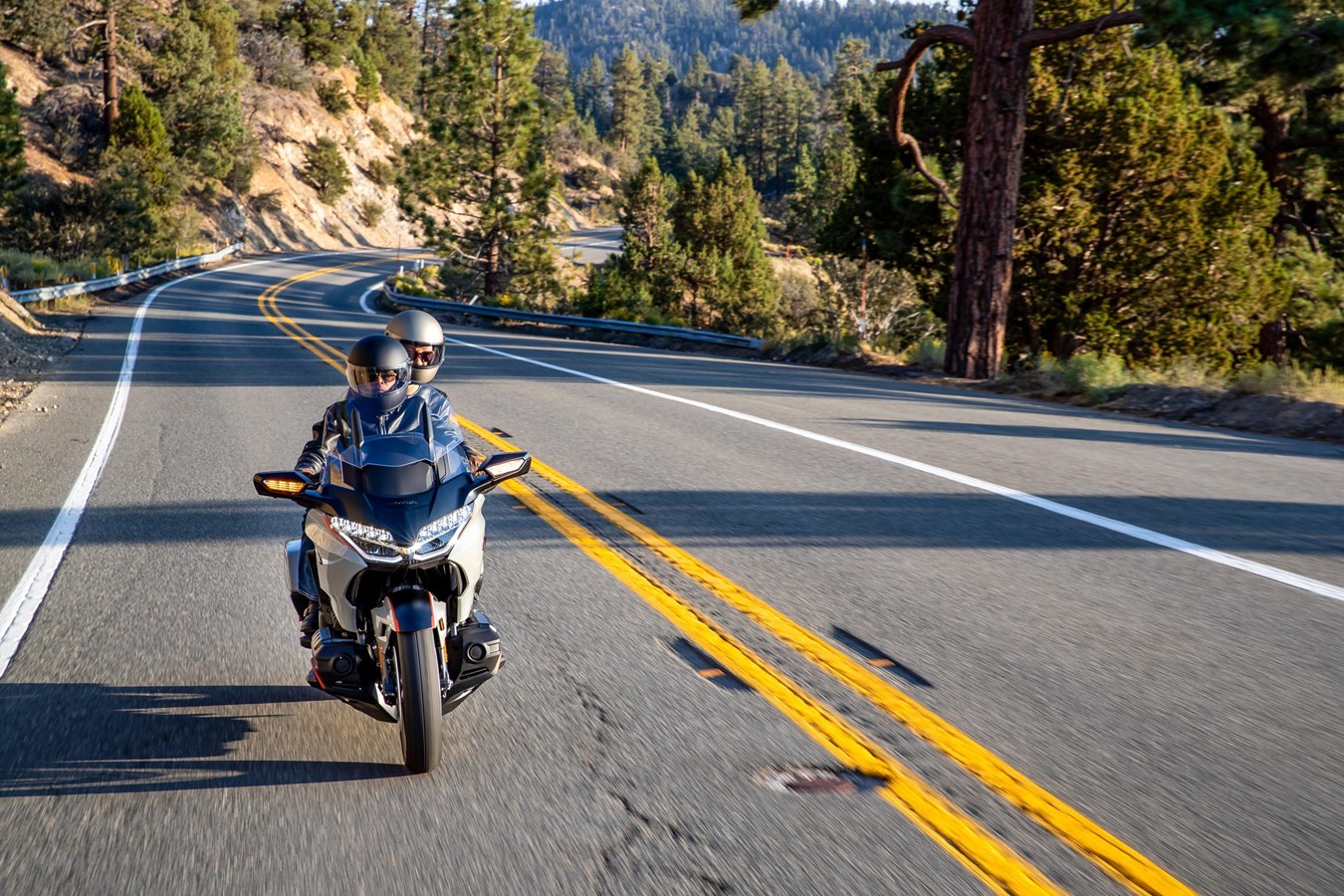
Model updates: The Gold Wing – Honda’s seminal touring flagship – was completely reborn in 2018 with a radical weight reduction, double wishbone front suspension, brand-new, flat six-cylinder engine and 7-speed DCT option; now it rides into 2021 with upgraded audio and speaker quality. Its status as a flagbearer for new technology is well-founded, with cutting edge features ranging from 7-inch TFT screen, gyrocompass navigation, Apple CarPlay™, Android Auto™, electric screen, Smart Key operation, 4 riding modes and Hill Start Assist. A new contemporary paint option also arrives for 2021.
Contents:
1 Introduction
2 Model overview
3 Key features
4.Technical specifications
1. Introduction
The Honda Gold Wing, since its introduction as a naked 1000cc machine in 1975, has always represented the ultimate in two-wheeled travel. And it’s a motorcycle that’s been very much on its own journey, growing in physical size and displacement over the decades, all the while creating an enduring and unrivalled reputation for luxury, quality and comfort.
For 2018, in response to the evolution of demographics and the motorcycle market, it made a radical departure from what would have been a traditional update trajectory. The GL1800 Gold Wing and Gold Wing ‘Tour’* took a new direction and, brand new from the wheels-up, became sleeker, lighter and more agile – very much a rider’s motorcycle – while adding a host of new features to cement its reputation as a technological flagship, including the option of 7-speed Dual Clutch Transmission (DCT).
And, as a result, the Gold Wing’s appeal became instantly broader, reaching out to a younger generation of motorcyclists that may have overlooked – or simply not been aware of – the previous incarnation. In 2020, improvements to suspension and slow speed manoeuvrability further complemented the evocative, flat six-cylinder engine beating at the heart of Honda’s premium tourer.
For 2021, the Gold Wing gains an audio upgrade and head-turning new paint option, further underlining its standalone desirability.
*See separate Gold Wing ‘Tour’ press kit.
2. Model Overview
The Gold Wing’s engine and chassis were designed in unison for the 2018 rebirth, to move the riding position forward and create a much more compact motorcycle. The aluminium beam frame is constructed around a double wishbone front fork, which allows the engine to sit forward in the machine – as the front wheel moves up and down in a more vertical plane – while providing high quality suspension control and front-end stability thanks to its stiffness and reduced friction.
Optimised for size, the 24V flat six-cylinder engine lost none of its power, avalanche of torque or addictive power delivery. The addition of Throttle By Wire (TBW) control brought with it 4 rider modes: TOUR, SPORT, ECON and RAIN; the operation of the Dual Combined Brake System (D-CBS) alters depending on the mode selected. Hill Start Assist (HSA) and (on the DCT option) Idling Stop offer ease of use and improved fuel efficiency.
The manual transmission is 6-speed, while DCT features 7 speeds, with clutch feel, shift speed and rpm range of up/downshifts tailored specifically to each riding mode. It also features a ‘creep’ forward and back function. The manual machine employs the same electric reverse system as featured on previous designs.
The Gold Wing offers a total sense of freedom, with sheer riding enjoyment and performance matched by stylish design. An aerodynamically efficient fairing channels air around the rider, while the electric screen adjusts for preference; the luxurious seats offer all-day comfort. The lightweight audio system and speakers show off newly upgraded sound quality. And features like Smart Key operation, Apple CarPlay™, Android Auto™ and Bluetooth™ provide modern-day convenience and connectivity.
The 2021 GL1800 Gold Wing is available in a contemporary new Pearl Deep Mud Grey colour scheme, with orange accents on the front fender, engine cover, headlight surround, fuel tank and rear section.
3. Key Features
3.1 Styling & Equipment
- Taut lines with a contemporary edge show off the motorcycle underneath
- Electric windscreen adjustable for angle and height
- Cruise control operates smoothly via Throttle By Wire (TBW)
- Ample luggage capacity for weekend touring
- 7-inch TFT display provides riding, navigation and audio information
- Apple CarPlay™ and Android Auto™ allow smartphone use
- Full LED lighting and auto-cancelling indicators
- Smart Key control adds convenience for ignition and luggage
- Two USB Type-C sockets
The Gold Wing’s lines exude a honed, athletic ethos. The styling presents a unique silhouette and counterpoints comfort with the dynamic abilities of chassis and engine, with the traditional Gold Wing premium level of fit, finish and materials. Its ‘face’ is daringly forward-slanting; combined with the compact fairing proportions, it presents an energetic frontal signature.
The key line of the body, stretching front to back, highlights the differing upper and lower bodywork functions. A central element is the fairing, with its sharp and solid flat surfaces, and its nuanced aerodynamic detailing. It adds a tension that hints at the performance potential on offer.
Also on display is the motorcycle itself – the double wishbone front suspension, flat six-cylinder engine, exhausts – in all their functional beauty. Drawn together, the design elements create cutting edge style, underpinned by incredible levels of engineering and electronics
Comfort, heat management and, most importantly, air management are also high on the Gold Wing’s agenda. The fairing channels airflow around the rider and pillion, effectively providing a pleasant cooling breeze.
A small electric screen operated from the left handlebar provides excellent wind protection yet, at the same time, a sense of space and freedom when required. Screen angle and height adjustment is step-less. Available as options are a larger screen, a fully-adjustable deflector for the arms and upper body, and fixed deflectors for the lower legs and feet.
From a seating perspective, rider and pillion are separated. The rider can enjoy a total focus on riding the bike. The rider’s seat shape is comfortable and supportive while allowing movement and easy ground reach.
All lighting is LED. The lower portion of the headlights use 5 polished optical lenses on both sides to create a Jewel-Eye low beam light signature. Using high beam (in the upper portion) creates a stereoscopic impression. The front indicators are housed in the mirrors and the indicators also auto-cancel; the system compares front and rear wheel speed difference and calculates when to cancel the indication relative to the riding situation.
When riding, the speed that’s been set with the cruise control switch (located on the right handlebar) is shown in the bottom left area of the speedometer. Through TBW the system achieves a smooth transition to the specified speed and an ultra-smooth operation, especially when going uphill. In the case of the manual transmission models, squeezing the clutch or brake, or twisting the throttle cancels cruise control.
For the DCT variant (in AT mode) after completing the deceleration with the cruise control system in operation – and resuming the previous speed – the Gold Wing returns to the pre-set with an appropriate shifting schedule.
Luxurious instrumentation creates a unique cockpit. Different low-contrast colours with dark tones are applied to the dials, of which the peripheral areas form cone-shaped slopes to create a feeling of depth. A ring with a metal texture surrounds each dial, and the graduations glow in LED, giving concrete depth and a calm, cool image.
The 7-inch full-colour TFT liquid crystal display screen provides all the information for the audio and navigation systems, as well as the riding modes and suspension adjustment. Information is displayed in differentiated segments in a very functional order, so the rider can get all the relevant data with the minimum of eye movement.
Brightness adjusts automatically (with the maximum luminous intensity of the screen being 1000 cd) and the rider can also choose from 8 brightness levels. Tyre pressure is displayed as a numerical figure in the bottom left area of the instruments.
Pride of place on the centre console and Smart Key is the Gold Wing emblem. Its crisp 3D, two-tone chrome design merges the strength and dignity of a lion’s head with the majestic wings of an eagle ready to pounce with open talons. The Smart Key activates all the motorcycle’s systems and also incorporates the emergency key. The ignition and handlebar lock can be turned on or off while carrying the Smart Key.
Most Gold Wing owners ride short, 2-3 day tours, so the total volume of 60L between both panniers is ample. Exclusively-designed inner bags are available as an option. With the Smart Key present, a simple push of a button opens the panniers. It’s also possible to temporarily unlock via remote control; the unlock button on the Smart Key enables the passenger instant access. Hydraulic dampers smooth the opening and closing. Pushing and holding the call button results in the indicators flashing.
The Gold Wing is compatible with Apple CarPlay™ and Android Auto™, so the rider can utilise the personalised information and content inside their smartphone, such as telephone numbers and music playlists. Bluetooth connectivity has been adopted and there are two USB Type-C sockets to plug in to.
Newly upgraded, lightweight speakers achieve superb sound quality with vivid presence. A passenger audio control switch is available to ensure an even more pleasant riding experience; the switches are located on the upper part of the right pannier and adjusting the volume, switching the source and fast forwarding is possible.
The navigation system is displayed on the 7-inch, full-colour TFT liquid crystal display screen in the central area of the instruments and includes a gyrocompass – which means guidance is continued even inside a tunnel. Cancellation of any waypoint or ‘go home’ instruction operation while riding is also possible. Maps are updated and also offer the possibility of entering up to 99 different waypoints for detailed journey planning.
The capacity of the fuel tank is 21 litres with fuel economy of 5.5 litres/100km.
3.2 Chassis
- Die-cast, aluminium twin-beam frame
- Double wishbone front suspension and Pro-Arm rear
- ABS and Dual-Combined Braking System (D-CBS)
The Gold Wing’s die-cast, aluminium twin-beam frame is designed to package the engine in a tight space; its structural thickness is optimised in each area to deliver a smooth and stable ride, from walking speed upwards, whether on tight city streets or out on the open road.
Aside from moving the front wheel forward under full suspension compression, another benefit of the double wishbone front suspension is the reduction in sliding friction (from bump deflection and steering input) that a standard telescopic fork creates, as the stanchions travel up and down in the fork leg. Bearings are used in all shaft bush areas for steering and suspension stroke, further reducing friction.
The steering input – via the dual fork holders – is also separated from the suspension provided by the single shock absorber, and the Gold Wing’s yaw moment make it nimble and easier to steer. In addition, patented steering cross tie-rods connect the handlebars to the front axle and the handlebar pivot, delivering an entirely natural feel to the rider.
Rake and trail are set at 30.5°/109mm, with wheelbase of 1695mm. The Gold Wing weighs 366kg wet; the DCT version 367kg.
The Dual Combined Brake System (D-CBS) optimally distributes braking forces to the front and rear wheels. The use of a single, light circulation type ABS modulator – integrated with the brake ECU – keeps weight down within the braking system. It also operates in linkage with the current riding mode of choice, automatically adjusting the braking characteristics to the riding situation. Dual 320mm front discs are gripped by 6-piston calipers, the rear 316mm disc by a 3-piston caliper.
The Gold Wing also benefits from a Pro-Arm swingarm, which attaches to the frame on its left side. The right side serves as a maintenance access. This allows much greater freedom of design and makes the machine easier to manage; it also contributes to stability. Pro-Link provides progressive suspension action and comfort while spherical joints are used throughout, cancelling out torsion. The rear preload is manually adjustable.
3.3 Engine
- Horizontally-opposed, flat six-cylinder SOHC 24-valve engine
- Throttle By Wire (TBW) with 4 rider modes to tailor power output
- Riding modes also manage suspension damping and brake force
- Idling Stop and Integrated Starter Generator (ISG) on DCT version
- Hill Start Assist (HSA)
- 6-speed manual gearbox with assist/slipper clutch and electric reverse; 7 speed DCT gearbox
To realise the handling potential of the chassis – and maintain the addictive power delivery and feel that’s so much part of this icon’s appeal – the Gold Wing’s 1,833cc engine was completely redrawn. Still as a horizontally-opposed flat six, but with four valves per cylinder rather than two, much more compact in size and 6.2kg lighter.
Peak power of 93kW arrives @ 5,500rpm, with peak torque of 170Nm delivered @ 4,500rpm. The bore size of 73mm matches the stroke of 73mm; the left and right cylinders are offset 4mm and the cylinder sleeves are aluminium. Compression ratio is set at 10.5:1.
The Unicam cylinder heads – the inlet valves are operated by finger-follower rocker arm, the exhaust valves by roller rocker arms – also employ a co-axial rocker-arm shaft for both inlet and exhaust.
The combustion chambers are a 4-valve ‘pentroof’ design with the inlet ports designed to promote ‘tumble’ flows inside the cylinders thus improving efficiency. The piston skirts wear a molybdenum coating to reduce friction. Throttle By Wire (TBW) engine management adds 4 rider modes to alter character and power delivery, linked to suspension damping and the Dual Combined Brake System (D-CBS):
TOUR mode is the base setting for comfort and power. It gives a direct 100% opening ratio between throttle grip and throttle body butterfly, with ‘default’ damping and front/rear brake force distribution.
SPORT serves up the highest throttle to butterfly ratio and delivers strong acceleration, with firmer damping and rear brake lever pressure.
ECON mode offers maximum fuel economy and easy cruising, with lower throttle to butterfly ratio and default damping and brake force.
RAIN turns the dial down to suit wet and slippery conditions, with lowest throttle to butterfly ratio, default braking force distribution and soft suspension damping.
There are two air intake ducts sited front left and right rear. This structure generates swirling as the air is drawn in – the result is more effective use of the air filter’s entire surface area and reduction in resistance. The internal shaping of both ducts is optimised to align with the intake pulses of the engine’s low-rpm range, improving response and torque from smaller throttle openings. A single throttle body speeds up airflow and improves response.
To complement the engine’s deep bass signature the exhausts emit a powerful throb, without excessive noise. The cross-sectional areas of the exhaust pipes for two out of the six cylinders are reduced 20%, bringing the sound volume and depth.
The ISG (Integrated Starter Generator) combines the generator and starter motor into one component, with the generator effectively becoming the starter motor when supplied with reverse power. It’s 2.4 kg lighter than a standard system. Helical gears are employed for the ISG driving gears, reducing mechanical noise.
Key characteristics of Idling Stop (on the DCT option) are the ultra-quiet start-up of the engine thanks to the use of ISG, and the smooth starting feeling achieved through a combination of DCT and TBW control. When stopping at a traffic light with Idling Stop on, the engine automatically stops after 3 seconds and, when restarting, the rider only needs to turn the throttle, which immediately starts the engine.
The system is controlled so that hydraulic oil pressure is applied in advance to the DCT line that activates the clutch when the engine starts, so the time lag from when the rider opens the throttle to movement is reduced. To curb any abruptness the TBW makes the throttle butterfly open gradually following the throttle opening – thus the smooth acceleration befitting of a Gold Wing. Idling Stop can be turned ON or OFF from the right handlebar switch.
Hill starts on a conventional motorcycle involve simultaneously releasing the brakes, opening the throttle and engaging the clutch according to the grade of the slope. To ease this effort, the Gold Wing has Hill Start Assist (HSA) on both Manual and DCT versions.
After stopping on a slope, further squeezing the brake lever quickly results in the ABS modulator generating hydraulic pressure for the rear brake caliper. When setting off – even when the brake lever is released – the hydraulic pressure temporarily retains braking force (for about 3 seconds) so starting on the uphill slope with the throttle is possible. When in operation, the HSA indicator is switched on to inform the rider.
The 6-speed manual gearbox is also fitted with a ‘cam damper’ between the clutch and transmission, separating each inertial mass, reducing noise and improving shift quality/durability. A cam assist and slipper clutch (with fewer discs and reduced hydraulic friction in the release mechanism) replace the traditional hydraulic assist clutch. This reduces clutch load at the lever by 20% and also smooths downshifts; the slipper mechanism also contributes to the high-quality downshift feel. An electric reverse is a familiar feature from the previous design.
4. Dual Clutch Transmission (DCT)
- Third-generation 7-speed DCT
- Smooth and quiet, with ultra-fast shifting
- Walking mode allows machine to ‘creep’ forward or back
- The 4 riding modes also manage DCT for optimised response
- Optimised low speed manoeuvrability
Honda’s DCT technology is now in its eleventh year of production, and over 140,000 units of DCT-equipped Honda two-wheelers have been sold in Europe. It delivers consistent, seamless gear changes up or down and very quickly becomes second nature in use. It uses two clutches: one for start-up and 1st, 3rd and 5th, the other for 2nd, 4th and 6th, with the mainshaft for each clutch located inside the other for compact packaging.
Each clutch is independently controlled by its own electro-hydraulic circuit. When a gear change occurs, the system pre-selects the target gear using the clutch not currently in use. The first clutch is then electronically disengaged as, simultaneously, the second clutch engages.
The result is a consistent, fast and seamless gear change. Furthermore, as the twin clutches transfer drive from one gear to the next with minimal interruption of the drive to the rear wheel, any gear change shock and pitching of the machine is minimised, making the change feel direct as well as smooth. Extra benefits include durability (as the gears cannot be damaged by missing a gear) impossibility of stalling, low stress urban riding, reduced rider fatigue and increased ability to focus on riding lines, braking and acceleration points.
The DCT system offers two distinct riding approaches – the Automatic settings, with pre-programmed shift patterns which constantly read vehicle speed, gear selected and engine rpm to decide when a shift should occur, and the Manual Transmission setting for gear changes using the paddle-shift style triggers on the left handlebar.
Employing the third generation – and the first to have 7-speeds – the Gold Wing’s DCT is specifically designed for long-distance cruising; it’s also extremely smooth and fast shifting.
It is also optimised for low speed manoeuvrability, with close ratios reducing shift-shock. In the higher speed range, they are set wider apart to reduce engine rpm. In both speed ranges comfort is improved as shifting up or down is of the highest quality.
Shift noise and shock were addressed throughout the development of the third generation, with noise damper rubbers on both ends of the fork guide and the master arm greatly reducing any impact sound during gear changes.
A spring damper is installed between the clutch and the main shaft in order to absorb the torque in the rotational direction, thus reducing the noise and shock of the contact between the clutch and main shaft when shifting gears.
The Gold Wing’s DCT features a 1.8km/h forward Walking Mode with reverse of 1.2km/h, operated instantly from a +/- switch on the left handlebar.
The main shaft has a double tube structure, with the outer main shaft (connected with the even-number gears) linked to the inner shaft with a chain, by way of the gears on the counter shaft. This structure gives the outer main shaft the role of the reverse idle shaft, which has resulted in a lightweight reverse mechanism with a compact structure – with no need for any reverse idle shaft.
When activating Walking Mode the two clutches of DCT are utilised to enable moving backward with clutch #1 and moving forward with clutch #2. In this way, moving forward or backward at walking speed is now possible with only clutch control, without any need for gear shifting. Furthermore, the throttle-by-wire system controls speed by minutely controlling the clutch capacity, while maintaining a certain engine speed, assuring controllability with a sense of security in wide-ranging situations.
The 4 riding modes are interleaved with DCT. All share the same engine character, delivery and suspension settings as the MT model but add extra DCT-specific parameters:
TOUR uses the default setting for smooth clutch engagement and gearshifts in AT mode, with a low-to-high rpm range for gear shifts.
SPORT deploys a more direct clutch engagement, with gear shifts programmed in a mid-to-high rev range.
ECON has a soft clutch engagement, with low-to-mid rpm gear hold and default shifting feel.
RAIN also operates a soft clutch, low-to-high rpm gear hold range and slower shifting in AT mode.
- Technical Specifications
|
ENGINE |
|
|
Type |
Liquid-cooled 4-stroke 24 valve SOHC flat-6 |
|
Displacement |
1,833cc |
|
Valves per cylinder |
4 |
|
Bore x Stroke |
73mm x 73mm |
|
Compression Ratio |
10.5:1 |
|
Max. Power Output |
93kW/5,500rpm |
|
Max. Torque |
170Nm/4,500rpm |
|
Oil Capacity |
4.4 litres (MT) / 5.6 litres (DCT) |
|
CO2 emissions |
127g/km |
|
FUEL SYSTEM |
|
|
Carburation |
PGM-FI electronic fuel injection |
|
Throttle Bore |
50mm |
|
Air cleaner |
Viscous, cartridge type paper filter |
|
Fuel Tank Capacity |
21.1 litres |
|
Fuel Consumption |
5.5 litres/100km |
|
ELECTRICAL SYSTEM |
|
|
Starter |
Integrated Starter Generator system |
|
Battery Capacity |
12V/20AH |
|
ACG Power Generation Capacity |
12V/120A |
|
DRIVETRAIN |
|
|
Clutch Type |
(MT) Hydraulic, wet, multiplate with coil springs, assist slipper cam (DCT) Hydraulic, wet, multiplate with oil pressure |
|
Transmission Type |
6 speed MT (including overdrive. Plus electric reverse) 7-speed forward and reverse DCT |
|
Primary Reduction |
1.795 (79/44) |
|
Gear Ratios |
(DCT) 1st: 2.167 2nd: 1.696 3rd: 1.304 4th: 1.038 5th: 0.821 6th: 0.667 7th: 0.522 Rev: 1.190 (MT) 1st: 2.200 2nd: 1.417 3rd: 1.036 4th: 0.821 5th: 0.667 6th: 0.522 |
|
Final Reduction |
Engine side 0.972 Rear Wheel side 2.615 |
|
Final Drive |
Enclosed shaft |
|
FRAME |
|
|
Type |
Aluminium die-cast, twin tube |
|
CHASSIS |
|
|
Dimensions (L´W´H) |
L: 2,475mm W: 925mm (DCT) / 905mm (MT) H: 1,340mm |
|
Wheelbase |
1,695mm |
|
Caster Angle |
30.5° |
|
Trail |
109mm |
|
Turning radius |
3.4m |
|
Seat Height |
745mm |
|
Ground Clearance |
130mm |
|
Kerb Weight |
MT: 366kg / DCT: 367kg
|
|
SUSPENSION |
|
|
Type Front |
Double Wishbone |
|
Type Rear |
Pro Link |
|
WHEELS |
|
|
Type Front |
130/70R 18 |
|
Type Rear |
200/55R 16 |
|
Rim Size Front |
18 x MT3.5 |
|
Rim Size Rear |
16 x MT6.0 |
|
BRAKES |
|
|
System Type |
Electronically-controlled combined ABS system |
|
Type Front |
320mm x 4.5mm dual hydraulic disc with 6-piston calliper, floating rotors and sintered metal pads |
|
Type Rear |
316mm x 11mm ventilated disc with 3-piston calliper and sintered metal pads |
All specifications are provisional and subject to change without notice.
** Please note that the figures provided are results obtained by Honda under standardised testing conditions prescribed by WMTC. Tests are conducted on a rolling road using a standard version of the vehicle with only one rider and no additional optional equipment. Actual fuel consumption may vary depending on how you ride, how you maintain your vehicle, weather, road conditions, tire pressure, installation of accessories, cargo, rider and passenger weight, and other factors.
21YM HONDA GL1800 GOLD WING TOUR
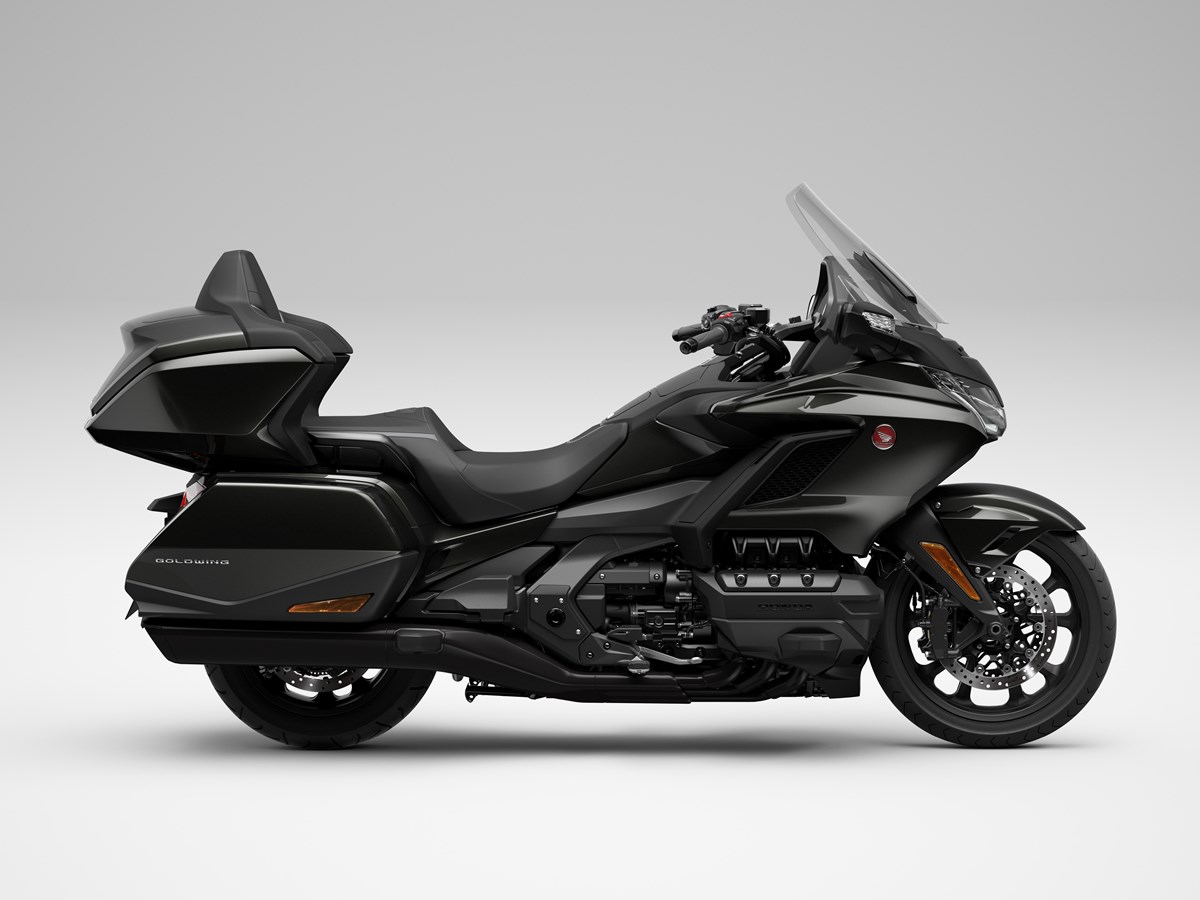
Model updates: Honda’s luxurious Gold Wing ‘Tour’ – a flagship completely reborn in 2018 – with radical weight reduction, double wishbone front suspension, brand-new, flat six-cylinder engine and 7-speed Dual Clutch Transmission option, glides into 2021 featuring more luggage capacity, a more relaxed pillion position, new seat material and upgraded audio quality. The comprehensive spec sheet includes 7-inch TFT screen, gyrocompass navigation, Apple CarPlay™, Android Auto™, electric screen, Smart Key operation, 4 riding modes, HSTC and Hill Start Assist – underlining its status as a flagbearer for new technology.
Contents:
1 Introduction
2 Model overview
3 Key features
4.Technical specifications
- Introduction
The Honda Gold Wing, since its introduction as a naked 1000cc machine in 1975, has always represented the ultimate in two-wheeled travel. And it’s a motorcycle that’s been very much on its own journey, growing in physical size and displacement over the decades, all the while creating an enduring and unrivalled reputation for luxury, quality and comfort.
For 2018, in response to the evolution of demographics and the motorcycle market, it made a radical departure from what would have been a traditional update trajectory. The GL1800 Gold Wing* and Gold Wing ‘Tour’ took a new direction and, brand new from the wheels-up, became sleeker, lighter and more agile – very much a rider’s motorcycle – while adding a host of new features to cement the Gold Wing’s reputation as a technological flagship, including the option of 7-speed Dual Clutch Transmission (DCT).
And, as a result, the Gold Wing Tour’s appeal became instantly broader, reaching out to a younger generation of motorcyclists that may have overlooked – or simply not been aware of – the previous incarnation. In 2020, standard-fit LED fog lights, larger pillion grab handles plus improvements to suspension and slow speed manoeuvrability further complemented the evocative, flat six-cylinder engine beating at the heart of Honda’s premium tourer.
For 2021, the Gold Wing Tour gains carrying capacity, improved pillion comfort and an audio upgrade, further cementing its standalone desirability.
*See separate Gold Wing press kit.
2. Model Overview
The Gold Wing Tour’s engine and chassis were designed in unison for the 2018 rebirth, to move the riding position forward and create a much more compact motorcycle. The aluminium beam frame is constructed around a double wishbone front fork, which allows the engine to sit forward in the machine – as the front wheel moves up and down in a more vertical plane – while providing high quality suspension control and front-end stability thanks to its stiffness and reduced friction. Suspension damping adjusts electrically.
Optimised for size, the 24V flat six-cylinder engine lost none of its power, avalanche of torque or addictive power delivery. The addition of Throttle By Wire (TBW) control brought with it 4 rider modes: TOUR, SPORT, ECON and RAIN; the operation of the Dual Combined Brake System (D-CBS) alters depending on the mode selected. Hill Start Assist (HSA) and Idling Stop (on the DCT option) offer ease of use and improved fuel efficiency. Honda Selectable Torque Control (HSTC) maintains rear wheel traction.
The manual transmission is 6-speed, while DCT features 7-speeds, with clutch feel, shift speed and rpm range of up/downshifts tailored specifically to each riding mode. It also features a ‘creep’ forward and back function. The manual machine employs the same electric reverse system as featured on previous designs.
The Gold Wing Tour offers a total sense of freedom, with sheer riding enjoyment and performance matched by stylish design. An aerodynamically efficient fairing channels air around the rider, while the extended electric screen adjusts for preference; the seats, too provide all-day comfort and, for 2021 feature a new suede/synthetic leather cover. The angle of the pillion back rest is also more relaxed. Upgraded, speakers show off vivid sound quality. And features like Smart Key operation, Apple CarPlay™, Android Auto™ and Bluetooth™ add modern-day convenience and connectivity.
The 2021 GL1800 Gold Wing Tour is available in the following colour options:
- Gunmetal Black Metallic
- Candy Ardent Red (available with DCT only)
3. Key Features
3.1 Styling & Equipment
- Taut lines with a contemporary edge show off the motorcycle underneath
- Ample luggage capacity for weekend touring; top box grows to 61L
- New suede/synthetic leather seats, more relaxed pillion back rest angle
- Upgraded audio quality
- Electric windscreen adjustable for angle and height
- Cruise control operates smoothly via Throttle By Wire (TBW)
- 7-inch TFT display provides riding, navigation and audio information
- Apple CarPlay™ and Android Auto™ allow smartphone use
- Full LED lighting, LED fog lights and auto-cancelling indicators
- Smart Key control adds convenience for ignition and luggage
- Two USB Type-C sockets
The Gold Wing Tour’s lines exude a honed, athletic ethos. The styling presents a unique silhouette and counterpoints comfort with the dynamic abilities of chassis and engine, with the traditional Gold Wing premium level of fit, finish and materials. Its ‘face’ is daringly forward-slanting; combined with the compact fairing proportions, it presents an energetic frontal signature.
The key line of the body, stretching front to back, highlights the differing upper and lower bodywork functions. A central element is the fairing, with its sharp and solid flat surfaces, and its nuanced aerodynamic detailing. It adds a tension that hints at the performance potential on offer.
Also on display is the motorcycle itself – the double wishbone front suspension, flat six-cylinder engine, exhausts – in all their functional beauty. Drawn together, the design elements create cutting edge style, underpinned by incredible levels of engineering and electronics
Comfort, heat management and, most importantly, air management are also high on the Gold Wing Tour’s agenda. The fairing channels airflow around the rider and pillion, effectively providing a pleasant cooling breeze.
An extended electric screen operated from the left handlebar provides excellent wind protection yet, at the same time, a sense of space and freedom when required. Screen angle and height adjustment is step-less. Available as options are a larger screen, a fully-adjustable deflector for the arms and upper body and fixed deflectors for the lower legs and feet.
From a seating perspective, rider and pillion are separated. The rider can enjoy a total focus on riding the bike. The rider’s seat shape is comfortable and supportive while allowing movement and easy ground reach. Both rider and pillion now benefit from a luxurious new suede/synthetic leather seat cover; the angle of the pillion back rest also relaxes, from 16° to 23°.
All lighting is LED and the Gold Wing Tour is equipped with dual LED fog lights. The lower portion of the headlights use 5 polished optical lenses on both sides to create a Jewel-Eye low beam light signature. Using high beam (in the upper portion) creates a stereoscopic impression. The front indicators are housed in the mirrors and the indicators also auto-cancel; the system compares front and rear wheel speed difference and calculates when to cancel the indication relative to the riding situation.
When riding, the speed that’s been set with the cruise control switch (located on the right handlebar) is shown in the bottom left area of the speedometer. Through TBW the system achieves a smooth transition to the specified speed and an ultra-smooth operation, especially when going uphill. In the case of the manual transmission models, squeezing the clutch or brake, or twisting the throttle cancels cruise control.
For the DCT variant (in AT mode) after completing the deceleration with the cruise control system in operation – and resuming the previous speed – the Gold Wing returns to the pre-set with an appropriate shifting schedule.
Luxurious instrumentation creates a unique cockpit. Different low-contrast colours with dark tones are applied to the dials, of which the peripheral areas form cone-shaped slopes to create a feeling of depth. A ring with a metal texture surrounds each dial, and the graduations glow in LED, giving concrete depth and a calm, cool image.
The 7-inch full-colour TFT liquid crystal display screen provides all the information for the audio and navigation systems, as well as managing riding modes and suspension adjustment. Information is displayed in differentiated segments in a very functional order, so the rider can get all the relevant data with the minimum of eye movement.
Brightness adjusts automatically (with the maximum luminous intensity of the screen being 1000 cd) and the rider can also choose from 8 brightness levels. Tyre pressure is displayed as a numerical figure in the bottom left area of the instruments.
Pride of place – on the centre console and Smart Key – is the Gold Wing emblem. Its crisp 3D, two-tone chrome design merges the strength and dignity of a lion’s head with the majestic wings of an eagle ready to pounce with open talons. It activates all the motorcycle’s systems and also incorporates the emergency key. The ignition and handlebar lock can be turned on or off while just carrying the Smart Key.
For 2021, an additional 11L for the rear top box brings total capacity to 121L. Exclusively- designed inner bags are available as an option. Luggage operation is simple. With the Smart Key present, a push button opens all of the boxes. It’s also possible to temporarily unlock via remote control; the unlock button on the Smart Key enables the passenger instant pannier access. Hydraulic dampers smooth the opening and closing. Pushing and holding the call button results in the indicators flashing.
The Gold Wing Tour is compatible with Apple CarPlay™ and Android Auto™, so the rider can utilise the personalised information and content inside their smartphone, such as telephone numbers and music playlists. Bluetooth connectivity has been adopted and there are two USB Type-C sockets to plug in to.
Newly upgraded, lightweight speakers achieve superb sound quality with vivid presence. A passenger audio control switch is available to ensure an even more pleasant riding experience; the switches are located on the upper part of the right pannier and adjusting the volume, switching the source and fast forwarding is possible.
The navigation system is displayed on the 7-inch, full-colour TFT liquid crystal display screen in the central area of the instruments and includes a gyrocompass – which means guidance is continued even inside a tunnel. Cancellation of any waypoint or ‘go home’ instruction operation while riding is also possible. Maps are updated and also offer the possibility of entering up to 99 different waypoints for detailed journey planning.
The capacity of the fuel tank is 21 litres with fuel economy of 5.5 litres/100km.
3.2 Chassis
- Die-cast, aluminium twin-beam frame
- Double wishbone front suspension and Pro-Arm rear
- Front and rear damping level adjusts to suit riding mode selected
- Rear spring preload electrically adjustable
- ABS and Dual-Combined Braking System (D-CBS)
The Gold Wing Tour’s die-cast, aluminium twin-beam frame is designed to package the engine in a tight space; its structural thickness is optimised in each area to deliver a smooth and stable ride, from walking speed upwards, whether on tight city streets or out on the open road.
Aside from moving the front wheel forward under full suspension compression, another benefit of the double wishbone front suspension is the reduction in sliding friction (from bump deflection and steering input) that a standard telescopic fork creates, as the stanchions travel up and down in the fork leg. Bearings are used in all shaft bush areas for steering and suspension stroke, further reducing friction.
The steering input – via the dual fork holders – is also separated from the suspension provided by the single shock absorber, and the Gold Wing Tour’s yaw moment make it nimble and easier to steer. In addition, patented steering cross tie-rods connect the handlebars to the front axle and the handlebar pivot, delivering an entirely natural feel to the rider.
Rake and trail are set at 30.5°/109mm, with wheelbase of 1695mm. The Gold Wing Tour weighs 385kg wet; the DCT version 390kg.
The Dual Combined Brake System (D-CBS) optimally distributes braking forces to the front and rear wheels. The use of a single, light circulation type ABS modulator – integrated with the brake ECU – keeps weight down within the braking system. It also operates in linkage with the current riding mode of choice, automatically adjusting the braking characteristics to the riding situation. Dual 320mm front discs are gripped by 6-piston calipers, the rear 316mm disc by a 3-piston caliper.
The Gold Wing Tour also benefits from a Pro-Arm swingarm, which attaches to the frame on its left side. The right side serves as a maintenance access. This allows much greater freedom of design and makes the machine easier to manage; it also contributes to stability. Pro-Link provides progressive suspension action and comfort while spherical joints are used throughout, cancelling out torsion.
Damping level adjusts electrically relative to riding mode. Stepper motors housed within the front and rear shock absorbers move needles to control oil flow, tailoring damping force for the riding situation. Rear spring preload is also electrically adjusted. Separate from the 4 riding modes, there are 4 settings of preload relative to load from soft to hard: single rider; rider with luggage; rider with pillion, and rider with pillion fully loaded with luggage. The setting is displayed on the TFT screen and adjusted via switch.
3.3 Engine
- Horizontally-opposed, flat six-cylinder SOHC 24-valve engine
- Throttle By Wire (TBW) with 4 rider modes to tailor power output
- Honda Selectable Torque Control (HSTC)
- Riding modes also manage HSTC, suspension damping and brake force
- Idling Stop and Integrated Starter Generator (ISG) on DCT version
- Hill Start Assist (HSA)
- 6-speed manual gearbox with assist/slipper clutch and electric reverse
To realise the handling potential of the chassis – and maintain the addictive power delivery and feel that’s so much part of this icon’s appeal – the Gold Wing Tour’s 1,833cc engine was completely redrawn. Still as a horizontally-opposed flat six, but with four valves per cylinder rather than two, much more compact in size and 6.2kg lighter.
Peak power of 93kW arrives @ 5,500rpm, with peak torque of 170Nm delivered @ 4,500rpm. The bore size of 73mm matches the stroke of 73mm; the left and right cylinders are offset 4mm and the cylinder sleeves are aluminium. Compression ratio is set at 10.5:1.
The Unicam cylinder heads – the inlet valves are operated by finger-follower rocker arm, the exhaust valves by roller rocker arms – also employ a co-axial rocker-arm shaft for both inlet and exhaust.
The combustion chambers are a 4-valve ‘pentroof’ design with the inlet ports designed to promote ‘tumble’ flows inside the cylinders thus improving efficiency. The piston skirts wear a molybdenum coating to reduce friction. Throttle By Wire (TBW) engine management adds 4 rider modes to alter character and power delivery, linked to suspension damping and the Dual Combined Brake System (D-CBS):
TOUR mode is the base setting for comfort and power. It gives a direct 100% opening ratio between throttle grip and throttle body butterfly, with ‘default’ damping and front/rear brake force distribution.
SPORT serves up the highest throttle to butterfly ratio and delivers strong acceleration, with firmer damping and rear brake lever pressure.
ECON mode offers maximum fuel economy and easy cruising, with lower throttle to butterfly ratio and default damping and brake force.
RAIN turns the dial down to suit wet and slippery conditions, with lowest throttle to butterfly ratio, default braking force distribution and soft suspension damping.
Honda Selectable Torque Control (HSTC) also seamlessly monitors and maintains rear wheel traction, in all riding conditions, for an extra layer of riding confidence. Its level of input, too adjusts via TBW relative to riding mode selection.
There are two air intake ducts sited front left and right rear. This structure generates swirling as the air is drawn in – the result is more effective use of the air filter’s entire surface area and reduction in resistance. The internal shaping of both ducts is optimised to align with the intake pulses of the engine’s low-rpm range, improving response and torque from smaller throttle openings. A single throttle body speeds up airflow and improves response.
To complement the engine’s deep bass signature the exhausts emit a powerful throb, without excessive noise. The cross-sectional areas of the exhaust pipes for two out of the six cylinders are reduced 20%, bringing the sound volume and depth.
The ISG (Integrated Starter Generator) combines the generator and starter motor into one component, with the generator effectively becoming the starter motor when supplied with reverse power. Its 2.4 kg lighter than a standard system. Helical gears are employed for the ISG driving gears, reducing mechanical noise.
Key characteristics of Idling Stop (on the DCT option) are the ultra-quiet start-up of the engine thanks to the use of ISG, and the smooth starting feeling achieved through a combination of DCT and TBW control. When stopping at a traffic light with Idling Stop on, the engine automatically stops after 3 seconds and, when restarting, the rider only needs to turn the throttle, which immediately starts the engine.
The system is controlled so that hydraulic oil pressure is applied in advance to the DCT line that activates the clutch when the engine starts, so the time lag from when the rider opens the throttle to movement is reduced. To curb any abruptness the TBW makes the throttle butterfly open gradually following the throttle opening – thus the smooth acceleration befitting of a Gold Wing Tour. Idling Stop can be turned ON or OFF from the right handlebar switch.
Hill starts on a conventional motorcycle often involve simultaneously releasing the brakes, opening the throttle and engaging the clutch according to the grade of the slope. To ease this effort, the Gold Wing Tour has Hill Start Assist (HSA) on both Manual and DCT versions.
After stopping on a slope, further squeezing the brake lever quickly results in the ABS modulator generating hydraulic pressure for the rear brake caliper. When setting off – even when the brake lever is released – the hydraulic pressure temporarily retains braking force (for about 3 seconds) so starting on the uphill slope with the throttle is possible. When in operation, the HSA indicator is switched on to inform the rider.
The 6-speed manual gearbox is also fitted with a ‘cam damper’ between the clutch and transmission, separating each inertial mass, reducing noise and improving shift quality/durability. A cam assist and slipper clutch (with fewer discs and reduced hydraulic friction in the release mechanism) replace the traditional hydraulic assist clutch. This reduces clutch load at the lever by 20% and also smooths downshifts; the slipper mechanism also contributes to the high-quality downshift feel. An electric reverse is a familiar feature from the previous design.
3.4. Dual Clutch Transmission (DCT)
- Third-generation 7-speed DCT
- Smoother, quieter with faster upshifts and downshifts
- Walking mode allows machine to ‘creep’ forward or back
- The 4 riding modes also manage DCT for optimised response
- Optimised low speed manoeuvrability for 2020
Honda’s DCT technology is now in its eleventh year of production, and over 140,000 units of DCT-equipped Honda two-wheelers have been sold in Europe. It delivers consistent, seamless gear changes up or down and very quickly becomes second nature in use. It uses two clutches: one for start-up and 1st, 3rd and 5th, the other for 2nd, 4th and 6th, with the mainshaft for each clutch located inside the other for compact packaging.
Each clutch is independently controlled by its own electro-hydraulic circuit. When a gear change occurs, the system pre-selects the target gear using the clutch not currently in use. The first clutch is then electronically disengaged as, simultaneously, the second clutch engages.
The result is a consistent, fast and seamless gear change. Furthermore, as the twin clutches transfer drive from one gear to the next with minimal interruption of the drive to the rear wheel, any gear change shock and pitching of the machine is minimised, making the change feel direct as well as smooth. Extra benefits include durability (as the gears cannot be damaged by missing a gear) impossibility of stalling, low stress urban riding, reduced rider fatigue and increased ability to focus on riding lines, braking and acceleration points.
The DCT system offers two distinct riding approaches – the Automatic settings, with pre-programmed shift patterns which constantly read vehicle speed, gear selected and engine rpm to decide when a shift should occur, and the Manual Transmission setting for gear changes using the paddle-shift style triggers on the left handlebar.
Employing the third generation – and the first to have 7-speeds – the Gold Wing’s DCT is specifically designed for long-distance cruising; it’s also extremely smooth and fast shifting.
It is also optimised for low speed manoeuvrability, with close ratios reducing shift-shock. In the higher speed range, they are set wider apart to reduce engine rpm. In both speed ranges comfort is improved as shifting up or down is of the highest quality.
Shift noise and shock were addressed throughout the development of the third generation, with noise damper rubbers on both ends of the fork guide and the master arm greatly reducing any impact sound during gear changes.
A spring damper is installed between the clutch and the main shaft in order to absorb the torque in the rotational direction, thus reducing the noise and shock of the contact between the clutch and main shaft when shifting gears.
The Gold Wing’s DCT features a 1.8km/h forward Walking Mode with reverse of 1.2km/h, operated instantly from a +/- switch on the left handlebar.
The main shaft has a double tube structure, with the outer main shaft (connected with the even-number gears) linked to the inner shaft with a chain, by way of the gears on the counter shaft. This structure gives the outer main shaft the role of the reverse idle shaft, which has resulted in a lightweight reverse mechanism with a compact structure – with no need for any reverse idle shaft.
When activating Walking Mode the two clutches of DCT are utilised to enable moving backward with clutch #1 and moving forward with clutch #2. In this way, moving forward or backward at walking speed is now possible with only clutch control, without any need for gear shifting. Furthermore, the throttle-by-wire system controls speed by minutely controlling the clutch capacity, while maintaining a certain engine speed, assuring controllability with a sense of security in wide-ranging situations.
The 4 riding modes are interleaved with DCT. All share the same engine character, delivery and suspension settings as the MT model but add extra DCT-specific parameters:
TOUR uses the default setting for smooth clutch engagement and gearshifts in AT mode, with a low-to-high rpm range for gear shifts.
SPORT deploys a more direct clutch engagement, with gear shifts programmed in a mid-to-high rev range.
ECON has a soft clutch engagement, with low-to-mid rpm gear hold and default shifting feel.
RAIN also operates a soft clutch, low-to-high rpm gear hold range and slower shifting in AT mode.
- Technical Specifications
|
ENGINE |
|
|
Type |
Liquid-cooled 4-stroke 24 valve SOHC flat-6 |
|
Displacement |
1,833cc |
|
Valves per cylinder |
4 |
|
Bore x Stroke |
73mm x 73mm |
|
Compression Ratio |
10.5:1 |
|
Max. Power Output |
93kW/5,500rpm |
|
Max. Torque |
170Nm/4,500rpm |
|
Oil Capacity |
4.4 litres (MT) / 5.6 litres (DCT) |
|
CO2 emissions |
127g/km |
|
FUEL SYSTEM |
|
|
Carburation |
PGM-FI electronic fuel injection |
|
Throttle Bore |
50mm |
|
Air cleaner |
Viscous, cartridge type paper filter |
|
Fuel Tank Capacity |
21.1 litres |
|
Fuel Consumption |
5.5 litres/100km |
|
ELECTRICAL SYSTEM |
|
|
Starter |
Integrated Starter Generator system |
|
Battery Capacity |
12V/20AH |
|
ACG Power Generation Capacity |
12V/120A |
|
DRIVETRAIN |
|
|
Clutch Type |
(MT) Hydraulic, wet, multiplate with coil springs, assist slipper cam (DCT) Hydraulic, wet, multiplate with oil pressure |
|
Transmission Type |
6 speed MT (including overdrive. Plus electric reverse) 7-speed forward and reverse DCT |
|
Primary Reduction |
1.795 (79/44) |
|
Gear Ratios |
(DCT) 1st: 2.167 2nd: 1.696 3rd: 1.304 4th: 1.038 5th: 0.821 6th: 0.667 7th: 0.522 Rev: 1.190 (MT) 1st: 2.200 2nd: 1.417 3rd: 1.036 4th: 0.821 5th: 0.667 6th: 0.522 |
|
Final Reduction |
Engine side 0.972 Rear Wheel side 2.615 |
|
Final Drive |
Enclosed shaft |
|
FRAME |
|
|
Type |
Aluminum die-cast, twin tube |
|
CHASSIS |
|
|
Dimensions (L´W´H) |
L: 2,615mm W: DCT 905mm / MT 925mm H: 1,430mm |
|
Wheelbase |
1,695mm |
|
Caster Angle |
30.5° |
|
Trail |
109mm |
|
Turning radius |
3.4m |
|
Seat Height |
745mm |
|
Ground Clearance |
130mm |
|
Kerb Weight |
MT: 385kg DCT with Air Bag: 390kg |
|
SUSPENSION |
|
|
Type Front |
Double Wishbone |
|
Type Rear |
Pro Link |
|
WHEELS |
|
|
Type Front |
130/70R 18 |
|
Type Rear |
200/55R 16 |
|
Rim Size Front |
18 x MT3.5 |
|
Rim Size Rear |
16 x MT6.0 |
|
BRAKES |
|
|
System Type |
Electronically-controlled combined ABS system |
|
Type Front |
320mm x 4.5mm dual hydraulic disc with 6-piston calliper, floating rotors and sintered metal pads |
|
Type Rear |
316mm x 11mm ventilated disc with 3-piston calliper and sintered metal pads |
All specifications are provisional and subject to change without notice.
** Please note that the figures provided are results obtained by Honda under standardised testing conditions prescribed by WMTC. Tests are conducted on a rolling road using a standard version of the vehicle with only one rider and no additional optional equipment. Actual fuel consumption may vary depending on how you ride, how you maintain your vehicle, weather, road conditions, tire pressure, installation of accessories, cargo, rider and passenger weight, and other factors.
HONDA COMPLETES ITS COMPREHENSIVE 2021 MODEL LINE-UP WITH UPDATES TO GL1800 GOLD WING AND GOLD WING ‘TOUR’
- Upgrades to audio system for both
- Contemporary new colour scheme for the Gold Wing
- For the ‘Tour’, enhanced long distance practicality and comfort
- Honda’s comprehensive 2021 line-up now complete
- 24 new or revised models ranging from the urban commuter Vision 110 through to the ultimate touring luxury of the Gold Wing
Honda welcomes 2021 with news of updates to its seminal touring flagship, the GL1800 Gold Wing.
The Gold Wing was redrawn from the ground up for 2018, becoming much lighter, sleeker and more agile, while still benefitting from the avalanche of torque provided by a monumental flat six-cylinder 1800cc engine, and adding a host of new features to cement its reputation as a technological flagship, including the option of 7-speed Dual Clutch Transmission.
For 2021 both the Gold Wing and Gold Wing ‘Tour’ receive upgrades to audio and speaker quality. The Gold Wing now comes in a contemporary new Pearl Deep Mud Grey colour scheme, with orange accents on the front fender, engine cover, headlight surround, fuel tank and rear section.
From the more traditional touring direction, the Gold Wing ‘Tour’ has enhanced long distance practicality and comfort. Top box capacity is increased to 61 litres, enough for two large full-face helmets, and it now features a luxurious suede/synthetic leather seat cover and a more relaxed angle for the pillion back rest. The Gold Wing ‘Tour’ will be available in two colour options: a stealthy Gunmetal Black Metallic and majestic Candy Ardent Red.
The two versions of the Gold Wings each project a distinctive aura of their own; each are the perfect choice for the modern rider who wants a technological and performance tour de force with understated, yet unmistakeable, presence.
Fittingly, the revised Gold Wing crowns Honda’s 2021 model year line-up. And what a line-up. 24 new or revised models, from the air-cooled Vision 110 scooter to the mighty ’Wing, and all points in between. Honda has long been in the business of providing something for riders of every age and taste. With the wide-ranging potential of its comprehensive 2021 line-up, this has never been more the case.
Sports bike enthusiasts are well catered for. The high-revving, hard-hitting MotoGP-inspired CBR1000RR-R Fireblade heads the family alongside the CBR650R’s real-world sporting ability and the pocket-rocket, twin-cylinder CBR500R.
Adventure-oriented riders also have great options, from the ‘go anywhere’ Africa Twin and its continent-crossing ‘Adventure Sports’ variant, to the unique, two-wheeled SUV X-ADV, do-it-all NC750X and CB500X compact adventurer.
The Neo Sports Café naked range strips the motorcycle back to bare metal. The CB1000R and CB1000R Black Edition set the style bar high and, close in their wheel-tracks, follow the CB650R and CB125R; both packing high specification and desirability.
Fans of custom cool now have the option of two Rebels, with the CMX1100 Rebel joining the CMX500 Rebel. This brand new, big-bore custom machine offers strong, characterful response from its twin-cylinder engine, sophisticated riding technology and a fine-handling chassis.
Luxury scooter riders will not be disappointed either. The premium Forza 125 and new Forza 350 are now joined by the new Forza 750 – a new flagship for the high performance sporty GT Forza line-up, loaded with technology (including Dual Clutch Transmission as standard) and deluxe comfort for two.
For new riders, a total of eight A1 licence-compatible machines are primed and ready to go: the Forza 125, PCX125, SH125, SH Mode and Vision 110 scooters, and the CB125F, CB125R and MSX Grom motorcycles. Although each offers its own unique appeal and identity, they all have in common a high level of specification, practicality, fuel economy, build quality and fun factor.
‘HONDA SMARTPHONE VOICE CONTROL SYSTEM’ AND HONDA ROADSYNC APP FOR MOTORCYCLES
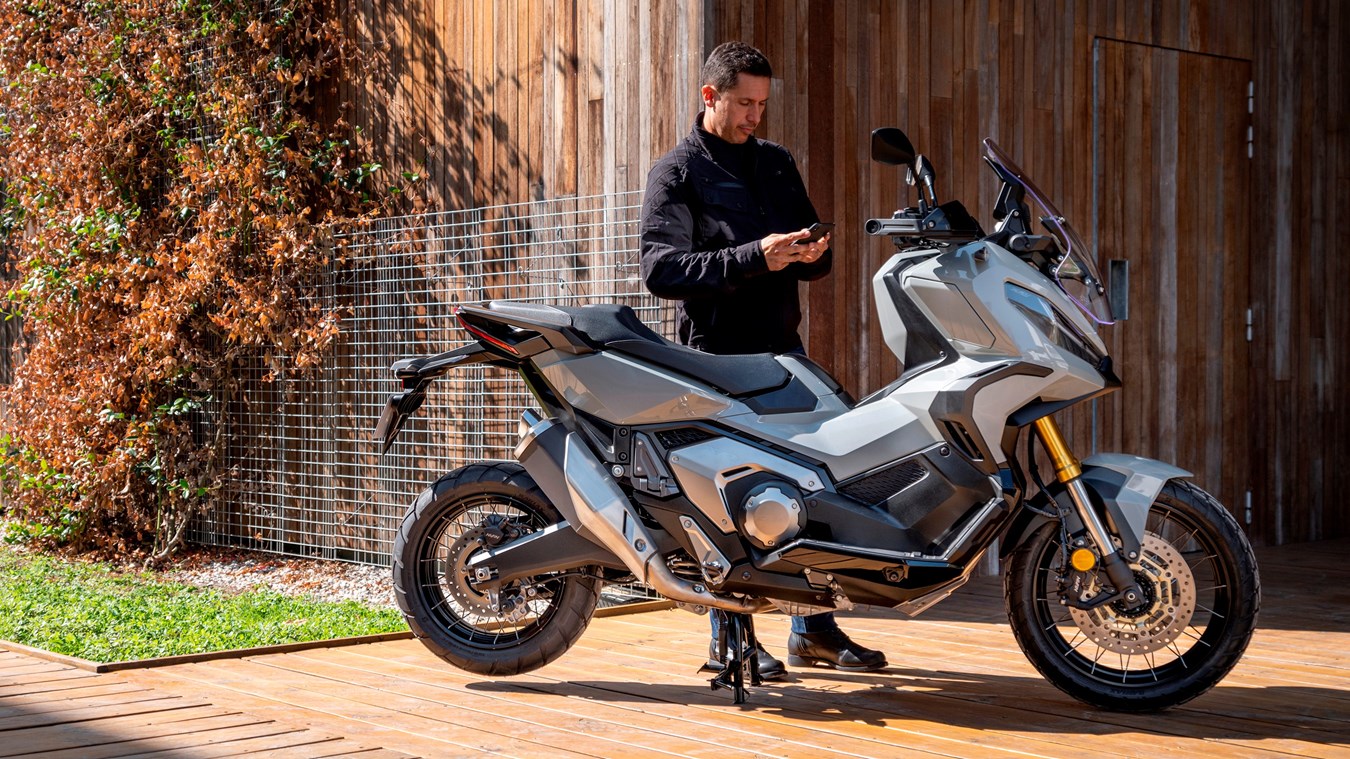
- Honda’s new bespoke connectivity system for motorcycles and scooters gives riders access to the most-used functions of their Android™ smartphone
- ‘Honda Smartphone Voice Control system’ is available as standard fitment on the 21YM X-ADV, CB1000R and the new Forza 750
- Also available as an option on 21YM Forza 350
- The free Honda RoadSync app has been developed for use in conjunction with the Honda Smartphone Voice Control system
- The Honda RoadSync app will be made available for download across Europe starting from December 2020
Honda Motor Europe is pleased to announce the availability of its new Honda RoadSync app for motorcycles. The bespoke app works together with Honda’s newly-developed connectivity system for motorcycles and scooters, the Honda Smartphone Voice Control system, to allow riders to take advantage of several of the most useful functions of their Android™ smartphone.
The Honda Smartphone Voice Control system is available as standard fitment on the 21YM X-ADV, CB1000R and Forza 750, and as an option on the Forza 350 scooter. This new system enables riders to control their smartphone using wireless connection via Bluetooth® between their smartphone and their compatible motorcycle or scooter. Having downloaded the Honda RoadSync app, with a paired Android OS smartphone and a Bluetooth® helmet-mounted headset (with audio input), riders will be able to:
- Navigate easily to favourite places and local points of interest
- Make and receive phone calls
- Generate and respond to SMS text messages, as well as other messaging apps
- Listen to music via a favourite streaming app
- Check the day’s local weather forecast, and, when using navigation, the weather forecast of their destination
All functionality of the app is operated through a combination of voice input and a 4-way toggle switch located on the left handlebar, allowing the rider to safely store their smartphone in a pocket and remain fully connected.
Developed by Honda, the Honda RoadSync app will be rolled out across Europe, starting from December 2020 with availability in the UK, with EU countries to follow in 2021. The proprietary Honda technology can be further developed, in the future, by Honda in response to evolving needs of customers.
Below are the main details of the functions available on the app:
NAVIGATION
Google Maps provides the navigation base for Honda RoadSync. The directions are given to the rider by voice communication. 5 pre-set favourite places can be stored. There is also the option to set a destination through voice commands*.
CALLS
5 frequent contacts can be stored; contacts can be selected by voice-search*. For incoming calls, the system voices the name of the caller to the rider.
MESSAGES
There are 5 default Quick Messages stored, which can be changed to personalised messages. Riders can voice-search a contact*, then voice-input an SMS message to be sent in text form. Incoming messages are converted to voice feedback. Supported message apps include WhatsApp and Facebook Messenger.
MUSIC
Riders can pre-select a favourite music app (Google Play Music, Spotify, Amazon Music, etc) in the Honda RoadSync settings before setting off on their ride.
WEATHER
The day’s local weather forecast can be checked for the following hour, 3 hours or 5 hours ahead. When using Navigation a detailed forecast for the rider’s destination is also available.
21YM CMX1100 REBEL
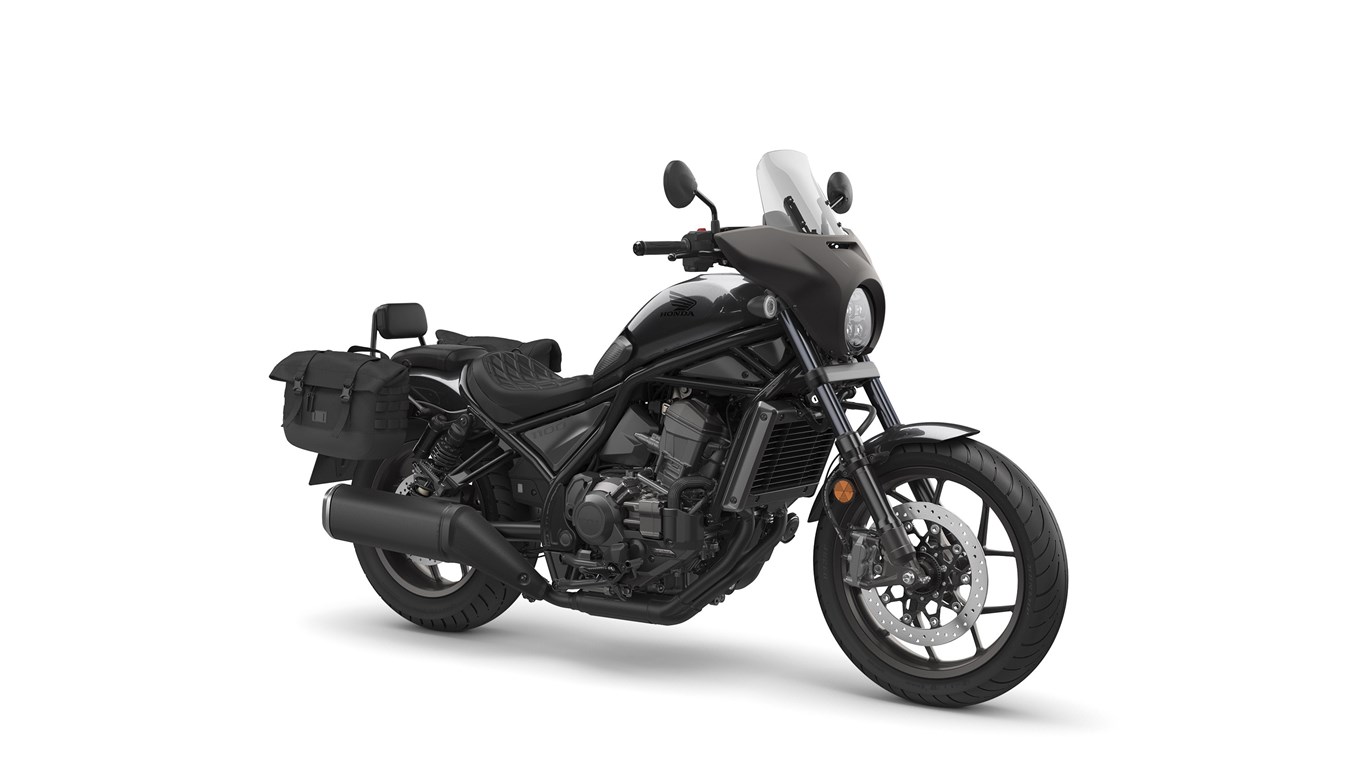
Model updates: Honda’s unique take on custom cool, the CMX500 Rebel, gets a big, bold sibling. Using the same formula – classic bare-boned ‘bobber’ with a modern-day twist – the CMX1100 Rebel offers to relax and excite in equal measure. Serious performance is on tap from its 1,084cc parallel twin-cylinder engine, plus a meaty character and evocative exhaust note; Honda Selectable Torque Control, Wheelie Control, Cruise Control and 3 default riding modes working through Throttle by Wire to make up a comprehensive package of supporting electronics. High-quality running gear includes 43mm cartridge-style front forks, ‘piggyback’ rear shock absorbers and four-piston, radial-mount front brake caliper. All lighting is LED, with negative LCD instrument display. A Dual Clutch Transmission option will be available.
Contents:
1 Introduction
2 Model overview
3 Key features
4 Accessories
5 Technical specifications
- Introduction
The A2 licence-friendly 500cc twin-cylinder CMX500 Rebel, released in 2017, fused tradition with ground-breaking new ideas to capture younger riders for whom a motorcycle is so much more than just transport – riders for whom their motorcycle is a lifestyle, an attitude and an expression of individual identity.
The Rebel’s combination of a timeless ‘bobber’ look and a unique, forward-looking, contemporary style earned it immediate popularity in its first sales season. And it has been far from a one-year wonder: in 2019 the Rebel was the third biggest selling custom style machine in Europe. Accessible, easy to ride and live with, by going its own way the Rebel has proved an accomplished success in standard trim. And as a blank canvas for customisation, it has been a machine more than ready for whatever its owner’s imagination has had in store for it.
For 2021, where the Rebel has led, a new motorcycle will follow: the CMX1100 Rebel. By taking the essence of what’s made the smaller bike so special, and adding more performance, more character and a wealth of Honda’s most advanced technology, it offers a step up – or across from a different segment altogether – for a wide range of riders looking for something that extra bit different.
2. Model Overview
The CMX1100 Rebel has a dual personality. It’s been designed for a leisurely laidback cruise, but also to offer an exciting riding experience when a twisty road presents itself. Riders moving up from smaller bikes will appreciate the manageable dimensions and weight (seat height is a mere 700mm), while more experienced riders will find instant, accessible enjoyment from the chassis’ handling potential, with its stiff tubular steel frame, quality naked bike-spec suspension and high-powered braking.
All-comers will love the character and performance of the 1,084cc parallel twin-cylinder engine (originally used on the CRF1100L Africa Twin), which has been re-tuned for super-strong bottom and mid-range punch and character, plus an evocative, enhanced exhaust note. Throttle By Wire management brings with it sophisticated rider aids: there are 3 default riding modes with a cluster of different parameters to suit riding conditions or rider mood, including engine power delivery, engine braking, the level of Honda Selectable Torque Control and Wheelie Control, and the shift schedule of the optional Dual Clutch Transmission technology. Cruise control comes as standard.
As a 21st century bobber, the Rebel 1100’s stripped-back style speaks volumes with its minimalism. Steel mudguards front and rear sit atop fat tyres; the circular headlight mixes old school looks with new school LED bulbs and mirrors the round, negative LCD instrument display. For modern day convenience, there’s a USB-C charger in the underseat storage space.
The 2021 Rebel 1100 will be available in the following colour options:
Bordeaux Red Metallic
Gunmetal Black Metallic
3. Key Features
3.1 Styling & Equipment
- Raw style a statement of muscular, stealthy simplicity
- Full LED lighting with 4 bulb LED headlight
- Ignition also opens the seat, which hides storage space and USB-C charger
- Cruise control
The blacked-out CMX1100 Rebel offers a simple, raw and ‘unprocessed’ look created by the same US-based Honda R&D studio that laid down the style of the CMX 500 Rebel. Long and low, with narrow body crowned by a scalloped, two-tone 13.6L flangeless fuel tank, its minimalist presence has real depth, with proportions that are complemented naturally with a rider on board.
Both front and rear mudguards are drawn from 1mm-thick steel and mount with die-cast aluminium brackets. And everywhere you look there are design cues that reinforce the unique overall Rebel look. The low-set 175mm diameter headlight has a classic form but houses four LED bulbs with thick inner lenses for a well-defined frontal signature. The small 55mm circular indicators, too, have classic looks but the oval, clear-lensed LED taillight strikes a contemporary note and chimes with other Rebel details.
The seat is contoured to support the rider under hard acceleration but with soft density for comfort. The Rebel rider can go solo or carry a passenger, as the rear seat pad quickly and easily unbolts. Under the seat there’s a 3L storage compartment which features a USB-C charging point.
An offset 120mm negative LCD instrument display offers intuitive information delivery. The ignition key locates on the left side of the frame and also opens the seat without having to be removed from the ignition. The uncluttered handlebars mount with substantial 1-inch clamps and the left-hand switchgear manages the riding modes and the optional DCT. And for long highway days, cruise control is fitted as standard.
3.2 Engine
- 1,084cc parallel twin drawn from the CRF1100L Africa Twin
- Strong performance, with a well-defined character from revised valve timing and ignition settings, plus increased flywheel mass
- Throttle By Wire engine management and tuned exhaust note
The Rebel 1100’s 1,084cc SOHC 8-valve parallel twin-cylinder engine is based on that of the CRF1100L Africa Twin, but with a variety of key changes that have completely altered its nature and feel to cater for its new cruiser duties. Peak power of 64kW @ 7,000rpm with 98Nm @ 4,750rpm peak torque are healthy numbers in this segment of the market, and a guarantee of strong performance. Increased inertia from 32% extra flywheel mass means the low-rpm response is not only extremely strong, but is delivered with real character.
Less obvious – and what makes the engine perfect in this application – is that its compact dimensions (thanks its adventure-bike origins, which gave it a Unicam drive train and semi-dry sump crankcase) centralise mass neatly, making for a low centre of gravity with maximum ground clearance when coupled with the Rebel’s low-slung frame design.
Carried over from Africa Twin is the 270° phased crankshaft and uneven firing interval. But aside from that, the engine exhaust system, valve timing and lift have been altered to generate an even stronger ‘pulse’ feel. And, in keeping with the Rebel’s dual personality, the engine pulse changes from one that responds harmoniously at low revs to all throttle inputs, to a more boisterous, sensation-heightening ‘throb’ as the rpm rises.
The engine is managed by Throttle By Wire (TBW) and PGM-FI feeds the throttle bodies from a 7L airbox. Adding to riding satisfaction is the exhaust note, which has been tuned to deliver a deep, low-frequency sound pulse through the 5.3L oval-section muffler below 4,000rpm married to a much more powerful, high-frequency note as rpm climbs.
Architecture is unchanged from the Africa Twin; the crankcases split vertically and the water pump is housed within the clutch casing with a thermostat integrated into the cylinder head. Manual and DCT versions of the engine share common crankcases with only minor external differences. Secondary vibrations are neutralised by the mutually reciprocating motion of the pistons, while primary inertial and coupling vibrations are cancelled by the use of biaxial balance shafts. The water and oil pumps are driven by the balancer shafts.
A crank pulsar – with relator teeth spaced at 10° intervals – manages misfire detection, important for OBD2/EURO5 compliance. In addition for EURO5 Linear Air Flow (LAF) sensors in the downpipes give accurate measurement of the air/fuel mixture ratio.
3.3 Engine Electronics
- 3 default riding modes to choose from, plus USER customisation
- 3-level Honda Selectable Torque Control and Wheelie Control
TBW manages engine performance and character, plus the level of Honda Selectable Torque Control (HSTC) and Wheelie Control. There are pre-set 3 modes for the rider to choose covering a wide variety of riding conditions. Mode selection is managed from the left-hand switchgear; an indicator in the instrument display activates when HSTC is working.
STANDARD offers a middle setting for engine power delivery, engine braking and Wheelie Control/HSTC, delivering a relaxed ride at low rpm and speeds, while unleashing much more of the Rebel’s potential as the revs rise.
RAIN transmits low engine power delivery and braking, matched to high Wheelie Control and HSTC, for relaxed riding and extra reassurance on wet or slippery surfaces.
SPORT gives aggressive engine power delivery and standard engine braking, with low Wheelie Control and HSTC intervention to allow maximum performance.
USER mode offers the ability to customise between the settings for the preferred combination. Once set, the USER setting is automatically stored so there’s no need to re-set each time the ignition is turned on.
3.4 Dual Clutch Transmission
- 3 default D mode (automatic) shifting schedules mirror the riding modes
- USER mode offers customisation
Honda’s DCT technology is now in its eleventh year of production, and over 140,000 DCT-equipped Honda two-wheelers have been sold in Europe since 2010. It delivers consistent, seamless gear changes and very quickly becomes second nature in use. It uses two clutches: one for start-up and 1st, 3rd and 5th, the other for 2nd, 4th and 6th, with the mainshaft for each clutch located inside the other for compact packaging.
Each clutch is independently controlled by its own electro-hydraulic circuit. When a gear change occurs, the system pre-selects the target gear using the clutch not currently in use. The first clutch is then electronically disengaged as, simultaneously, the second clutch engages.
The result is a consistent, fast and seamless gear change. Furthermore, as the twin clutches transfer drive from one gear to the next with minimal interruption of the drive to the rear wheel, any gear change shock and pitching of the machine is minimised, making the change feel direct as well as smooth. Extra benefits include durability (as the gears cannot be damaged by missing a gear) impossibility of stalling, low stress urban riding, reduced rider fatigue and extra ‘brain space’ to concentrate on pure riding aspects such as riding line, cornering, braking and acceleration points.
The DCT system offers two distinct riding approaches – the Automatic settings, with pre-programmed shift patterns which constantly read vehicle speed, gear selected and engine rpm to decide when a shift should occur, and the Manual Transmission setting for gear changes using the paddle-shift style triggers on the left handlebar.
Through TBW control, the DCT shift patterns are linked with the 3 riding modes.
In STANDARD riding mode, the DCT shift pattern offers a balance between high-gear, low-speed cruising and low-gear, full-throttle excitement.
RAIN selects higher gears more quickly for a super-smooth ride.
SPORT delivers higher-rpm and lower gears, holds onto revs for longer before upshifts, and downshifting at higher rpms for more engine braking effect.
The USER option also allows the rider to adopt any of the three DCT shift patterns in any riding mode according to preference.
3.5 Chassis
- Signature tubular steel frame underpins Rebel styling
- Steering geometry provides stability with easy handling characteristics
- 43mm cartridge-style front forks and piggyback rear shocks, both spring preload adjustable
- Radial mount four-piston front brake caliper and 330mm floating disc
- 130/70B18, 180/65B16 front and rear tyres
A styling statement in itself, the Rebel’s tubular steel frame is based around the raw and simple design of its sibling and features the same defined ‘theme’ line running diagonally front to back, with the fuel tank playing its part sat above the 35mm diameter main tubes which, naturally, are larger than the CMX500 Rebel’s. The 50.8mm diameter swingarm, too has an ‘engineered’ look to match.
Wheelbase is 1,520mm; the forks have a 30° angle for cruiser style, 2° offset from the 28° ‘rake’ line itself; trail is 110mm. This combination delivers the right look, but also straight-line stability and accurate, easy handling. Wet weight is set at 223kg for the standard Rebel 1100 and 233kg for the DCT-equipped option.
Seat height is a very manageable 700mm and the triangle between handlebars, seat and mid-mount footpegs places the rider firmly ‘in’ the motorcycle. The overall geometry allows generous lean angles of 35° each side (as measured by Honda), meaning the Rebel 1100 can enjoy a twisty ‘canyon’ ride and clip apexes with the best of them.
The cartridge-style front forks feature blacked-out 2-piece lowers (manufactured from both extruded and die-cast aluminium) mated to 43mm stanchions finished in a dark navy titanium oxide coating. Twin rear shocks feature a 12.5mm rod and pressurised ‘piggyback’ reservoir. Both front and rear suspension are adjustable for spring preload.
Braking power is served up by a front radial-mount monoblock four-piston caliper biting a 330mm floating disc and rear single piston caliper/256mm disc, both managed by ABS. Cast aluminium wheels feature 5 sporty Y-shaped spokes and wear fat tyres; a 180/65B16 rear and 130/70B18 front.
4. Accessories
As a motorcycle born to be accessorised there are a range of Honda Genuine Accessories ready to bolt straight on to the Rebel 1100.
These are grouped into two categories with different customer styles in mind: the
“street” and the “tour” line-ups:
‘STREET’
Wadding Seat – Standard/forward set replacement black/brown seats
Rear rack (solo type)
Tank pad
Headlight fairing
Short front mudguard
Wheel stripes
‘TOUR’
Wadding Seat – Standard/forward set replacement black/brown seats
Passenger back rest
Rear rack
Fabric saddlebag
Screen
5. Technical Specifications
|
ENGINE |
|
|
Type |
SOHC liquid-cooled 4-stroke 8-valve parallel twin with 270° crank and Uni-cam. EURO5 compliant |
|
Displacement |
1084cc |
|
Bore & Stroke |
92mm x 81.5mm |
|
Compression Ratio |
10.1:1 |
|
Max. Power Output |
64kW at7,000rpm |
|
Max. Torque |
98Nm at 4,750rpm |
|
Oil Capacity |
4.8/4.3 (5.2/4.7 DCT) |
|
FUEL SYSTEM |
|
|
Carburation |
PGM-FI electronic fuel injection |
|
Fuel Tank Capacity |
13.6L |
|
Fuel Consumption |
4.9L/100km – MT |
|
CO2 Emissions |
114g/km – MT |
|
ELECTRICAL SYSTEM |
|
|
Starter |
Electric |
|
Battery Capacity |
12V/11.2AH |
|
ACG Output |
0.419kW |
|
DRIVETRAIN |
|
|
Clutch Type |
MT:Wet multiplate clutch DCT: Wet multiplate hydraulic 2-clutch |
|
Transmission Type |
MT: 6-speed Manual Transmission DCT: 6-speed Dual Clutch Transmission |
|
Final Drive |
Chain |
|
FRAME |
|
|
Type |
Diamond |
|
CHASSIS |
|
|
Dimensions (L x W x H) |
2240mm x 853mm x 1115mm – MT |
|
Wheelbase |
1,520mm |
|
Caster Angle / Fork Angle |
28° / 30° |
|
Trail |
110mm |
|
Seat Height |
700mm |
|
Ground Clearance |
120mm |
|
Kerb Weight |
MT: 223kg / DCT 233kg |
|
SUSPENSION |
|
|
Type Front |
Preload adjustable 43mm cartridge style |
|
Type Rear |
Preload adjustable twin piggyback rear shock |
|
WHEELS |
|
|
Type Front |
Multi-spoke cast aluminium |
|
Type Rear |
Multi-spoke cast aluminium |
|
Rim Size Front |
MT3.50 |
|
Rim Size Rear |
MT5.00 |
|
Tyres Front |
130/70B18 M/C |
|
Tyres Rear |
180/65B16 M/C |
|
BRAKES |
|
|
ABS System Type |
2-channel ABS |
|
Type Front |
Radial mounted monoblock four-piston brake caliper, 330mm floating single disc |
|
Type Rear |
Single piston caliper, 256mm single disc |
|
INSTRUMENTS & ELECTRICS |
|
|
Instruments |
Offset 120mm negative LCD instrument display, USB-C charger |
|
Security System |
HISS |
|
Headlight |
LED |
|
Taillight |
LED |
All specifications are provisional and subject to change without notice.
# Please note that the figures provided are results obtained by Honda under standardised testing conditions prescribed by WMTC. Tests are conducted on a rolling road using a standard version of the vehicle with only one rider and no additional optional equipment. Actual fuel consumption may vary depending on how you ride, how you maintain your vehicle, weather, road conditions, tire pressure, installation of accessories, cargo, rider and passenger weight, and other factors.
INTRODUCING HONDA’S BIG NEW REBEL

- All-new CMX1100 Rebel mixes classic aesthetic with cutting-edge technology
- Ready for laid-back cruising and up-tempo exhilaration
- Characterful parallel twin-cylinder engine with 98Nm torque and 64kW power
- Fine-handling chassis includes high-quality suspension and brakes
- 4 riding modes, 3-level Honda Selectable Torque Control and Wheelie Control
- Unique Dual Clutch Transmission option available
Honda Motor Europe is pleased to announce a further addition to its model line-up for the coming 2021 season: the CMX1100 Rebel.
The A2 licence-friendly 500cc twin-cylinder CMX500 Rebel, released in 2017, provided a unique take on custom cool, fusing ‘bobber’ tradition with ground-breaking new ideas. Eye-catching, fun to ride and easy to live with, it found a place in the hearts of riders across Europe, and in 2019 was the continent’s third biggest selling custom-style machine.
Now for 2021, the CMX500 Rebel has a bigger, bolder sibling: the CMX1100 Rebel. By taking the essence of what makes the smaller bike so special and adding more performance, more character and a wealth of Honda’s most advanced technology, it offers a step up – or across from another segment – for a wide range of riders looking for something that extra bit different. It has been designed, deliberately, as a motorcycle with dual personality, equally ready for a leisurely laidback cruise as it is for an exciting ‘blast’ whenever a twisty road presents itself.
Those moving up from smaller bikes will appreciate the Rebel’s manageable dimensions, 700mm seat height and 223kg wet weight; the more experienced will get instant enjoyment from the chassis’ handling potential – with its stiff tubular steel frame, 43mm cartridge-style front forks, piggyback rear shock absorbers and radial-mount four-piston front brake. And all riders will enjoy exploring the character and performance offered by the 1,084cc, parallel twin-cylinder engine (derived from the CRF1100L Africa Twin) which, with 64kW peak power and 98Nm peak torque, features super-strong bottom end and mid-range punch, plus characterful feel and exhaust note.
The big Rebel’s stripped-back style speaks volumes with its minimalism. Steel mudguards front and rear sit atop fat tyres; the circular headlight mixes old school looks with new school LED bulbs and mirrors the round, negative LCD instrument display. The rear seat pad also quickly, and easily, unbolts. Under the surface sit a host of cutting-edge features: Throttle By Wire (TBW) management that adds 3 default riding modes plus a fourth user-customisable option, 3 levels of Honda Selectable Torque Control (HSTC), Wheelie Control, cruise control and the option of Honda’s unique Dual Clutch Transmission for the six-speed gearbox.
This special combination of classic look and the most modern of technologies means the new CMX1100 Rebel offers something refreshingly unique to a market where genuine innovation is hard to come by.
HONDA TO SHOWCASE NEW 2021 MODEL LINE-UP AT MOTORCYCLE LIVE ONLINE BEFORE SPONSORING ARMCHAIR ADVENTURE FESTIVAL
Honda to showcase new 2021 model line-up at Motorcycle Live Online before sponsoring Armchair Adventure Festival
- Honda exhibits 2021 model line-up at first Motorcycle Live Online
- Major updates to Adventure, Street and Scooter line-ups to be shown
- Honda UK and Africa Twin Sponsor Armchair Adventure Festival
Honda UK has joined the line-up to feature at Motorcycle Live Online (21st – 29th November), where it will showcase its latest 2021 model range. Following, Honda will be celebrating the adventuring spirit by sponsoring the Armchair Adventure Festival with the CRF1100L Africa Twin.
Later this month, in lieu of physical exhibitions, the events’ organisers will be bringing eleven days’ worth of dynamic and engaging content to smartphone and computer screens, on which Honda’s the latest models from the Street, Adventure, Off Road and Scooter model families will appear.
Motorcycle Live Online
Motorcycle Live Online promises to capture all the hype typically brought by the UK’s annual exhibition. Delivering its part, Honda will show-off no less than 20 new and/or updated models.
Street
There is a top to bottom range update for the Neo Sports Café trio, starting with a makeover for the CB1000R. Visual touches impart a minimalist aesthetic, one well suited to the all-new and brooding Black Edition that mixes extra equipment with an all-black colour scheme.
A new infotainment system is headlined by a new colour TFT instrument display that connects the rider to their smartphone via Honda Smartphone Voice Control System, while a USB charging socket has been installed under the seat. Metal-deep changes see the engine fuelling revised to help achieve Euro-5 compliance.
Similarly, the CB650R’s inline-four has been tweaked to meet the emission standard. However, the big addition here comes in the shape of Showa’s 41mm Separate Function Big Piston forks. Elsewhere, a USB Type-C socket and an improved LCD dash also feature. These changes are mirrored by the middleweight naked’s, closely-related Super Sport equivalent, the CBR650R.
The CB125R overhaul amounts to a sector-leading specification. An all-new engine delivers the maximum-power permitted for an A1 licence bike and offers a 12% increase in torque over the previous generation. Showa’s ‘Separate Function front fork Big Piston’ (SFF-BP) USD forks appear – never seen before on a 125cc motorcycle.
MSX125 Grom and CB125F return better than ever in 2021. The former strengthens its cult status with retro styling cues and removable body panels that conceal a new, Euro-5 complaint engine that’s mated to a five-speed gearbox, which you’ll be able to monitor via the gear indicator that joins the rev counter in the LCD dash.
eSP engine technology and an 11kg weight-saving combine to make the frugal CB125F even more efficient. Furthering its practical nature is a bright LED headlight, centre stand and ECO meter.
Euro-5 updates have also been applied to the CB500F, CBR500R and Adventure-styled CB500X.
Adventure
Following previous colour updates announced for the CRF1100L Africa Twin, the NC750X and X-ADV receive comprehensive updates for 2021.
Both models retain the frugal 750cc parallel-twin, however it’s now more responsive and spritelier in feel courtesy of a power bump, shorter gear ratios (1st, 2nd and 3rd) and a higher redline. The throttle-by-wire system and Dual Clutch Transmission allow riders to adjust the character of the bike with three rider modes to choose from. The X-ADV is only available with DCT, whereas a manual option is available to the NC750X.
The above updates, which lower the NC750X’s weight by 6kg, are joined by a new screen, increased central storage space (23 litres) and a 30mm drop in seat height.
A more rugged look for the 2021 X-ADV look bellies its scooter-esque practicality. A new screen, 1.2L glovebox and enlarged under seat-storage, where a USB port can be found, offer commuting credentials. Sealing this adventure scooter’s dual purpose is the introduction of Honda Smartphone Voice Control – allowing riders to use handlebar switches and voice commands to control functions of their Smartphone, including calls, navigation, music and messaging.
Off-road
Every part of the CRF450R and CRF450RX is new for 2021, save for wheels and engine, with the comprehensive update benefiting directly from knowhow gained by the development of Tim Gajser and HRC’s championship-winning CRF450RW works machine.
Scooter
The UK’s best-selling PTW, the PCX125 goes from strength to strength, like the models above, benefitting from more power and fuel-efficient technologies in 2021 guise.
A futuristic, one-of-a-piece look hides an overhauled chassis. A lighter steel frame, longer travel suspension and larger tyres offer a more complaint ride without sacrificing agility. Practicality is enhanced further by increased underseat luggage space (up 2.4 litres to 30.4 litres) and a USB charging port.
2021 pushes the sports/GT Forza scooter brand on to new levels. Crowning it is the new Forza 750, which sits above the new Forza 350 and an upgraded version of the Forza 125. As expected, revisions to the range enhance comfort, performance and practical qualities that mark out Forza models.
As the name suggests, the SH350i replaces the SH300i bringing with it a larger and more powerful engine, delivering gains in both performance and economy. Urban focused mod cons introduced include a USB charging port, keyless start and locking, emergency stop signals and Honda Selectable Torque Control.
Similar updates have been brought to the SH Mode, further emphasised by a lightened frame. A larger floor, USB charging port, increased storage space and keyless start make it the consummate commuter.
Armchair Adventure Festival
Honda UK is delighted to partner with the Armchair Adventure Festival with the headline sponsor being the Africa Twin which has been synonymous for adventure right from the very beginning.
The Armchair Adventure Festival is the world’s only virtual adventure festival and will be streamed live online from 27th – 29th November. It celebrates all forms of adventure through interviews, panel discussions, film screenings and Q&As, and features world famous adventurers, record-breakers, authors, filmmakers, and many more.
The Armchair Adventure Festival the idea of The Sidecar Guys, Matt Bishop and Reece Gilkes and will bring swathes of real-life (and armchair) adventurers together, at a time when global adventure isn’t as accessible as it once was.
To join in, all you have to do is visit www.armchairadventurefestival.com and sign up and free tickets to join will be sent out by email on the day. It’s just like TV – you can see them, but they can’t see you – the only difference is that you can jump on the live chat and quiz the speakers throughout the weekend.
21YM HONDA PCX125
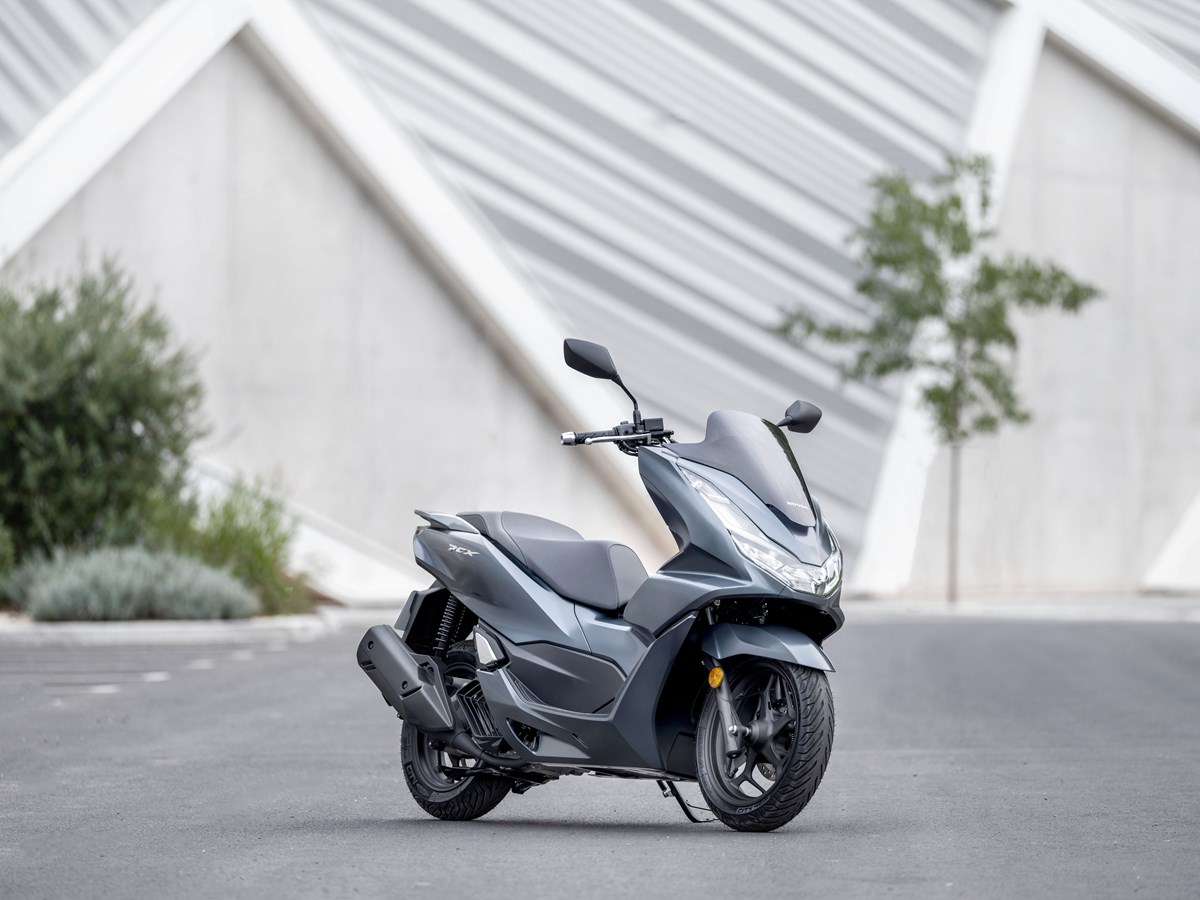
Model updates: Honda’s popular PCX125 evolves its style with a crisper edge. It also features more under seat storage, a USB Type-C charging socket and Smart Key operation. Power is drawn from a new, enhanced Smart Power Plus (eSP+) four-valve EURO5-specification engine, now with Honda Selectable Torque Control (HSTC). A redesigned frame incorporates longer suspension travel at the rear, and larger-sized tyres.
Contents:
1 Introduction
2 Model overview
3 Key features
4 Accessories
5 Technical specifications
- Introduction
The PCX125 is one of the quiet success stories of Honda’s two-wheeled line-up, having clocked up sales of over 140,000 units in Europe since its arrival in 2010. Its success is down to a formula Honda has had many years’ experience in perfecting: a strong, modern design that allows it to fit elegantly into a style-conscious urban lifestyle, coupled with compact dimensions that ensure it can plot a path through busy traffic – and be parked – with ease.
Also integral to the formula is an ‘X’ level of Personal Comfort (thus PCX) provided by the sit-in riding position, weather protection, underseat storage for a full-face helmet and all-round build quality. And, not to forget, outstanding value for money (both at purchase and throughout ownership) has always helped underpin the PCX’s popularity.
In 2010, the PCX was the first two-wheeler in Europe to feature Idling Stop technology; two years later it became the first scooter in Europe to use Honda’s ultra-efficient enhanced Smart Power (eSP) engine. For 2016 it gained EURO4 compliance and, in 2018, received a major design update, a new chassis and more power for its engine.
It’s a scooter that’s always moved with the times and the 2021 PCX125 leaps forward once again with a new engine and frame combination, increased convenience and comfort, plus a bold evolution of its avant-garde style – all aimed to retain the PCX’s place close to the beating heart of European two-wheeled travel.
2. Model Overview
The new PCX125 maintains a unique presence but sees its style mature; bolder and crisper, a rolling statement of difference, with redesigned LED lighting. The bodywork also hides extra under seat storage, more floor space and a USB Type-C charger in the glovebox. A new, ‘widescreen’ instrument display presents all the vital information and Honda’s Smart Key now operates the ignition and seat.
Also new is the enhanced Smart Power Plus (eSP+) four-valve engine, which offers more power and torque, and the rider benefit of Honda Selectable Torque Control (HSTC). It mounts in a redesigned tubular steel frame; for improved ride comfort the rear shocks feature extra travel and both front and rear tyre sizes have grown.
The 2021 PCX125 will be available in the following colour options:
Matt Dim Gray Metallic **NEW**
Pearl Jasmine White
Candy Luster Red
Matt Galaxy Black Metallic
3. Key Features
3.1 Styling & Equipment
- Bodywork completely redrawn in crisp evolution of the futuristic looks
- New LED headlight features signature running light
- More room under the seat; USB charging socket in the glove box
- Smart Key operation of ignition and seat opening
A consistent design signature of the PCX125 has always been the bodywork – with its strong character line and ‘block’ primary paint colour – flowing together as a whole, front to rear. For the 2021 update the theme continues – but bolder and crisper, with a heightened sense of the futuristic style that has always been part of the PCX appeal.
And full, premium LED lighting also sets the PCX125 apart from the crowd. The headlight is new and features a signature running light with 5 narrow flash lines positioned in parallel. It’s matched to an X-shaped taillight using multi-optic technology to give an intense, 3D effect.
All of the lines and angles have been subtly re-carved, to dramatic effect. The front fairing flares in its upper portion but elegantly draws in at the waist; alongside a slightly larger, blacked-out screen this produces improved wind protection without excess bulk.
The seat is contoured for both rider/pillion comfort and easy ground reach; there’s also 30mm extra foot space forward and at the sides. Seat height remains 764mm, but is very manageable with a ‘straddling’ height of 540mm.
The swooping lines also hide more storage capacity under the seat. An extra 2.4L brings the total volume up to 30.4L – perfect for a full-face helmet, and more. There’s also now a USB Type-C socket in the glovebox, replacing the ACC charger of the previous design, ready to plug a smartphone straight into. Even the fuel filler cap cover has been revisited, featuring space to store the fuel cap during re-fuelling.
A Smart Key is also a fresh addition to the PCX125’s armoury. As well as controlling the main ignition switch knob and compartment locking it can also manage the (optional) 35L removable Smart top box. With the Smart Key in the rider’s pocket the box is unlocked, and automatically locks when the rider walks away. It can also be locked from the key.
A new, ‘widescreen’ central console instrument layout presents all information neatly and concisely, in an easy-to-read format. An inverted LCD displays the speed, while other information available includes odometer, trip meter, fuel gauge, average fuel consumption and Idling Stop indicator.
Wide, chrome handlebars are a PCX signature. Mounted in traditional clamps (with newly optimised rubber density) they offer excellent leverage around town and are a neat retro touch.
The rear grab rail has been redesigned. The new shape is thinner, saving 310g from the previous design, and provides the passenger with a comfortable and supportive grab handle while on the move.
3.2 Engine
- New, more powerful eSP+ four-valve, water-cooled SOHC engine
- Honda Selectable Torque Control (HSTC) also applied for 2021
- The engine features Idling Stop plus EURO5 compliance
The PCX125’s new, enhanced Smart Power Plus (eSP+) four-valve, water-cooled SOHC powerplant delivers 9.2kW @ 8,750rpm, with peak torque of 11.8Nm @ 6,500rpm. Bore and stroke is set at 53.5 x 55.5mm with compression ratio of 11.5:1 (as opposed to 52.4 x 57.9mm and 11:1 of the previous design). The shorter stroke not only allows room for the two extra valves, it reduces sliding friction.
Acceleration from a standing start or roll-on is improved, and the PCX will cruise happily around 90km/h. V-max is 98km/h. And, thanks to the engine’s fuel efficiency of approximately 47.6km/l (WMTC mode), and 8.1L tank, range is approximately 385km between fill ups.
An additional technology, new to the PCX, to boost rider confidence in wet conditions is Honda Selectable Torque Control (HSTC) which works in the background to deftly manage rear wheel traction. A ‘T’ indicator flickers on the dash when HSTC is actively reducing wheelspin, and the system can be turned off completely.
Honda’s eSP+ low-friction technologies are found throughout the engine; clever packaging of items like the oil pump (which is built into the crankcase) help to further ensure efficiency. A compact combustion chamber and PGM-FI fuel injection – with 28mm diameter throttle body, 2mm larger – optimises burning velocity and cooling performance.
An offset cylinder reduces friction caused by contact between piston and bore, efficiently transmitting combustion energy to the crankshaft. A ‘spiny’ cast-iron sleeve – with tiny surface extensions – keeps in check any distortion of the inner bore diameter. This design lowers tension in the piston ring, reducing friction. A new hydraulic cam chain tensioner further improves engine efficiencies by reducing internal vibrations and improving fuel economy.
Piston oil jets – as used by CRF450R competition MX machine – maintain consistent cooling. This allows ignition timing advances and prevents abnormal combustion, such as ‘knocking’. A hydraulic cam chain tensioner lifter inhibits chain vibration, controls noise and reduces friction.
A high-efficiency radiator – integrated into the exterior of the right-side crankcase – employs a small, light fan reducing frictional losses and lowering drag. Rolling resistance within the transmission unit is reduced by the use of three low-friction main bearings, all designed to deal with the loads they individually receive. An optimised clutch – and pulleys – complement the performance increase.
The electronically controlled, brushless ACG starter is an integrated component mounted directly on the end of the crankshaft, serving as starter motor and alternator. It spins the engine directly, eliminating any noise from gear engagement or meshing.
Idling Stop automatically stops the engine running after three seconds at idle when the scooter is stationary and the brakes applied, and re-starts it instantly the throttle grip is twisted. It’s seamless in use thanks to ACG and the swing-back system that returns the crank to its position before air intake, and a decompression mechanism that negates cranking resistance from compression. It has the functionality to ‘read’ the battery charge and turns itself off to avoid excessive drain.
Through the 2021 update the engine cover and swingarm have been redesigned to complement the new bodywork. Revisions to internal structure of the muffler and the repositioning of the catalyser have enhanced gas purification performance, helping the engine secure EURO5 compliance.
3.3 Chassis
- New steel frame offers durability with nimble handling
- Twin rear shocks feature larger spring diameter and longer stroke, improving comfort
- Stylish new wheels complement the re-style; larger tyre sizes enhance road holding
The new PCX125 has a redesigned duplex steel cradle frame designed to deliver the durability needed for the rigours of urban life, without losing the in-town manoeuvrability the PCX has always been famous for, plus its user-friendliness and relaxed riding position.
Wheelbase is set at 1,315mm, with 26° 30’ rake and 80mm trail. Overall kerb weight is 130kg. Both wheels employ a stylish new design to complement the bodywork, and the rear is now a 13-inch diameter, 1-inch smaller. Tyre sizes are also larger, 110/70-14 front and 130/70-13 rear (as opposed to 100/80-14 and 120/70-14).
The 31mm front forks are unchanged with 89mm axle travel, but the rear shock absorbers feature 10mm extra stroke, at 95mm, and use heavier weight springs for a smoother ride on rough city streets.
Stopping power is provided by the twin-piston front caliper and 220mm disc, matched to a 130mm rear drum brake; single-channel ABS operates on the front brake.
4. Accessories
A range of Genuine Honda Accessories are available for the PCX 125, including windshield and a 35-litre Smart Top Box.
5. Technical Specifications
|
ENGINE |
|
|
Type |
Single-cylinder, water cooled, eSP+ SOHC 4-stroke 4-valve |
|
Displacement |
125cc |
|
Bore x Stroke |
53.5 x 55.5mm |
|
Compression Ratio |
11.5:1 |
|
Max. Power Output |
9.2kW @ 8,750rpm |
|
Max. Torque |
11.8Nm @ 6,500rpm |
|
Oil Capacity |
0.9 L |
|
FUEL SYSTEM |
|
|
Carburation |
PGM-FI electronic fuel injection |
|
Fuel Tank Capacity |
8.1 L |
|
Fuel Consumption |
47.6km/litre (without Idling Stop) (WMTC mode) |
|
ELECTRICAL SYSTEM |
|
|
Starter |
Electric |
|
Battery Capacity |
12V/7AH (10H) |
|
ACG Output |
255W |
|
DRIVETRAIN |
|
|
Clutch Type |
Automatic, centrifugal, dry type |
|
Transmission Type |
V-Matic |
|
Final Drive |
10.65 |
|
FRAME |
|
|
Type |
Tubular steel duplex |
|
CHASSIS |
|
|
Dimensions (L´W´H) |
1,935 x 740 x 1,105mm |
|
Wheelbase |
1,315mm |
|
Caster Angle |
26° 30’ |
|
Trail |
80mm |
|
Seat Height |
764mm |
|
Ground Clearance |
135mm |
|
Kerb Weight |
130kg |
|
SUSPENSION |
|
|
Type Front |
31mm telescopic fork, 89mm axle travel |
|
Type Rear |
Twin suspension aluminium swingarm, 95mm axle travel |
|
WHEELS |
|
|
Type Front |
5-spoke Y-shaped cast aluminum |
|
Type Rear |
5-spoke Y-shaped cast aluminum |
|
Rim Size Front |
14M/C x MT2.75 |
|
Rim Size Rear |
13M/C x MT3.50 |
|
Tyres Front |
110/70-14M/C |
|
Tyres Rear |
130/70-13M/C |
|
BRAKES |
|
|
Type Front |
220mm hydraulic disc with combined 2 piston caliper with ABS |
|
Type Rear |
130mm drum |
|
INSTRUMENTS & ELECTRICS |
|
|
Headlight |
LED |
|
Taillight |
LED |
All specifications are provisional and subject to change without notice.
*Please note that the figures provided are results obtained by Honda under standardised testing conditions prescribed by WMTC. Tests are conducted on a rolling road using a standard version of the vehicle with only one rider and no additional optional equipment. Actual fuel consumption may vary depending on how you ride, how you maintain your vehicle, weather, road conditions, tire pressure, installation of accessories, cargo, rider and passenger weight, and other factors.
21YM HONDA CB1000R
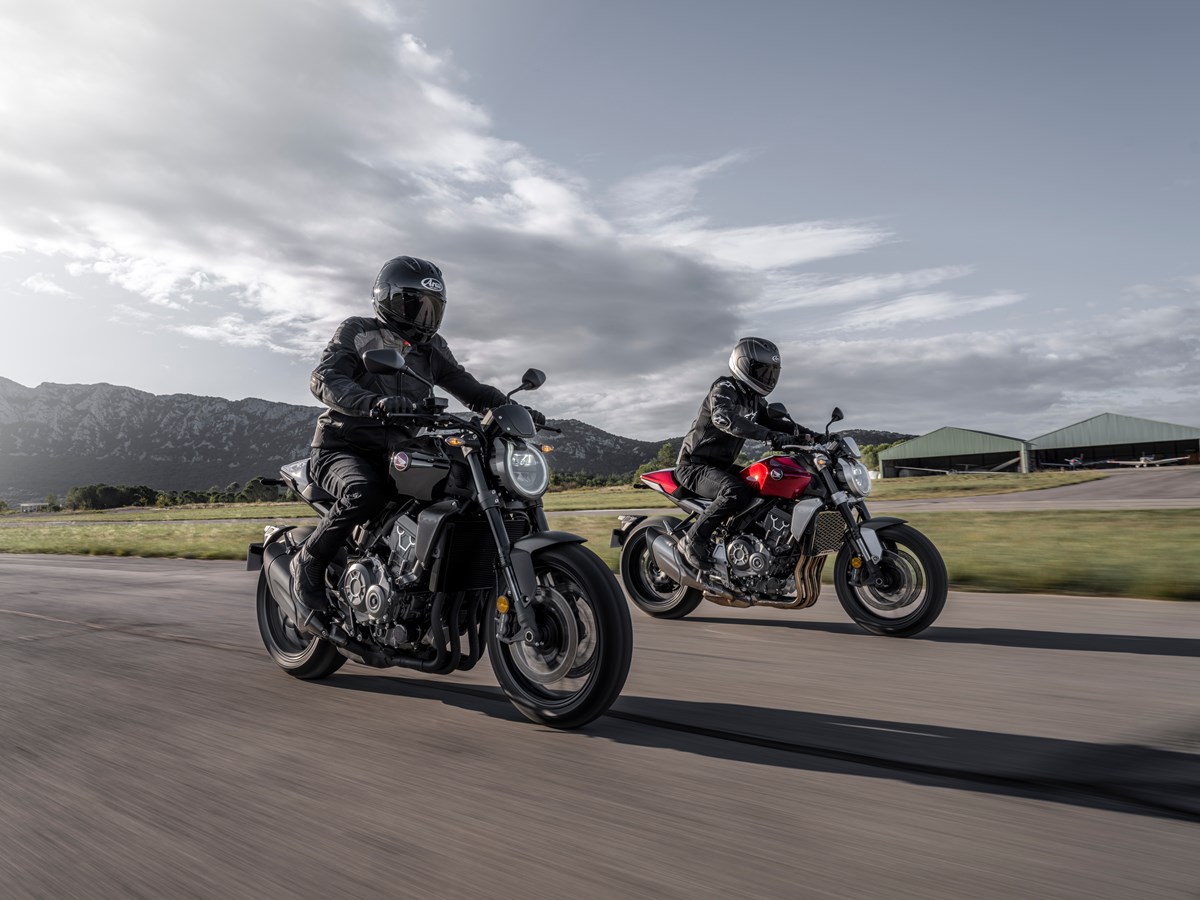
Model updates: The flagship of Honda’s Neo Sports Café family evolves – tighter, sleeker, with an even more aggressive stance - further developing the unique motorcycling proposition that it represents. A new, colour TFT instrument display connects the rider to their smartphone via Honda Smartphone Voice Control System, and there’s also now a USB charging socket under the seat. Alongside the standard CB1000R, the Black Edition is exactly that: accessorised with fly screen, pillion seat cover and quickshifter it is as blacked-out as a motorcycle can be, with just the merest hint of aluminium on show. The engine gets revised PGM-FI settings and EURO5 compliance.
Contents:
1 Introduction
2 Model overview
3 Key features
4 Accessories
5 Technical specifications
- Introduction
Motorcycling has seen many shifts in riders’ expectations of their bikes – what they do, how they look and how they make them feel – over the last decade. And Honda has never been afraid to apply its technology, engineering and ‘what if…?’ imagination to create motorcycles that inhabit new spaces in the marketplace.
The CB1000R is one such bike. Introduced through a major model change in 2018, Honda’s development engineers re-assessed the hard-core streetfighter underpinnings of the previous model and, steered by retro-industrial minimalism, stripped everything back. The resulting machine, born under the banner of ‘Neo Sports Café’, was a new fusion of sport naked and bare-boned Café Racer inspirations.
It stood out from the crowd by moving away from the standard super sports-derived big naked formula, melding exhilarating function to a form that offered a radically fresh, visually stunning two-wheeled aesthetic. Combining more with less, the reborn CB1000R gave its rider a huge amount of usable engine performance, with the control of a super sports machine.
Exciting to ride, and fully capable of chasing much more focused machinery down on a twisting back road, from whichever way it’s approached – aesthetics, emotions, performance or technology – the CB1000R has proved itself a hard motorcycle to ignore.
Minor cosmetic updates for 2020 further enhanced its premium status. Now, for 2021, the CB1000R moves forward significantly, both in terms of style and rider engagement.
2. Model Overview
Visually, the 2021 CB1000R’s lines are more aggressive, forward-set with shrink-wrapped new details like the exposed aluminium subframe, radiator shrouds and airbox covers, flowing in holistic, dynamic harmony. The headlight, too, evolves in shape and now slants back, while intricately crafted new wheels add to the engineering prowess on display.
While the chassis is unchanged the engine earns revised PGM-FI settings, smoothing power delivery, and EURO5 compliance. A new, full colour TFT instrument display offers Honda Smartphone Voice Control System, linking the rider to their smartphone function, and there’s also a USB charging socket under the seat.
The 2021 CB1000R will be available in the following colour options:
Candy Chromosphere Red
Mat Ballistic Black Metallic
Matt Beta Silver Metallic
The Black Edition
While the new CB1000R is a motorcycle hewn into purposeful beauty, Honda’s engineers chose to go several steps further with the new Black Edition. With a hand-built, custom look, the Black Edition starts out on the same manufacturing line as the standard CB1000R, then takes a detour into a moodier aesthetic territory and some extra, desirable, accessories.
Apart from a few machined aluminium details – on the wheel spokes, swingarm plates, engine covers and handlebar clamps – everything on show is black: the headlight bezel, fly-screen, fork stanchions, radiator shrouds, and airbox covers (with an anodized finish), exhaust and muffler. Deep Graphite Black paint adorns the fuel tank and pillion seat cover.
A quickshifter, too is standard-fit. A machined ‘CB’ logo adds a finishing touch,
3. Key Features
3.1 Styling & Equipment
- Aggressive, ‘mass-forward’ stance heightened, with sleeker styling front to back, and new cast aluminium wheels
- Honda Smartphone Voice Control System links the rider to their smartphone via Bluetooth and 5-inch colour TFT screen; USB charging socket under the seat
Honda’s ‘Neo Sports Café’ design aesthetic was created not only with a fondness for the past, but with an eye on the future as well, with ample scope for variations to the theme. As such, it is not standing still for 2021; the CB1000R takes the impressive styling statement made in 2018 as a springboard, and turns up the dial. The distinctive Neo Sports Café look is unmistakeable, but the drama is heightened and stance even more aggressively hunched forward, and diagonally down, around the striking, black-finished engine. New 7-spoke cast aluminium wheels add an intricate, head-turning finish.
From tip to tail the flow is harmonious: the instantly-recognisable round headlight now sits in a teardrop style surround, and lays backwards between the forks; the burnished aluminium radiator shrouds are much more compact and angled into the direction of travel, a design cue mirrored by the airbox covers.
The sinuous aluminium subframe, completely redesigned, is now finished in aluminium (rather than black) highlighting the stark minimalism of the rear. And not to miss an aesthetic detail, the number plate mount is also smaller.
While it may turn heads and stop traffic with its revised looks, the day-to-day practicalities have also not been overlooked, and real-world ease-of-use is improved with the new CB1000R. The instruments now comprise a 5-inch, full colour high-visibility TFT screen, which offers four types of speed/rpm display – according to rider preference – as well as fuel gauge/consumption, riding mode selection/engine parameters and Shift Up indicator. Management is via the buttons on the left handlebar.
Also incorporated into the interface is the new Honda Smartphone Voice Control (HSVC) system, which links the rider to their smartphone while on the move and allows voice management of phone calls, email, music and navigation. A helmet-mounted headset is needed and the smartphone connects to the dash via Bluetooth; management of HSVC is also possible using buttons the left switchgear. There’s also now a USB socket under the seat, for smartphone charging.
The CB1000R’s rear indicators have an Emergency Stop Signal (ESS) function. Under hard braking, the hazard lights flash to warn other road users a hard stop is in process. The indicators also auto-cancel; rather than using a simple timer, the system compares front and rear wheel speed difference and calculates when to cancel the indication relative to the situation.
3.2 Engine
- CBR1000RR derived, four-cylinder engine with Throttle By Wire
- Revised PGM-FI settings smooth delivery and response
- The engine is now EURO5 compliant
The CB1000R’s 998cc DOHC four-cylinder engine provides a healthy dose of both power and torque: 107 kW @ 10,500rpm and 104Nm @ 8,250 pm. Bore and stroke are set at 75mm x 56.5 mm with compression ratio 11.6:1. The redline begins at 11,500rpm and the rev-limiter cuts in at 12,000rpm; the only changes for 2021 are optimised PGM-FI settings – smoothing power delivery and improving response – and EURO5 compliance.
This engine is tuned to deliver its torque with a characteristic ‘ramp’ in the 6-8,000rpm range, where it bulges significantly, generating an exciting and engaging riding experience. It’s also a useful aid for rapid roll-on acceleration in real-world overtaking conditions.
The airbox, ducting and air filter present a smooth route for airflow into the engine, reducing pressure loss all the way from the outer ducts; a 44mm diameter throttle body feeds air/fuel mixture into large diameter inlet ports and carefully-shaped combustion chambers. Inlet valve lift is set at 8.3mm, exhaust 8.1mm. The pistons are constructed from forged aluminium.
Short gear ratios ensure exhilarating acceleration through the gears between 30-130km/h. The assist/slipper clutch is super-light and helps manage hard, rapid downshifts.
The exhaust adds to the CB1000R’s mid-range muscle and light weight. It’s a 4-2-1 design, feeding via 4 short catalysers into a main chamber, which then feeds a dual chamber muffler. The exhaust note has been tuned internally, meaning that as the revs rise past 5,500rpm it takes on a significantly deeper, more raw tone.
For EURO5 compliance, the 02 lambda exhaust sensors have been replaced with Linear Air Flow (LAF) sensors in the downpipes to allow for much more accurate measurement of the spent gases. The engine returns fuel efficiency of 17.1km/L.
3.3 Engine electronics
- Three default rider modes plus USER customisation option
- Three levels of Power, Engine Brake and Honda Selectable Torque Control
Throttle By Wire (TBW) allows the rider maximum control over the CB1000R’s powerful engine via 3 default riding modes plus 1 USER mode, managed between the left handlebar and the TFT screen.
There are 3 levels of Engine Power (P), Engine Brake (EB) and Honda Selectable Torque Control (HSTC) available; HSTC can also be switched off. The riding modes offer different combinations of each parameter.
RAIN mode employs the lowest Power setting for the least aggressive power delivery, medium amount of EB and high HSTC. The lower levels of power and torque delivery are focused on the first 3 gears.
STANDARD mode uses the middle setting for Power, HSTC and EB. It softens the power delivery a little out of first and second gear, and uses a power delivery just below that of SPORT mode, with reduced torque at partial throttle openings.
SPORT uses the highest Power delivery and lowest levels of EB and HSTC to deliver 100% performance through all six gears, maximum torque and power at all throttle positions and minor intervention from HSTC.
USER mode allows the rider to choose between the 3 settings for each parameter and save the setting for future use.
- Chassis
- Strong, lightweight mono-backbone steel frame, adjustable Showa SFF-BP forks and rear monoshock
- Dual, radial-mount four-piston calipers and 310mm floating front discs
The CB1000R’s chassis is unchanged for 2021 and employs a mono-backbone steel frame and uses split-tightening aluminium pivot plates to grip the signature 574.2mm single-sided swingarm. Rake is set at 25° with trail of 100mm. Wheelbase is 1455mm with wet weight of 212kg. Weight bias is 48.5%/ 51.5% front/rear.
A ‘natural crouch’ is afforded by the relaxed rider triangle of wide, tapered aluminium handlebars matched to an 830mm seat height. The flangeless fuel tank too, is broad-shouldered, but heavily cut-away to allow plenty of knee room.
The adjustable front fork is a Showa Separate Function Fork Big Piston unit (SFF-BP). It contains all the damping function in one leg, reducing weight, while delivering compliance, comfort and control across a broad range of riding conditions. The Showa rear shock, adjusts for spring preload, and rebound damping.
Up front, dual radial-mount four-piston front calipers bite 310mm floating discs, matched to a twin-piston caliper and 256mm rear, and 2-channel ABS. The new, intricately designed cast aluminium seven-spoke wheels exude bold elegance; the rear tyre (sitting on a 6-inch rim) is sized 190/55 ZR17, the front a 120/70 ZR17.
4. Accessories
A full range of Honda Genuine Accessories are available for the CB1000R, and include:
Tank pad
Fly screen
Pillion seat cover
Front fender cover
Alcantara pillion/rider seat
Bar ends
Engine cover
Radiator grill
Wheel stripes
Heated grips
Quickshifter
Luggage base
Rear seat bag
Tank bag
5. Technical Specifications
|
ENGINE |
|
|
Type |
Liquid-cooled DOHC In-line 4 cylinder |
|
Valves per cylinder |
4 |
|
Engine Displacement (cm³) |
998cc |
|
Bore and Stroke (mm) |
75mm x 56.5mm |
|
Compression Ratio |
11.6:1 |
|
Max. Power Output |
107kW @ 10,500rpm |
|
Max. Torque |
104Nm @ 8,250rpm |
|
FUEL SYSTEM |
|
|
Carburation |
PGM-FI |
|
Fuel Tank Capacity |
16.2 litres |
|
Fuel Consumption |
17.1km/litre |
|
ELECTRICAL SYSTEM |
|
|
Starter |
Electric |
|
Battery Capacity |
12V/8.6AH |
|
DRIVETRAIN |
|
|
Clutch Type |
Wet, multiplate clutch |
|
Transmission Type |
6-speed |
|
Final Drive |
Chain |
|
FRAME |
|
|
Type |
Steel mono backbone |
|
CHASSIS |
|
|
Dimensions (LxWxH) |
2120mm x 789mm x 1090mm |
|
Wheelbase |
1455mm |
|
Caster Angle |
25° |
|
Trail |
100mm |
|
Seat Height |
830mm |
|
Ground Clearance |
135mm |
|
Kerb Weight |
212kg |
|
SUSPENSION |
|
|
Type Front |
Showa SFF-BP USD fork |
|
Type Rear |
Showa monoshock (axle travel 131mm) |
|
WHEELS |
|
|
Rim Size Front |
Cast aluminium |
|
Rim Size Rear |
Cast aluminium |
|
Tyres Front |
120/70 ZR17 |
|
Tyres Rear |
190/55 ZR17 |
|
BRAKES |
|
|
ABS System Type |
2 channel |
|
Front |
310mm double disc |
|
Rear |
256mm single disc |
|
INSTRUMENTS & ELECTRICS |
|
|
Instruments |
5” TFT screen |
|
Headlight |
LED |
|
Taillight |
LED |
All specifications are provisional and subject to change without notice.
# Please note that the figures provided are results obtained by Honda under standardised testing conditions prescribed by WMTC. Tests are conducted on a rolling road using a standard version of the vehicle with only one rider and no additional optional equipment. Actual fuel consumption may vary depending on how you ride, how you maintain your vehicle, weather, road conditions, tire pressure, installation of accessories, cargo, rider and passenger weight, and other factors.
21YM HONDA CB125R
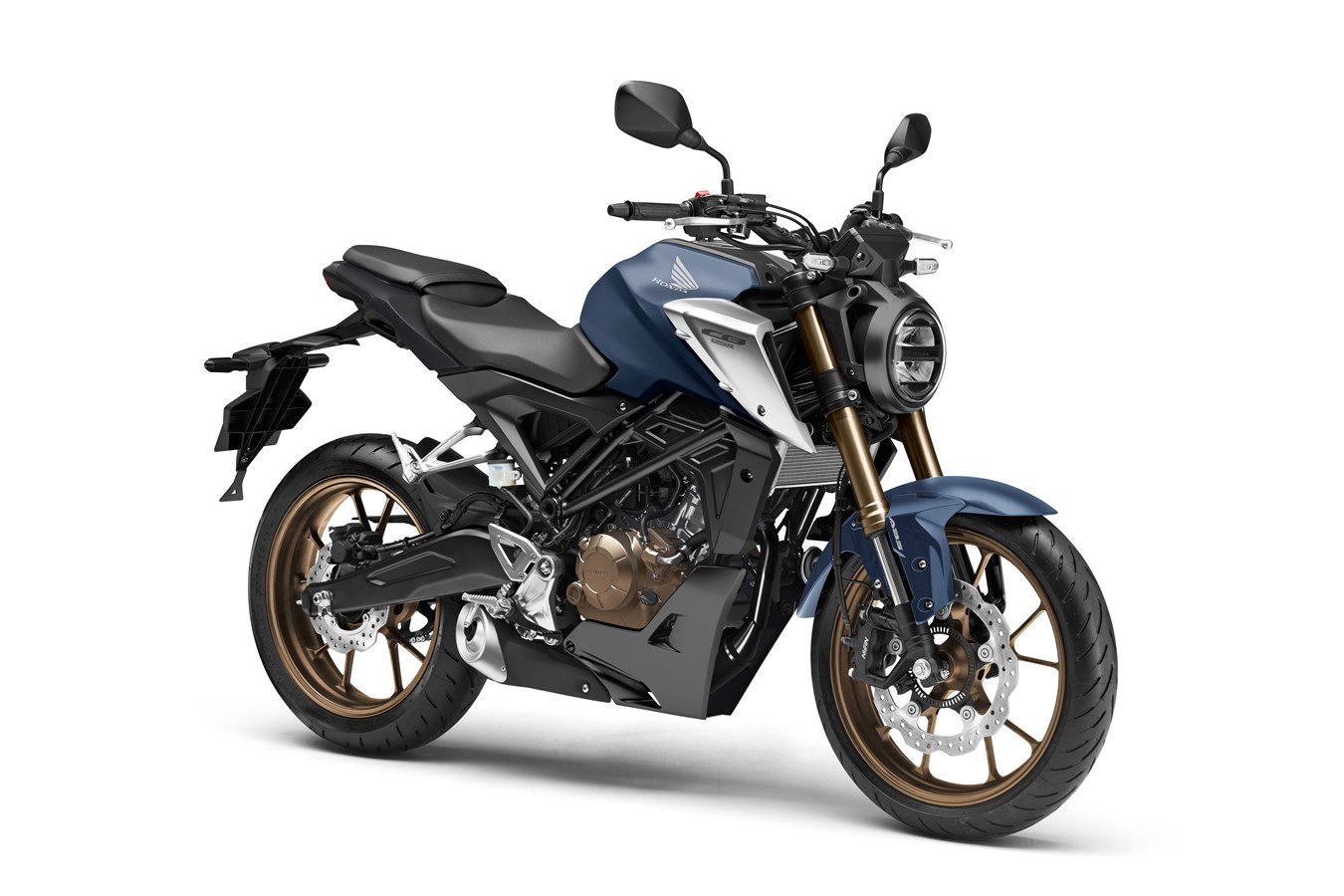
Model updates: Honda’s premium Neo Sports Café 125 gets a power and torque boost from an all-new DOHC 4V engine, improving performance across the board. It also receives a major suspension upgrade – high-quality 41mm Showa’s ‘Separate Function’ Big Piston (SFF-BP) USD forks, the first 125cc motorcycle in the world to do so.
Contents:
1 Introduction
2 Model overview
3 Key features
4 Technical specifications
- Introduction
When embarking on a two-wheeled career, there are certain fundamentals that every rider looks for from their first motorcycle: an easy-to-ride chassis, with engaging real-world engine performance, and super-agile handling. Wrap those fundamentals, however, in distinctive, classy styling and add a host of premium specifications, and the result can be an extra special machine with which to begin a two-wheeled career.
It was for new riders looking for this kind of package that Honda introduced the all-new CB125R in 2017. The smallest member of Honda’s minimalist, bare-boned ‘Neo Sports Café’ family, the CB125R was launched alongside the CB300R and the flagship CB1000R, and represented a bold new, premium addition to the ranks of Honda’s entry level machines.
Now, for 2021, the CB125R gets a brand-new engine and major front suspension upgrade, keeping it at the head of a competitive field, and at the top of many young riders’ wish list.
2. Model Overview
While the attention-grabbing styling of the CB125R is unchanged, its new DOHC two valve engine delivers 1.2kW more power and 1.2Nm more torque – with improved response throughout the rev-range.
And, in a world’s first for a 125cc motorcycle, 41mm Showa Separate Function Big Piston (SFF-BP)* USD forks – the same unit fitted to the 21YM CBR650R and CB650R, with spring rate and damping changes – are now standard equipment.
The 21YM CB125R will be available in the following colour options:
Pearl Smoky Gray **NEW for 2021**
Mat Gunpowder Black Metallic
Candy Chromosphere Red
Mat Jeans Blue Metallic
*Full name: Showa Separate Function front Fork Big Piston (SFF-BP)
3. Key Features
3.1 Engine
- New DOHC, 4V liquid-cooled engine
- An extra 1.2kW peak power, with 1.2Nm more peak torque
- Full EURO5 compliance
Originally derived from the CBR125R the SOHC, 2 valve engine of the 2018 CB125R was an effective powerplant, tuned for response in real-world situations.
For 2021 the CB125R gets its very own, new 125cc, DOHC 4V design and with it comes a power and torque boost – 11.0kW @ 10,000rpm and 11.6Nm @ 8,000rpm (from 9.8kW @ 10,000rpm and 10Nm @8,000rpm). Thanks to the extra power, top speed goes from 101km/h to 105km/h, with 0-200m covered in 11.3s. The gearbox remains six-speed.
Bore and stroke is set at 57.3 x 48.4mm, with compression ratio of 11.3:1 as opposed to the previous engine’s 58 x 47.2mm and 11:1. PGM-FI fuel injection is fed through a revised inlet duct, air cleaner connector tube and resonator. As before, the exhaust is underslung and exits through a dual-chamber muffler.
The CB125R engine is fully EURO5 compliant.
3.2 Chassis
- Now with 41mm Showa’s Separate Function Big Piston (SFF-BP) USD forks
- Radial-mount 4-piston caliper and hubless 296mm floating front disc
- ABS works through Inertial Measurement Unit (IMU)
Underpinning the CB125R’s minimalism is its tubular and pressed steel construction lattice-style frame, which is unchanged for the 21YM update. The swingarm is manufactured from steel plate, irregularly shaped in cross-section. Both are designed to achieve high longitudinal rigidity and control torsion from wheel deflection without excess rigidity or weight.
The chassis’ core strength is anchored by the pressed steel swingarm pivot plates and swingarm, allowing the frame to deliver agile handling with stability and feedback; rake and trail are set at 24.2°/90.2mm.
A 51.6% front/48.4% rear weight bias provides a positive feel for front-end grip and easy steering which is also helped by the low, 129.8kg wet weight and compact 1342mm wheelbase. Fat bar-style handlebars turn through 40° and the 2.3m turning circle guarantees easy passage in jammed city traffic. Seat height is 816mm.
41mm Showa Separate Function Big Piston (SFF-BP) USD forks are a major upgrade; this is the first time they’ve made an appearance on any 125cc motorcycle. A pressure separation damper in one fork tube and spring mechanism in the other deliver high damper performance and lighter weight. Together with the use of a larger sized piston the result is increased feel, bump absorption and control. The rear monoshock is spring preload adjustable.
The rest of the running gear remains unchanged; a 296mm hubless floating front disc is worked by a radial-mount Nissin 4-piston caliper, the rear 220mm disc a single-piston caliper. Both are modulated by 2-channel ABS. The high specification system works through an IMU (Inertial Measurement Unit) to give precise front to rear distribution of ABS operation depending on the vehicle behaviour.
The 150/60R-17 radial rear tyre is matched to a 110/70R-17 radial front.
3.3 Styling & equipment
- Industrial minimal styling makes bold visual impact
- Full LED lighting and LCD instrumentation
- 10.1L fuel tank gives 470km range
The CB125R’s styling is unique to the machine and also remains unchanged. It follows the unmistakeable ‘Neo Sports Café’ design language of the CB1000R – minimalist retro styling with a very modern twist – and injects a harder-edged attitude to Honda’s entry level range. The cutaway tail unit is minimalist in the extreme and holds the rear mudguard mount, which moves from nylon to steel manufacture. Both rider and pillion footpeg hangers are aluminium.
A thin (23.5mm) lightweight (230g) full function LCD instrument display provides speed, engine rpm, fuel level and gear position, with warning lights arrayed across the top. Full LED lighting – including indicators – adds a further premium feel and contributes to mass centralisation. The headlight uses a dual bar light signature, upper for low beam and lower for high beam and the taillight is the thinnest ever mounted on a Honda motorcycle.
The 10.1L fuel tank is hidden underneath an angular cover and shrouds and houses an aircraft-style filler cap. With fuel economy of 46.9km/l (WMTC mode), the CB125R can cover over 470km from full.
4. Technical Specifications
|
ENGINE |
|
|
Type |
Liquid-cooled 4-stroke 4-valve DOHC single cylinder |
|
Engine Displacement (cm³) |
124.9cc |
|
No. of Valves per Cylinder |
4 |
|
Bore and Stroke (mm) |
57.3mm x 48.4mm |
|
Compression Ratio |
11.3:1 |
|
Max. Power Output |
11.0kW @ 10,000rpm |
|
Max. Torque |
11.6Nm @ 8,000rpm |
|
Oil Capacity |
1.5L |
|
FUEL SYSTEM |
|
|
Carburation |
PGM-FI electronic fuel injection |
|
Fuel Tank Capacity |
10.1L |
|
Fuel Consumption |
46.9km/L (WMTC Mode) |
|
ELECTRICAL SYSTEM |
|
|
Starter |
Electric |
|
Battery Capacity |
YTZ6V 12V 5Ah MF |
|
ACG Output |
180W/5000rpm |
|
DRIVETRAIN |
|
|
Clutch Type |
Wet, multiplate with coil springs |
|
Transmission Type |
6-speed |
|
Final Drive |
O-ring sealed chain |
|
FRAME |
|
|
Type |
Inner Pivot Diamond Frame |
|
CHASSIS |
|
|
Dimensions (LxWxH) |
2018mm x 822mm x 1056mm |
|
Wheelbase |
1342mm |
|
Caster Angle |
24.2° |
|
Trail |
90.2mm |
|
Seat Height |
816mm |
|
Ground Clearance |
140mm |
|
Kerb Weight |
129.8kg |
|
Turning radius |
2.3m |
|
SUSPENSION |
|
|
Type Front |
41mm (SFF-BP) USD forks |
|
Type Rear |
Single-damper with preload adjustment |
|
WHEELS |
|
|
Rim Size Front |
17M/C x MT3.00 |
|
Rim Size Rear |
17M/C x MT4.00 |
|
Tyres Front |
110/70R17M/C 54H |
|
Tyres Rear |
150/60R17M/C 66H |
|
BRAKES |
|
|
ABS System Type |
Front & rear independent ABS with IMU |
|
Type front |
296mm hubless floating disc. Radial-mount Nissin 4-piston caliper |
|
Type rear |
220mm single disc a single-piston caliper |
|
INSTRUMENTS & ELECTRICS |
|
|
Instruments |
LCD Display |
|
Headlight |
LED |
|
Taillight |
LED |
All specifications are provisional and subject to change without notice
Please note that the figures provided are results obtained by Honda under standardised testing conditions prescribed by WMTC. Tests are conducted on a rolling road using a standard version of the vehicle with only one rider and no additional optional equipment. Actual fuel consumption may vary depending on how you ride, how you maintain your vehicle, weather, road conditions, tire pressure, installation of accessories, cargo, rider and passenger weight, and other factors.
Model updates: Honda’s premium Neo Sports Café 125 gets a power and torque boost from an all-new DOHC 4V engine, improving performance across the board. It also receives a major suspension upgrade – high-quality 41mm Showa’s ‘Separate Function’ Big Piston (SFF-BP) USD forks, the first 125cc motorcycle in the world to do so.
Contents:
1 Introduction
2 Model overview
3 Key features
4 Technical specifications
- Introduction
When embarking on a two-wheeled career, there are certain fundamentals that every rider looks for from their first motorcycle: an easy-to-ride chassis, with engaging real-world engine performance, and super-agile handling. Wrap those fundamentals, however, in distinctive, classy styling and add a host of premium specifications, and the result can be an extra special machine with which to begin a two-wheeled career.
It was for new riders looking for this kind of package that Honda introduced the all-new CB125R in 2017. The smallest member of Honda’s minimalist, bare-boned ‘Neo Sports Café’ family, the CB125R was launched alongside the CB300R and the flagship CB1000R, and represented a bold new, premium addition to the ranks of Honda’s entry level machines.
Now, for 2021, the CB125R gets a brand-new engine and major front suspension upgrade, keeping it at the head of a competitive field, and at the top of many young riders’ wish list.
2. Model Overview
While the attention-grabbing styling of the CB125R is unchanged, its new DOHC two valve engine delivers 1.2kW more power and 1.2Nm more torque – with improved response throughout the rev-range.
And, in a world’s first for a 125cc motorcycle, 41mm Showa Separate Function Big Piston (SFF-BP)* USD forks – the same unit fitted to the 21YM CBR650R and CB650R, with spring rate and damping changes – are now standard equipment.
The 21YM CB125R will be available in the following colour options:
Pearl Smoky Gray **NEW for 2021**
Mat Gunpowder Black Metallic
Candy Chromosphere Red
Mat Jeans Blue Metallic
*Full name: Showa Separate Function front Fork Big Piston (SFF-BP)
3. Key Features
3.1 Engine
- New DOHC, 4V liquid-cooled engine
- An extra 1.2kW peak power, with 1.2Nm more peak torque
- Full EURO5 compliance
Originally derived from the CBR125R the SOHC, 2 valve engine of the 2018 CB125R was an effective powerplant, tuned for response in real-world situations.
For 2021 the CB125R gets its very own, new 125cc, DOHC 4V design and with it comes a power and torque boost – 11.0kW @ 10,000rpm and 11.6Nm @ 8,000rpm (from 9.8kW @ 10,000rpm and 10Nm @8,000rpm). Thanks to the extra power, top speed goes from 101km/h to 105km/h, with 0-200m covered in 11.3s. The gearbox remains six-speed.
Bore and stroke is set at 57.3 x 48.4mm, with compression ratio of 11.3:1 as opposed to the previous engine’s 58 x 47.2mm and 11:1. PGM-FI fuel injection is fed through a revised inlet duct, air cleaner connector tube and resonator. As before, the exhaust is underslung and exits through a dual-chamber muffler.
The CB125R engine is fully EURO5 compliant.
3.2 Chassis
- Now with 41mm Showa’s Separate Function Big Piston (SFF-BP) USD forks
- Radial-mount 4-piston caliper and hubless 296mm floating front disc
- ABS works through Inertial Measurement Unit (IMU)
Underpinning the CB125R’s minimalism is its tubular and pressed steel construction lattice-style frame, which is unchanged for the 21YM update. The swingarm is manufactured from steel plate, irregularly shaped in cross-section. Both are designed to achieve high longitudinal rigidity and control torsion from wheel deflection without excess rigidity or weight.
The chassis’ core strength is anchored by the pressed steel swingarm pivot plates and swingarm, allowing the frame to deliver agile handling with stability and feedback; rake and trail are set at 24.2°/90.2mm.
A 51.6% front/48.4% rear weight bias provides a positive feel for front-end grip and easy steering which is also helped by the low, 129.8kg wet weight and compact 1342mm wheelbase. Fat bar-style handlebars turn through 40° and the 2.3m turning circle guarantees easy passage in jammed city traffic. Seat height is 816mm.
41mm Showa Separate Function Big Piston (SFF-BP) USD forks are a major upgrade; this is the first time they’ve made an appearance on any 125cc motorcycle. A pressure separation damper in one fork tube and spring mechanism in the other deliver high damper performance and lighter weight. Together with the use of a larger sized piston the result is increased feel, bump absorption and control. The rear monoshock is spring preload adjustable.
The rest of the running gear remains unchanged; a 296mm hubless floating front disc is worked by a radial-mount Nissin 4-piston caliper, the rear 220mm disc a single-piston caliper. Both are modulated by 2-channel ABS. The high specification system works through an IMU (Inertial Measurement Unit) to give precise front to rear distribution of ABS operation depending on the vehicle behaviour.
The 150/60R-17 radial rear tyre is matched to a 110/70R-17 radial front.
3.3 Styling & equipment
- Industrial minimal styling makes bold visual impact
- Full LED lighting and LCD instrumentation
- 10.1L fuel tank gives 470km range
The CB125R’s styling is unique to the machine and also remains unchanged. It follows the unmistakeable ‘Neo Sports Café’ design language of the CB1000R – minimalist retro styling with a very modern twist – and injects a harder-edged attitude to Honda’s entry level range. The cutaway tail unit is minimalist in the extreme and holds the rear mudguard mount, which moves from nylon to steel manufacture. Both rider and pillion footpeg hangers are aluminium.
A thin (23.5mm) lightweight (230g) full function LCD instrument display provides speed, engine rpm, fuel level and gear position, with warning lights arrayed across the top. Full LED lighting – including indicators – adds a further premium feel and contributes to mass centralisation. The headlight uses a dual bar light signature, upper for low beam and lower for high beam and the taillight is the thinnest ever mounted on a Honda motorcycle.
The 10.1L fuel tank is hidden underneath an angular cover and shrouds and houses an aircraft-style filler cap. With fuel economy of 46.9km/l (WMTC mode), the CB125R can cover over 470km from full.
4. Technical Specifications
|
ENGINE |
|
|
Type |
Liquid-cooled 4-stroke 4-valve DOHC single cylinder |
|
Engine Displacement (cm³) |
124.9cc |
|
No. of Valves per Cylinder |
4 |
|
Bore and Stroke (mm) |
57.3mm x 48.4mm |
|
Compression Ratio |
11.3:1 |
|
Max. Power Output |
11.0kW @ 10,000rpm |
|
Max. Torque |
11.6Nm @ 8,000rpm |
|
Oil Capacity |
1.5L |
|
FUEL SYSTEM |
|
|
Carburation |
PGM-FI electronic fuel injection |
|
Fuel Tank Capacity |
10.1L |
|
Fuel Consumption |
46.9km/L (WMTC Mode) |
|
ELECTRICAL SYSTEM |
|
|
Starter |
Electric |
|
Battery Capacity |
YTZ6V 12V 5Ah MF |
|
ACG Output |
180W/5000rpm |
|
DRIVETRAIN |
|
|
Clutch Type |
Wet, multiplate with coil springs |
|
Transmission Type |
6-speed |
|
Final Drive |
O-ring sealed chain |
|
FRAME |
|
|
Type |
Inner Pivot Diamond Frame |
|
CHASSIS |
|
|
Dimensions (LxWxH) |
2018mm x 822mm x 1056mm |
|
Wheelbase |
1342mm |
|
Caster Angle |
24.2° |
|
Trail |
90.2mm |
|
Seat Height |
816mm |
|
Ground Clearance |
140mm |
|
Kerb Weight |
129.8kg |
|
Turning radius |
2.3m |
|
SUSPENSION |
|
|
Type Front |
41mm (SFF-BP) USD forks |
|
Type Rear |
Single-damper with preload adjustment |
|
WHEELS |
|
|
Rim Size Front |
17M/C x MT3.00 |
|
Rim Size Rear |
17M/C x MT4.00 |
|
Tyres Front |
110/70R17M/C 54H |
|
Tyres Rear |
150/60R17M/C 66H |
|
BRAKES |
|
|
ABS System Type |
Front & rear independent ABS with IMU |
|
Type front |
296mm hubless floating disc. Radial-mount Nissin 4-piston caliper |
|
Type rear |
220mm single disc a single-piston caliper |
|
INSTRUMENTS & ELECTRICS |
|
|
Instruments |
LCD Display |
|
Headlight |
LED |
|
Taillight |
LED |
All specifications are provisional and subject to change without notice
Please note that the figures provided are results obtained by Honda under standardised testing conditions prescribed by WMTC. Tests are conducted on a rolling road using a standard version of the vehicle with only one rider and no additional optional equipment. Actual fuel consumption may vary depending on how you ride, how you maintain your vehicle, weather, road conditions, tire pressure, installation of accessories, cargo, rider and passenger weight, and other factors.
21YM HONDA SH MODE 125

Model updates: Honda’s fashionable SH variant receives a style refresh, LED headlight, next-generation enhanced Smart Architecture Frame (eSAF) and enhanced Smart Power Plus (eSP+) four-valve, water-cooled SOHC engine. New wheels are fitted with fuel-saving tyres. Also now included in the specification is a glovebox with USB Type-A socket, more under-seat storage and Smart Key operation.
Contents:
1 Introduction
2 Model overview
3 Key features
4 Accessories
5 Technical specifications
- Introduction
Since the arrival of the original SH50 in 1984, the enduring popularity of Honda’s SH scooter series has earned it the status of a brand within a brand, relied upon by people all over Europe as an integral part of their daily lives.
During that time, the SH family has constantly grown and evolved, with sales totalling over a million units since its introduction thanks to excellent engine performance and fuel economy plus nimble, sure-footed handling and reassuring stability – from 16-inch wheels – on rougher roads.
On sale in Europe since summer 2014, the SH Mode 125 has broadened the appeal of the SH family to a younger audience. It’s proved a smart scooter in every sense, very much of the moment, with its deft combination of on-trend style, confidence-inspiring performance and low running costs.
Now, for 2021 there’s a brand-new SH Mode 125, designed to reflect the evolving aspirations, desires and expectations of an ever-growing audience of young Honda riders.
2. Model Overview
A chic refresh enhances the SH Mode 125, led by an attractive LED headlight for its distinctive face. Underneath, there’s a new, lighter steel ‘enhanced Smart Architecture Frame’ (eSAF) and more powerful (and fuel efficient) enhanced Smart Power Plus (eSP+) four-valve, water-cooled SOHC engine. New aluminium wheels wear fuel-saving tyres.
Extra storage space is always a bonus, and under-set capacity is larger. A glovebox has been installed on the left inner fairing, with a USB Type-A socket for charging duties. And Smart Key operation of ignition and seat – from the rider’s pocket – is the premium finishing touch.
The 2021 SH Mode 125 will be available in the following colour options:
Candy Noble Red **NEW**
Pearl Jasmine White
Mat Techno Silver Metallic
Poseidon Black Metallic
3. Key Features
3.1 Styling & Equipment
- Redesigned body expands flat floor, increasing leg room
- New LED headlight smartens the front
- More room under the seat, USB charging socket in the glove box
- Smart Key operation of ignition and seat
While the elegant 2021 update adds even more appeal and desirability to the SH Mode 125, with a sharp LED headlight elevating road presence, practical enhancements have not been overlooked. The flat floor – an SH signature, with built-in hook from which to hang a shopping bag between the knees – has been extended 10mm forward, improving leg room. Seat height remains a very manageable 765mm.
There’s also now a glove box on the left, which houses a USB Type-A socket for charging a smartphone. The under-seat storage compartment grows in volume by 0.5L, to 18.5L, and includes luggage hooks for load security.
A Smart Key is also a fresh addition to the SH Mode 125. Kept in a pocket, it controls both ignition and seat locking, adding genuine convenience in support of busy urban life.
The meter panel is laid out so all the most important information is instantly easy to read. A large, dial-style central speedometer is surrounded by Idling Stop indicator and turn signal warning light. A fuel gauge is located to the centre and the odometer, trip meter and clock are housed in a central LCD display; buttons control information displayed.
The main stand is carefully sited at just the right contact area on the ground for the rider’s foot, making it easier to use. In addition, a side stand is standard equipment. Passengers are not forgotten, either. They have a comfortable space plus folding footplates and grab rails integrated into the large die-cast aluminium rack.
3.2 Engine
- New, more powerful eSP+ four-valve, water-cooled SOHC engine
- The engine features Idling Stop plus EURO5 compliance
- And increased fuel efficiency, to 50km/l
The SH Mode 125’s new, enhanced Smart Power Plus (eSP+) four-valve, water-cooled SOHC engine delivers 8.4kW@ 8,500rpm, with peak torque of 12.1Nm @ 5,000rpm. Bore and stroke is set at 53.5 x 55.5mm, with compression ratio of 11.5:1.
Through development the aim was to build on, and improve the formula of the previous design and produce an engine with a well-balanced, easy-to-use power delivery – providing flat, linear torque from low rpm – perfect for urban environments and riders with diverse riding experience. And, thanks to the engine’s improved fuel efficiency of approximately 50km/l, (WMTC mode) plus the new tyres and 5.5L tank, range is approximately 275km between fill ups.
Honda’s eSP low-friction technologies are found throughout the engine; clever packaging of items like the oil pump (which is built in to the crankcase) help to further ensure efficiency. A compact combustion chamber and PGM-FI fuel injection optimises burning velocity and cooling performance.
An offset cylinder reduces friction caused by contact between piston and bore, efficiently transmitting combustion energy to the crankshaft. A ‘spiny’ cast-iron sleeve – with tiny surface extensions – keeps in check any distortion of the inner bore diameter. This design lowers tension in the piston ring, reducing friction.
A high-efficiency radiator – integrated into the exterior of the right-side crankcase – employs a small, light fan reducing frictional losses and lowering drag. Rolling resistance within the transmission unit is reduced by the use of three low-friction main bearings, all designed to deal with the loads they individually receive. The drive pulley features a fin design that lowers air resistance and the follower pulley reduces pressure on the drive belt, cutting transmission losses.
The electronically controlled, brushless ACG starter is an integrated component mounted directly on the end of the crankshaft, serving as starter motor and alternator. It spins the engine directly, eliminating any noise from gear engagement or meshing.
Idling Stop automatically stops the engine running after three seconds at idle when the scooter is stationary and the brakes applied, and re-starts it instantly when the throttle grip is twisted. It’s seamless in use thanks to ACG and the swing-back system that returns the crank to its position before air intake, and a decompression mechanism that negates cranking resistance from compression. It has the functionality to ‘read’ the battery charge and turns itself off to avoid excessive drain.
The eSP+ engine is fully EURO5 compliant.
3.3 Chassis
- New, lighter enhanced Smart Architecture Frame
- Stylish new wheels complement the re-style.
- New tyres reduce rolling resistance and improve fuel efficiency
An advanced, next-generation enhanced Smart Architecture Frame (eSAF) replaces the tubular steel underbone design of the previous model. Constructed from pressed steel it’s 8% lighter and, thanks to carefully engineered rigidity balance, offers good handling feel, with enhanced stability, ride comfort and durability.
Rake is set at 26° 30’, with 69.5mm trail and wheelbase of 1,305mm (from 27°, 68mm and 1305mm). Overall dimensions are compact: (LxWxH) of 1950mm x 670mm x 1100mm, with a ground clearance, at 150mm. Combined with a kerb weight of 118kg, the overall result is an outstandingly agile and user-friendly city scooter.
The telescopic forks feature 89mm travel, the rear suspension – with 5-stage adjustable spring preload – has 75mm travel. The new, 16-inch cast-aluminium front wheel mounts an 80/90-16 tyre, the 14-inch rear wheel a 100/90-14; both tyres are also new, designed to reduce drag and improve fuel efficiency by 4%.
Up front the 220mm hydraulic disc brake links to a rear 130mm drum via CBS, ensuring smooth and evenly distributed braking force at all times, including hard and emergency stops.
4. Accessories
A range of Genuine Honda Accessories are available for the SH Mode. They include:
35-litre Top box & rear carrier kit
Windshield & knuckle visor set
Scooter blanket
- Technical Specifications
|
ENGINE |
|
|
Type |
Liquid-cooled, 4-stroke SOHC |
|
Engine Displacement (cm³) |
125 cc |
|
No. of Valves per Cylinder |
4 |
|
Bore ´ Stroke (mm) |
53.5 x 55.5mm |
|
Compression Ratio |
11.5:1 |
|
Max. Power Output |
8.4kW@ 8,500rpm |
|
Max. Torque |
12.1Nm @ 5,000rpm |
|
Oil Capacity |
0.9L |
|
FUEL SYSTEM |
|
|
Carburation |
PGM-FI electronic fuel injection |
|
Fuel Tank Capacity |
5.5L |
|
Fuel Consumption |
50km/litre |
|
ELECTRICAL SYSTEM |
|
|
Starter |
Electric |
|
Battery Capacity |
12V7Ah |
|
ACG Output |
570w/5,000rpm |
|
DRIVETRAIN |
|
|
Clutch Type |
Automatic; centrifugal |
|
Transmission Type |
CVT |
|
Final Drive |
V-Belt |
|
FRAME |
|
|
Type |
Tubular Steel Underbone |
|
CHASSIS |
|
|
Dimensions (LxWxH) |
1950mm x 670mm x 1100mm |
|
Wheelbase |
1,305mm |
|
Caster Angle |
26° 30’ |
|
Trail |
69.5mm |
|
Seat Height |
765mm |
|
Ground Clearance |
150mm |
|
Kerb Weight |
118kg |
|
Turning radius |
1.97m |
|
SUSPENSION |
|
|
Type Front |
Telescopic 33mm – 89mm travel |
|
Type Rear |
Dual-damper unit swing arm. 5 stage adjustment |
|
WHEELS |
|
|
Rim Size Front |
16M/C x MT2.50 |
|
Rim Size Rear |
14M/C x MT2.75 |
|
Tyres Front |
80/90-16 inch |
|
Tyres Rear |
100/90-14inch |
|
BRAKES |
|
|
System Type |
CBS |
|
INSTRUMENTS & ELECTRICS |
|
|
Instruments |
Honda Smart Key, USB charger |
|
Headlight |
LED |
|
Taillight |
Bulb |
All specifications are provisional and subject to change without notice
Please note that the figures provided are results obtained by Honda under standardised testing conditions prescribed by WMTC. Tests are conducted on a rolling road using a standard version of the vehicle with only one rider and no additional optional equipment. Actual fuel consumption may vary depending on how you ride, how you maintain your vehicle, weather, road conditions, tire pressure, installation of accessories, cargo, rider and passenger weight, and other factors.