
THE HONDA AFRICA TWIN HEADS TO ICELAND FOR THE THIRD ADVENTURE ROADS TOUR
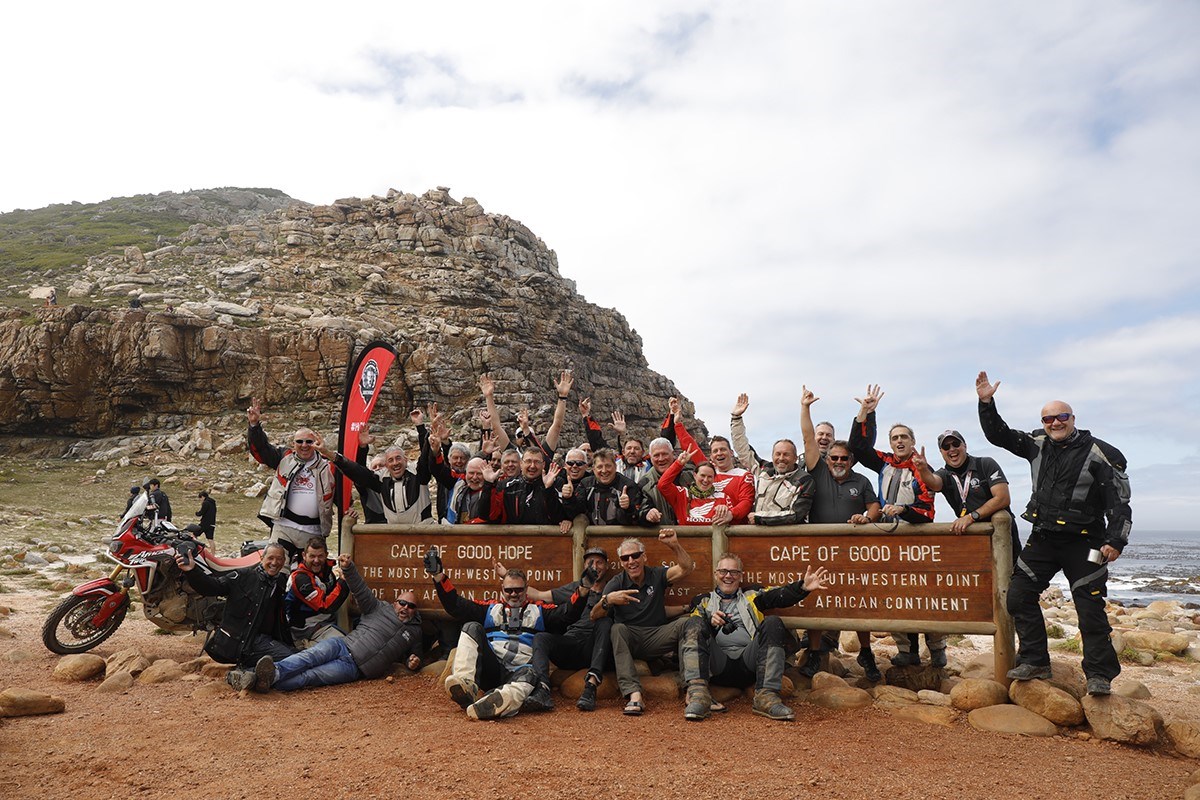
- Adventure Roads heads to Iceland for 2021
- 30 riders all on the latest CRF1100L Africa Twins
- 11 days
- Once in a lifetime experience, complete ‘turn-key’ package
- Meet and benefit from the knowledge of HRC rally stars
Following in the wheel tracks of previous tours across Norway and South Africa, Honda’s Adventure Roads returns for its third edition in June 2021 to tackle the unique volcanic landscape of Iceland on the CRF1100L Africa Twin.
The first Adventure Roads trip saw 40 motorcycle enthusiasts set out in summer 2017 on an 8-day, 3,500km journey from Oslo to Nordkapp – the northernmost point of Europe. Returning in 2019, Adventure Roads travelled 3,700km ‘coast to coast’ from Durban to Cape Town in South Africa, exploring varied terrain and epic landscapes over 12 adventure filled days.
For 2021, Honda Motor Europe will be offering 30 riders the opportunity to ride the new CRF1100L Africa Twin, the CRF1100L Adventure Sports as well as the CRF1100L Adventure Sports ES – complete with Showa EERA semi active suspension – on a once in a lifetime 11 day journey through the land of ‘Fire and Ice’.
From Reykjavik, the most northerly capital city in the world, the third Adventure Roads tour will wind its way down to the south of the island, before heading through the remote highlands of the north, and back to Reykjavik. Taking in some of the most stimulating riding scenarios in the northern hemisphere, participants will guide their Africa Twins down perfect tarmac roads and gravel passes, navigate the famed black sand, and ford rivers, all while taking in the majestic beauty of an island famed for its volcanos, waterfalls, lava fields, geysers and 22hrs+ of summer daylight.
‘Adventure Roads 2021’ will be a turn-key package for 30 customers from across Europe. With all accommodation, Africa Twins, guides and maintenance taken care of, the participants will arrive safe in the knowledge that they can relax, ride and enjoy. And get to meet and benefit from the riding tips of some of Honda’s HRC rally stars.
For more details of the Adventure Roads programme, and to register your interest please go to: www.hondaadventureroads.com or download the ‘Adventure Roads Outline’ from hondanews.eu.
True Adventure is calling…
For off-road riding on the latest Africa Twins closer to home, where better to hone your skills before an experience of a lifetime in Iceland than the Honda Adventure Centre, based in the South West of England. Run by 3 time World Motocross champion, Dave Thorpe, the Adventure Centre offers a variety of excellent courses that highlight the Africa Twin’s capabilities on and off-road and whether you’re new to off-road riding or keen to master your skills, there’s something for everyone. For more information, visit https://davethorpehonda.com/adventure-centre/
RANK TWELVE OF EUROPE'S BEST CB1000R CUSTOM BUILDS
ON-LINE

- New ‘HondaCustoms’ page celebrates 12 of Europe’s best CB1000R custom builds
- Allows users to rank the bikes from 1 to 12, and share their choice via social channels
- Free wallpaper download of their top bike – for desktop or mobile
- Available in five languages
The Honda CB1000R, flagship of the Neo Sports Café range, has proven itself to be the perfect canvas for custom builders across Europe.
Honda are revisiting 12 of the continent’s best customised CB1000Rs, first shown last year at the Wheel & Waves festival in Biarritz, with a webpage giving users the chance to chair their own judging panel and ‘drag and drop’ the bikes in their order of preference from one to twelve. Having made their selection, users will be able to share their choice with friends via Facebook™, Twitter™ or WhatsApp™ .
Among the twelve CB1000Rs at www.hondacustoms.com are the Africa Twin-inspired ‘CRF1000 Africa Four’, the Monkey bike homage ‘Monkey Kong’ and the ‘Alfredo’ tribute to classic Freddie Spencer CBs of yesteryear. All twelve certainly merit a close inspection.
The Honda Customs page is available in English, French, German, Italian and Spanish and once users have chosen their favourites, they’ll be able to download their number one choice as either a desktop or mobile phone wallpaper.
HONDA ANNOUNCES ANDROID AUTOTM INTEGRATION FOR GOLD WING SERIES
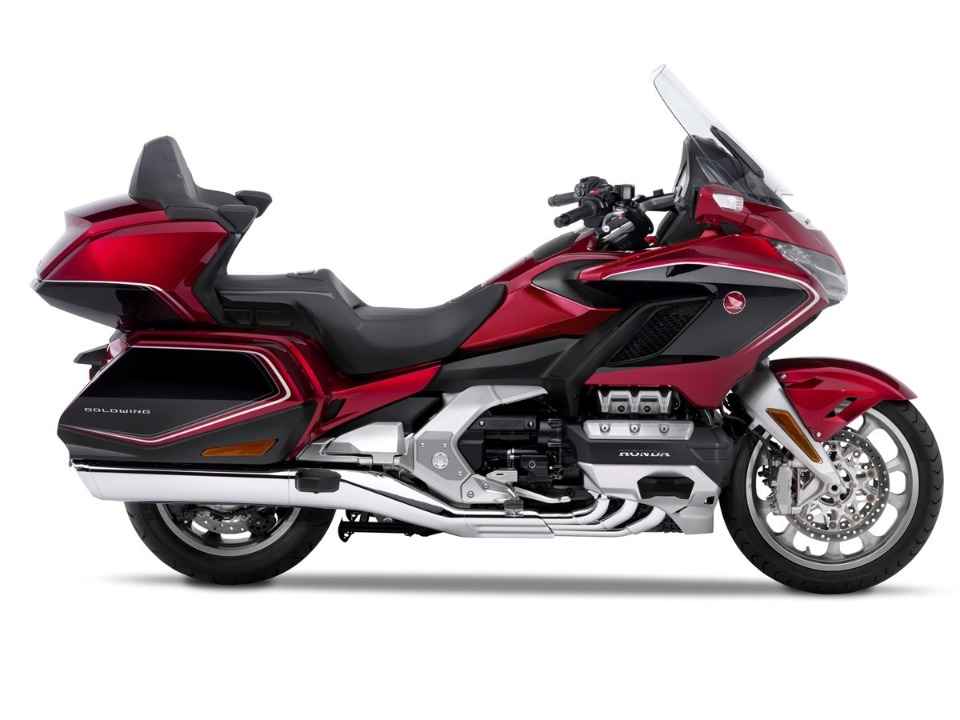
Honda is pleased to announce that Android AutoTM *1 will be integrated*2 with the current-model Gold Wing*3. Customers with AndroidTM smartphones will be able to enjoy application services seamlessly such as music, phone calls and messaging. The method to update software is planned to be available in the middle of June, 2020.
Since the GOLDWING GL1000 went on sale in North America in 1975, the Gold Wing series has evolved as Honda’s flagship model for over four decades. In October 2017, the all-new Gold Wing became the world’s first*4 motorcycle with Apple CarPlay integration*5. Navigation features to enhance the ride experience and application-specific services have been well-received by many customers.
Android Autois a simple, safe way to use your phone on the motorcycle. With simplified interface, and easy-to-use voice actions, it is designed to minimize distraction so you can stay focused on the road. Android Auto makes it easy to access your favourite music, media, and messaging apps on your motorcycle. With your Google Assistant on Android Auto, you can stay focused, connected, and entertained, keeping your eyes on the road and your hands on the handlebar, while using your voice to help you with your day.
With Apple CarPlay and Android Auto integration coming to more models, Honda plans to bring more comfort and convenience to customers’ motorcycle lifestyles worldwide.
For details on Android Auto, visit the official Android site at the following URL.
(https://www.android.com/auto/)
?Trademarks?
AndroidTM and Android AutoTM are registered trademarks of Google LLC. Apple CarPlay is a registered trademark of Apple Inc.
Bluetooth® is a registered trademark of Bluetooth SIG, Inc.
*1 Android Auto is a mobile app developed by Google LLC to support driving. Android Auto requires an Android smartphone with Android 5.0 or later and the Android Autoapp. When you utilize it riding Gold Wing, connection with a Bluetooth® headset (sold separately) will also be required. App and communication costs may apply.
*2 Certified by Google LLC.
*3 Subjected Current Model after 2018 model: 2BL-SC79/SC79.
*4 Internal research by Honda (as of October 2017).
*5 Bluetooth® headset (sold separately) required for use with Apple CarPlay. App and communication costs may apply.
MONTESA 75TH ANNIVERSARY
Precedents
Montesa's history began in 1944, when the young industrialist from Barcelona Pere Permanyer Puigjaner, at the time 33 years old, started branching out from his industry of producer gas to the automotive industry, opening a new branch of his activities towards the motorcycle sector.
The gas generator industry was very representative of post-war life in Spain. During the Second World War (1939-1945) and amid Spain's reconstruction after the devastating Civil War (1936-1939), the shortage of fuel had paralyzed transport in Spain. This meant that the application of the producer gas system (a skillful procedure for obtaining fuel by burning almond shells) was an almost magical resource, be it for the propulsion of cars, trucks, or electric current generators.
Pere Permanyer learned about vegetable fuels through the family business, founded by his grandfather, which dealt in the import and distribution of coal. The Permanyer Coal Company acquired raw materials from the islands of Corsica and Sicily and transported it to Barcelona through two schooners of its own. A fleet of trucks then distributed the product throughout Spain.
Pere Permanyer Puigjaner was born in Barcelona on 21 July 1911. When he was only one year old, he moved with his parents to a new family home in the Sant Martí district of Barcelona, where the company was located. His integration in the area and his cooperation in the progress of the youth, as well as the development of the district during his years of residence there, made him worthy, in 1975, of the prize “San Martín de Oro with international transcendence”, awarded the District's Municipal Board. Although for some time he collaborated in the family industry under his father's orders, he soon showed a natural inclination towards manufacturing and a passion for mechanics.
As a child, the game of “Meccano” helped him develop a natural leaning towards industrial innovation. When he finished his studies in Industrial and Commercial Expertise in 1931, his interest drove him to develop one of his first youthful ideas: in anticipation of possible energy restrictions, he studied the propulsion system using gas generators applied to internal combustion engines. He traveled to Madrid, and then to London and Paris, where the system had been studied academically, to gather as much information as possible. In the French capital, he even drove a garbage truck powered by the gas generator system, to check its operation first hand.
During the Spanish Civil War, Pere Permanyer took over the management of a repair and reconstruction workshop for air force vehicles in Zaragoza. During this period, he developed a great friendship with Josep Antoni Soler i Urgell “Jasu”, with whom he shared the difficult years of the war. Permanyer was in charge of that workshop, which had more than 50 welders, mechanics, fitters, turners, carpenters, bodyworkers, and assemblers. The young director, then 26, developed a particular interest for the two-stroke engine of the German DKW vans, which would become the inspiration of his subsequent projects.
However, around 1944, with the foreseeable end of the Second World War, Permanyer realized that the supply of fuel would soon return to normal and, therefore, he would have to refocus his industry towards an activity other than producer gas, which was, in reality, an emergency resource, the result of the circumstances of the time. His first idea was to study a two-stroke engine for motorcycles, given the extraordinary demand for this type of light vehicles, and the complete lack of local manufacture and imports, due to two wars, the Spanish Civil War of 1936-39 and the World War II of 1939-45.
The beginning until 1945
His friend “Jasu”, well aware of Pere Permanyer's industrial potential, introduced him to his brother-in-law, Francisco X. Bultó, a big fan of motorsports and an expert biker. It was during June 1944 when, among the three of them, they decided to produce light motorcycles in Permanyer's workshops, at 408 Córcega Street, in Barcelona.
A Motobecane B1V2GR38 that Bultó had given as a present to his nephew Juan Soler Bultó (son of “Jasu” who would go on to become a prominent speed and test rider) would serve as the basis for the first prototype that started to appear in the streets of Barcelona at the end of October of the same year. With some improved features, the prototype was modified, and on February 11, 1945, it was registered for a team motorcycle regularity test, organized by the Real Moto Club of Catalunya with the XX anagram, the name of the brand still undecided on. The rider on the motorcycle was José Luis Milá, who sadly wouldn’t finish the test due to a failure in the ignition system.
This setback did not discourage the company in the slightest, in fact, it became yet another incentive to accelerate the technical evolution of the design, on which intense work was done. At the time, the difficulties of sustaining a mass production were enormous, so much so that even a true believer would have had trouble not giving up. Spain didn’t have the required auxiliary industry and the current political isolation of Spain made it extremely difficult to obtain the necessary raw materials and components.
During these years, one of the most desired components, and probably the hardest to obtain, was the magnetic flywheel for the engine ignition. Fortunately, Manuel Giró, who had a film projector manufacturing industry (Orfeo Sincronic S.A.- O.S.S.A.) had imported, before the war, some Bosch flywheels with the purpose, then rejected, of making motorcycles. Permanyer and Bultó bought the batch of 100 units for 22,000 pesetas and started to build the first hundred mass-produced motorcycles.
To acquire the necessary materials, given the particularity of these circumstances, Permanyer had to use his imagination and resources in a way that today would be seen as impossible. There were no means of production at all, and no specialized personnel. That is why he traveled almost non-stop looking for information to Madrid, Bilbao, and even abroad, and had to resort to picturesque maneuvers such as exporting Spanish wines from La Rioja to obtain, in exchange, a license to import the raw materials needed for the industry.
Meanwhile, Bultó was designing prototypes. His friend Carles Carreras, also an engineer, helped him with the first sketches. Those days, Bultó could only spend a few hours of “spare time” on the project, having to attend his own business, the company Barella y Bultó S.L., with a production plant in Vilanova y la Geltrú, (Barcelona) dedicated to the production of piston rings and cylinder sleeves for the automotive industry, sold under the brand name “Bolaco”.
In June 1945, three units of the new motorcycles were showcased at Barcelona’s Trade Fair. The name of the brand had been chosen, Montesa, selected after analyzing a wide variety of alternatives. It was the A-45 model, a motorcycle with a rigid frame, a 98 cc (45.6 x 60mm) engine and a three-speed manual gearbox. They also made a ladies' version and a version with rear suspension. The carburetors used were made by the French brand Gurtner, although later versions would incorporate one of their own making.
In the first balance sheet of the recently created company, on 31 December 1945, the partners were Pere Permanyer Puigjaner and his father, Marcelino Permanyer Grifoll, with 630,003.36 pesetas, which represented 89% of the company; and Francisco X. Bultó with 80,619.75 pesetas, who owned 11%.
Pere Permanyer was the company's first manager. The combination of his competitive and adventurous spirit present since the company's foundation, together with the need to test the motorcycles to complete their development, led to the organization, in July of 1945, of an ascent to the Caldes de Bohí spa. A place that had never been reached before with a motor vehicle, as there were no roads or paths, the only way to get there being through climbing, cross-country, or by animal traction. Five motorcycles reached the spa, and the riders, true heroes and forerunners of mountain biking, were Paco Bultó, José Luis and Alfonso Milá, J. M. Llobet “Turuta” and Juan Soler Bultó.
In November 1945, they took part for the first time in a speed race at the “First Motorcycle Prize of Montjuic”, where the local Montesa motorcycles proved to have an incredible performance, taking the first four places of the 100 cc class, to the great surprise of a large crowd of fans. The first place was won by J.M. Llobet, “Turuta”.
The start of mass production (1945-1947)
Mass production started on June 19, 1945, the first unit appearing on the market, with the chassis number MB-0001. The buyer was Pere Permanyer himself. The second unit was for Juan Soler Bultó, the third (the Lady version) for Ana Mª Villavecchia, the fourth for Carlos Carreras and the fifth for F.X. Bultó. The sale prices were 8,500 pesetas for the normal version and 9,000 pesetas for the lady's one.
In that first year of 1945, production reached a total of 21 units. And although there had been some attempts to manufacture motorcycles in Spain, none of them were serious enough for it to be considered as standard industrial manufacture. According to Francisco Herreros, author of the Encyclopedia of the Spanish Motorcycle, “the only one was the Madrid-based Soriano with its grand facilities and the full support of General Franco's regime, thanks to the political loyalty of its owners, but the quality of their products left much to be desired…”
There is no doubt that Montesa was the real first Spanish motorcycle factory, with mass production and a real industrial and exporting projection. On the year 1946, the company was focused primarily on increasing and improving its production, with the stimulus of a growing demand throughout the country. Meanwhile, when it came to competitions, Montesa took part in an international competition for the first time: it was on May 5 at the International Grand Prix of Barcelona, held at the Montjuic circuit, which ended with a spectacular victory in the 125 cc class race. That year, they also won the Spanish 100 and 125 cc Championships.
During the same year, 1946, some standard units were made with a 51.5 mm diameter piston and the same 60 mm stroke: the model, with 125 cc, was called B-46. In some of their units, they also tried using English Villiers engines, even though the project to import engines made by the brand for the series was later rejected.
Finally, at the beginning of 1947, the mass production of a new version was started, a model called B-46/49, with a new cylinder and head, externally larger, to create more of a square shape, whilst maintaining the same characteristics of 51.5 x 60.
The definitive industrial company was established on February 3rd, 1947 by public deed before the public notary Mr. F. Trias de Bes and assumed the name Permanyer S. A. de Industrias Mecánicas. The Permanyer family contributed 76.3% of the capital to the company and the Bultó family 23.7%. The total capital was 810,000 pesetas.
As the company continued to grow, more financial resources were needed. In November 1947, in the minutes presented to the Treasury, the intention to carry out a capital increase was declared, in which the Bultó family would contribute an amount equal to that of the Permanyer family. But this increase did not come to fruition, since the Bultó family withdrew, considering that the future business of Montesa motorcycles was not secure enough, in fact, there still was a clear deficit when it came to auxiliary industries in Spain.
Finally, on May 29, 1948, the necessary capital increase took place. Permanyer pledged his private assets and, together with 23 small shareholders, contributed the capital required to continue the company's expansion plan. The capital was set at 2,310,000 pesetas. The distribution of the shareholders remained as follows: Permanyer family 44%, Bultó-Marqués family 30.9%, Guixà-Arderiu family 13.6%, Milá family 9.5%, others 2%. At that time, 2 units were manufactured daily and the monthly turnover was 500,000 pesetas.
Orders for Montesa motorcycles continued to grow at a faster rate than production, but the priority was still to maintain and increase the quality of the product. The premises on Calle Córcega could not be expanded any further and arrangements were made to move to larger premises.
From the first international competitions to the production plant in Pamplona street
F.X. Bultó’s great passion and enthusiasm for motorcycle competitions and the company’s initial successes made him decide to take part in 1948, for the first time, in a race outside Spain. He chooses the “Tourist Trophy” of Assen, in Holland, as it was the most important event of the calendar that year. The news created great expectations in the Spanish press.
Four motorcycles were tuned to participate in the 125cc class race. A large group of fans and friends bid farewell to the riders and their companions at the El Prat airport, their departure attended as if they were members of a famous football team. The members of the expedition were: José-Vicente Muntadas, as manager, and Paco Bultó, “Turuta”, Leopoldo Milá, Alfonso Milá, Guillermo Cabestany and José-Antonio Romeu as riders, among which the four racing motorcycles were assigned, with no particular preference or prior decision.
Once they reached the race track, they noticed difficulties in setting the carburetor because it ran on 72 Octane gas. That’s why, against what was originally decided, they choose the four riders that weighed less to race. Later on, they would verify that the rider who had placed best, “Turuta”, was the one that weighed less out of all of them.
32 riders and 14 different brands of motorcycles took part in the race. The final classification was:
- 1st Dick Renouy, Eysink-Villiers, at 98 km/hour (average)
- 2nd Nello Pagani, Morini
- 5th “Turuta”, Montesa, 95.5 Km/hour
- 9º L. Milá, Montesa
- 15º A. Milá, Montesa
Guillermo Cabestany had to retire early from the race, unable to finish it. Regardless, it is important to give credit where credit is due, and the reality was that they were competing with the experience and prestige of Italian and British brands, which had better resources and more experience in speed racing on the track.
In 1950, they rented a large three-story building in Pamplona street, no. 89, in Barcelona, this would prove a much better production plant for Montesa as it had more possibilities for expansion. Meanwhile, they also rented premises at 113 Ausiàs March street, where they established the company's offices. This was the moment they introduced a completely innovative model, the result of the creativity of the company's design team. It was called D-51.
The introduction of the X-48/49 “Montjuic” engine was a big step forward. This engine, already used in competition, began to be tested on test tracks in June 1948. It had a piston without deflector with a diameter of 54.2 x 54 race. The fuel tank, round instead of square, called for a change in color, the designers working with a variety of sketches. Ultimately, they would choose the color red, which would go on to be the characteristic color of the brand. The X-48/49 engine would be rejected because of difficulties in machining the cylinder. The clutch was changed to multi-disc wet clutch.
The new model was showcased at the Barcelona’s 1951 Trade Fair and marked the end of the use of parallelogram suspension, which was replaced by a telescopic fork. They also incorporated doubly efficient aluminum cast brakes. Several units of this model took part in the Andorra Rally on 16th and 17th of June 1951 and Leopoldo Milá, riding atop one of them, took the win.
A new departure in international competition led to F.X. Bultó and Guillermo Cabestany to participate in the 6 International Days held in Varese (Italy). Both of them were crowned in the hardest race, the 2000 km, winning the bronze medal.
Another important event during the same year was the first participation in the speed races of the Tourist Trophy of the Isle of Man on June 6th. The classification, in 125 cc race was:
1.- C. McCandless (Mondial)
2.- C. Ubbiali (Mondial)
3 – G. Leoni (Mondial)
4.- N. Pagani (Mondial)
5 – J.S. Bultó (Montesa)
6.- “Turuta” (Montesa)
The fact that it was the second brand to be classified (among the 16 registered), and the first with a 2-stroke engine, had a great impact on the specialized English press.
The first international fairs to the separation (1953-1958)
Technical development within the premises of the brand continued steadily and in February 1953 the Montesa Brío 90 was introduced, a finely detailed model with a racing heart that incorporated for the first time a carburetor at the rear of the cylinder, in addition to important modifications to the engine, which translated into greater power and acceleration.
In March 1953, Montesa took part in its first motor show outside Spain: it was the Geneva Motor Show, where Pere Permanyer personally unveiled the new Brío 90 model. They also came up with the brilliant idea of exhibiting some miniatures Montesa models (meticulously made by the artist Manuel Olivé) that caused great admiration among the public. The specialized press tested several Montesa models and the magazine reviews were very favorable.
Pere Permanyer was proud of this participation in the Geneva Motor Show, not only was it the first time that a Spanish motorcycle was showcased outside of Spain, but it was also incredibly unusual at that time to see Spanish industrial products being valued outside of our borders. This is especially relevant considering it was a time when Seat hadn’t even started producing cars. A more utilitarian concept model, the Brío 80, was showcased the following year at Barcelona’s Trade Fair. The new Montesa was equipped with smaller diameter wheels, larger balloon tires, and wider fenders. This model's ride was smoother and more suitable for riding with two passengers, a very common option those days.
In February 1954, a “Sprint” type motorcycle participated in two International speed Grand Prix, held in Sao Paulo (Brazil) competing against the most famous riders and brands. The success achieved began to cement Montesa's popularity throughout the world. The rider John Grace placed 7th in the Tourist Trophy of the Isle of Man, on this same year, with the Montesa “Sprint”. Yet another important success was made in the popular International Motorcycle Trophy of Monaco, with a Brío 90.
That summer, as a result of the experiences at the last Isle of Man TT, a new fairing was adopted for the “Sprint”, tested at the Spanish Grand Prix, which counted towards the World Championship. The brand placed 3rd and 4th, in the 125 cc category. The long succession of successes accumulated in the technical, racing and commercial aspects was endorsed worldwide in November 1954, at the London Motor Show, an exhibition held in the classic Earls Court Exhibition Hall, where Montesa exhibited its Brío 80 and Brío 90 models for 1955 and the “Sprint”.
Montesa's stand caused great interest and was one of the most visited in the great London exhibition center. J.P. Griffith, a reporter for the “Motor Cycling” magazine, after testing Montesa motorcycles, wondered: “What have I learned? Spain produces good motorcycles, and they work as well as they look”.
At the beginning of 1955, the new versions of the Brío 80 and Brío 90 were introduced to the public, incorporating an odometer and speedometer in the headlight, a light switch on the handlebars, a new two-seater saddle and a handlebar lock, the latter being a complete novelty in Spain. Pere Permanyer had brought the patent for this clever gadget at the Geneva Fair when he became friends with its inventor, Abraham Neiman (who would eventually become the owner of the multinational with the same name). To develop this product, Permanyer creates the Clausor Company, becoming its first president. The same year, brilliant results are achieved with the “Sprint”: 2nd and 3rd place in the 6th International Speed Grand Prix of Saarland, its motorcycles ridden by Paco Gonzalez and Enric Sirera. They also won the Speed Race in the Cuesta a la Rabasada, with José A. Elizalde, and later, in the International Grand Prix of Lyon, John Grace, with the 175cc version, will also achieve a spectacular victory by doubling the score of the second rider.
In June, Montesa returned to the Isle of Man Tourist Trophy, placing three motorcycles in 2nd, 3rd, and 4th positions in the 125cc race on the Clypse track. It was an extraordinary testimony of the brand's potential, praised by all the international motorcycle press.
On July 2nd and 3rd, the 24 Hours of Montjuic would be held for the first time. 88 riders took part, alternating in the driving of 44 motorcycles. Juan Soler Bultó and “Turuta”, took the first positions, in front of Guzzi, BMW, Triumph, etc., known for their superior engine displacement.
This year was the tenth anniversary of the company's foundation, and different commemorative events are held. The first of these events took place on 1 December, St. Eloy's Day, when all the company's personnel were treated to a trip to Montserrat including a banquet at the Hotel de la Colonia Puig, in the same area of the Montserrat mountain range, here the employees that had been there since the start were presented with gold badges.
On the 9th of the same month, the first National Convention of Official Montesa Distributors was held to mark the milestone. Here they presented the Brío 80/56 model, which had numerous improvements over the previous version, especially in the toolbox with lock, fuel gauge, removable sprocket, illuminated speedometer, etc.
The success of that first convention led to the periodic repetition of conventions by Montesa's Spanish and international distribution agencies, a system that allowed them to jointly discuss commercial projects and listen to problems, sales plans, and collective experiences that the attendees put forward up for discussion, strengthening communication channels between distributors and between distributors and the factory on all levels.
The celebrations ended that year with a tribute to all the brand's riders on 23 December at the Saló Rosa in Barcelona. The progress of the company was nothing but astounding, the commercial work and the success in international competitions making Montesa motorcycles known and admired all over the world.
Two new models were introduced: one with a clear racing features that incorporated 4 speeds and with the shifter integrated into the gearbox: the Brío 91, in 1956; and another the following year, with a touring aspect, the Brío 81, which incorporated a system to silence the intake, a flywheel to achieve greater smoothness and other features. With this model, the usual red color was abandoned in favor of the new “trout green”.
In the 1956 edition, Montesa won yet again the 24 Hours of Montjuic, this time with the Elizalde brothers, riding a special 142 cc bike. The 2nd, 3rd, and 4th places also went to riders of the brand. As the brand grew, the bike started to be exported in substantial quantities to many countries in Europe, South America, and the United States. But in 1958, the Spanish government decided to implement the National Stabilization Plan, which was extremely restrictive, to reduce inflation and eliminate the public deficit. The general cutback forced a business restructuring in most companies based in Spain, and Permanyer, given the circumstances, proposed to limit structural expenses, a limitation that also temporarily affected the competition department which, for the time being, and as a first provisional measure, had to suspend all its activities. However, F. X. Bultó did not accept this and decided to leave the company, arguing that competitions were the main reason for his presence in Montesa.
In this quandary, the large family formed by Muntadas, Cabestany, Rumeu, and the Milá brothers proved their unique dedication to Montesa, including his collaborator and faithful friend “Jasu”, who remained with Montesa as long as possible. The break-up was inevitable. The sale of the shares of Permanyer S.A. de Industrias Mecánicas owned by the Bultó-Marqués family was decided, and Pere Permanyer once again relied on his family and friends to face the new adversity. At the time, Permanyer was unaware that Bultó had already considered setting up his own motorcycle manufacturing company, even while he was still working hard at Montesa. When several members of the competition department “deserted” to join Bultó's new project, Permanyer was taken completely by surprise.
The situation was complicated for Montesa, but Permanyer faced it with his usual determination: he renewed the Board of Directors, placed Leopoldo Milá at the head of the technical department, and restructured all other departments.
Milá refused to continue with the “monobloc” engine project, which he had been working on with his former colleagues (and which would eventually serve as the basis for the future Bultaco Tralla 101) and wanted a fresh start, introducing his own ideas and philosophy when it came to what a design concept should be like.
While Milá was working on what would be the future Impala, they launched some evolutions of the existing models to the international market, such as the Brío 82, the Montesa 150, and, above all, the Brío 110.
In 1959 the first shipment of motorcycles exported to Japan was made, which was considered a spectacular milestone. Japan was a world power in the field of exports and its own country was an impregnable stronghold for other exporting countries.
Then a rumor spread that some Japanese technicians wanted to test the Montesa in their country, to examine it closely, and eventually to copy some of its details.
The Impala and the production plant in Eplugues (1959-1963)
Bultó and his team started their activity and named the new brand Bultaco, a composite of the founder's (Paco Bultó) surname and name, who imprinted his personal racing spirit from the very first moment on his new company. The appearance of a new unexpected competitor and the positive evolution of the market contributed to Montesa's reconsideration of the temporary abstention from competitions. On March 19th, 1959 the first confrontation between Montesa and Bultaco took place on a racing circuit. It was at the 15th Grand Prix of Montjuic, in the 125cc category. An exciting duel took place, amidst an atmosphere of enormous expectation, between the best riders of both brands: Juan “Tey” Elizalde from Montesa and Johnny Grace from Bultaco. At the end of a very exciting race, Montesa's rider won by a few centimeters across the very finish line.
This was a time of great racing victories for Montesa with motorcycles ridden by César Gracia, Enric and Jordi Sirera, Rafa Marsans, and the versatile Juan Ramón López de la Torre. However, the most significant development was the incorporation of a young rider of great strength in the specialty of motocross: it was Pere Pi, who would go on to play a fundamental role, first as a rider and then as a technician and creative, both in motocross and later on trial. His first race with Montesa was the 1st International Moto-Cross in Barcelona, held in the Pedralbes track, in February 1960.
Pere Pi took part with a standard Brío 110, equipped simply with knobby tires and a larger diameter sprocket to shorten its final ratio. The precarious conditions of his bike did not allow him to contend for the victory in equal conditions, but later on the same year, he would achieve several victories with a motorcycle of suitable “motocross” design, culminating by his victory in the II International Moto-Cross of Barcelona the following year.
That same year, 1961, Pere Pi won the Spanish 125 and 250cc Championships. In 1962 he renewed his victory in 250cc. On September 5th, 1961, the ceremony of laying the “first stone” of what would be the new production plant in Esplugues del Llobregat was held. Activity beginning the following year, and on April 19, 1963, the official inauguration ceremony took place, with the attendance of all official authorities. The new 10,000 m2. building, designed by the famous architects Correa and Milá, used prefabricated materials that were very innovative at the time.
Meanwhile, Leopoldo Milá was working intensely on the Impala project. One of the objectives of the project was to ensure the quality and reliability of the product, and to do this they had to subject the prototypes to extensive testing. It was with this in mind, that the idea of taking a motorcycle journey across Africa (Operación Impala), from South to North, where the most taxing travel conditions were assured, arose. The plan was risky and ambitious. Soon five volunteers would show up to carry out the plan: Oriol Regás, Tey Elizalde, Enrique Vernis, Rafael Marsans, and Manuel Maristany.
A journey to the African continent, by motorcycle, from Cape Town to Cairo, given the conditions of the time, was an epic adventure. The media followed the news eagerly. Three prototypes of the Impala model were thoroughly tuned, and with a supporting Land Rover, they set out on the adventure on the 15th of January 1962. In 100 days, they covered some 20,000 kilometers, with nothing more issues than the multiple incidents typical when traveling through inhospitable countries, through forests and plains, with no roads or highways, and with an incredible number of risks of every kind imaginable.
Leopoldo Milá's ideas were confirmed and the project was a complete success. The new Montesa Impala was a great technical, commercial, and racing success from the very beginning and became a design precedent for many years to come.
Even today you can see “Impalas” circulating the streets of Barcelona, which is totally unusual considering its product designed in 1961. Young bikers still compete for a chance to buy bikes of this model as if they were real treasures.
The Montesa Impala was awarded the ADI-FAD for the best industrial design in 1962. At the time, the company had 460 employees on its payroll, producing more than 11,000 units per year. The industrial concept of that time envisioned a very complete manufacturing: casting, presses, welding, complete machining of the engine, painting, assembly… The models that were manufactured, simultaneously, in the '60s, were Impala, Impala Sport, Comando, and the first mass production of a motocross bike (Impala Cross of 175 and 250cc) primarily for export. They also introduced a new model with a very advanced idea: the 4-stroke 60cc scooter, called Montesa Microsooter.
The period between 1963-1968. Motocross. The United States market.
In the following years, Pere Pi would win several Spanish Motocross Championships, with hard racing duels with the riders Oriol Puig-Bultó, first, and José Sanchez, later, both Bultaco riders. He also won many important international competitions, especially in France and Belgium.
The year 1963 was particularly brilliant for sports victories: Jordi Sirera was proclaimed Spanish Champion of Speed in 175cc and José Mª Busquets in 250 cc. The brothers Jordi and Enric Sirera won with a 250cc Impala Sport in the 24 Hours of Montjuic, while the team of Carlos Rocamora and Juan Ramón López De la Torre took second place with a 175cc Impala. Finally, Pere Pi is once again crowned with the Spanish 125cc Motocross Championship.
Victories were also achieved in other specialties such as Rallies, where the consummate specialist Oriol Regás had several wins, including the Cannes-Geneva-Cannes International Trophy. José Mª Arenas shifted between victories in speed and in hill climb races, which were very popular at the time. On this side, the Madrid rider J. R. López De la Torre managed to win the Spanish Regularity Championships in the years 1960, 1963, and 1964.
The North American market, with its great potential, created great expectations for exports. The importer from that country, Kim Kimball (associated with the popular film actor Steve McQueen) started his activity in 1963 by importing some Impala 175 Cross, called “Scrambler” in its American version. Beginning a small business from the garage of his house, he would soon have to expand to new and larger facilities.
Kimball himself began to participate in trials called “del desierto” (the most popular at the time), making the brand known throughout North America, beginning with California. His friend Dan Gurney, a famous motor racing rider, became part of Montesa Motors Inc., which ended up owning a network of 350 dealers around the United States. Other drivers joined the company as shareholders, Ritchie Ginther (first winner for Honda in a Formula 1 race) and Phil Hill.
Several Montesa motorcycles could be seen in numerous Hollywood films, such as “Big Jake”, “Freebie and the Bean”, “On any Sunday”, etc. Even the famous actor Steve McQueen, a friend of Kimball, enjoyed his holidays by racing, on his own, a Montesa through the Californian desert.
Another interesting anecdote was the gift that the astronaut Neil Armstrong found when he returned from his successful trip to the moon. Pere Permanyer, always impressed by big advances in technology, wanted a Montesa to be at his door, waiting for him upon his return.
In 1964, three German motocross riders were signed by the brand: Fritz Betzelbacher, Otto Walz, (the famous duo Otto and Fritz), and Georg Hauger, who achieved numerous victories in Europe. The popularity of motocross led Montesa to launch new models for clients who took part in competitions in this specialty. Thus, in 1966 the Impala Cross was followed by the Cross '66 (designed for the American market) and later by the Cappra 250.
In 1965, Montesa decided to explore the moped market, foreseeing the possible decline of the utility model motorbike during the following years. This was the beginning of the production of the Montesa Cycle, equipped with a 50cc engine and 3-speed manual gearbox (manufactured under a JLO license due to the impossibility of developing their own engine in such a short time). This engine will evolve in the following years, finally becoming one of their own design. This would be the year the rider Carlos Rocamora won the European Endurance Championship.
But top-level speed competition was not easy, as Japanese brands – which had grown enormously thanks to the potential of their domestic market – had entered this arena like a steamroller. This was the era of Mike Hailwood's unbeatable 6-cylinder Honda 250 and Luigi Taveri's 5-cylinder Honda 125. However, far from giving up, Montesa started developing a 125cc, rotary valve, (with the cooperation of the Italian specialist Francesco Villa) to compete on an international level.
Important results were achieved with this bike, like the Spanish Speed Championship with José Mª Busquets. The same year (during July) they won the 24 Hours Motorcyclists of Montjuic again, by the team made up by F.Villa and J.M. Busquets, who were riding a bike specially designed for the event. It was a 250cc with central exhaust and a 5-speed gearbox. Pere Pi was crowned champion, once again, in the 250cc motocross category. He also won the English Karting Championships in 3 categories.
This intense racing activity also included the “Hill Climb” category where Santiago Trías and Roberto Blanc are unbeatable. In motocross, Manuel Olivencia and Francisco Lancho were preparing to take over from P. Pi, but their results never seemed to be at the same level. On the other hand, in the area of international motocross, the Swedish rider Cenneth Loof finished atop a great season that ended, later on, with the same rider receiving the title of official importer of Montesa for Sweden.
Continuing the collaboration of F. Villa, a 250cc two-cylinder was designed to compete in speed races, with a rotary valve and mixed cooling (water for the cylinders and air for the cylinder head). The bike was a real “rocket”; it reached incredible speed, but its mechanical fragility meant that the only brilliant result was achieved in April 1967, at the Riccione circuit in Italy, where Walter Villa stood against Mike Haillwood, who had to work very hard to win with his powerful 6 cylinder Honda. The excellent performance in this race was widely commented by the Italian press.
In 1968 they started to manufacture the Cappra 250 and the 360 GP, with a completely different design than the well-known Impala style. The important sporting successes of these machines culminated in 1969 when they won the national championships of Belgium, France (with Jacky Porte, who had already won it in 67 and 68), Italy, Switzerland and also USA where J. de Soto and R. Nelson won the 250 and 500cc categories.
The beginning of trial
Trial was a very popular, especially in Great Britain, where the competition season began in early autumn, once the speed and motocross races were over, and it was an occasion for the great sportsmen to have fun in winter, competitively, alongside amateurs, in friendly and healthy competition.
John Surtees, for example, who was world champion in speed and later in Formula 1, was a regular in the winter trials, and the Irish Sammy Miller, who was an extraordinary speed racer, also did the same, with such success that he ended up committing himself fully to this specialty, and becoming an almost unbeatable rider. In 1964, Sammy Miller had won, with his Ariel 500 four-stroke, his sixth British Championship, and for the third time, the Scottish Six Days Trial (S.S.D.T.).
But he was not clear about his future with Ariel, so he proposed the idea to Bultaco (through the importer Don Rickman) of building a lightweight trial motorcycle with a 2-stroke engine. At the time, trial was almost unknown in Spain. The first trial competitions in Spain were the I Trial de Viladrau which was held at “Mas Noguer” in Viladrau on August 27th, 1961, and a year later, on September 2nd, the second edition held in the same place. Riders and fans of other specialties such as Juan Soler Bultó, Oriol Puig, Pere Pi, José Mª Busquets, Carlos Giró took part in it.
In October 1964, the International Federation sent an invitation to several European federations to participate in a course in Grenoble, with the objective of promoting trial. A team of Spanish riders went to participate. At the end of the course, a competition was held between the competitors, with the German W. Steiner winning with Triumph and Manuel Marqués taking third place. Pere Pi, who was the only representative of Montesa, did so with a slightly adapted motocross bike and qualified in 13th place. But this wasn't really a competition, it was a demonstration of what the penalty “zones” are like in a trial event and how the rules of this modality are applied on the ground.
All this was done to promote the practice of this sport. Something at which they succeeded, the 1st Tibidabo Trial being held on November 1st, 1964, organized by the Real Moto Club de Catalunya on the slope of the emblematic Barcelona mountain. So many fans registered that the organization was forced to close admissions when the safe limit of riders had been exceeded.
Riders from other specialties participated, such as Jaime Martínez de la Rosa (Go Karts champion, and father of the Formula 1 pilot), Tito Puig (father of the G.P. pilot Alberto Puig), Ramón Torras (the formidable racer from Sabadell). Pere Pi took part with a prototype adapted for this specialty, but knowing his limitations in competing with more experienced riders and better bikes, he showed up at the starting line with a jacket, tie, and “dress” shoes. The winner was Juan Soler Bultó with a Sherpa N and P. Pi was classified in tenth place. It was in the Trial of Manresa, on January 31st, 1965, when P. Pi finally achieved his first victory in a trial competition, ahead of Oriol Puig Bultó and Juan Soler Bultó's Bultacos and the other Montesa ridden by Otón Tena who placed sixth.
Sammy Miller managed to put together what would be the first Sherpa T, but Montesa didn't take trial very seriously yet and only made timid improvements that are tested little by little. In 1966, a prototype with an “Earles” type suspension began to be tested with a little more interest. Then, in April 1967, the first Montesa mass-produced trial bike was showcased at the Motorcycle Sector Exhibition in Barcelona. It was the 250 Trial, but only 44 units were manufactured.
That summer, intense training sessions were organized in the Viladrau district, with the objective of entering the start of the season with the best conditions possible. The model was introduced to competition in the 1st Trial in Sant Llorenç (Terrassa) on 1 October 1967. The winner is, again, Juan Soler Bultó with Pere Pi taking third place, an encouraging improvement. From that moment on a frenetic race took place led by P. Pi as a technician-racer, Jordi Ros and Leopoldo Milá, to develop a motorbike that could compete advantageously with the experienced Sherpa T that Sammy Miller had sponsored.
The expert French rider Christian Rayer is hired as a rider and tester, going on to win the French Championship. The first Spanish Trial Championship is held in 1968. Three trials are held, the first one in Valencia on February 11th and the surprising result of Pere Pi win, beating the experienced “bultaquista” team.
Pi also wins the other two races, the Spring Trial in Barcelona and the Madrid Trial, thus becoming the first Spanish Trial Champion. Montesa had finally created a competitive bike and its commercial name will be Cota 247.
Its innovative design with integrated tank and saddle earns the Adi-Fad Silver Delta for industrial design. This same year, the British rider Don Smith was hired and managed to win the European Championship, beating the mythical Sammy Miller and his Sherpa. His triumph was a blew everyone away.
In May 1968, Montesa made his official debut at the Scottish Six Day International Trial, with Cota 247 motorcycles ridden by Don Smith, Charlie Harris, and Pere Pi. Don Smith, in his first international contact with Montesa in the Six Days, placed third in the general classification, showing a clear view of the possibilities of the new Montesa Trial. The following year P. Pi was faced with a new tough competitor: the young Ignacio Bultó. In the final count of the 1969 Spanish Championship, they were tied on points, but in the play-off, Ignacio won by a minor penalty.
During the second participation in the S.S.D.T. (6 days of Scotland Trial) in May 1969, Montesa wins in the team ranking with Don Smith, Gordon Farley, and Lawrence Telling.
The height of trial and motocross in the 70s
At the end of 1968, and despite the fact that Walter Villa had won the Italian 125cc Championship, the decision was made to focus production towards the mountain bikes, then in full swing, and speed competition was abandoned. They also decided to diversify industrial activity, launching a “power tiller” in 1968 and an “outboard” marine engine in 1969.
In 1970, Benny Sellman and Christian Rayer won the Swedish and French championships respectively, while a young American hopeful named Kenny Roberts won the US Junior Motocross Championship with a Cappra. Yet another youngster, Yrjo Vesterinen, with a 247, wins the Finnish Trial Championship.
The British Formula IV Championship is won by a rider with a great future, using a 250cc Montesa engine in his car. It is Tony Brise, who unfortunately would meet his death years later in a plane crash with the late Graham Hill, while he was preparing to participate in the Formula 1 World Championship. That same year, two young and already established riders of British Trial teams joined the Montesa team: Ian Haydon and Rob Edwards.
But it was Gordon Farley who finally won the prestigious British Championship in 1971. By then, the sport of Trial is in full expansion, from England, to the whole world. Due to the technical participation of the Spanish industry – with Montesa, Bultaco and Ossa – trial ceased to be a kind of winter pastime and became a new sport with a great market and harsh competition. Its practice was supported by a great number of highly prepared international riders, while all over the world clubs organizing new trial events for the international calendar were making an effort to find new and harder circuits for the newly enhanced machines, generally Spanish, which were already being manufactured especially for the practice of trial.
With all this going on, trial competitions no longer take place only during winter but throughout the year, becoming real spectacles of showmanship and becoming events of massive public attendance all over the world. To satisfy the youngest “fans”, Montesa launched the Cota 25, a small reproduction of the Cota 247, making children's trial become incredibly popular, with races for children in areas specially designed for them. Jordi Tarrés and Alex Crivillé learned to ride a motorbike with those little Montesa.
To mark the occasion of the 25th anniversary of the company, Pere Permanyer hired the sculptor José Mª Subirachs to create a splendid monument, which would be placed in the courtyard of the Montesa production plant in Esplugues de Llobregat. The monument bears the signatures of all the workers of Montesa and consists of a “mass” of historical pieces welded together, which are held between two rectangular columns where the names of all the models made are inscribed.
A great international motocross rider joined the Montesa team at the end of 1971. It was the Finnish rider Kalevi Vehkonen. With the base of a Cappra 250 MX, he will achieve excellent results in the classifying tests for the disputed World Championship of motocross in 1972, it was also the first European motorcycle classified behind the Japanese bikes of Joel Robert (Suzuki), Hakan Anderson (Yamaha) and Silvain Geboers (Suzuki).
It is the year of the presentation of the Cota 123, the younger sister of the 247. In the first edition of the Trial of the Three Days of Santigosa, a competition organized in the style of the 6 Days of Scotland, Pere Pi wins with a motorcycle of this model, in spite of competing with Sherpas and Cotas of greater capacity. The Alguersuari-Escobosa team wins the European Endurance Championship by winning, in its category, the 24 Hours of Montjuic and the French “Bol d'Or”.
The decade of the 70s was a brilliant period for business, thanks to the success of the extensive range of trial models and the competitive motocross Cappra models. The best trial riders in the world were competing to enter the official Montesa teams, which were successively expanded with riders of the stature of Rob Shepherd, Geoff Chandler, Malcolm Rathmell, among others. Meanwhile, the Japanese manufacturers, who were already producing very competitive road motorcycles in terms of price, began to greatly improve their quality and performance, so much so, that they gradually earned the trust of the world markets and because of this, the British industry in the sector, which was until then the world's leading exporter of road motorcycles, entered a process of crisis from which it would no longer emerge.
Suzuki was the first Japanese brand to enter the international arena of cross-country competition and in 1970 won its first World Championship with Joel Robert. Yamaha and Honda would follow closely behind. The latter tested its first prototypes under the name Elsinore on the California cross tracks at the end of 1972, with the intention of entering the American market. It was becoming clear that the international competition was getting stronger, meaning that the company had to adapt its industrial structure to achieve maximum competitiveness. Strategically, Montesa planned a decentralization of its production centers trying to achieve greater efficiency and flexibility.
Thus, different societies are created: Dentex S.A. for the manufacture of gears; Tonova S.A. for the manufacture and assembly of engines; Comec S.A., which produces front suspensions and frames; Cyser S.A., which deals with marketing; and Motocicletas Montesa which, at the Esplugues facilities, carries out the final assembly of the motorcycles. The same production plant also houses the research, development, and competition departments. The group of companies has up to 650 employees. Meanwhile, in 1973, Benny Sellman won the Swedish National Trial Championship, Jean Marie Lejeune won the Belgian National Trial Championship and Felix Krähnstover the German National Trial Championship. But the Spanish championship resists itself, neither Jaume Subirá, Miquel Cirera, or Pere Ollé managing to overcome Manuel Soler with his Bultaco.
In 1974 the Cota 172 was displayed at the Paris Motor Show. It was designed based on the structure of the 123 but with 21 and 18-inch wheels and an engine “increased” to 153cc. This idea for a trial bike would prove to be the most successful later on, but at this time Montesa still preferred an engine with a larger capacity, and in 1976 the long-awaited Cota 348 appeared. The 125cc category is known for being a promotional category for young riders. That is why the brand came up with the idea of organizing the 125cc Montesa Trophy so all these young riders could use the Cappra 125.
The success of the event is so good and the number of entries so high that before the competitions themselves they set up a multitude of qualifying rounds and play-offs to determine which riders can make it to the final. This promotional formula will produce outstanding riders, such as Toni Arcarons who will win the 75cc and 125cc National Trophies in 1976 and the 250cc and 500cc Spanish Championships in 1980.
The motocross models evolve from a replica of the bike Vehkonen used in the 1972 season. Thus, the Cappra 250 VR from 1973 would give way to the first VR75 version, the Cappra 250 VA in 1975, and the VB in 1976. The unforgettable Fernando Muñoz, who won several Spanish 250cc and 500cc Championships in 1976 and 1977, is considered to be the Spanish rider in history who has achieved the best results in World Championship races. Michel Combes, the French 500cc champion is also an outstanding rider of this era. But Montesa's most important acquisition was the Swedish rider Hakan Anderson, who had an excellent season in the 250cc world championship of 1976, and the following year in the 500cc class, his most outstanding result being an individual victory in the Motocross of Nations which was held in France the same year.
Another of Montesa's most important victories was achieved by the Belgian Raymond Boven at the Grand Prix de Cross held on April 3rd, 1977 at the Sabadell-Terrassa circuit, when he won the first race and the absolute classification of the Grand Prix ahead of the KTMs ridden by Russians Moiseev and Kavinov, the Husqvarna of Carlson, the Maico of H. Maisch or the CZ of the Czech J. Falta, placing him at the top of the World Championship classification. In 1977, the young rider Carlos Mas joined the Montesa All-Terrain team. This was a specialty Montesa had not yet achieved any relevant championship as its riders, Casanovas, Sucarrats, and Bellsolá had not managed to surpass the superior skill of Narcís Casas. But that changed radically with Carlos Mas as he led his Montesa Enduro to victory in the Spanish Championship in 1979, a victory that he would renew six more times. The different versions of the Enduro 360H6 to 360 H7 were also a notable sales success and contributed to the popularity of the All-Terrain vehicle even at a time when Trial was the most popular specialty.
Anticipating the end of the popular off-road trend, a new touring model, the Crono, was introduced in 1978 in 75 and 125cc versions. In 1981 the Crono 350, a touring bike with a classic design, was released and in 1982 the decision was made to produce the Impala 2, a version with alloy wheels and electronic ignition, from the series that had been discontinued in 1972.
With the Cota 348 and later with the Cota 349, outstanding triumphs were achieved in trial, such as Malcolm Rathmell's victories in the Six Days of Scotland in 1979 and the historic first victory of a non-British rider in this event by Yrjo Vesterinen, with a Montesa in 1980. The American Marland Whaley was crowned Trial Champion twice in the United States, the last time in 1980 with a Cota 349 that is kept for display in the Museum of the foundation. Later Curt Comer in 1981 and Scott Head in 1984 would repeat this victory for Montesa.
But the most awaited victory came in 1980, with Ulf Karlson, who became World Champion with the prototype of what would be the future Cota 349. To understand the importance of this, one has only to look at the competitiveness of the World Championship at the time, the final classification including in its top 10 having drivers from six countries, with six different brands. Montesa would win the title of brands this year and next.
In 1982, Toni Gorgot joined the Montesa team and in 1983 achieved the first major victory that was completely Spanish in the Six Days of Scotland, proof that the Spanish bikes Montesa (with Rathmell and Vesterinen), Bultaco (with Sam Miller) and Ossa (with Mick Andrews) had won repeatedly. But in 1982, Gorgot was the first Spanish rider, with Montesa, who managed to inscribe his name in that legendary race, riding a “Cota 349”.
Montesa decided to introduce trial bicycles into the market, with the aim of diversifying the product. This new sport, called Trialsín by Montesa, is a real school for future champions. A. Codina, J. Tarrés, and M. Colomer will come from this school. However, at the end of the 1980s, Spain entered a strong economic crisis and the motorcycle sector was doubly affected by the growing competition of Japanese brands in foreign markets.
Bultaco and Ossa, Montesa's traditional competitors, are forced to close their factories. Other smaller factories had already closed. Thankfully, Montesa had anticipated this situation and before reaching it, it had made an enormous effort to acquire, outside of Spain, an endowment of super-modern equipment and machinery to improve its products following the most advanced technologies. Faced with the dilemma of abandoning or surpassing itself, the company secured bank loans for the aforementioned industrial renovation, necessary to manufacture a better product at lower costs, which would allow it to compete on the world market against the most technically advanced international industry.
The new technologies and the drop in sales figures due to the crisis meant that the workforce was reduced, but external conditions were not the best for accepting such a measure, which was necessary for the company's survival. There were strikes and little institutional protection at key moments (in 1980 there was a strike that kept the company inactive for 3 months, something that today seems inconceivable). The financial situation became critical, investments in new models had to be stopped and finally, the company went into receivership in September 1983.
Thanks to Montesa's solid commercial and industrial organization, it managed to avoid total closure by reaching an agreement with Honda Motor in 1982. Thus, a new company was set up, called Montesa Honda S.A. with the commitment, on the part of Honda, to market special versions manufactured under the acronym MH of the popular Cota 125, 200 and 349 models, which were distributed through its sales network in Europe.
For its part, Montesa Honda S.A. used Montesa's Spanish sales network to sell its units. The Esplugues plant started production of the Honda MBX model in a 75cc version to sell it in the domestic market. This agreement was completed on July 1, 1986, with the absorption by Montesa Honda, S.A. of the remaining Montesa facilities and workers. The shared capital was finally decided with 88% owned by Honda Motor and 12% by the Spanish partners. The objective of this company would be the production, distribution, and sale of motorcycles under the Honda and Montesa brands. Unfortunately, and totally unexpectedly, Pere Permanyer died on March 20, 1987, at the age of 75, and on April 3, a few days later, he was no longer able to preside the official inauguration of a “renovated” facilities in Esplugues. The President of the Generalitat, Jordi Pujol, attended the event and spoke movingly in memory of Pere Permanyer Puigjaner, whom he cited as one of the most important faces of the Catalan industry.
On behalf of Honda, Mr. Kume, president of Honda Motor, attended. During the first year, the new company puts into production the Honda MTX 75/50, and in March of 87 what would become the very popular Honda Scoopy, both transferred from the production plant that Honda has in Belgium. In addition, the Cota 304/125, Enduro 360H7, Enduro 80, and Impala 2 models are produced with abundant success under the Montesa brand. In January 1987, the new Cota 335 entered the market, and in November of the same year, the Cota 307, which can be considered the first of a generation of Cota, with the “123” engine, a truly competitive model at World Championship level and one that would definitively displace the “348” base engine models.
Riders Philippe Berlatier in 1987 and Eddy Lejeune in 1988 both took the World Championship races with a Cota 307. With the introduction of the Cota 314 in October 1993 and especially the Cota 315 in 1997, an important step forward was taken in the competitiveness of the trial models. The engine, designed in Japan by HRC in collaboration with the Montesa competition department, allowed Marc Colomer to win the 1996 Trial World Championship.
Montesa wins the Trial World Championship in 2000 with the rider Dougie Lampkin (son of former World Champion Martin Lampkin), as well as taking the first three positions in the Championship with T. Fujinami second and Marc Colomer third. Doug Lampkin succeeded in winning four consecutive outdoor world championships (2000-2003). T. Fujinami, “Fujigas”, managed to do so in 2004, while Toni Bou, in his debut as a rider of the brand, won both the indoor and outdoor world titles in 2007. Laia Sanz, also a member of Montesa-HRC, has won the women's world championship since 2000.
Montesa, today
Montesa Honda's production plant was moved to Santa Perpètua de Mogoda, next to the company's commercial headquarters, in 2000. In this new phase, the plant specializes in the production of large-capacity motorcycles, such as the popular Deauville, Transalp or the XL1000V Varadero, the largest model ever made in Spain. In addition to the Honda models, the factory continues to manufacture trial motorcycles. In this regard, it is worth noting that the Cota 315R was the last Montesa model to be equipped with a 2-stroke engine.
Thus, taking advantage of the synergy of technology between Montesa and Honda, by 2004 the brand had already established itself as the great contender of the four-stroke in trial. It was in that year that it launched the revolutionary Cota 4RT, putting aside its production of 2-stroke trial mechanics. Montesa once again proved its tremendous insight into the future, and its commitment to society and the environment, with a motorcycle that is a technological benchmark that enjoys an excellent reputation for performance, quality, and efficiency.
The Cota 4RT was born taking advantage of Honda's technical experience with the CRF 250R cross, being a pioneer in Montesa selling a trial frame bike with PGM-FI electronic injection. It also does not use a battery, minimizing the weight of the assembly and simplifying its design. The 4RT has the advantages of a valve’s engine, compared to a 2T, such as its greater traction or not having to make a mixture for gasoline, while significantly reducing its level of emissions.
For the cycle part, it remained faithful to the aluminum chassis that had already been used on the Cota 311, 314R, and 315R for years, although it had a new design, as well as resorting to premium materials such as Showa suspension. Without a doubt, the quality of the components and finish of the bike is unquestionable. Highly valued for its great reliability and strength, the 4RT is very well regarded by trial enthusiasts.
After the 2007 world economic crisis, motorcycle sales plummeted and many of the national manufacturers were forced to close their doors forever. In 2010 the production of Honda motorcycles manufactured until then in the Santa Perpètua plant is moved to the brand's factory in Atessa (Italy). But far from giving up, Montesa knows the way to recovery once again and reinvents its industry. As of this year, Montesa Honda's production function is based on the manufacture of both Montesa and Honda trial motorcycles exclusively for the entire world, while also incorporating the manufacture of components for the various business areas of the Honda group (Cars, Motorcycles and Power Products). The Montesa Honda factory thus integrates industrial processes such as plastic injection, steel and aluminum welding, painting and assembly of motorcycles and components.
With a clear vocation for growth, in 2016, and without losing its signs of identity, Montesa decided to present the 4RIDE, a model that arrived on the market to recover a concept that the brand itself began with, models such as the trial version of the Cota 247 or the Cota 348 and that it consolidated with the Evasión. It was a motorcycle focused on trial-excursion. The 4RIDE takes up the adventurous side of Cota: more comfort with a wide, raised seat, greater range with a larger fuel tank, greater versatility by allowing you to carry some load and higher speed for riding in greater comfort. All this while maintaining the trial skills in technical steps as a fundamental premise.
On the other hand, the iconic Montesa Cota would celebrate its half-century of life in 2018, launching a special version of the Cota 50th Anniversary, based on the Cota 300RR. This is the only model of motorcycle marketed uninterruptedly in Spain since 1968. Its successful formula is based on R&D efforts and high technological quality, adapting to the market needs and the taste of trial riders at all times. That is how the Montesa Cota is the longest-lasting motorcycle manufactured in Spain and the only motorcycle, not a scooter, that has been in continuous production in Europe for five decades.
In 2019, Montesa surprised everybody with the announcement of the new Cota 301RR, a model that replaces the 300RR and aims to bring it even closer to the world champion competition bike. The 301RR is the most powerful mass-produced Cota. It is a motorcycle designed to compete, hence its name RR (Race Ready). The model has the proven experience inherited from the competition machines used by the Montesa riders in the World Trial Championship, from which it adopts most of its components and technical solutions.
In all its history, from 1945 to 2019, Montesa Honda has amassed a total production of 1,280,000 units, 445,000 units under the Montesa brand, and 835,000 units under the Honda brand. In its 75 years of history, Montesa can proudly boast of maintaining, year after year without interruption, the production of a model with the brand's emblem. This is, without a doubt, completely unprecedented in the motor industry at a national level, it being one of the longest-lasting motorcycle brands in the world.
Montesa currently manufactures the Cota 4Ride, Cota 301RR, Cota 4RT260, the Cota Race Replica & Honda RTL models exclusively for the entire world. It also manufactures components for the three divisions of the Honda group (cars, motorcycles, and power products).
Today, the Montesa facility is part of a conglomerate of companies of the Honda group, located in the town of Santa Perpètua de Mogoda, where, in addition to the Montesa Honda production plant and offices, the car and motorcycle division of Honda Motor Europe Spain, the financial division Honda Bank GmbH Spain, the Honda Safety Institute, the headquarters of the Repsol Honda Team de trial, the headquarters of HRC in Europe and the Honda Motor Europe Logistics Center are located.
Montesa is also an iconic brand at the sporting level, mostly thanks to the Cota, which has brought it more world titles than any other brand.
In May 1968 Montesa made its debut with the Cota 247 at the Scottish International Six Day Trial, with Don Smith coming in third. A year later, he won the team title. In addition, Pere Pi became the first Spanish Champion with the 247.
It is the birth of a mythical binomial in the world of motorsport: Montesa and trial. Montesa is a world reference in motorsport of all times, accumulating 70 world titles (22 of brands and 48 of riders). Toni Bou, Cota's best ally, has won the last 26 world trials championships – both Indoor (now called XTrial) and Outdoor (now called TrialGP).
Along with Toni Bou, who has been winning titles without interruption since 2007, there are 22 other riders: Ulf Karlson, 1; Marc Colomer, 3; Dougie Lampkin, 6; Takahisa Fujinami, 1; Laia Sanz, 8; Alfredo Gómez, 1 Junior; Matteo Grattarola, 1; Gabriel Marcelli, 1.
This is the best example of the quality and innovation of the products resulting from the Montesa-Honda alliance, applied to the most demanding market: high competition.
It is also worth mentioning that both Honda and Montesa are the only motorcycles in the World Trial Championship (outdoor and indoor) to be equipped with 4-stroke technology. The results obtained in both categories once again demonstrate the great reliability and competitiveness of these models, despite the handicap of competing against machines that are in theory lighter 2-stroke machines. From then until today, the successes obtained in competition only reinforce this philosophy.
But beyond the commercial and competitive successes, Montesa continues to be a brand that, 75 years later, continues to raise passions. Montesa's popularity among trial enthusiasts is considerable, but not only in this field. The Catalan brand continues to arouse the enthusiasm of many people who admire and value its historic models, which have now become collector's items and are much sought after by lovers of old and classic motorcycles.
In this sense, it is worth mentioning the permanent exhibition that the National Museum of Science and Technology of Catalonia (mNACTEC) has been exhibiting in Terrassa since 2017, consisting of some 70 motorcycles – apart from bicycles and engines -, more than 400 graphic documents and various emblematic objects such as trophies, helmets, suits, drawings, posters, and advertising posters and audiovisual material, all of which are distributed over some 1,100 m2 of surface area. The exhibition, which is based on the collections of the Pere Permanyer Collection, deposited at mNACTEC, tells the history of Montesa from its beginnings, paying special attention to its most significant technical, social and sporting milestones such as Operación Impala, Operación Crono, the 24 Hours of Montjuïc, the various production plants, exports worldwide, advertising, etc., up until the creation of Montesa-Honda SA in 1986.
In 2014 the new Design Museum was opened in Barcelona, in an emblematic building built for this purpose called Disseny Hub, whose collection includes, in addition to a Cota 247, a Montesa Impala. The Impala, in particular, is considered to be one of the distinctive symbols of Barcelona. Its users have turned it into a living element, habitually present in the urban landscape. Far from going out of fashion, it is a motorbike that has been passed from parents to children and even grandchildren, becoming a true intergenerational vehicle.
The Montesa Impala has also generated plenty of literature with hundreds of articles in the press and half a dozen books on its history, technique, competition, travel stories, and interviews with related characters, as well as a documentary feature. It has even been reproduced in miniature at various scales, as a model for collectors and fans.
But if there is something that has been decisive for its recovery, conservation and promotion it is the Moto Club Impala, founded in Barcelona in 1997 by a group of Impala fans, with the aim of keeping the model alive. This association, which today has more than 400 members, carries out numerous activities every year among which the Impala stands out. The formula is well established: a route of about 200 km on roads with little traffic, where the Impala can show off its virtues – stability, comfort, reliability – all while its drivers enjoy the scenery.
In the image and likeness of the Impalada, but with a more trial-like spirit, an event was born in the year 2000 that periodically brings together all the Montesa fans of yesterday and today: the Montesada. This meeting organized by the Montesa Club and the Moto Club Tona is held every October in the town of Tona (Barcelona). The Montesada's program of activities is very complete and usually includes various exhibitions, excursions, displays, and, especially, a trial designed for all levels of riding in which those registered have the unique opportunity to ride alongside champions Toni Bou and Takahisa Fujinami.
History, technology, design, industry, competition, even lifestyle… Montesa continues to be fully active and present not only in our culture but also in the daily life of our society. We hope that it will remain so for many more years to come: Viva Montesa!
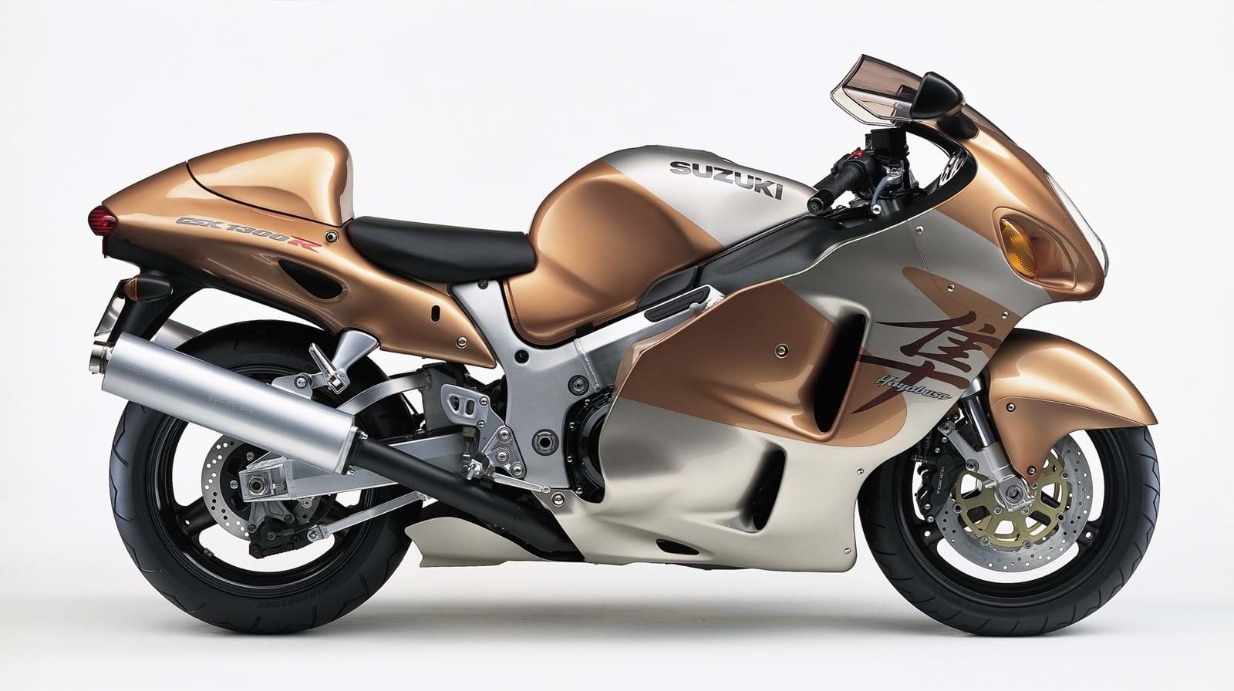
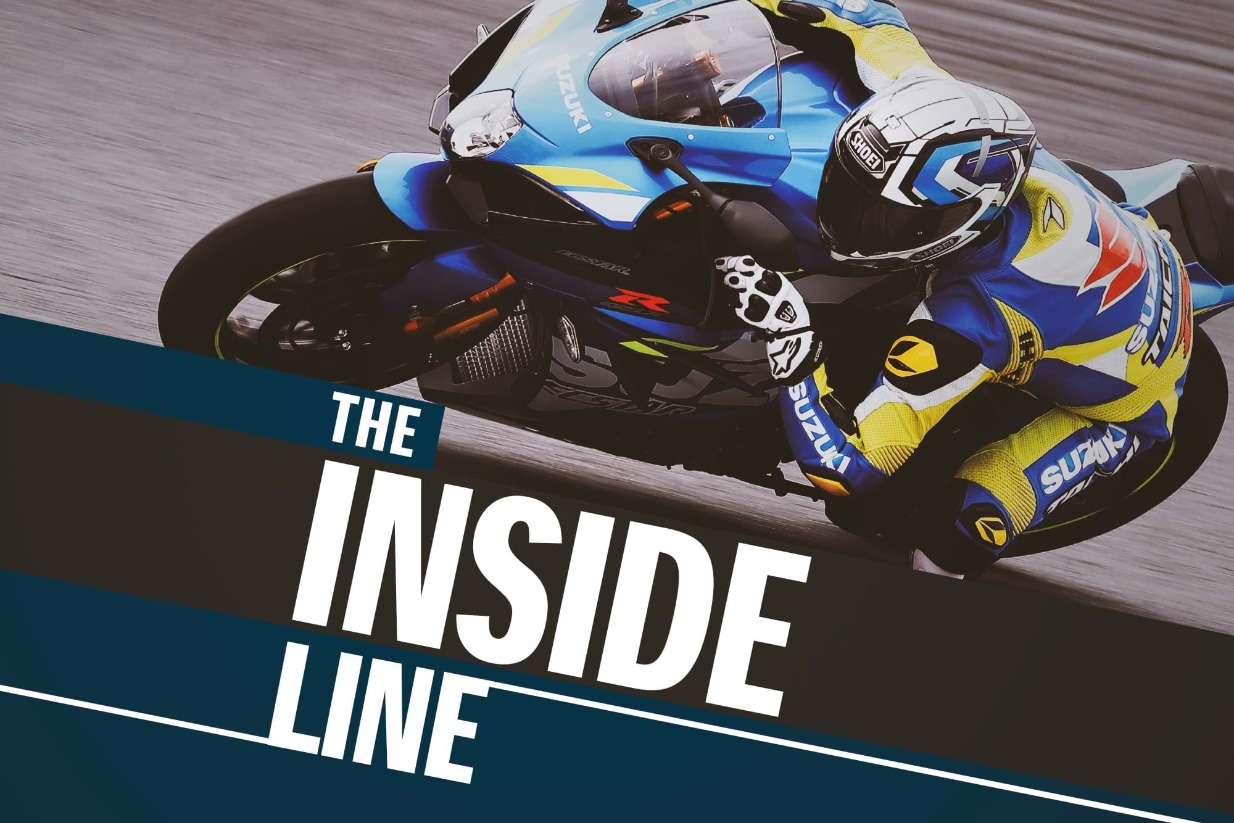
HAYABUSA LEGEND RE-LIVED ON LATEST INSIDE LINE PODCAST
The legend of the Suzuki Hayabusa is the latest topic to be discussed on the Inside Line podcast, as host Chris Moss talks to two other journalists that were on the launch of the original, a tuner, a race car builder, and a long distance traveller.
Martin Child talks to Moss about his attendance on the world launch for Bike Magazine, while Mark Hoyer dials in from the USA to talk about his experiences, plus the US Busa culture.
Sean Mills from Big CC reveals just what's possible from the Hayabusa's engine, and tells us about his 1000bhp Busa that's good for nearly 300mph, before Radical Sportscars Will Brown explains just why the Hayabusa engine is a perfect fit for their racing exploits.
Sushanth Shetty then showcases how the Busa is not just good at going fast, but good at going far, too, by recounting his trip from London to India.
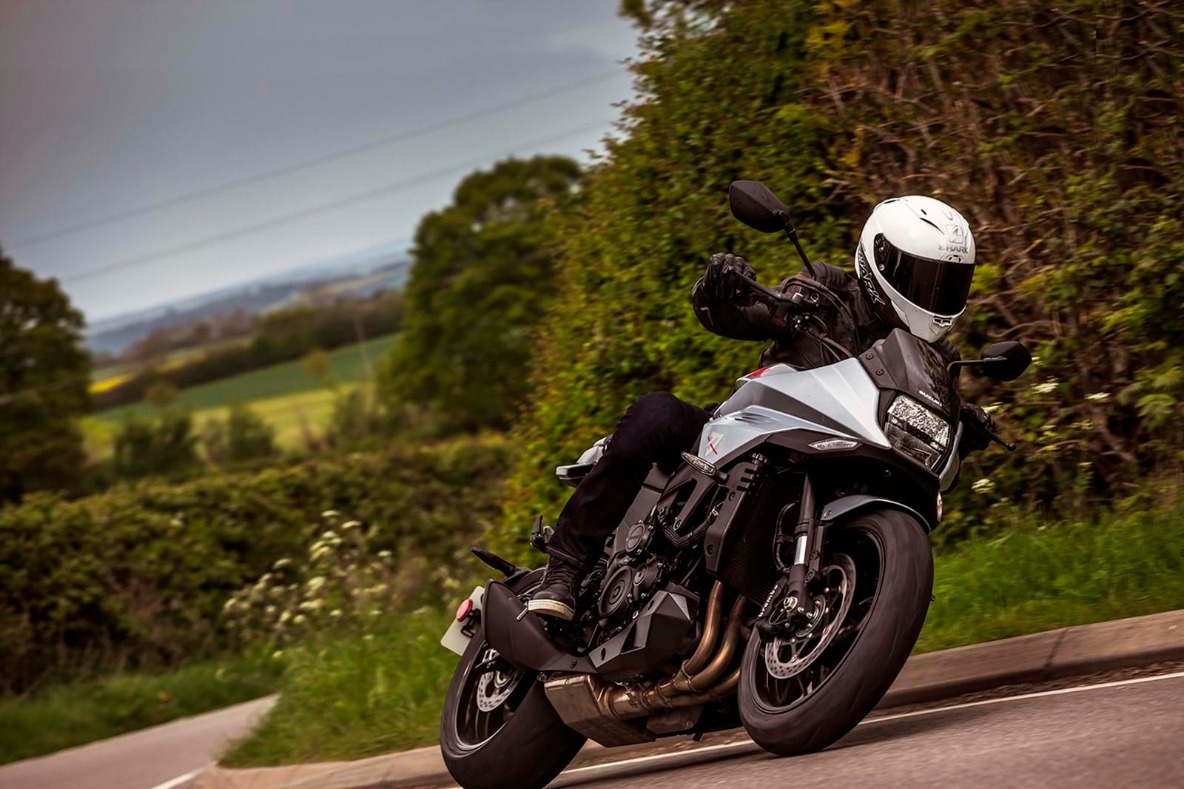
SUZUKI OFFERS ADDITIONAL £500 OFF ON TOP OF EXISTING 0% APR FINANCE CAMPAIGN
Suzuki GB is offering customers an extra £500 off the RRP of selected models this spring, in addition to its current four-year 0% APR Hire Purchase finance deal that is currently available.
The money-saving offer follows the most recent government announcement, allowing dealerships to take orders online or over the phone and deliver new bikes and parts to customers, in line with social distancing measures. It means those looking for a new bike this spring can still take delivery and start planning those post-lockdown rides.
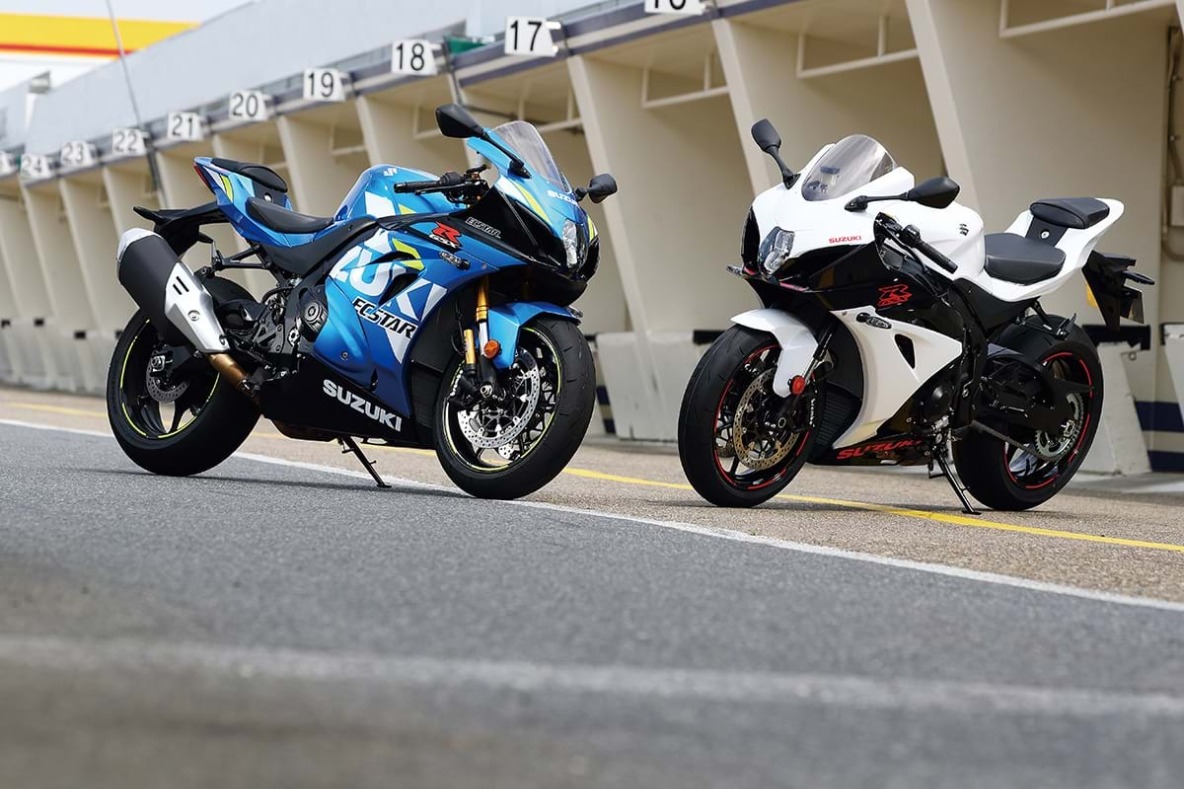
Available with both an additional £500 off and included in the 0% APR offer is Suzuki’s championship-winning GSX-R1000R and the GSX-R1000, along with the Katana and V-Strom 650 and 650XT. The GSX-S range – the 750, 1000, and 1000F – is also included.
Suzuki is also offering £500 off its SV650X and S650, taking their RRPs to £6099 and £5499, while extending its current £500 off campaign on the entry-level GSX-R and GSX-S125 machines, bringing the cash prices down to £3899 and £3599 respectively.
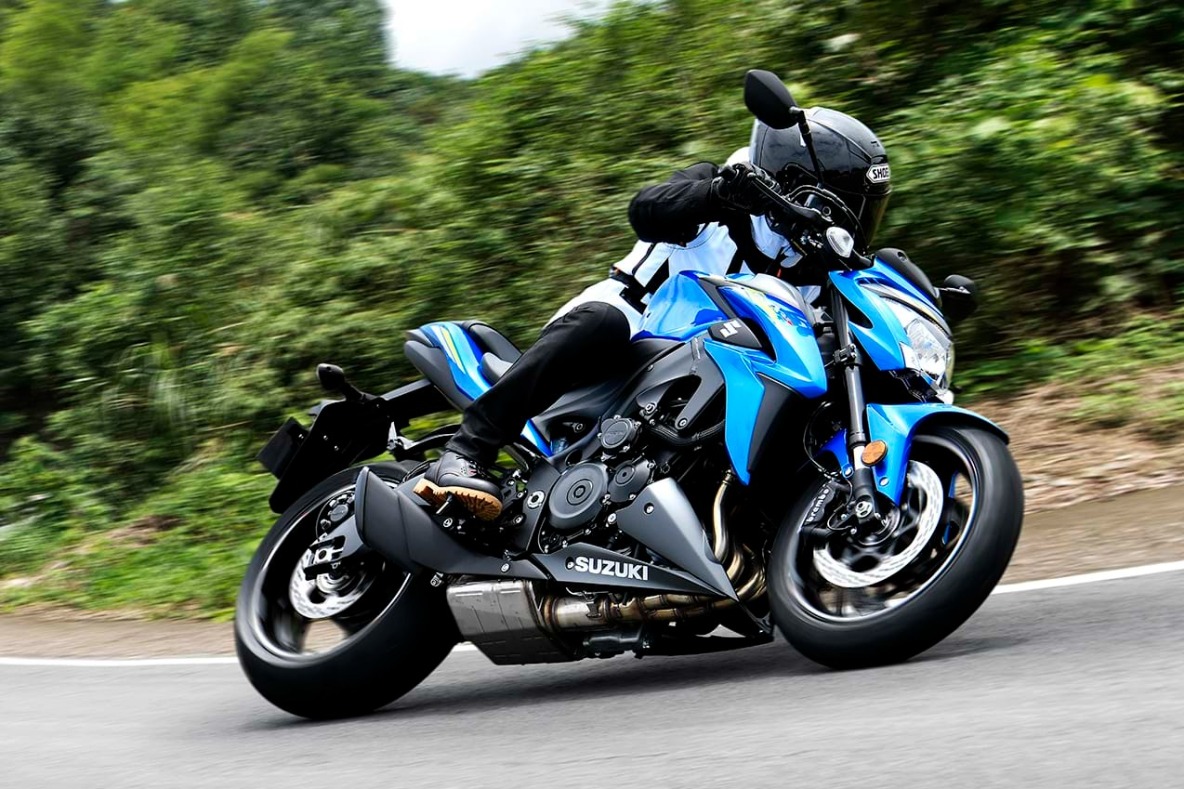
Suzuki GB head of motorcycles, Jonathan Martin, commented, “This is obviously a unique time for everyone. However, we’re also acutely aware that people want to look beyond the current situation, plan for the future and look forward to riding motorcycles again. By extending our offer into the start of summer we’re giving more people a chance to take advantage, put a new bike in the garage for less, and get ready to ride when the current restrictions are lifted.”
Terms & Conditions: 0% APR Finance available on Hire Purchase with £500 minimum deposit. £500 customer saving is available with or without finance.Credit is subject to status and is only available to UK residents aged 18 and over. Suzuki Finance, a trading style of Suzuki Financial Services Ltd, St. William House, Tresillian Terrace, Cardiff, CF10 5BH.
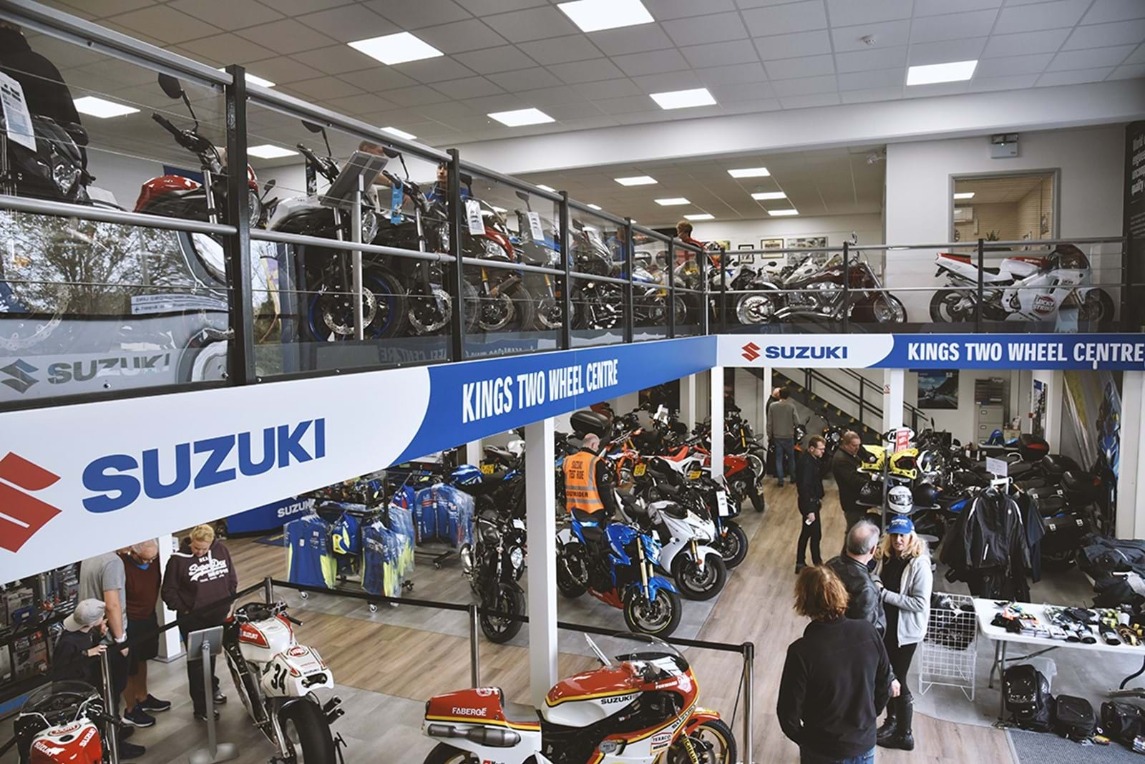
SUZUKI DEALERSHIPS TO OPEN ON JUNE 1
Suzuki's dealer network is set to re-open on June 1, and with the new V-Strom 1050XT in showrooms and a host of offers available across the range, it's the perfect time to head in.
Of course, despite the country's lockdown rules relaxing to a degree, Suzuki's dealerships will be following strict guidelines and practices around cleanliness and social distancing, plus the adoption of PPE where required, to ensure the safety and wellbeing of both customers and staff alike.
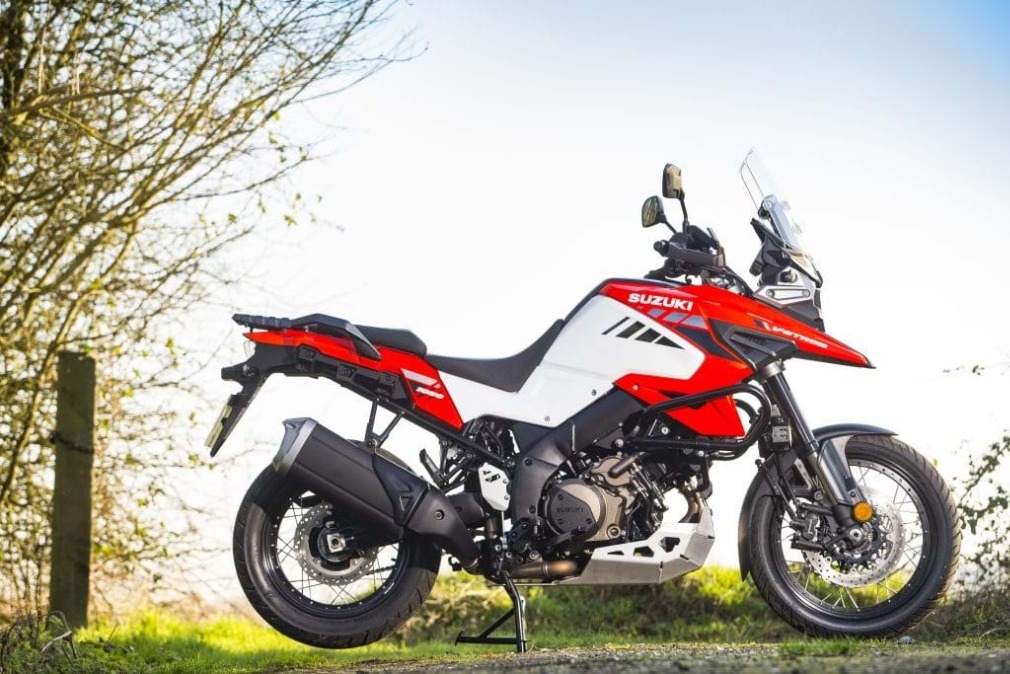
Yet with the new V-Strom 1050XT and V-Strom 1050 beginning to arrive in showrooms just prior to the lockdown coming to force, the re-opening will give many potential suitors their first chance to try one for size and take a test ride.
Suzuki is also currently offering 0% APR HP finance across much of its big bike range, as well as knocking £500 off the RRP to help customers get on a new Suzuki this summer.
Terms and Conditions:
0% APR offer applies to purchases of all variants of the GSX-R1000R, GSX-R1000, GSX-S1000F, KATANA, GSX-S1000, GSX-S750, and V-Strom 650/XT purchased from a participating Suzuki Dealership. HP finance only. Minimum deposit required: £500. Credit is available to UK residents aged 18 and over, subject to status. Suzuki Finance is a trading style of Suzuki Financial Services Limited. St William House, Tresillian Terrace, Cardiff, CF10 5BH. The purchase and registration of the motorcycle must take place between 01/02/2020 and 30/06/2020. This offer may be extended or withdrawn at any time.
†To qualify for the £500 purchase contribution, simply contact your preferred Suzuki Dealer directly. Purchase and registration of your chosen motorcycle must take place between 27/04/2020 and 30/06/2020. £500 purchase contribution is available to both finance and non-finance customers. Offer may be extended or withdrawn at any time.
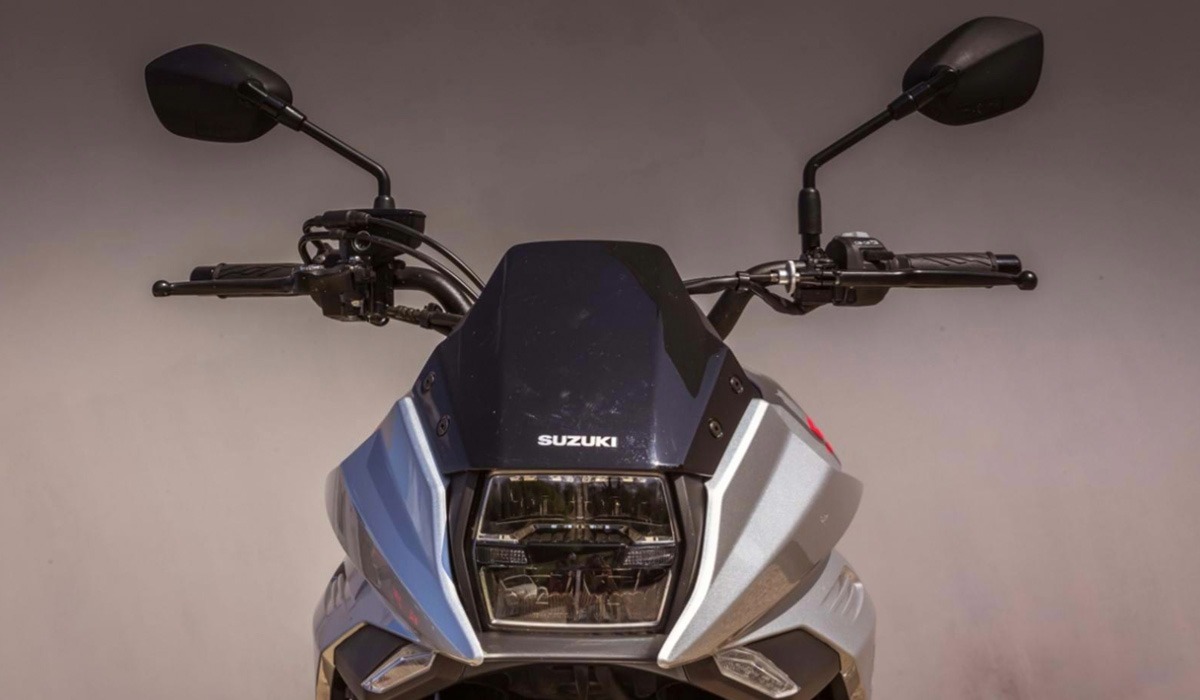
SUZUKI ANNOUNCES WINTER OFFERS INCLUDING 0% APR FINANCE ON GSX-R1000R AND KATANA
Suzuki has announced its winter offers, which run until the end of March 2020 and include 0% APR finance on a number of key models in its current on-road range, plus £500 off its 125cc motorcycles.
Suzuki’s headline offer of 0% APR HP finance over 48 months is available on the range-topping GSX-R1000R and GSX-R1000, the new-for-2019 Katana, the GSX-S1000 and GSX-S1000F, GSX-S750 as well as the standard and XT variants of the V-Strom 650 – all with a minimum deposit of just £500 required.
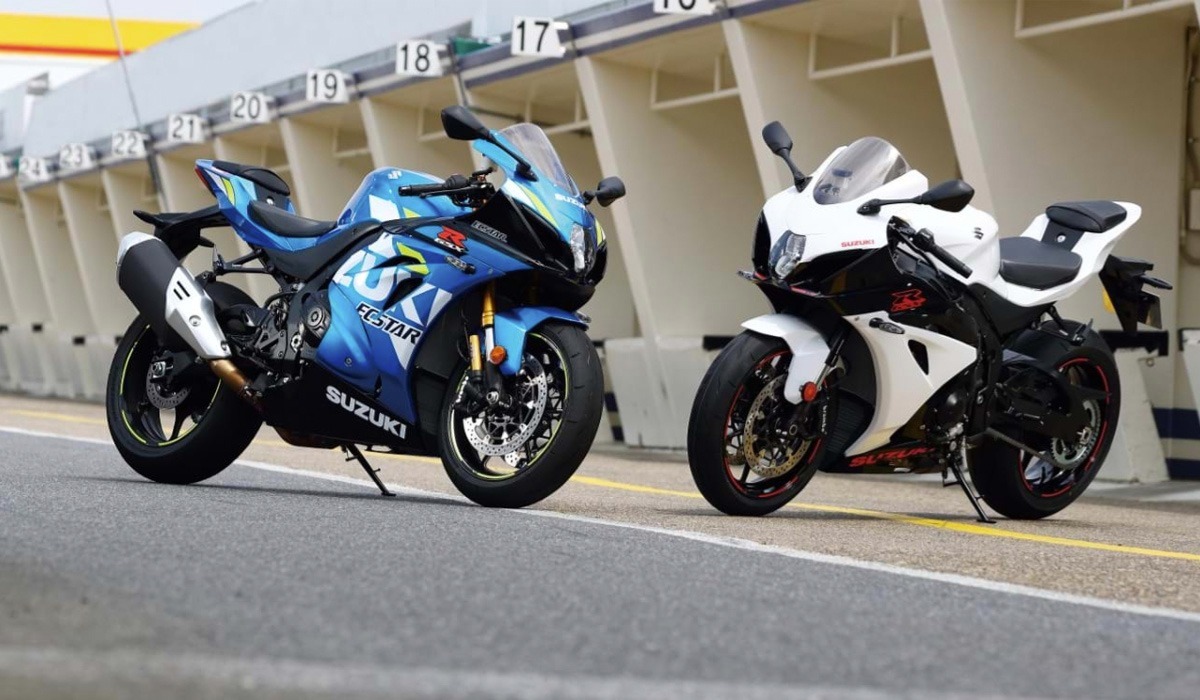
As a result, some of Suzuki’s most popular models are now available with even more affordable monthly repayments, plus there’s the added benefit that you’ll be the owner of the bike once you’ve paid all the monthly repayments.
Those looking for a learner or A1 licence-friendly machine can benefit from £500 off Suzuki’s GSX-R125 and GSX-S125 models, which lowers prices to £3,899 and £3,599 respectively until the end of March. Both bikes use a free-revving DOHC single-cylinder engine, with styling that echoes their larger GSX-R and GSX-S siblings.
For more information on the latest Suzuki promotions, visit our promotions page.
Terms & Conditions: £500 minimum deposit. HP finance only. Credit is available to UK residents aged 18 and over, subject to status. Suzuki Financial Services Limited, St William House, Tresillian Terrace, Cardiff, CF10 5BH. This offer may be extended or withdrawn at any time.
THREE V-STROM 1050 ACCESSORY PACKS ANNOUNCED AHEAD OF SPRING ARRIVAL
Suzuki has announced three accessory packs for its hotly anticipated V-Strom 1050 and V-Strom 1050XT ahead of their arrival in March, and knowing everyone’s idea of adventure varies, Suzuki has tailored its new kits to suit.
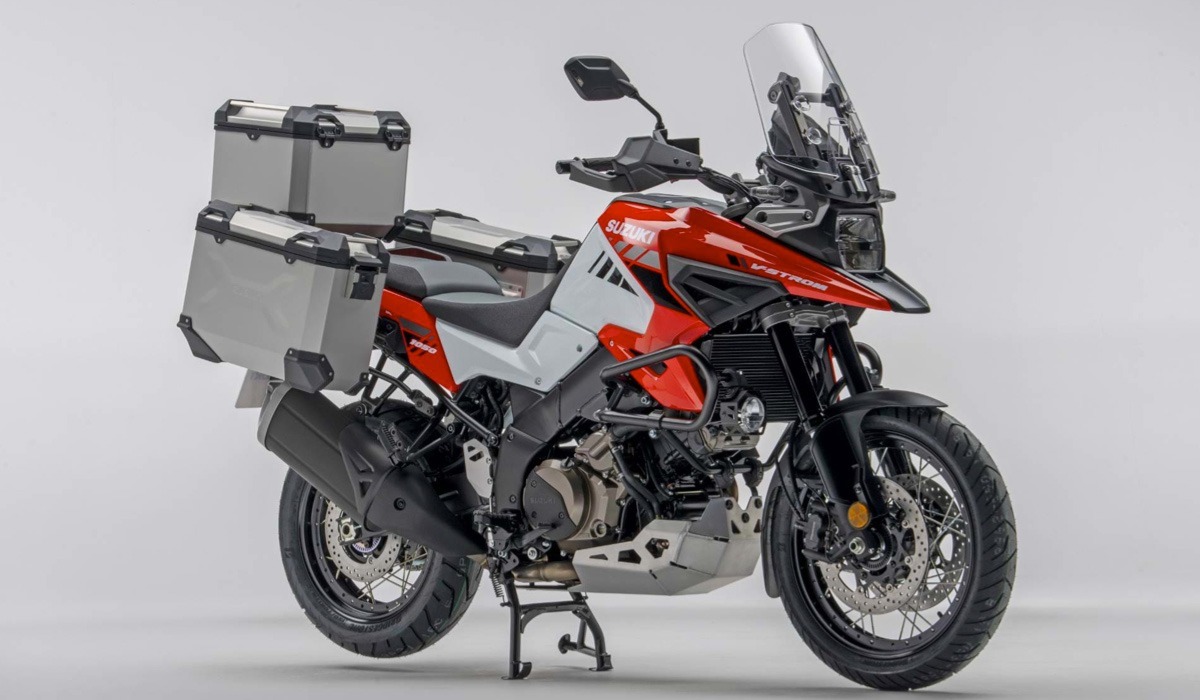
A fully-loaded Explore pack equips the DR-Z-inspired V-Strom 1050XT with full aluminium luggage, engine bars, LED fog lamps, aluminium bash plate, and heated grips. Ideal for those looking to cover big mileage and conquer rougher terrain, the Explore pack comes with an RRP* of £2,499 and represents a saving of £626 over the cost of the individual items.
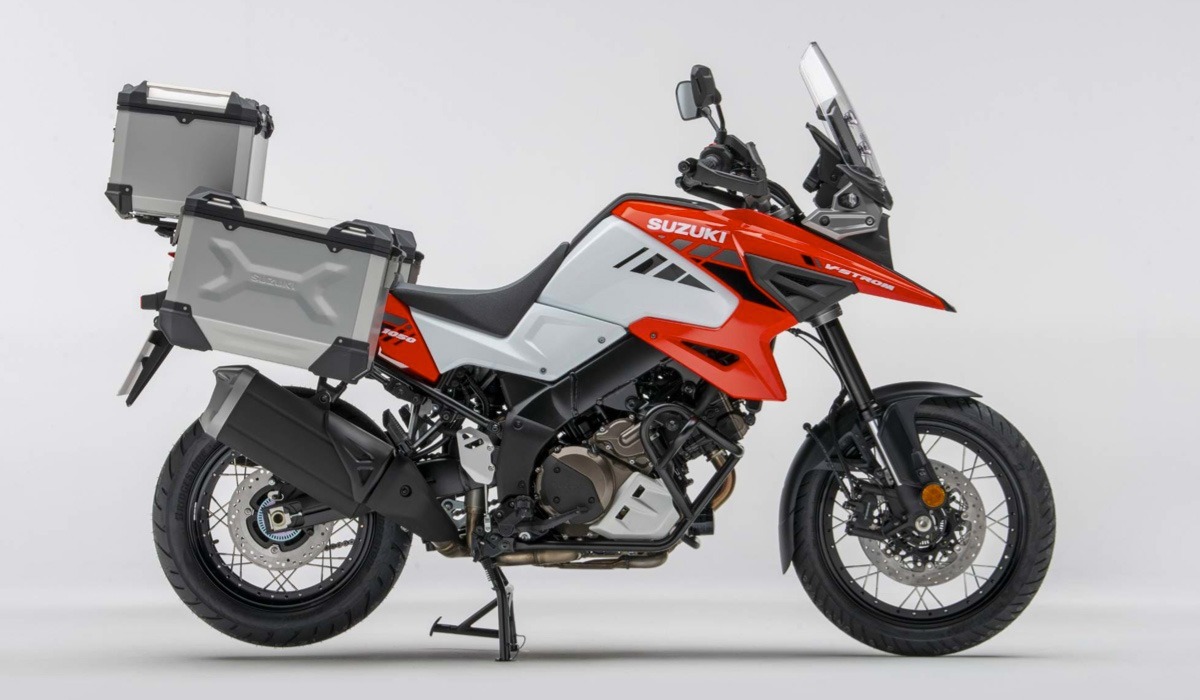
For customers plotting weekends away the Tour pack comprises full aluminium luggage and costs £1,299, meaning a saving of £316. Those looking to exploit the V-Strom 1050s capabilities as a city tool can opt for the City pack which includes a spacious 55-litre top box and centre stand for £549, saving £115 in the process
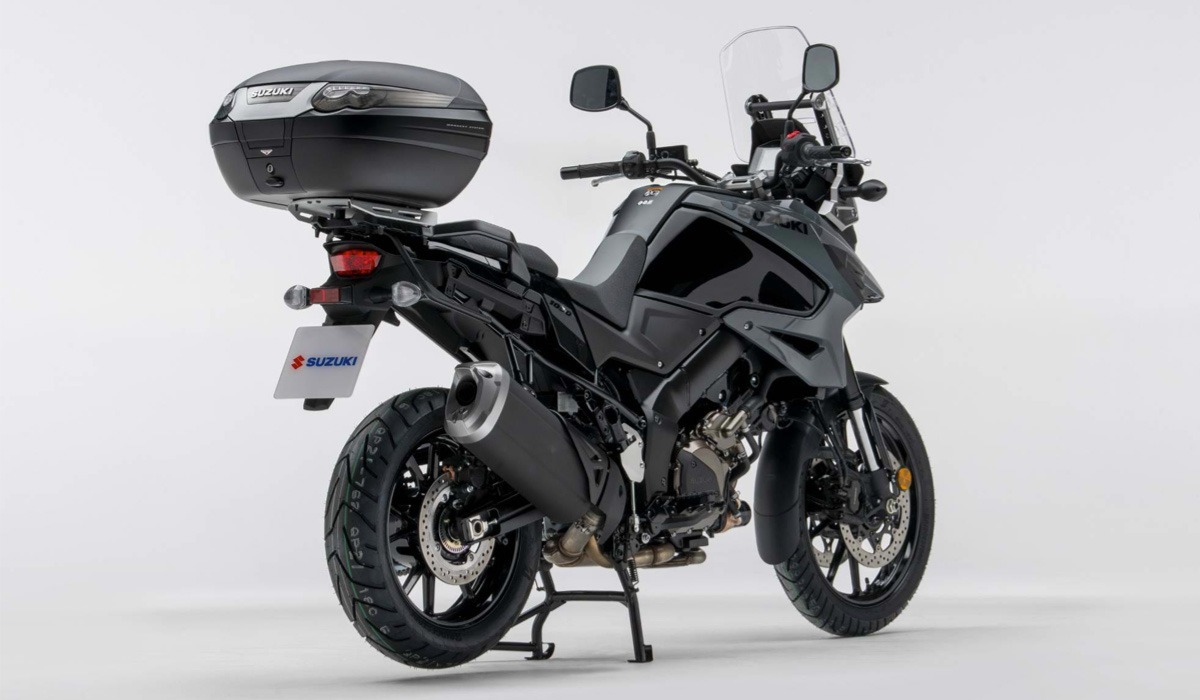
Suzuki GB’s national motorcycle marketing manager, Ian Bland, commented, “We know a lot of owners want to add a personal touch or tailor their V-Strom to their specific needs, and by offering three different accessory packs that is now not only easier but also more affordable, too. The packs can also be fitted at the point of sale, and benefit from the same three-year warranty we offer across our range.”
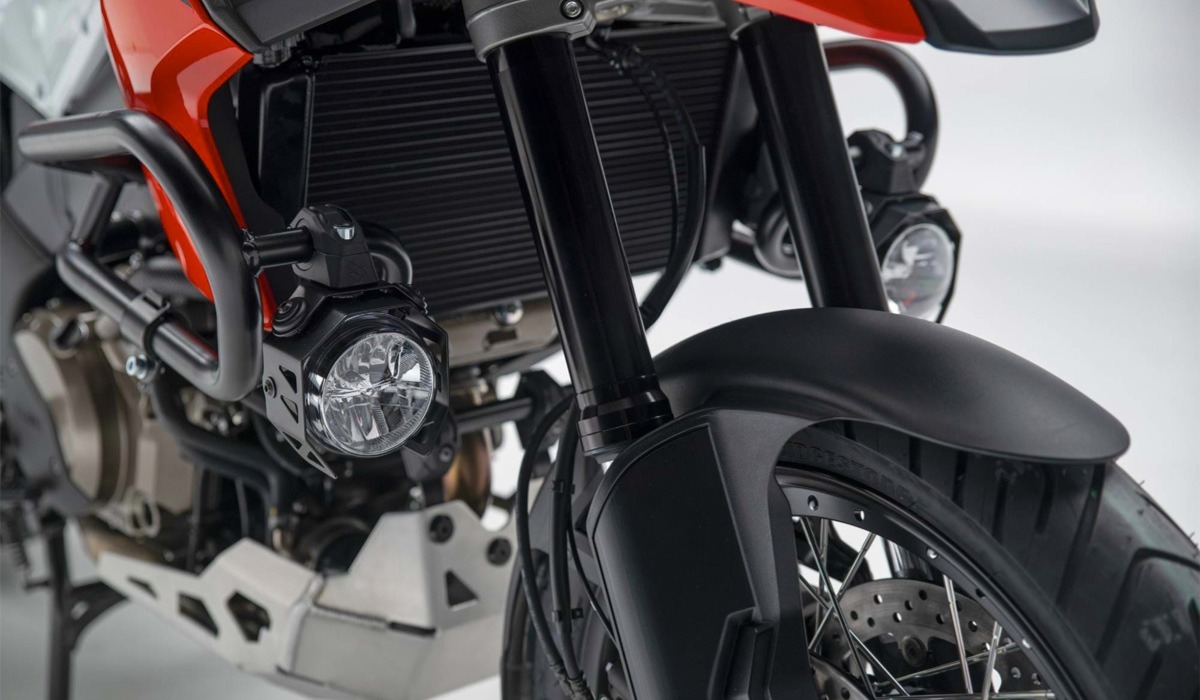
The new V-Strom 1050 and V-Strom 1050XT use an updated version of Suzuki’s 1037cc V-Twin engine, the Euro5 version of the popular power plant producing 7% more power than the previous iteration. Both machines also get a three-mode traction control system and three selectable engine power modes.
An enhanced electronics package on the V-Strom 1050XT boasts Suzuki’s Intelligent Ride System (SIRS), which, with a six-axis inertial measurement unit (IMU) at its heart, includes lean angle-sensitive ABS with two settings, linked brakes that can detect and adapt to load and inclines, plus hill hold control and cruise control.
*RRP excludes fitting.
Explore and Tour packs available on both V-Strom 1050XT and V-Strom 1050. City pack available on V-Strom 1050 only.
HONDA IS CELEBRATING THE PRODUCTION OF 400 MILLION MOTORCYCLES
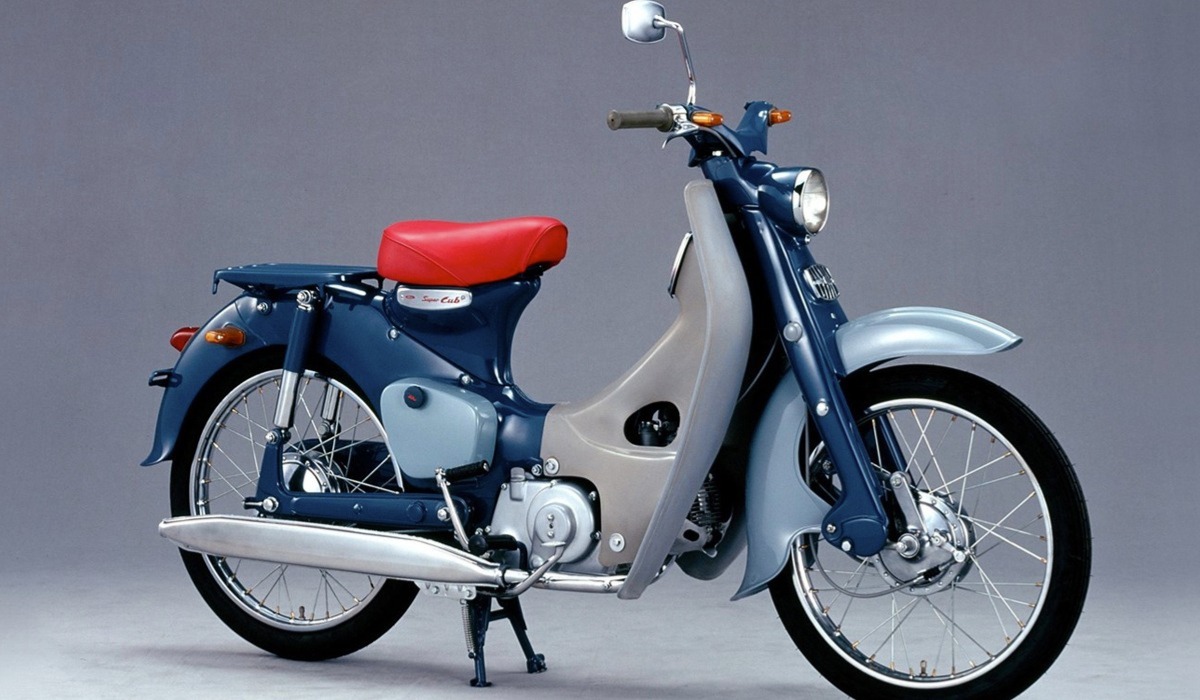
- Honda celebrating global production of 400 million units motorcycles and scooters
- Milestone reached after 70 years of motorcycle production
- First motorcycle factory outside of Japan opened in Belgium in 1963
Seventy years after the first Dream D-Type rolled out of the factory in 1949, Honda are today celebrating their 70th anniversary of motorcycle production having produced 400 million units world-wide.
Honda was founded in 1948. Motorcycle mass production at its first factory outside of Japan began in Belgium in 1963. Since then, Honda has expanded its global production in accordance with its fundamental principle of making motorcycles locally to supply demand, with 35 production facilities in 25 countries across Europe, Asia, Africa and the Americas.
Honda currently produces a wide range of exciting and dynamic motorcycles and scooters for the global market from funky 50cc commuters like the Dunk, to cutting edge off-road bikes like the CRF450R, to icons like the GL1800 Gold Wing, the new CRF1100L Africa Twin and the new 160Kw CBR1000RR-R Fireblade.
Since its foundation, Honda has continued to develop and produce products that meet the many and varied needs of its global audience based on the belief that ‘the purpose of technology is to help people’. This principle led Honda to achieving the 100 million-unit milestone in 1997, the 300 million- unit milestone in 2014, and today, the 400 million-unit milestone.
2018 saw Honda exceed annual global production of 20 million-units for the first time in its history and it continues to enjoy strong support from customers old and new across the globe.
Hondas continues to strive towards its 2030 vision to serve its worldwide audience with the ‘joy of expanding their life’s potential.”
Takahiro Hachigo, Chief Executive Officer, Honda Motor Co., Ltd
“For 70 years Honda has provided to customers worldwide motorcycles that make life easier and enjoyable. As a result, we have achieved our 400 million-unit milestone. I am grateful to all of our customers, and everyone involved in development, manufacturing, sales and service of our products. We will continue to do our best to provide attractive products that meet the needs and dreams of customers worldwide”
Honda’s 400 motorcycle million-unit journey –
1948 Honda Motor Co., Ltd founded
1949 The Dream D-Type went on sale
1958 The iconic Super Cub and Super Cub C100 join the Honda range
1959 Honda becomes worlds largest motorcycle manufacturer
1969 The CB750 goes on sale
1975 The GL1000 Gold Wing goes on sale
1986 The XRV650 Africa Twin joins the range
1992 The CBR900RR FireBlade goes on sale
2001 The SH125i goes on sale
2009 The VFR1200F is unveiled at the Tokyo Motorshow – the world’s first dual clutch motorcycle
2014 The Honda Super Cub becomes the most produced motorcycle in history (87 million units sold in 160 countries
Marc Marquez becomes the youngest ever premier class world champion at 21yrs of age
2015 The Gold Wing celebrates its 40th Anniversary
2017 Fireblade celebrates its 25th Anniversary
2019 CB750 celebrates its 50th Anniversary
100,000 DCT equipped motorcycles sold in Europe since its introduction in 2010
Honda celebrate winning 25th Premier Class Constructors Championship
Marc Marquez wins 8th world title
Honda’s Global Motorcycle production
1963 Belgium
1967 Thailand
1971 Indonesia
1976 Brazil and Italy
1979 North America
1980 Nigeria
1992 China
1997 Vietnam
2001 India
2013 Bangladesh
Honda’s Motorcycle Production Milestones
1968 Honda reaches 10 million unit milestone
1984 Honda reaches 50 million unit milestone
1997 Honda reaches 100 million unit milestone
2004 Honda exceed 10 million unit annual motorcycle production
2008 Honda reaches 200 million unit milestone
2014 Honda reaches 300 million unit milestone
2018 Honda exceed 20 million unit annual motorcycle production
2019 Honda reaches 400 million-unit milestone
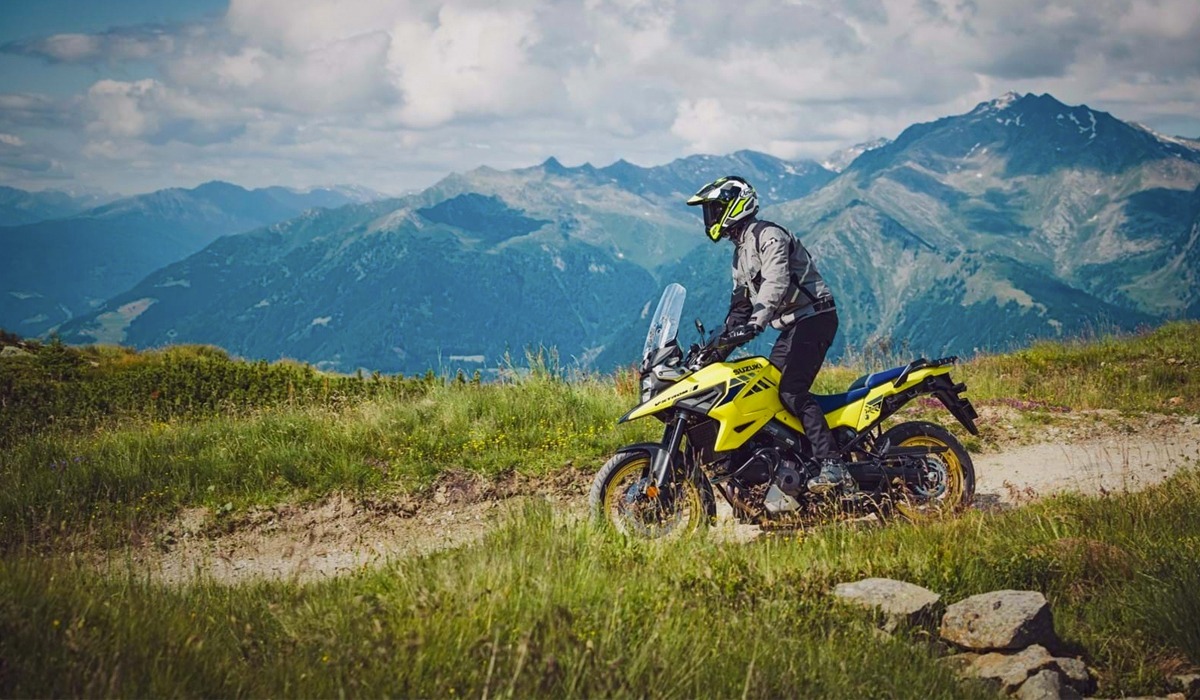
NEW V-STROM 1050 AND 1050 XT AVAILABLE TO ORDER NOW – PRICES START FROM £9,999.
Suzuki has announced pricing for its new DR-Z inspired adventure machine, with the V-Strom 1050 available for £9,999, while the flagship V-Strom 1050XT comes with an RRP of £11,299.
Both machines use an updated version of Suzuki’s proven 1037cc V-Twin engine, which produces 7% more power than the outgoing V-Strom 1000 while meeting Euro5 regulations. Peak power is now 107PS. They also get a three-mode traction control system, that can be turned off, and three selectable engine maps.
The V-Strom 1050XT’s electronics package is enhanced thanks to Suzuki’s Intelligent Ride System (SIRS), which features an inertial measurement unit (IMU), lean-angle sensitive ABS with two settings, linked brakes that can detect and adapt to load and inclines, plus hill hold control and cruise control.
The XT also swaps the V-Strom 1050’s cast aluminium wheels for spoked items, and boasts hand guards, engine bars, and a centre stand as standard.
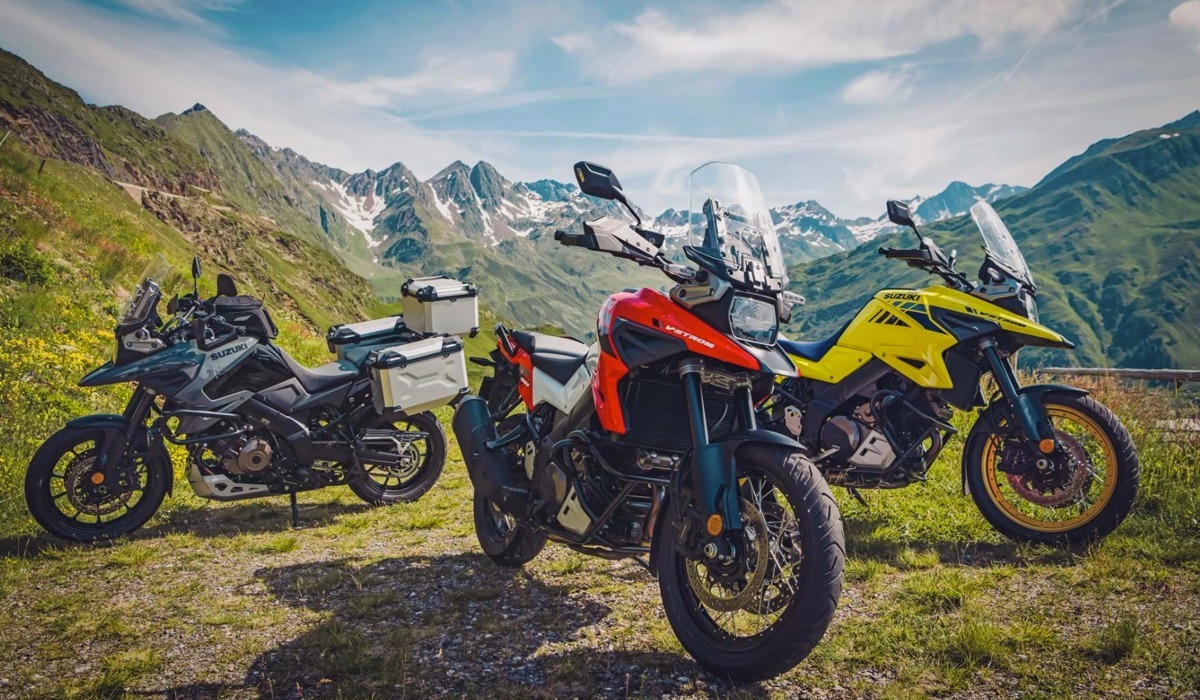
Announcing the pricing, Suzuki GB’s head of motorcycles, Jonathan Martin said, “Suzuki’s V-Strom range has always delivered exciting and dependable performance you can enjoy every day and everywhere while offering great value, and the new V-Strom 1050 and V-Strom 1050XT continue to do that.
“Available from just £9,999, it means it is the most competitively priced adventure bike over 1000cc, and means customers can enjoy all the benefits of the new V-Strom 1050s plus still afford to take off on some adventures on their new bikes.”
The new V-Strom 1050 and V-Strom 1050XT are currently on display at Motorcycle Live, which is taking place at Birmingham’s NEC until Sunday 24 November.
SUZUKI STAY WARMER WITH SUZUKI WITH 25% OFF HEATED GRIPS
Suzuki is helping riders stay warmer this winter, by offering 25% off all heated grips from 1 November 2019 until the end of February 2020.
Genuine Suzuki heated grips are available for the firm’s V-Strom range, as well as the GSX-S1000 and GSX-S1000F, plus the entire scooter lineup, from Burgman 400 to Address 110.
The offer can mean a saving of over £80, depending on the model.
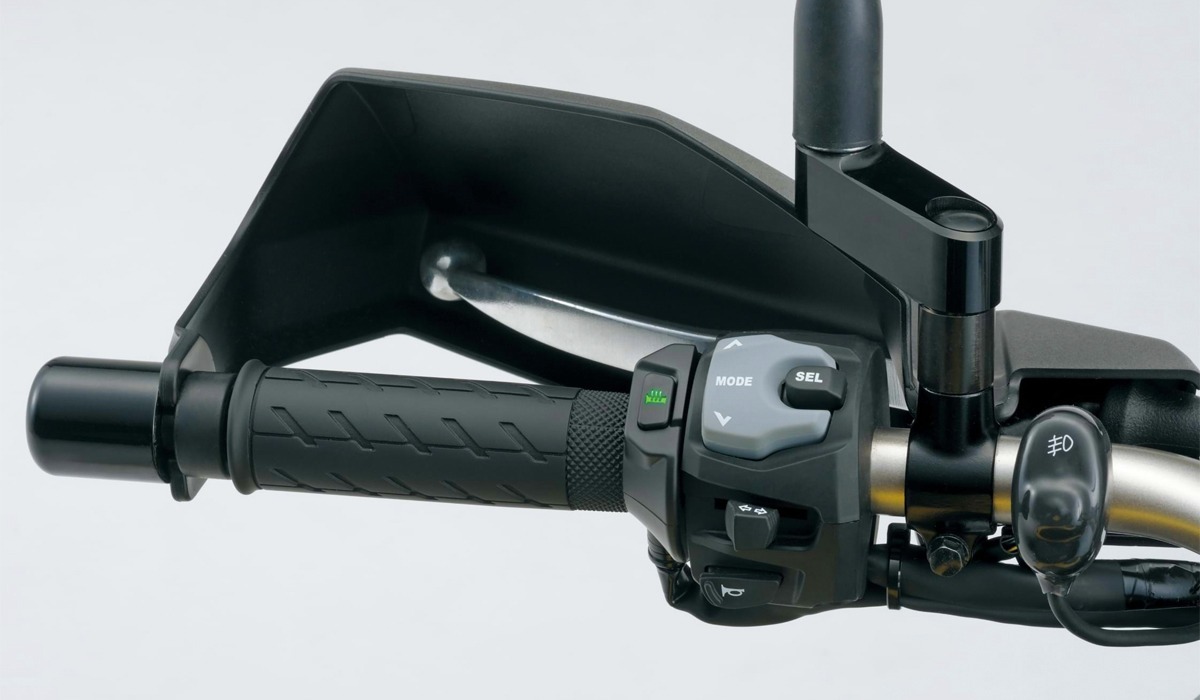
Suzuki’s genuine accessory range also includes items such as centre stands, hand guards, top boxes and panniers, and taller screens.
SUZUKI DISPLAYS NEW COLOURS FOR 2020 AT MOTORCYCLE LIVE
Suzuki has displayed new colours for its 2020 model range at Motorcycle Live, which is currently taking place at Birmingham’s NEC.
The GSX-S1000 super-naked – which uses the legendary GSX-R1000 K5-derived engine packed with grunt and character, housed in a lightweight twin-spar aluminium chassis and kept in check by a three-mode traction control system – comes in a new grey and matt black for 2020, set off by dark red accents and matching wheels, alongside a white version with blue detailing, and a MotoGP-inspired blue.
The same white and blue colour schemes are also available on the GSX-S750 and leaner-friendly GSX-S125. The 750 can also be had in a striking white, black, and dark red option, while the 125 is available in a standout matt grey and black. Both get red wheels.
An all black version of the GSX-S1000F – which adds a wind-cheating fairing and screen to the GSX-S1000 package to create the comfy sports bike – will be available in 2020, along with a blue and black variant and white version with subtle blue graphics.
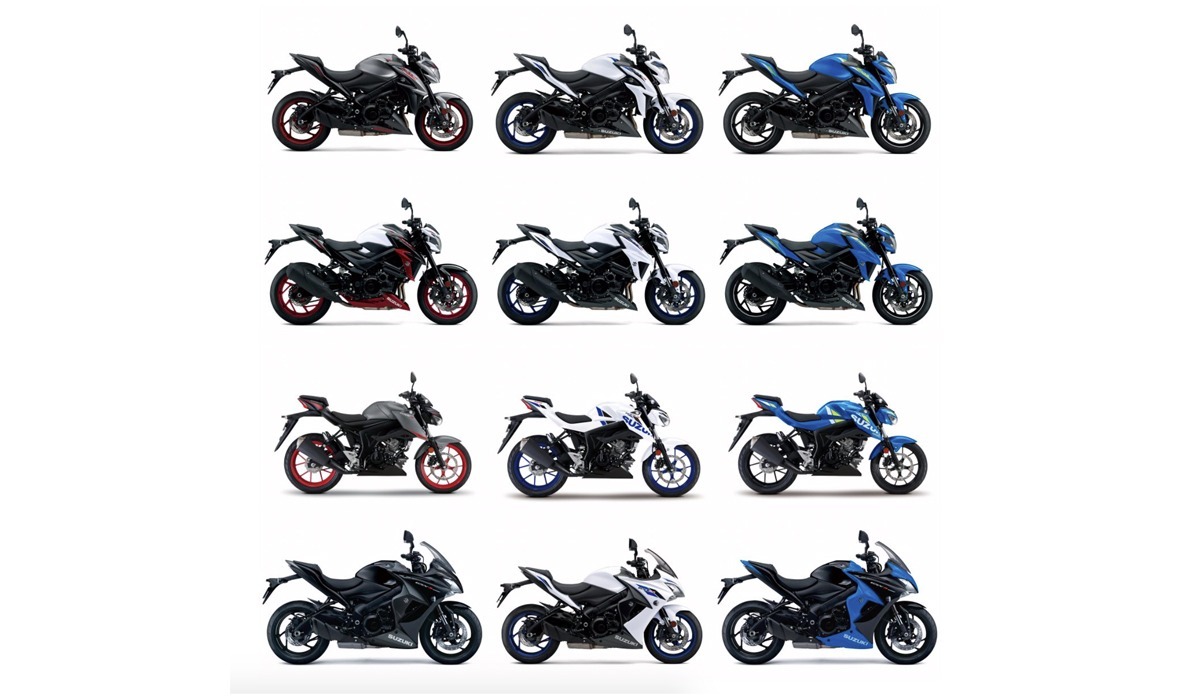
Three MotoGP-inspired liveries on the GSX-R125 – the race replica blue with white SUZUKI lettering, an inverted white with blue lettering, and a black with red lettering – match the liveries of the 2020 GSX-R1000R.
The GSX-R1000 also comes in the MotoGP blue, but is joined by a white and black version and an all-black edition.
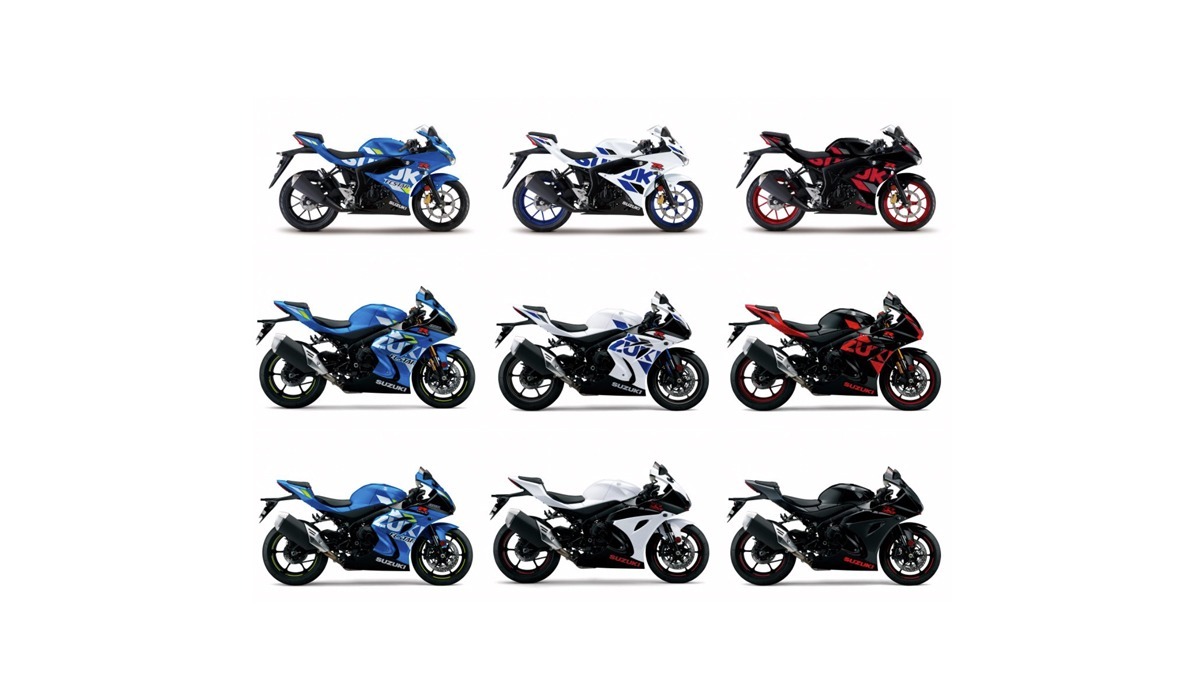
Off the back of launching its new V-Strom 1050XT and V-Strom 1050 at Eicma earlier this month, Suzuki has updated the colour options on the V-Strom 650XT and V-Strom 650 middleweight.
The more off-road focussed XT gets a revised version of the firm’s motocross yellow with gold spoke wheels. A black model gets the same rims, while a blue version uses black wheels.
Three colour schemes for the V-Strom 650 include a white, black, and solid grey.
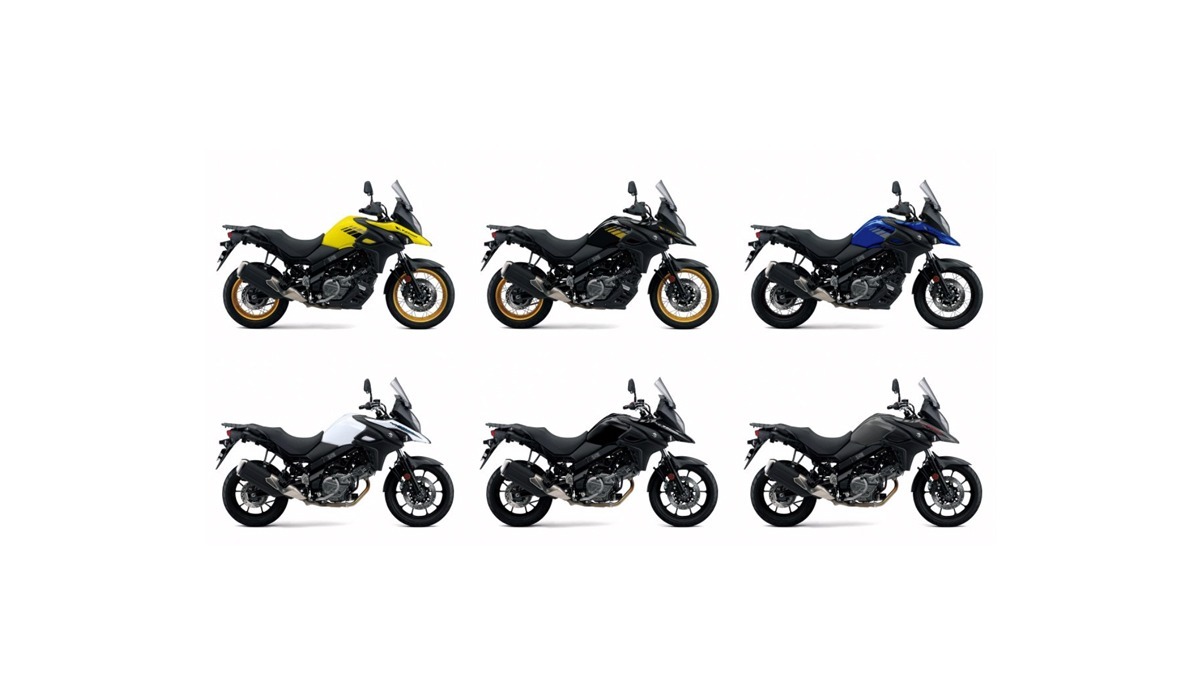
Suzuki’s scooter range – which includes the Burgman 400, the original maxi-scooter – also gets new paint. The Burgman 400 can be had in white or black with classy dark blue wheels, or dark blue with black wheels.
White and silver are the options available for the Burgman 125 and Burgman 200, while the congestion-busting Address comes in a royal blue or dark blue, or gloss white.
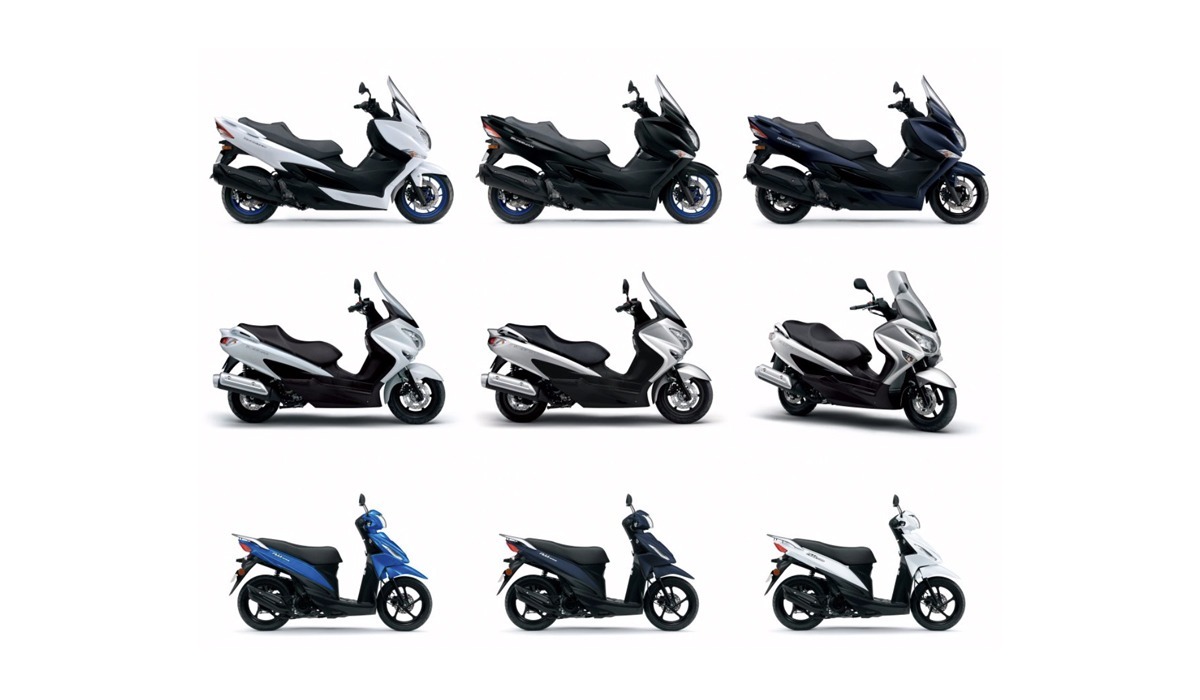
2020 colours for Suzuki’s SV650 include a metallic silver and blue trellis frame, a matt black version uses a similarly striking red frame and wheels, while those looking for a more understated SV650 can opt for a gloss black model with black frame and wheels.
The café racer-inspired SV650X comes in black with a brown ribbed seat.
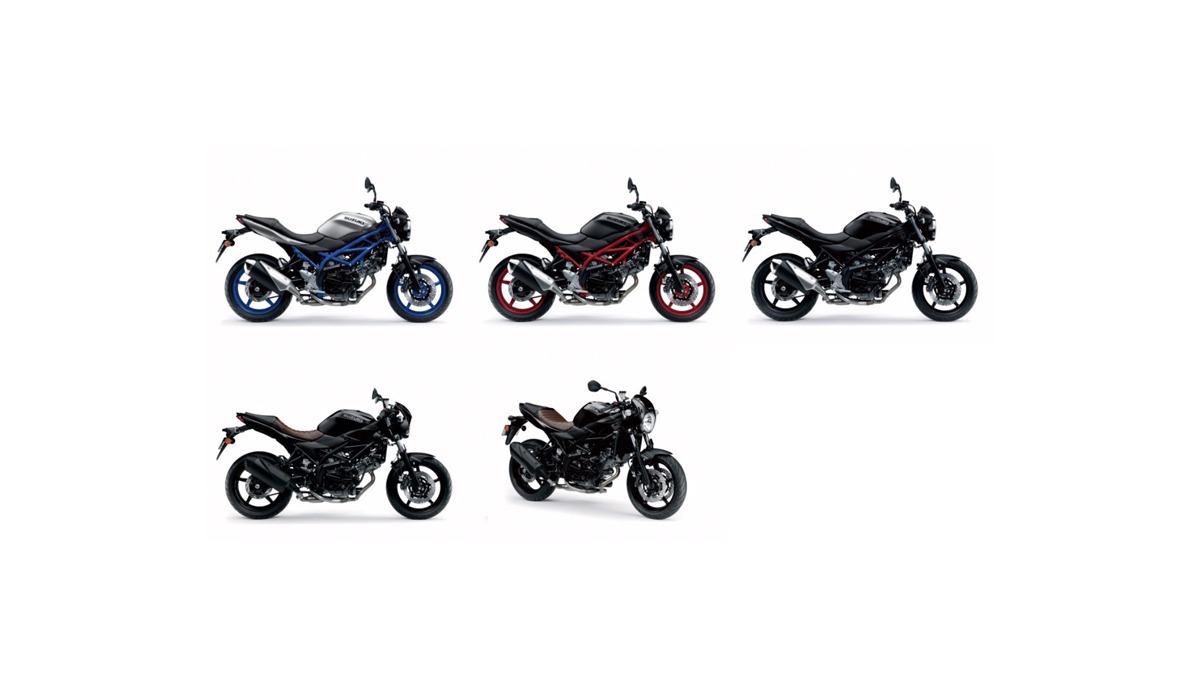
The Super Cub and Monkey return to Honda’s European line-up
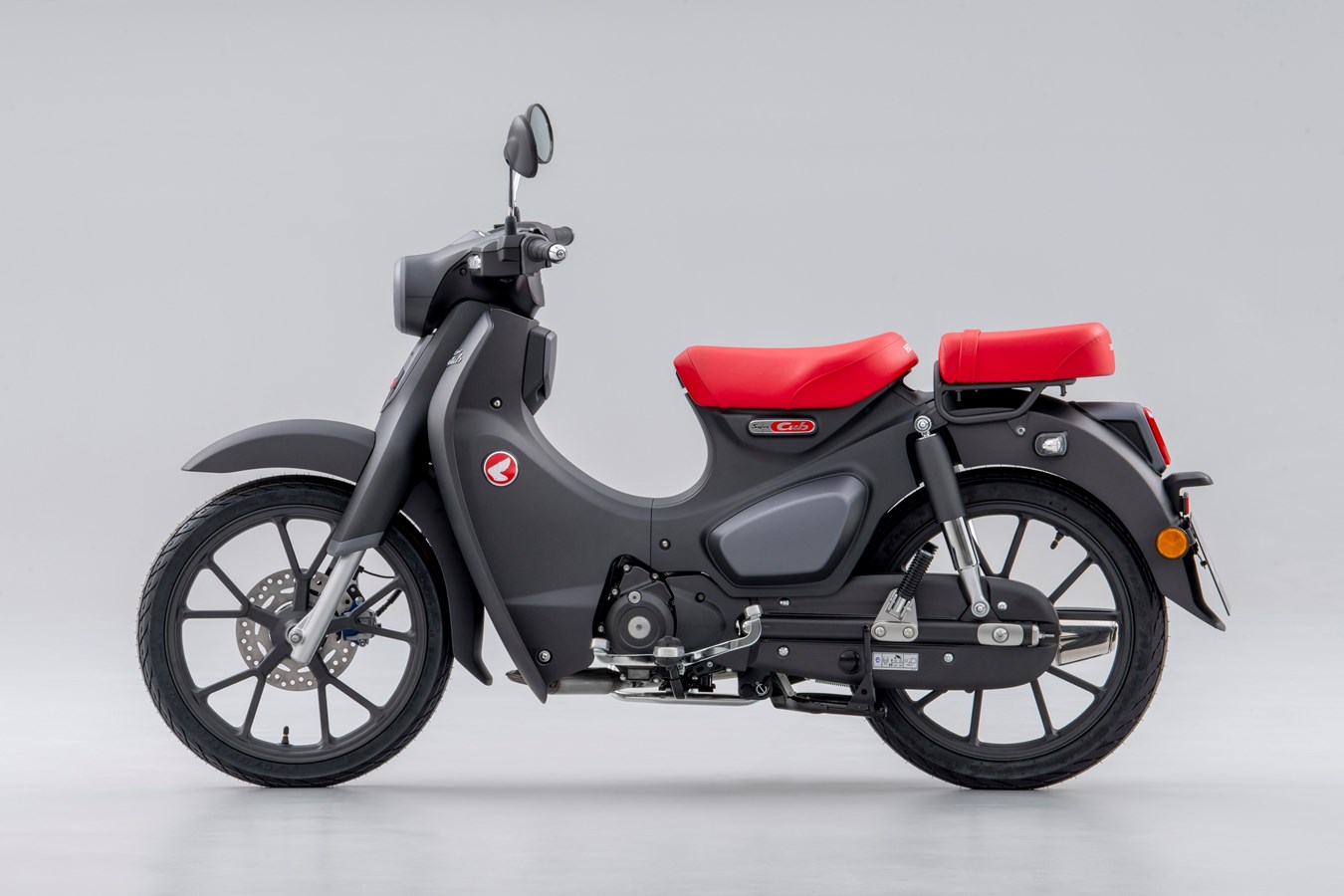
- The Super Cub now features a pillion seat and rear footpegs as standard with revised suspension to improve ride quality
- New highly efficient engine returns economy of 1.5L/100kM
- Iconic ‘S’ shaped Super Cub styling complemented by a new Matte Grey colour scheme complete with classic red seats
- The Monkey features a new engine and new 5 speed gearbox for improved long distance performance
- New two stage rear shocks improve Monkey’s handling and rider comfort
- Classic Monkey styling now features a new Pearl Glittering Blue colour scheme
- Both models are now EURO5 compliant
The Honda C125 Super Cub and Monkey 125 are returning to Honda’s European line-up. With brand-new air-cooled engines that feature EURO5 compliance, comfort-focussed chassis improvements and striking new colours, two of Honda’s most enduring icons are set to continue putting smiles on the faces of their European customers.
The Honda Super Cub, the world’s best-selling motor vehicle – having sold in excess of 100 million units worldwide since 1958 – now benefits from a new, more powerful SOHC air- cooled engine that produces outstanding fuel economy of 1.5L/100km (WMTC mode). The deft- handling Super Cub is fully at home in busy city streets, and, to match the engine improvements, has improved rider comfort thanks to suspension changes that smooth out the urban ride.
The iconic ‘S’ shaped Super Cub styling remains and now features a pillion seat and rear footpegs as standard alongside full LED lighting. This year this style is elevated by a brand-new Mat Axis Grey Metallic colour scheme, which in true ‘Cub style, is topped off with classic red seats that pays homage to the 1958 original.
Re-joining the Super Cub in Honda’s 2022 year model European line-up is the loveable Monkey. After its popular reintroduction in 2018 as a useful, fun motorcycle fit for 21st Century living, the Monkey now benefits from a new EURO5 compliant engine that returns peak power of 6.9kW and 11Nm of torque alongside excellent fuel economy of 1.5L/100km. With a potential range of over 370km from its 5.6L tank, a larger 5 speed gearbox has also been added to make longer journeys more enjoyable.
A key part of the Monkey’s success has been the friendly handling provided by its combination of steel frame, chunky 12in ‘block’ tyres and high-quality USD forks. Ride quality has been further improved with new two stage dual rear shocks designed to better deal with rougher road surfaces.
Of course, the classic Monkey style of old returns. Mini-ape handlebars, chromed mudguards, upswept exhaust, large padded seat combined with the chunky tyres and peanut shaped tank to make its silhouette unmistakable. This year the classic Banana Yellow and Pearl Nebula Red colour schemes are joined by a brand-new Pearl Glittering Blue to further emphasise the fun factor and continue the Monkey’s legacy as the fun motorcycle that began in 1961 with its introduction in Japan as an amusement park ‘runaround’.
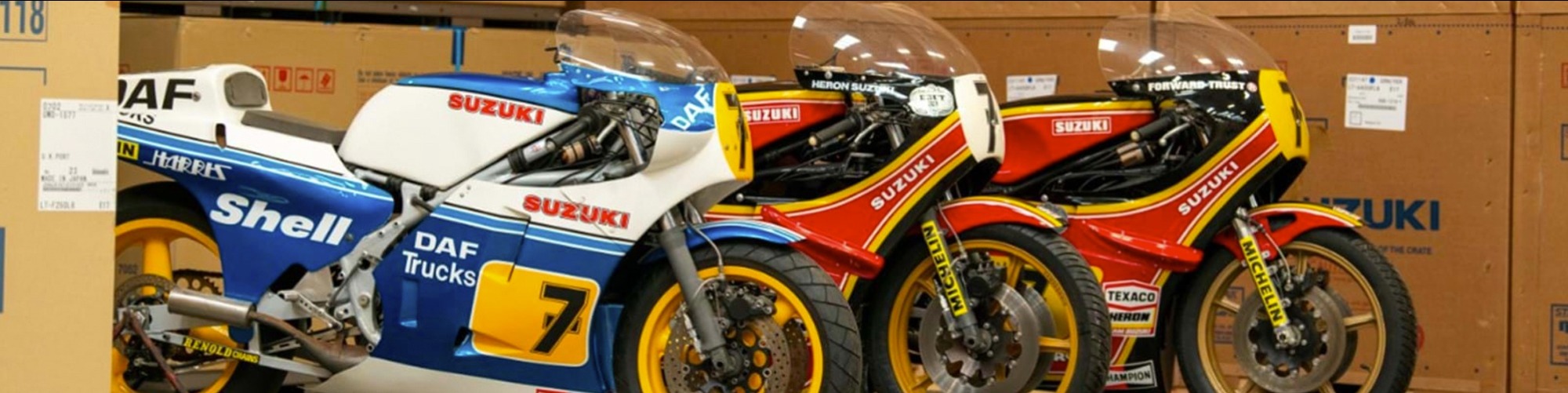
SUZUKI TO RESTORE MORE SHEENE BIKES AT MOTORCYCLE LIVE
Three more of Barry Sheene’s race bikes have arrived at Suzuki GB from the family home in Australia, and two of them will be restored at this year’s Motorcycle Live, which takes place at Birmingham’s NEC from 16-24 November.
Watch the arrival and uncrating of the bikes in the video below:
Sheene’s last Grand Prix bike – a DAF Trucks-sponsored 1984 Harris-framed XR45 RG500 – arrived alongside a 1978 XR27 RG500 and a special XR23A 652cc big bore RG500, raced in the Trans Atlantic series and F1 Championship in 1979.
In conjunction with Suzuki’s Vintage Parts Programme, both the XR45 and XR23A will be refurbished and fired into life once again at Motorcycle Live, while the XR27 will be displayed alongside Sheene’s 1976 and 1977 world championship-winning XR14s, both of which were also restored thanks to the Vintage Parts Programme in 2017.
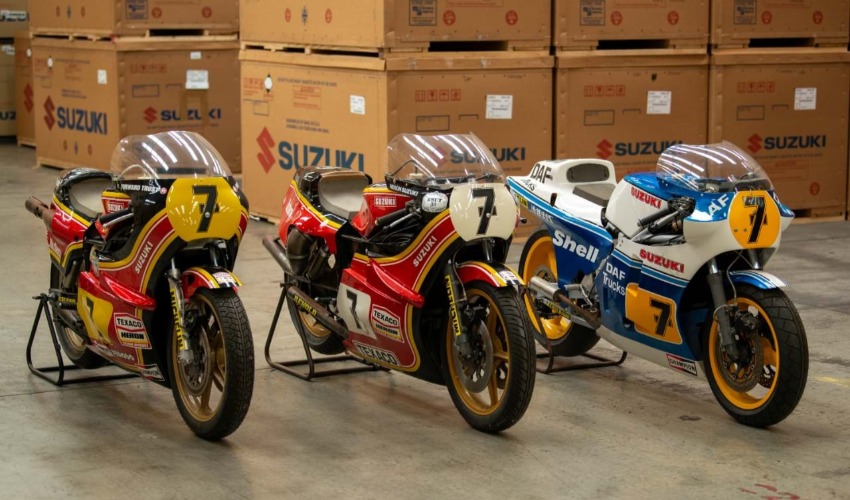
Suzuki GB aftersales marketing coordinator, Tim Davies, said, “This is another special moment for us. These bikes haven’t been back in the UK since Barry and his family emigrated to Australia, so it’s quite something to get them out of the crates and see them here again. But it’s going to be even more of a special occasion when they live again, thanks to the restoration process which will be carried out by former ‘70s and ‘80s Grand Prix technician Nigel Everett and former mechanic for Barry Sheene, Martyn Ogborne. And it’s a great opportunity for fans to again see, hear, and smell them as they would have existed at the time. We can’t wait.”
Launched in 2013, Suzuki’s Vintage Parts Programme exists to help owners of older Suzukis keep their machines maintained or help with restoration projects, with a host of parts available from cylinders, pistons, and conrods, to a range of bearings and seals, and everything in between.
For more information visit https://bikes.suzuki.co.uk/vintage-parts-programme/
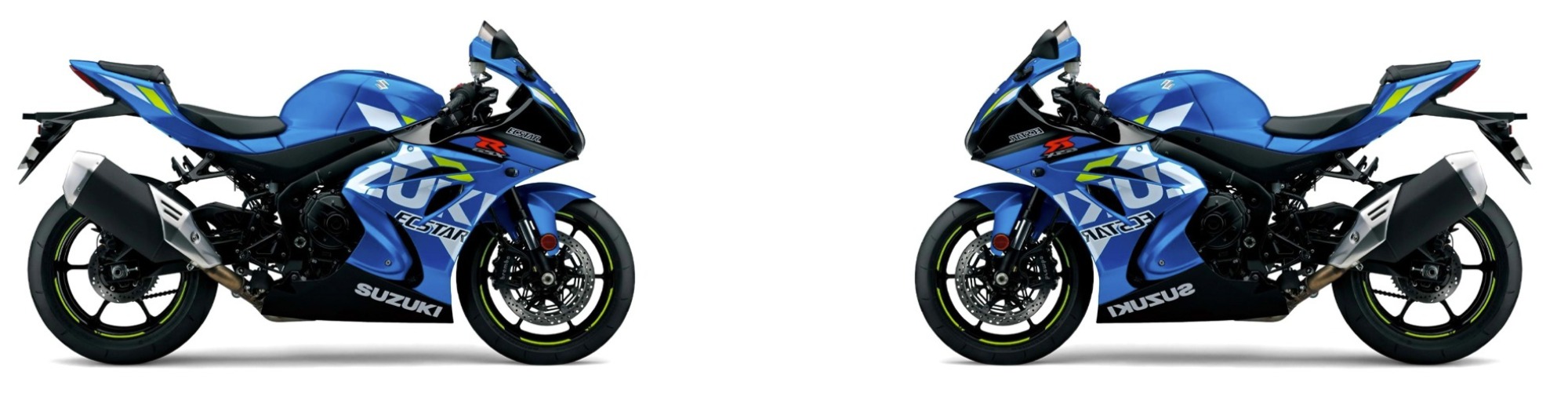
SUZUKI GSX-R1000 WINS NATIONAL SUPERSTOCK 1000 CHAMPIONSHIP
The Suzuki GSX-R1000 has won the 2019 National Superstock 1000 Championship at the hands of Richard Cooper and the Buildbase Suzuki team.
With two rounds to spare, a double victory at Oulton Park last weekend [6-8 September] gave Cooper an unassailable series lead in a championship where he has finished on the podium at every round apart from one, including 11 wins.
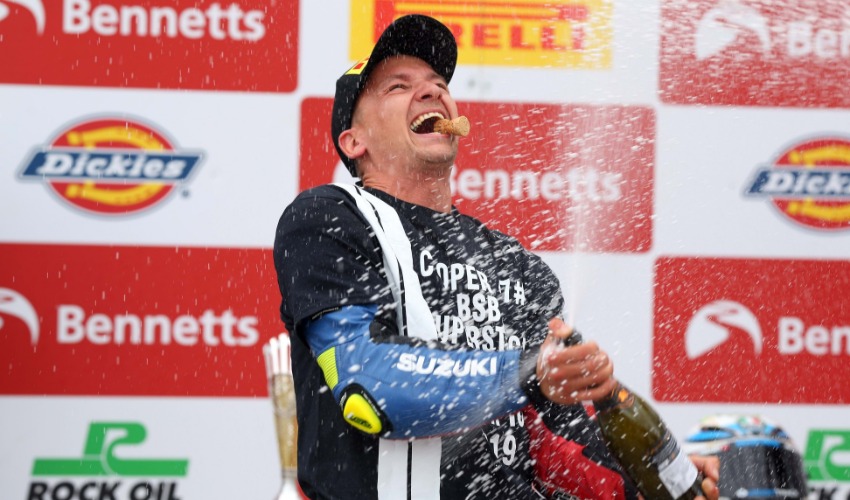
Cooper said after his title win, “It was ours to lose at Oulton but we approached the weekend in the same way we always do and in the way that’s seen us on the podium at every round bar one. Honestly, we’ve hardly touched the bike from round to round because it’s so rider-friendly. So then you’re riding the same bike each time you go out and just get more and more comfortable and more and more confident and can go out and enjoy yourself.
“In my opinion we’ve got the best all-round package on the grid. Other bikes have their own strong points, but when you look at every element, every aspect, I think it’s hard to argue otherwise, just because of how consistent and how strong it’s been at so many different types of circuit.”
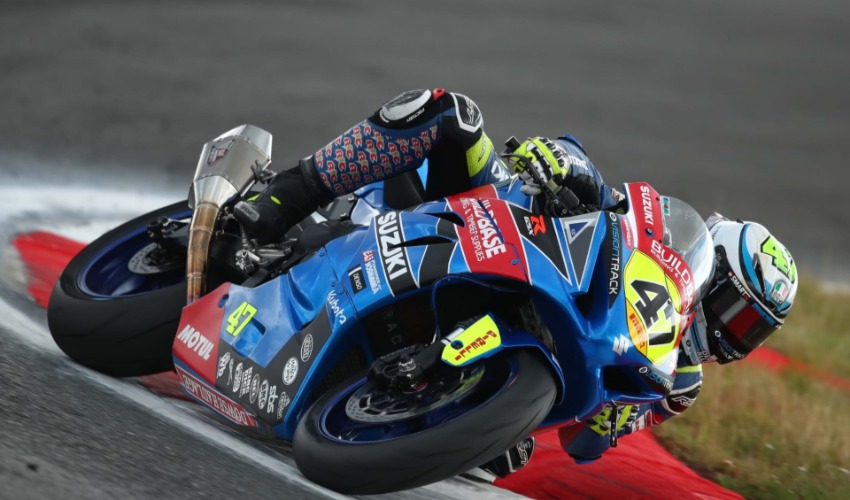
Suzuki GB head of motorcycles, Jonathan Martin, said, “The GSX-R1000 has proven itself as a competitive package since its launch, winning races and titles not only in the UK, but also across the world including MotoAmerica, Australian Superbikes, and around the Isle of Man TT course. The Buildbase Suzuki team turned it into a race-winner here at the first time of asking in 2017, and have now delivered an incredible title, for which we are incredibly thankful and proud.”
The GSX-R1000 and GSX-R1000R – both of which are currently available on 0% APR finance – inherit a host of technology developed on Suzuki’s GSX-RR MotoGP racer, including the inline four-cylinder engine’s variable valve timing, chassis design, and suite of electronics that features a bidirectional quickshifter, 10-mode traction control system, and launch control on the R. The R It also gets cornering ABS, adjustable swingarm pivot and Showa’s Balance Free suspension.
NEW COLOURS FOR 2020 SV650AND ADDRESS SCOOTER.
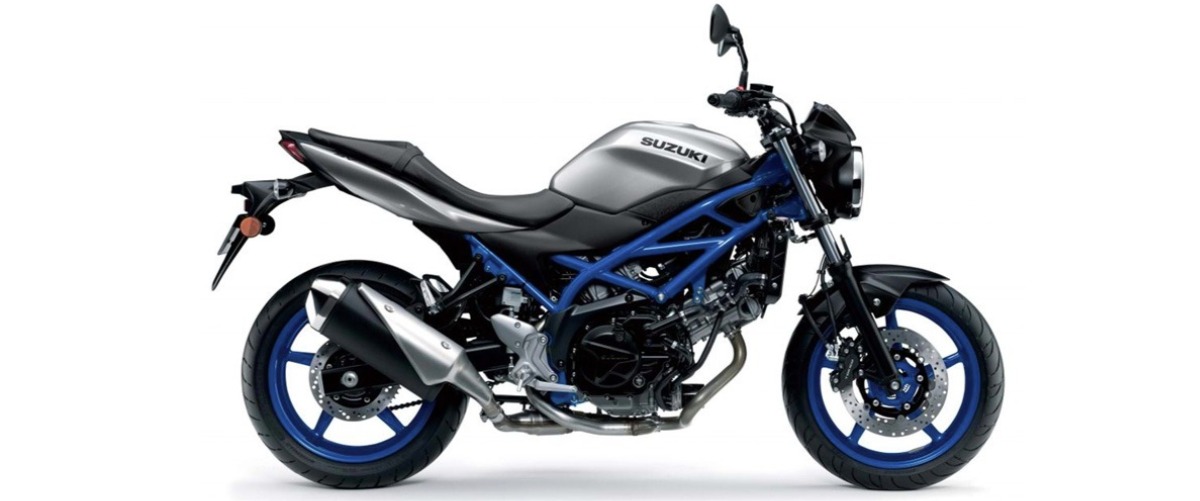
Suzuki has shown its new colour options for the 2020 SV650 and Address scooter, which are available from UK dealerships this month.
The ever-popular SV650 comes in a new metallic silver with an eye-catching blue trellis wrapped around its punchy 645cc V-twin engine and blue wheels. A matt black version uses a similarly striking red frame and wheels, while those looking for a more understated SV650 can opt for a gloss black model with black frame and wheels.
Boasting 135mpg, the frugal and congestion-busting Address scooter also comes in a trio of colours for 2020. A simple pearl white is joined by a bright Suzuki blue, plus a classy, dark, matt stellar blue option.
The 2020 SV650 comes with an RRP of £5,999, the Address is available for £2,199.
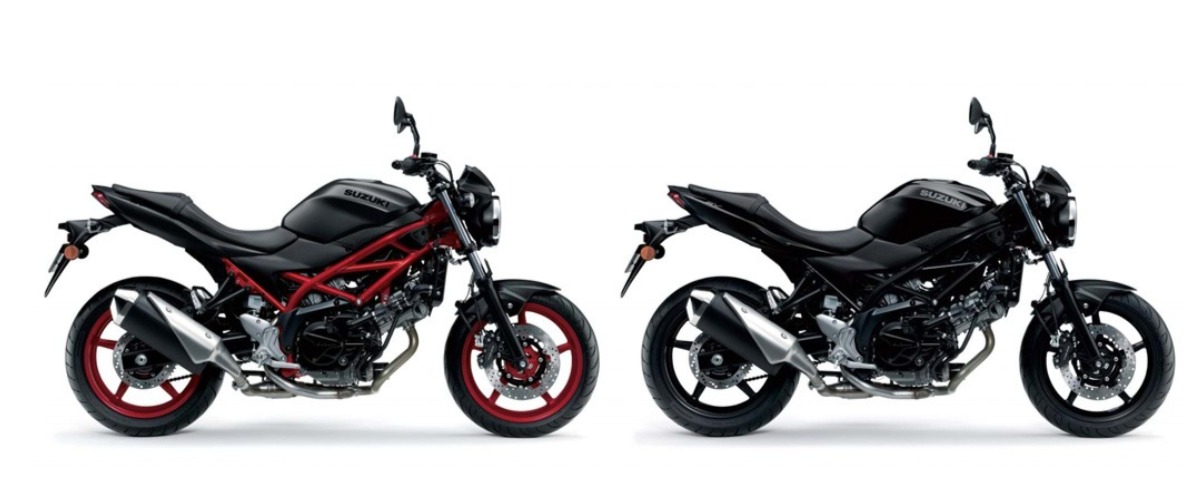
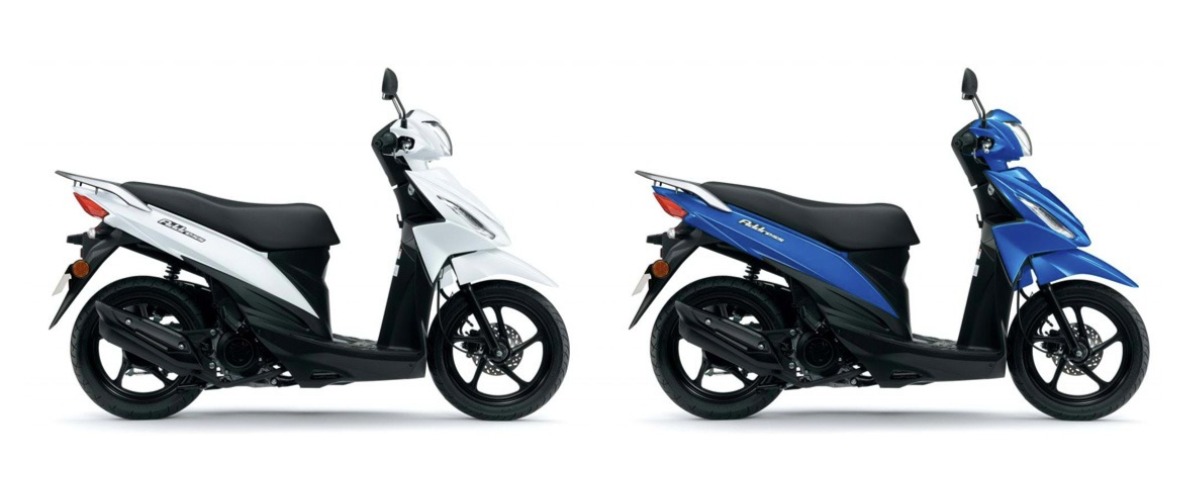
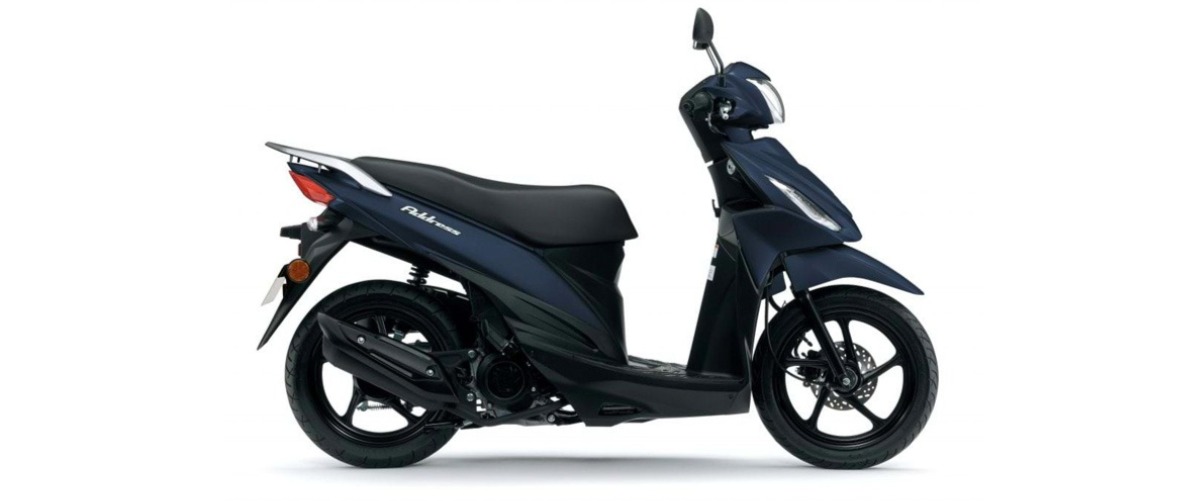
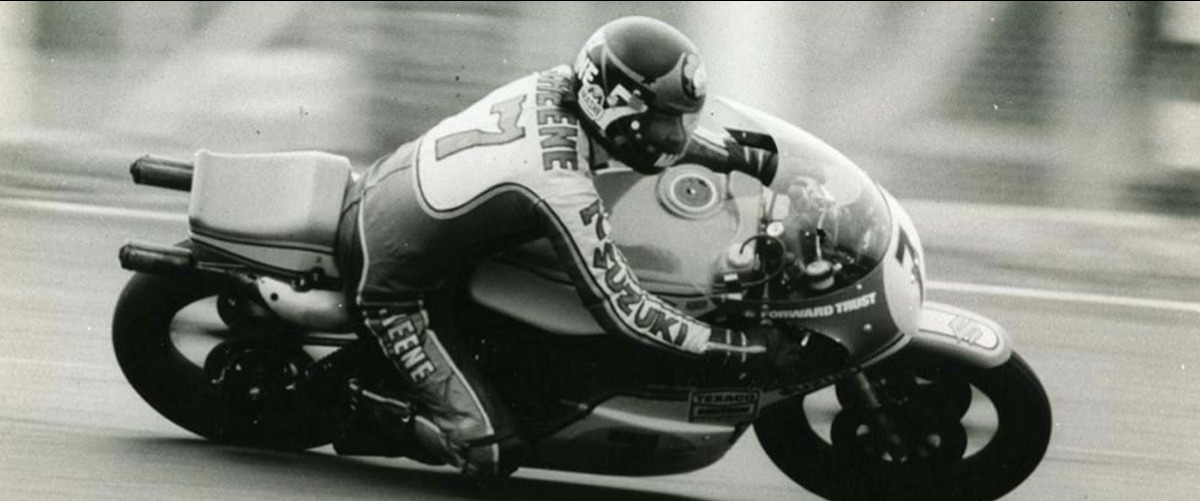
A STROKE OF GENIUS
Over 40 years ago Suzuki changed the face of 500cc GP racing with the release of the two-stroke square four XR14. This, and subsequently the legendary customer RG500 went on to win seven consecutive 500GP championships, four rider world titles, and allowed privateers to compete for GP glory on an equal footing with factory teams for the first time. One of the men responsible for this machine was Makoto ‘Big Mac’ Suzuki who, alongside Makoto Hase, developed and built the RG500 that in 1976, with Barry Sheene onboard, delivered Suzuki its first 500GP world title.
In the early 1970s, the thought of entering 500GPs with a two-stroke motor was laughable. ‘Smokers’ were confined to the tiddler classes. However despite all this, in 1974 Suzuki went against convention and entered the championship using a 500cc two-stroke that would go on to dominate the world.
“People thought we were crazy as two-stroke engines were only used on small bikes, but that was all Suzuki knew, we didn’t build four-strokes,” remembers Makoto Suzuki. “The decision was made for us, we had no option so we looked at our small capacity bikes. We had already built square four and V4 125cc and 250cc race bikes, so we upsized them. We started the project in 1973 with the target of being ready for the 1974 season and only had four people were working on it – two for the engine and two for the chassis.”
Although nowadays GP racing has reverted to four-stroke, the bike that Suzuki built demonstrated that two-strokes are very good at producing power. While this was good news for the engine’s development team, the chassis engineers were faced with some tough challenges.
“With the bike we aimed for over 100bhp, but it made 110bhp in the end,” said Makoto Suzuki, “which would have been an issue for the chassis had we not been racing the XR11 in America. The XR11 was a 750cc triple with lots of power so we had all the chassis issues with this bike. In America we suffered torn tyres, snapped drive chains, overwhelmed suspension, it was terrible, the chassis development was so far behind the engine.
“For the RG500 we used the knowledge from the XR11 to build a good chassis, however the engine was very hard to ride and peaky. The power was produced from 8,000 – 10,500rpm, that was it, but the GP mechanics at the circuit could alter these characteristics with exhausts and jets at the circuits. At that time there was a lot of experimentation and development happening, we were looking for inspiration from everywhere, even household items.
“The original exhaust end cans on the RG500 were modified green tea cans, they looked the correct size so I introduced this technology into the GP bike.”
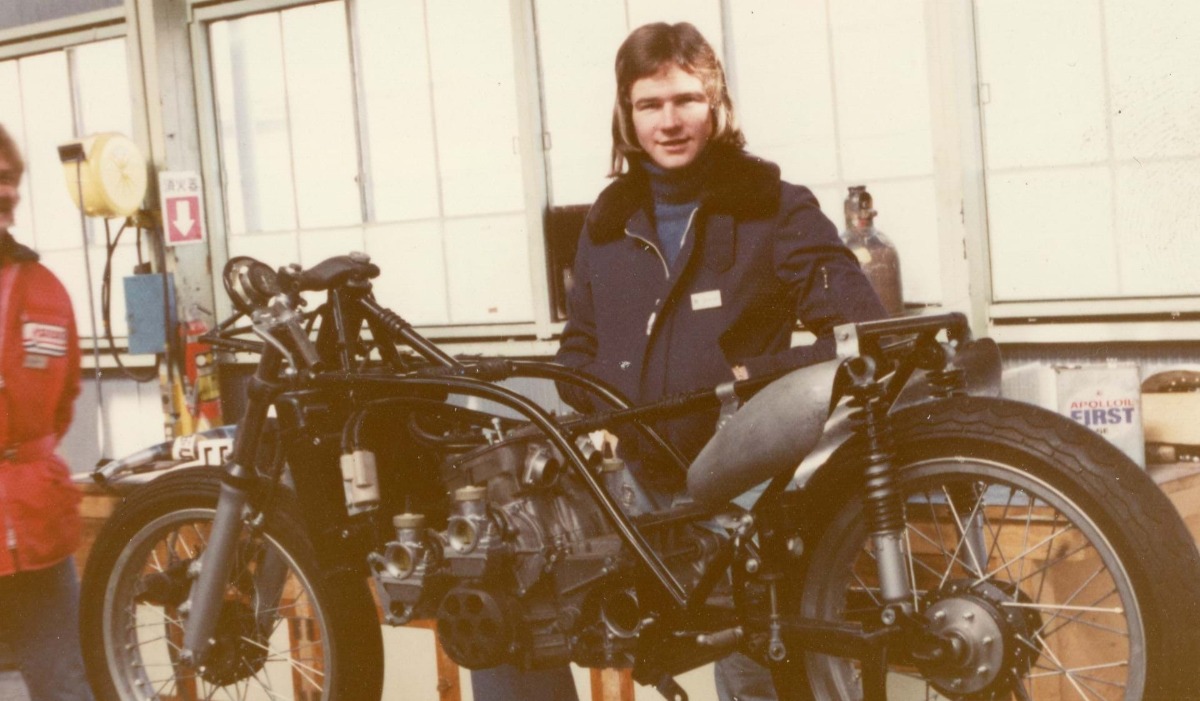
Success was quick to arrive for the RG500 and in its debut year Barry Sheene rode the XR14 to its, and Suzuki’s, first 500GP win at the Assen. Two years later he brought Suzuki its first 500GP world title, however for the RG’s development team, it was the constructor’s title that came alongside the rider’s title that meant the most.
“For Suzuki the most important thing was the constructor’s championship, not the rider’s one. If your rider wins you can only say the rider is a world champion, if you win the constructor’s championship you can say ‘Suzuki is world champion’. This drove Barry mad, he would get very upset because the privateer bikes were identical to the factory ones! For Suzuki it was excellent, we won seven constructor’s championships in a row,” laughs Makoto Suzuki.
With the RG500 Suzuki made a radical decision – they would release a privateer bike at a cost of £12,000 each that were identical in specification to the factory machines. With a grid full of RGs, the constructor’s title was all but assured.
“The only difference was the fact the factory bikes had titanium or magnesium fasteners where the production bike had steel or aluminium ones. The engine was 100% identical, we just changed the name from prototype to production. You could buy a production RG500 and win a GP, as Jack Middleburg did in 1981. That was the last time a privateer won a 500GP, however he rode an RG500 Mk VIII based on the XR22. You can imagine Barry Sheene’s frustrations.”
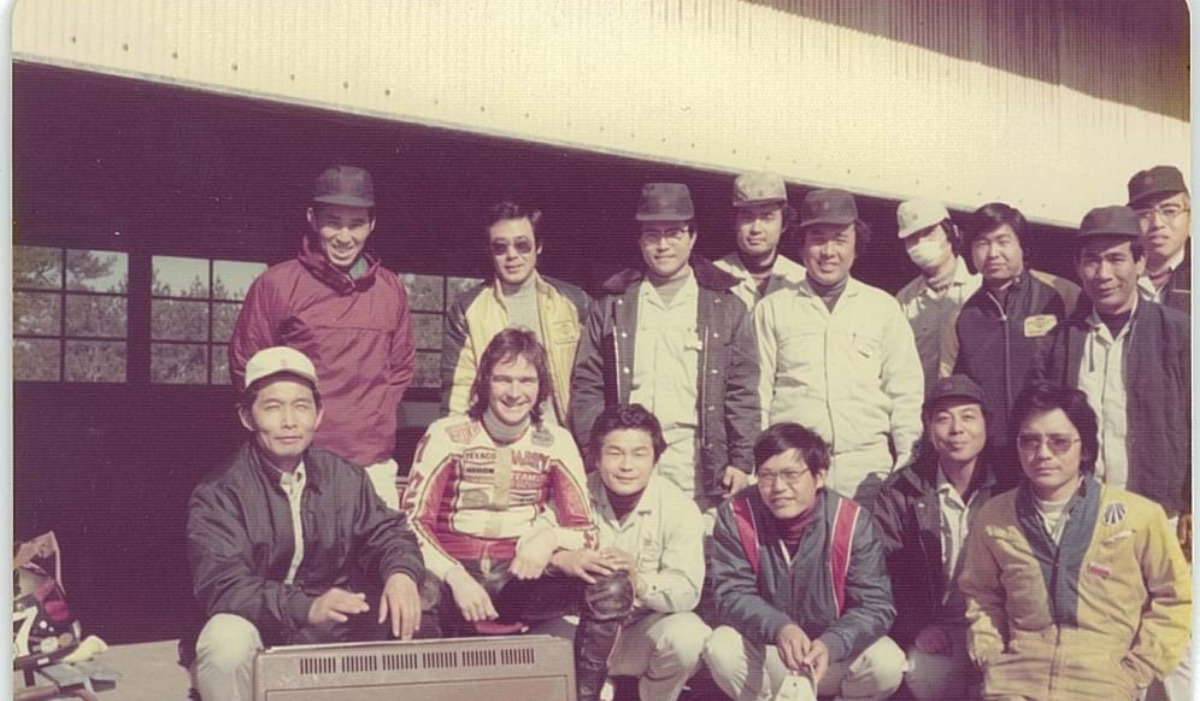
With the 1976 and 1977 titles in the bag thanks to Barry Sheene, 1978 saw Suzuki face tough competition, and upgraded the XR14 to the XR22 with its ‘step motor’. This engine used the first ‘cassette gearbox’ on a motorcycle, a feature that is common to most engine designs nowadays but was radical technology in 1978, designed following input from the McLaren F1 racing team. However, it was developed back in 1976, but it didn’t see the light of day until 1978.
“Barry won the 1976 title on the XR14 but we held the XR22 back in 1977 in case other manufacturers came out with something special,” explains Makoto Suzuki. “Yamaha in particular were a concern, but only unveiled exhaust valves and so we kept it hidden until 1978. Also, our customer RG500 was proving very popular and we didn’t want to detract from it, although we also needed to beat it as privateer riders were starting to challenge the factory ones.
“People had developed their XR14s so well they were incredibly fast and more than capable of matching the XR22. The power was not so different with the XR22 when compared to the XR14, they both made around 124bhp, however the engine was lighter which made the bikes handle better. Weight was a big factor in GPs in the 1970s and 1980s as despite there being a minimum weight of 100kg the bikes would never match this, the best we got was 108kg. With 124bhp and 108kg, the XR22 was quite a beast!”
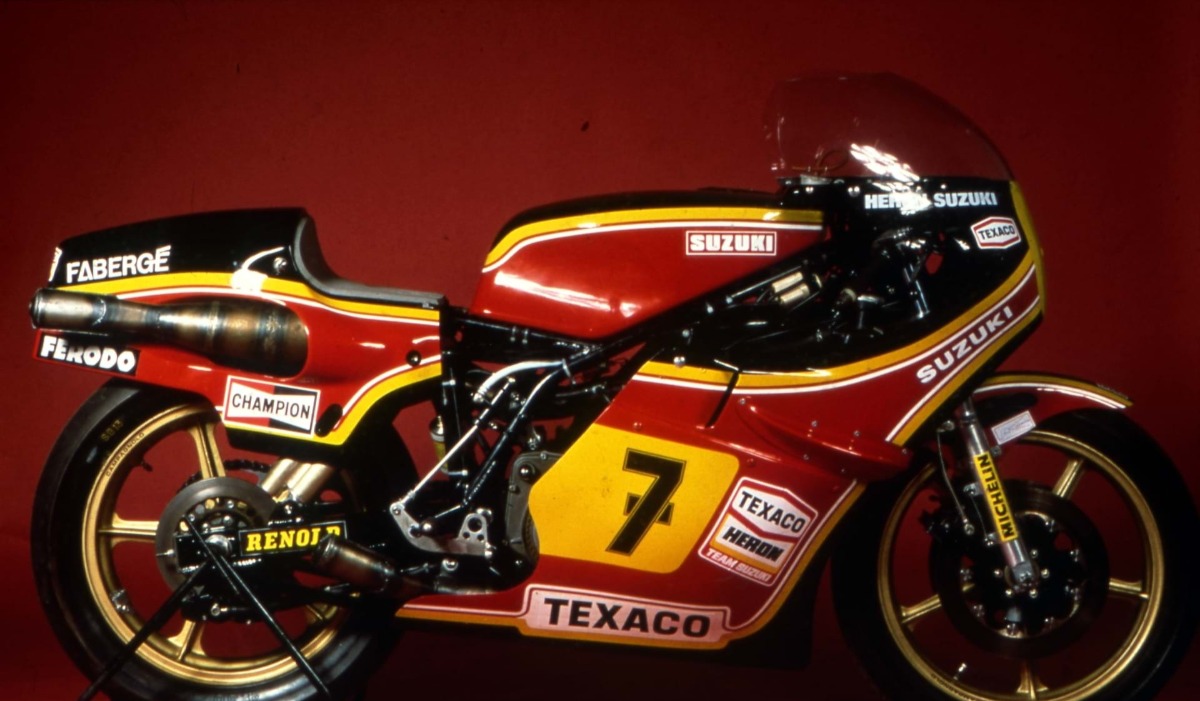
After developing the XR14 and subsequently the XR22, Makoto Suzuki was eventually able experience the power first hand.
“I rode the XR22 for half a lap in Japan and only once – that was enough for me. I pulled out of the pits and rode around a 200-degree corner and the rev counter wasn’t even registering as it started at 5,000rpm. On the straight I opened the throttle, the revs suddenly appeared, the bike wheelied and I pulled in. It was terrifying. I really appreciated the skill riders such as Barry Sheene had”
The square four design went on to dominate 500GP racing, taking two more world titles (1981 with Marco Lucchinelli and 1982 with Franco Uncini) and winning a total of 50 races alongside the seven consecutive constructor’s championships. But everything has to come to an end and in 1987 the square four RG500 was replaced by the V4 RGV500, something that was inevitable due to the fact the competition were all now using two-stroke motors.
“The square four had very good weight distribution and a lot of power. It is a simple engine but one that was reliable and worked very well, however it was limited in its power output, which is why it was replaced by the V4,” explains Makoto Suzuki. “The inlet port was limited in space, however on a V4 it is not. The more fuel and air you can get into an engine the more power you get out, which is why the introduction of the V4 boosted power from 133bhp to over 145bhp instantly.”
Suzuki GB recently restored Barry Sheene's world championship-winning XR14s to their former glory. Watch the two-part video documentary below.
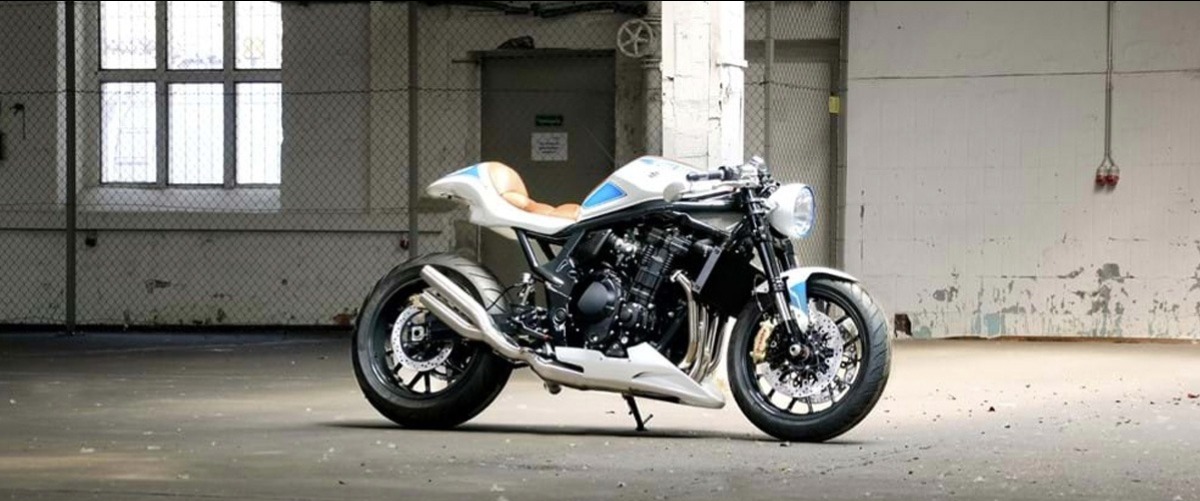
DESIGNING THE SUZUKI' FATMILE'
The Bandit 1250-based 'FatMile' was designed using what the Japanese call Senpai-Kohei, where a young designer with new and fresh ideas is brought together to work with an experienced designer who will guide and direct them. For the FatMile designer Daniel Händler teamed up with legendary Suzuki designer Hans A. Muth, architect of the iconic Suzuki Katana.
The bike was initially built for the Glemseck 101 festival in Germany; one of the biggest café racer gatherings in Europe. Since then it has done the rounds at Intermot, EICMA and Motorcycle Live.
To stay true to the Senpai-Kohei design principle, Suzuki deliberately opted to buck the obvious trend of working with a big design studio or well-known customiser, instead putting its faith in Händler to steer the project with Muth overseeing the process.
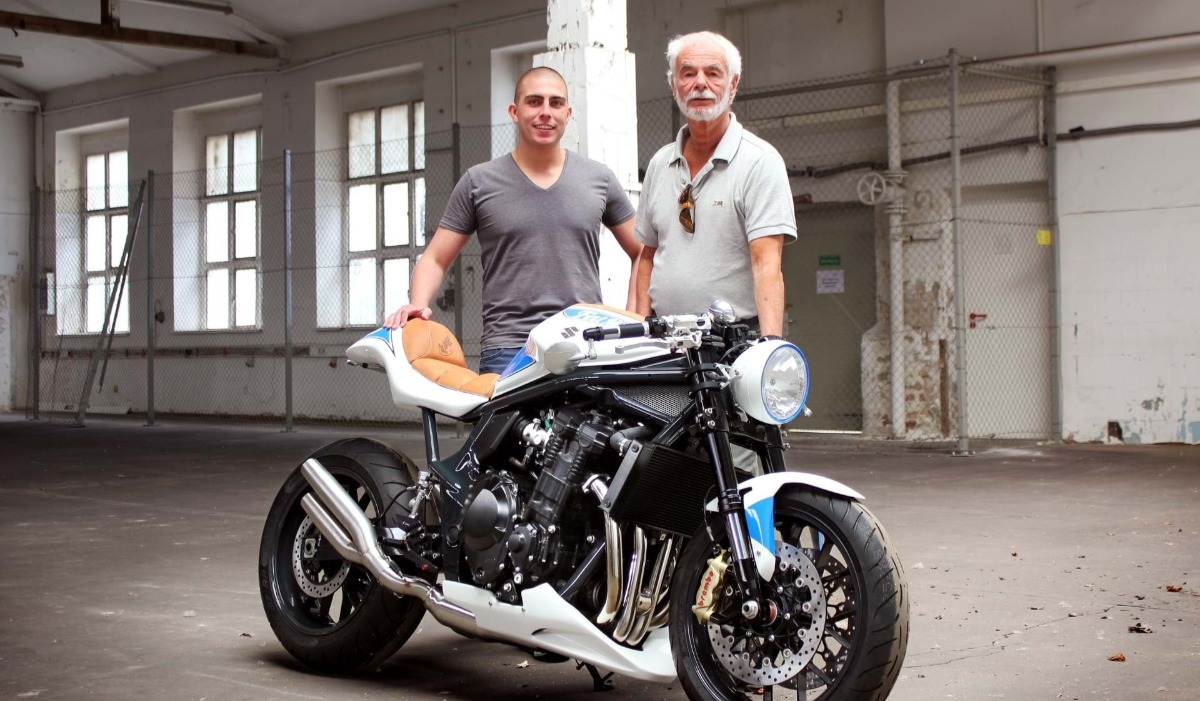
“Of course we took a certain risk with this decision,” admits Gerald Steinmann of Suzuki Europe. “When you hire an established design agency or world-famous custom builder hardly anyone will come out with criticism. But we consciously took this different approach and chose a solution in the Japanese tradition. Looking at the FatMile now I am convinced we did the right thing.”
A number of donor bikes were considered for the project, with the Bandit 1250 eventually becoming the starting point.
“We looked at a number of options,” Händler explains. “But, along with the GSX-R, the Bandit series is an iconic series for Suzuki, so this is why we chose it.”
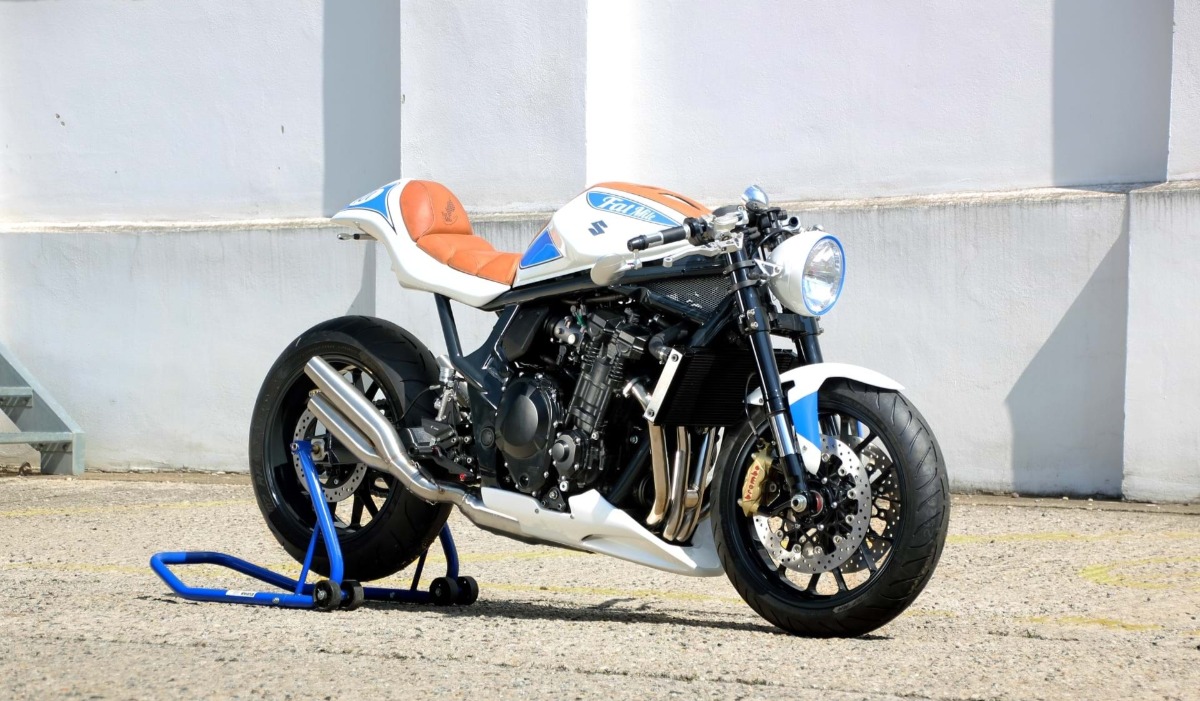
With Händler bringing the innovation and fresh approach, responsibility fell to Muth to guide him on his ideas, designs, concepts and finally implementation when it came to building the FatMile. Muth also had an eye on preserving the Suzuki design identity.
Händler continued, “In this project Mr. Muth was an extremely good tutor for me. At the beginning of our cooperation we shut ourselves away for three days to only talk and outline the FatMile project. That was enormously motivating and instructive for me.”
Muth added, “Mr. Händler is full of good thoughts and ideas. Sometimes I had to remind him to consider the limits of real implementation at early draft stages, but we worked in good harmony. I think that together we have created a very good machine.”
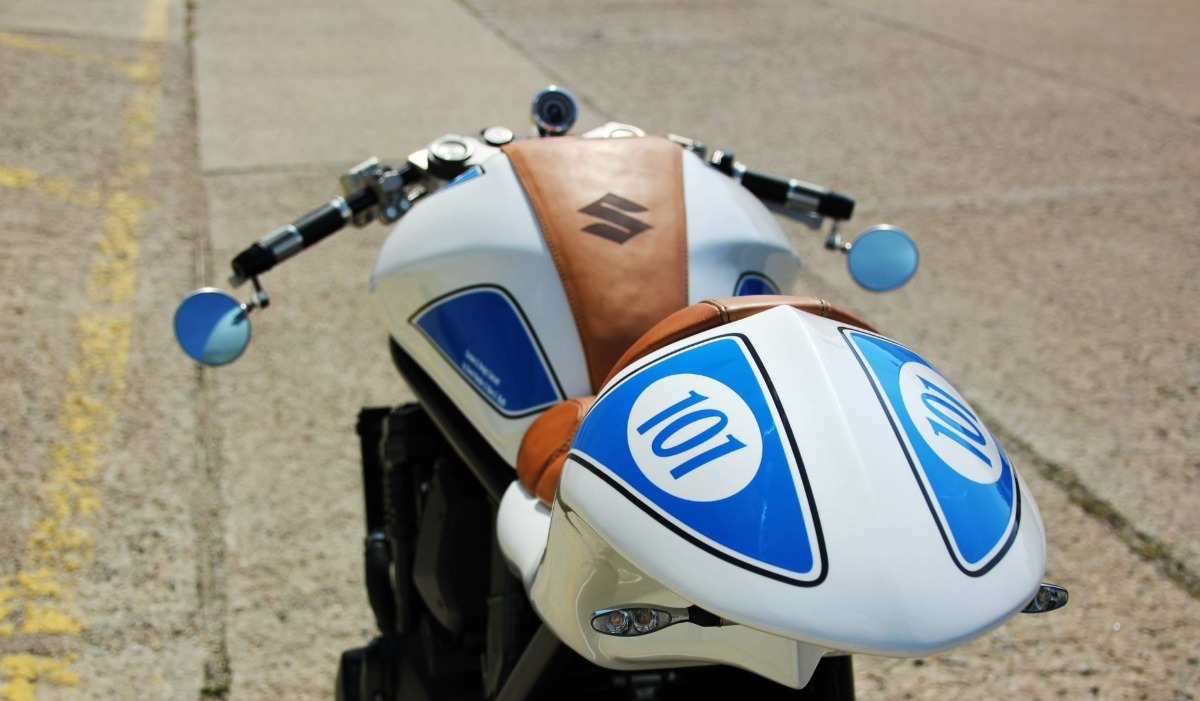
The Suzuki FatMile uses the 1255cc motor from the Bandit mated to custom Cobra Urban Killer exhausts. Swingarm is standard Bandit but the frame has a modified rear subframe and seat unit with a custom seat to go with the new Paaschburg & Wunderlich headlight, GFK front fender and custom paint scheme.
Front forks are 2012-2016 GSX-R1000 which, at 5cm shorter than Bandit forks lower the front end of the bike. Front brake calipers are Brembo monobloc from the same GSX-R1000 with GSX-R discs too. Rear stopping power comes from a four-pot Nissin caliper and B-King disc. The bike is fitted with Spiegler brake lines.
Tacho is a tiny Motogadget Motoscope and PVM wheels don Metzeler Sportec tyres. Rearsets are Rizoma RRC, handlebars are Rizoma Lux, and mirrors are Rizoma Spy-R 80.
Photography:Sven Wedemeyer
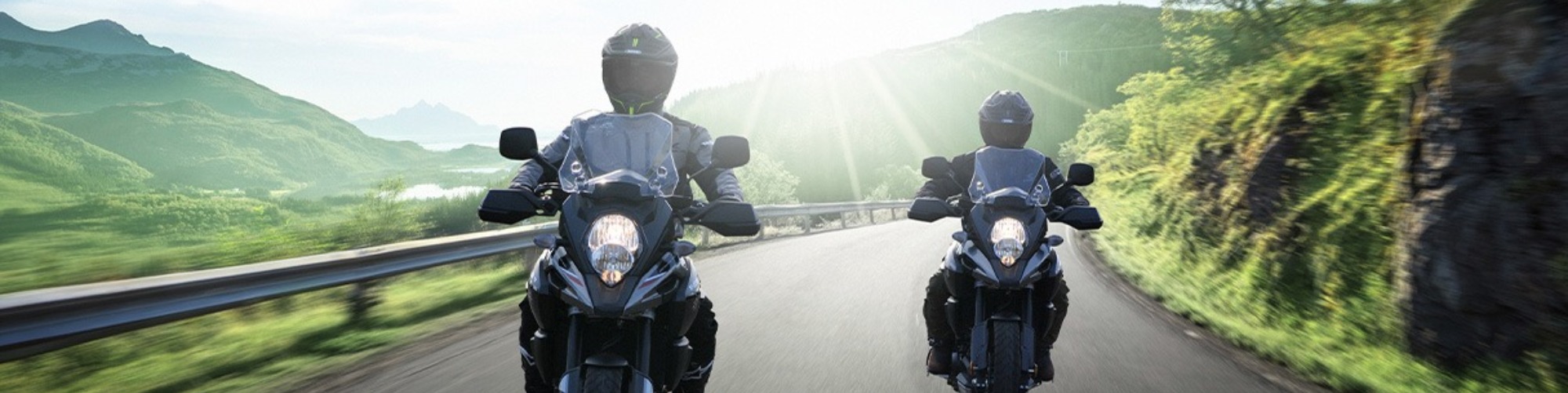
SUZUKI OFFERS SUMMER TEST RIDE INCENTIVE WITH £500 CUSTOMER SAVING
Suzuki has launched a new summer incentive, rewarding anyone that takes a test ride on selected models with £500 off the RRP when they go on to purchase. The offer runs in conjunction with all current campaigns, and across most of Suzuki’s on-road range.
Running from 1 August to 9 September, the incentive applies to both the GSX-R1000 and range-topping GSX-R1000R, the GSX-S1000F, GSX-S1000, and GSX-S750, both variants of the V-Strom 650 and V-Strom 1000, plus the SV650X and the new-for-2019 KATANA.
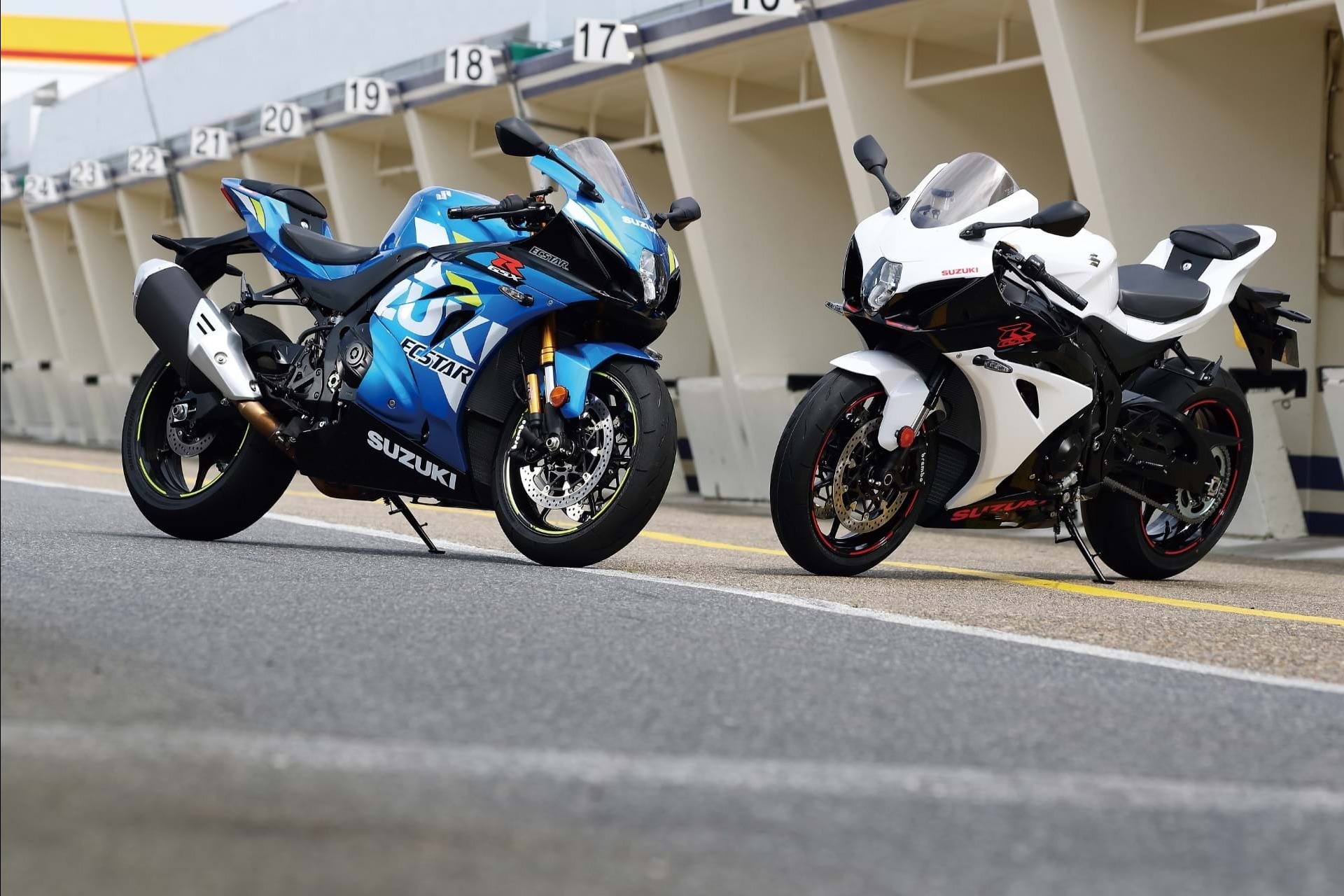
The offer also runs alongside the current HP and PCP promotions. This includes both the 0% APR finance offer on the GSX-R1000R, as well as Suzuki’s low rate finance campaign, which allows customers to choose from 2, 3 or 4 years with an APR to match.
Finally if choosing a V-Strom, customers will also benefit from £500 worth of free accessories, making Suzuki’s adventure range a truly tempting proposition.
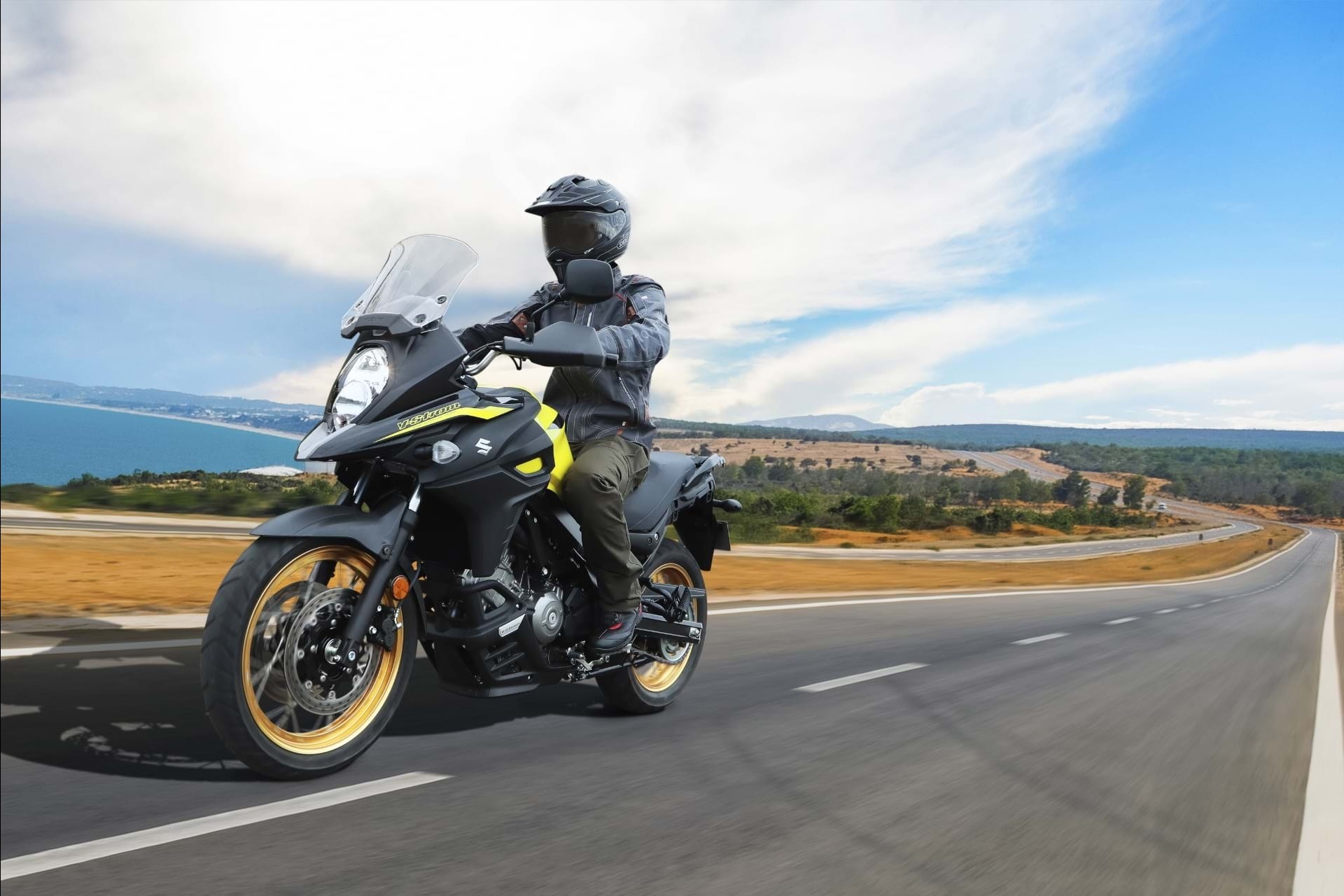
Suzuki GB head of motorcycles, Jonathan Martin, commented, “Summer’s in full swing, but for those still in the process of selecting a new bike for the season, this offer is an added sweetener alongside our current offers, that makes riding a new Suzuki this summer a tempting and viable option”
0% APR finance available on 2018 models of GSX-R1000R/RZ. Low rate finance available on GSX-S1000F, GSX-S1000, GSX-S750, Vstrom 650 & V-Strom 1000. Minimum Deposit £1,000. Credit is available to UK residents aged 18 and over, subject to status. Suzuki Finance is a trading style of Suzuki Financial Services Limited; St William House, Tresillian Terrace, Cardiff, CF10 5BH.
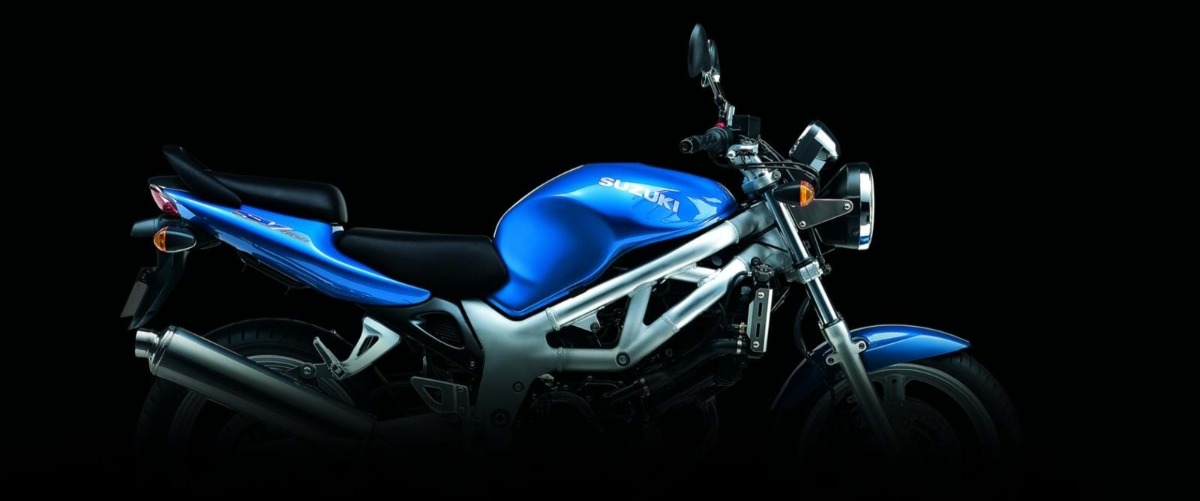
The story of the SV650
The SV650 was first introduced in 1999 as an affordable-but-fun middleweight, available either naked or half-faired. No one, not even Suzuki, could have imagined the cult appeal the bike would develop, as it appealed to everyone from commuters to riders looking for a capable tool for a weekend blast, and now fills race grids up and down the country. 20 years on, we take a look back at the history of one of the biggest overachievers in motorcycling.
The naked version of the SV650 cost just £3,999 when it was launched back in 1999, with the S model a mere £300 more. Both bikes immediately found favour with the motorcycling public, with a combined 2,549 sold in the first year and 2,939 the following year.
The SV was designed to be the answer to many people’s prayers; a robust, reliable, but characterful V-twin middleweight, suited to a range of riders and uses.
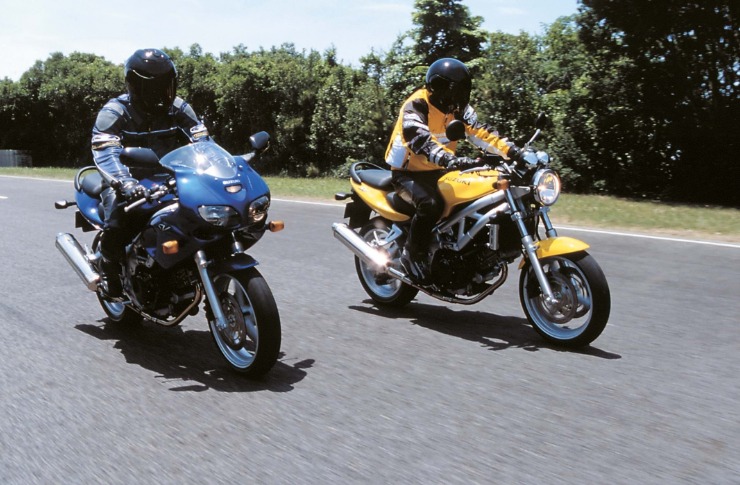
It was affordable and did everything it needed to. But it did it better than its rivals, with nimble, agile handling more akin to more expensive, sportier machines, and an engine that has gone down in motorcycle folklore. MCN referred to it as a ‘straightforward middleweight V-twin all-rounder which proves you don’t have to be boring to be practical’. It found a niche and it excelled.
It was comfortable as well, with a plush seat and easy-going ergonomics – especially the naked version. It could take a pillion too. And there was a great range of accessories, which meant the SV could be taken touring across the continent, or, with the fitment of fairing lowers, a pillion seat cowl, and a racy exhaust, become a mini V-twin weapon between the hedges.
Such a weapon in fact, that in club racing, the SV650 was the bike to be on when it came to the twin classes. As people sought more affordable ways of going racing, the SV filled Minitwin grids up and down the country, which boasted tighter regulations than other classes of racing. Frames couldn’t be modified, nothing could be done to the engine, and even things like the forks had to remain standard. However, the basic package from Hamamatsu was far greater than the sum of its parts, and the bikes posted impressive lap times around circuits like Donington Park, Brands Hatch, and Cadwell Park.
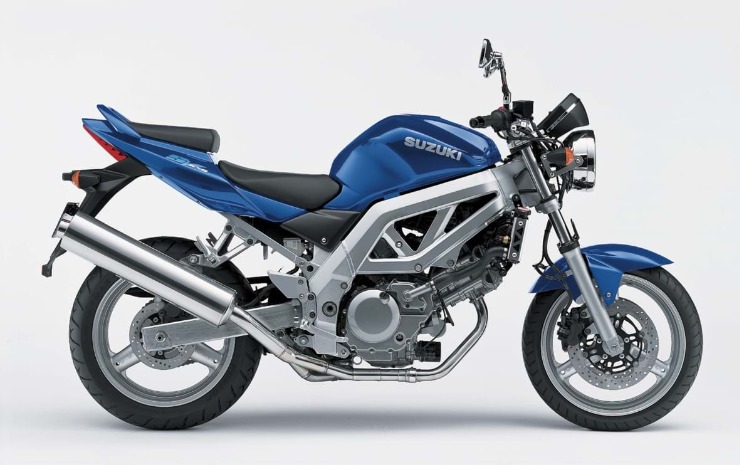
2003 saw the introduction of the second generation SV650. The new bike boasted an all-new cast aluminium frame, new swingarm and new exhaust. It also made the switch to fuel injection from carburettors. It got a power hike, too, taking peak power up to over 73bhp, while peak torque increased to 47.2lb-ft.
And it continued to fly out of the showrooms too. 2,266 were sold when the new bikes were introduced, as new riders, commuters, and racers alike sought them out.
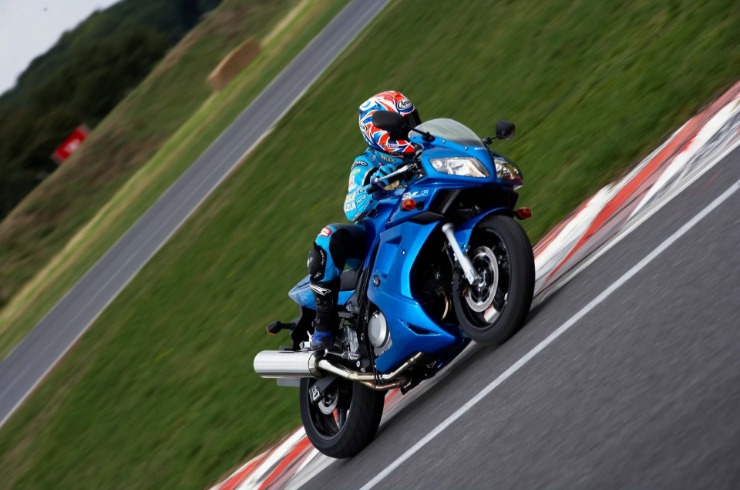
In 2007 new twin-plug heads were introduced to improve emissions, but it was the last update before the naked SV650 was superseded by the SFV650, which was launched in 2009.
The SFV650 was launched in Fuerteventura to widespread praise. MCN rated the upgraded engine five out of five, and commended the new bike, writing “the old SV650 was a good bike and to be honest Suzuki didn’t have to do much to make it a great bike once more. But they have gone one better and given us an excellent bike.”
Changes to the camshaft profiles and valve lift, a 10% increase in crankshaft inertia, newly staggered intake and exhaust tract lengths, and a new exhaust made it possible to boost low-rpm and midrange power, without sacrificing top-end output. There were also new valve springs, and while the bore and stroke remained the same from the older SV650, the bore was plated with Suzuki’s race-proven nickel-phosphorus-silicon-carbide coating. It also benefited from new iridium spark plugs.
The most striking difference was how the new bike differed visually from the SV. The classic styling made way for more modern lines, and a new steel trellis frame replaced the aluminium frame of the outgoing SV650.
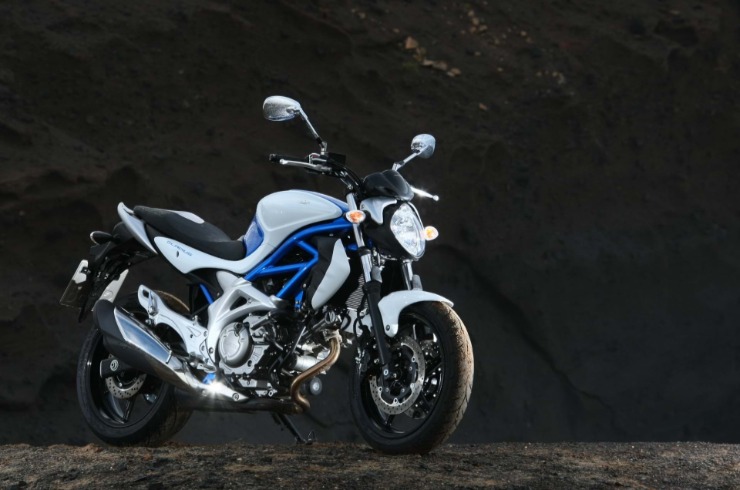
In classes where limited modifications were permitted, the SV650S continued its dominance of club racing grids, with it’s clip-ons and removable rear subframe. But in the more relaxed Supertwin classes, the SFV650 was carving a name for itself.
JHS Racing in particular were championing the way with the SFV, turning out an exquisite example dressed in GSX-R600 fairings, that turned heads when on display at Motorcycle Live.
The preparation put into the bike was essentially the same that goes into a superbike. The JHS SFVs used the original crankshaft, but got new con-rods, pistons, valves and valve springs. It retained the standard ECU, but with some parameters changed and some sensor eliminators, to extract every ounce of power. This bike didn’t have to do thousands of miles between services.
“The SFV650 boasts even more potential than the SV for racing,” James Holland from JHS Racing said at the time. “It’s the engine we like the most, as the nickel-phosphorus-silicon-carbide coating in the bores allows us to run higher tolerances with our pistons and rings.”
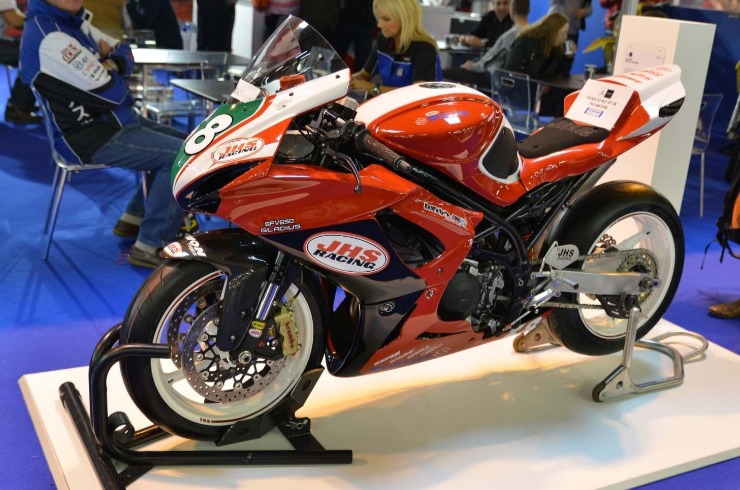
But for 2016 the naked SV returned to the range, doing everything it did in 1999, only better. It’s more powerful and lighter than the SFV650, with clean, classic styling to appeal to a variety of riders. It boasts some more tech too, with a one-push, easy-start system and Suzuki’s low-rpm assist function that makes it incredibly difficult to stall the bike when pulling away. On its launch in northern Spain it was praised for its handling, with Bike Social writing, “The Suzuki’s chassis is mint. It turns well, holds a line, and leans over till the long hero blobs and exhaust are dragging if you want.”
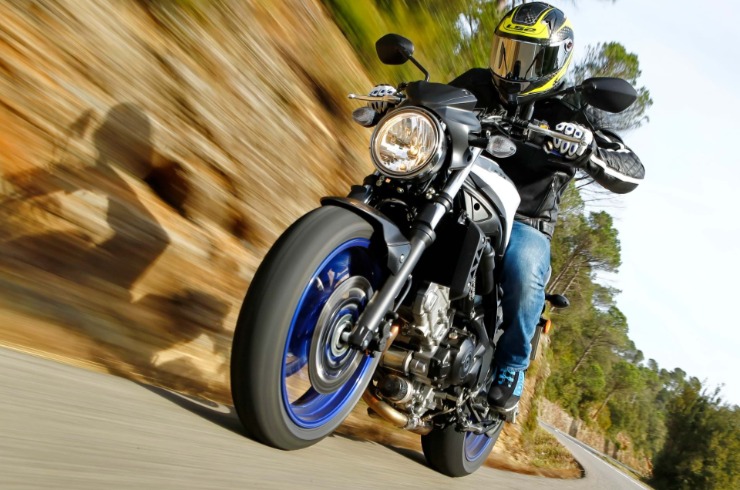
Two years later and the SV650X joined the lineup alongside the standard SV, while the S made way. It offered something new for SV customers, sporting café racer-inspired styling with a bikini fairing, dropped bars, and ribbed seat, plus a retro-style livery.
The SV650 remains a model that does far more than it should, better than it should. When the first SV650 rolled off the production line in the late 90s, no one would have believed that it would find favour with so many riders looking for so many different things, and go on to fill club racing grids and tackle the Isle of Man TT. It really is one of motorcycling’s biggest overachievers.
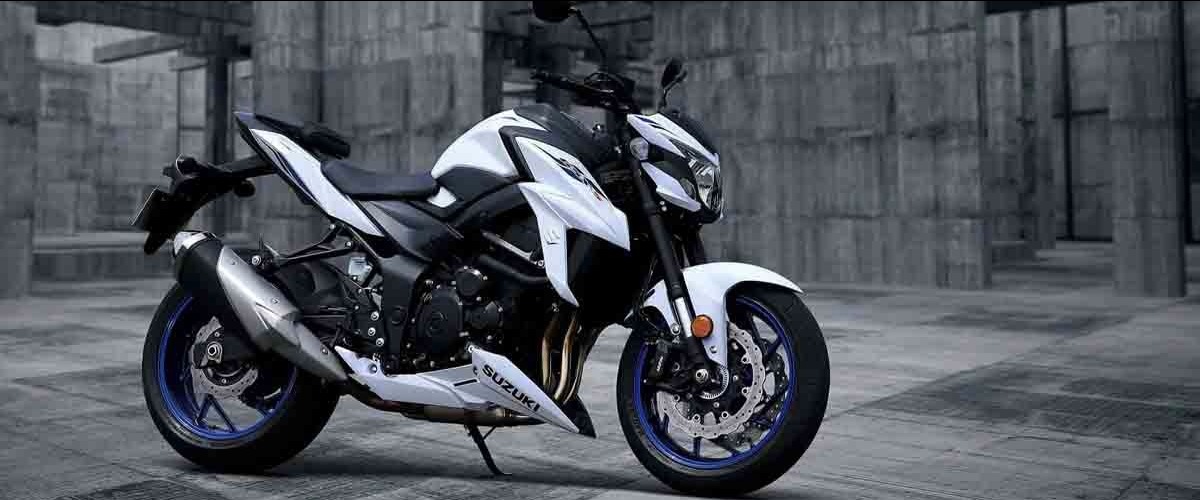
SUZUKI ANNOUNCES ITS SUMMER LOW-RATE FINANCE OFFER
Suzuki has announced the details of its summer low rate finance offer, which gives customers the ability to tailor a finance package to their individual needs by choosing from either a Personal Contract Purchase (PCP) or Hire Purchase (HP) agreement, and the term of their choice – from two, three, and four years – with an APR to match.
The offer is available on all V-Strom 650 and V-Strom 1000 models, plus the GSX-S1000F, GSX-S1000, and GSX-S750 street machines, with a minimum deposit of £1,000. With a minimum deposit of £500 customers can also take advantage of the offer on the GSX-S125 and Address scooter.
Address HP Only. Credit is available to UK residents aged 18 and over, subject to status. Suzuki Finance is a trading style of Suzuki Financial Services Limited; St William House, Tresillian Terrace, Cardiff, CF10 5BH.
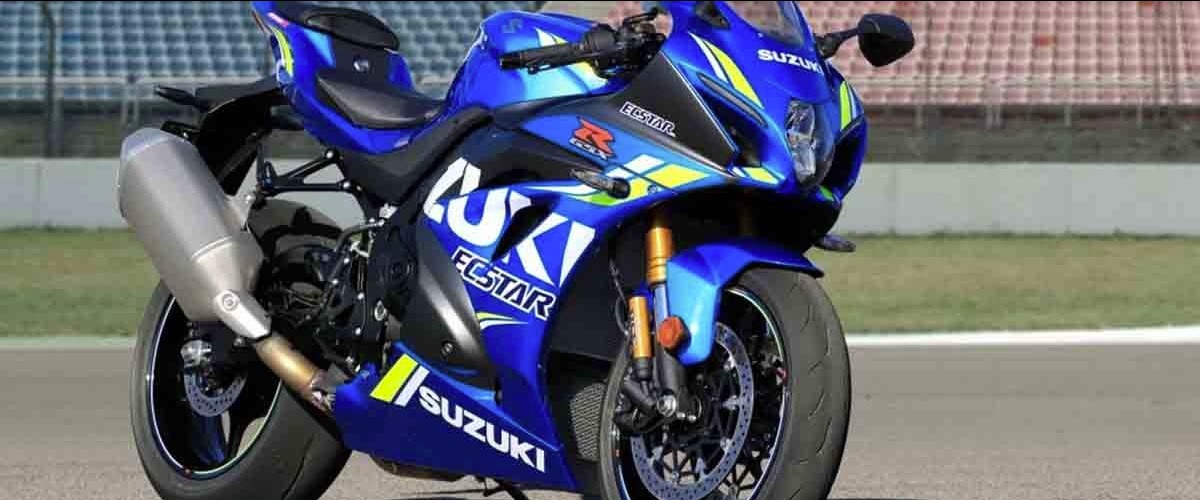
SUZUKI ENHANCES GSX-R 0%REPRESENTATIVE FINANCE OFFER
Suzuki has announced an enhanced 0% APR Representative finance offer on the award-winning and race-proven GSX-R1000R plus the entry-level GSX-R125, available until the end of September 2019. There’s also a new £250 Suzuki deposit contribution on the GSX-R125.
Available with a minimum deposit of £1,000 on the range-topping GSX-R1000R, customers can ensure they’re choosing a deal that best suits their personal circumstances, and opt for either a Personal Contract Purchase (PCP) or Hire Purchase (HP) agreement.
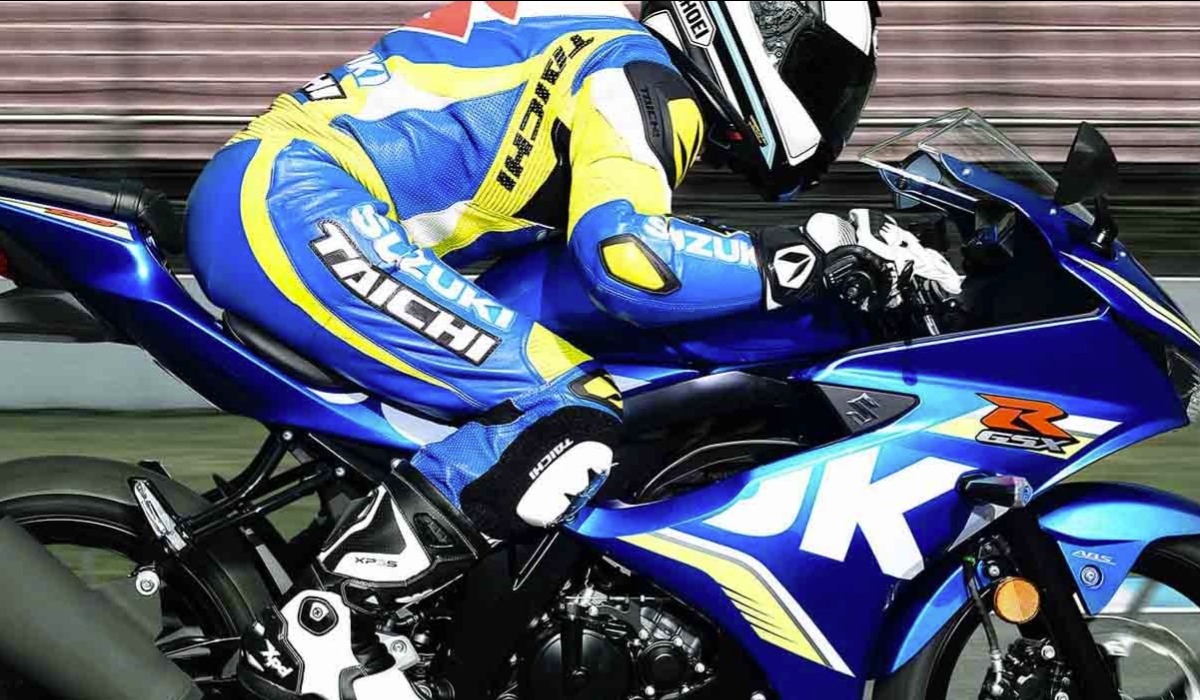
Suzuki’s 0% APR Representative offer also extends to the learner-friendly GSX-R125, which is available with a minimum deposit of £750, £250 of which comes as a Suzuki deposit contribution, meaning buyers need only £500 deposit.
The GSX-R1000R uses a host of MotoGP-derived technology, from a clever variable valve timing system that allows it to produce both low-down and midrange torque and impressive top-end power, to a comprehensive suite of performance-boosting electronics that includes an IMU-governed, 10-mode traction control system, launch control, quickshifter and auto-blipper, and cornering ABS.
The GSX-R125 set new benchmarks when it was launched in 2017, coming into the 125 sports bike market with the best power-to-weight ratio. It boasts an LCD dash, LED lighting, keyless ignition, and Suzuki’s easy-start system.
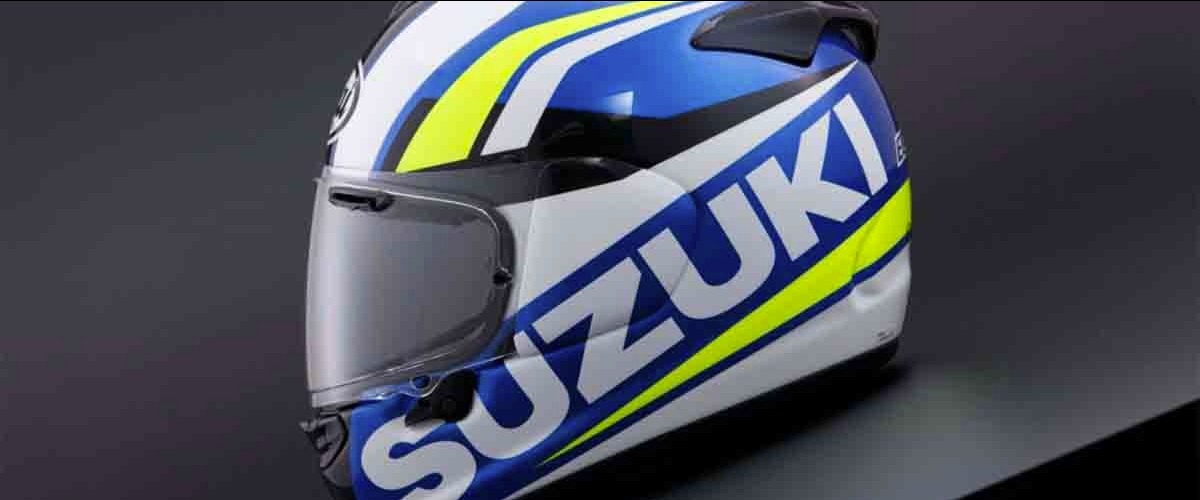
SUZUKI MOTOGP-INSPIREDARAI CHASER-X AVAILABLE
Suzuki and Arai have joined forces to create a Team Suzuki Ecstar, MotoGP-inspired Chaser-X limited edition helmet, which comes with an RRP of £550 and is available now through authorised Suzuki dealerships or online.
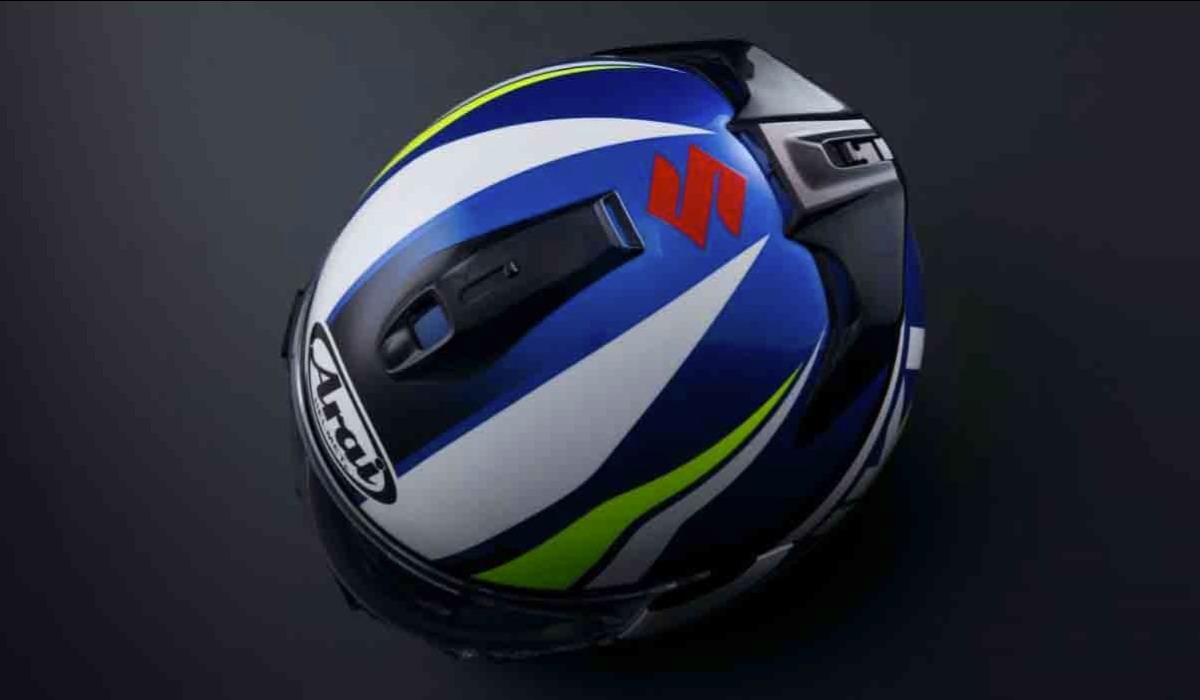
The helmet gets a striking blue, white, and yellow design with bold Suzuki lettering, reminiscent of the firm’s GSX-RR MotoGP racer, and is ACU Gold Standard certified. It also uses a double d-ring chin strap fastener, Arai’s new shield latch system, and includes liner speaker pockets.
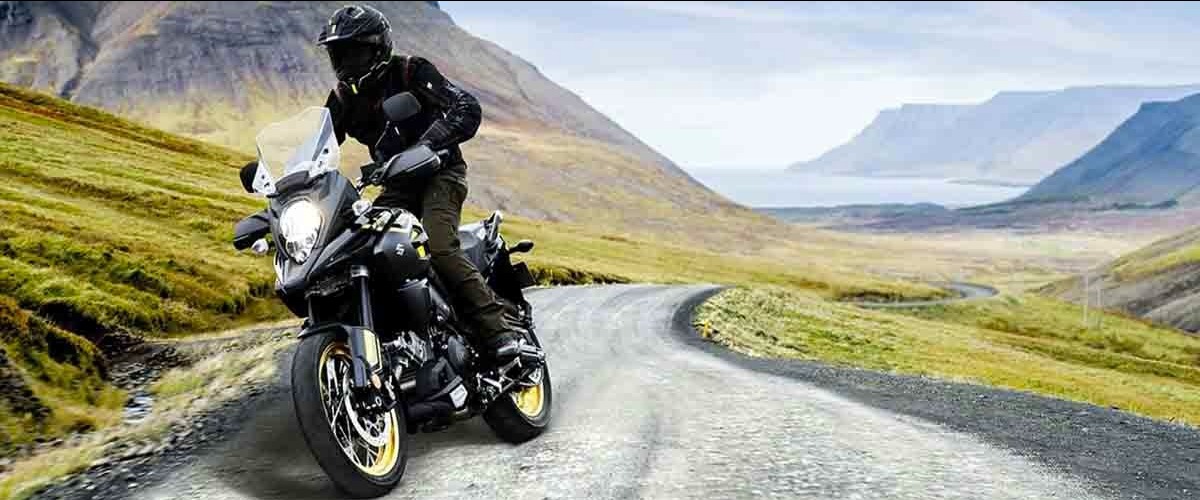
SUZUKI SET FOR INAUGURAL ADVENTURE BIKE RIDER FESTIVAL
Suzuki will showcase its adventure and off-road ranges at the inaugural Adventure Bike Rider Festival, which takes place from 12-14 July at the Ragley Hall Estate in Warwickshire, with visitors also able to enjoy test rides on many of the models on display.
The range-topping V-Strom 1000XT – which features a 1037cc V-twin engine packed with low-down torque and a broad midrange, plus a two-mode traction control system and intelligent cornering ABS – will be displayed alongside the standard V-Strom 1000. The cult-favourite V-Strom 650 will also be on display, side-by-side with the more off-road-focussed V-Strom 650XT, which swaps cast wheels for lightweight spoked options, and gets hand guards and lower cowling as standard. Both models use Suzuki’s characterful and famed 645cc V-twin engine, and get traction control and low RPM assist.
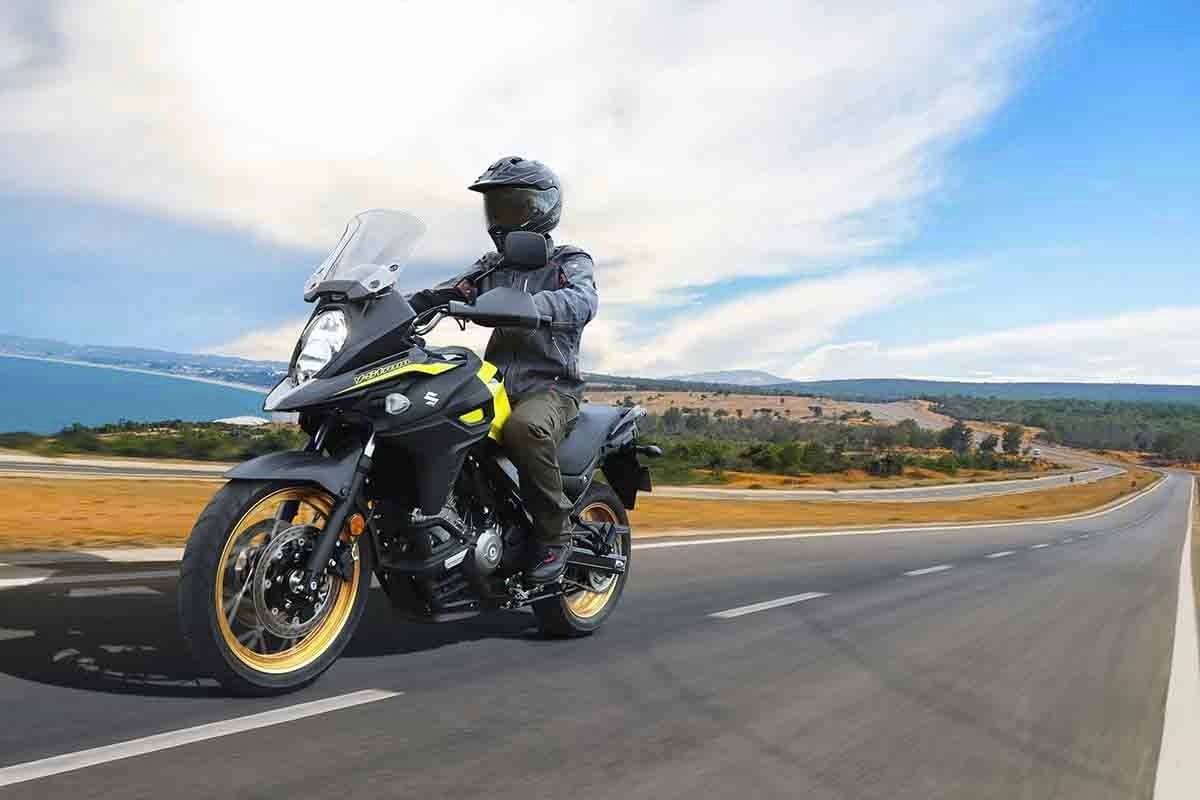
Demonstrating the V-Strom’s adventure-potential is the Bike to Japan V-Strom 1000, which was ridden from the UK all the way back to the Suzuki factory in Hamamatsu, Japan in 2014.
Proving big adventures can come in small packages is the V-Strom 250. The A2 licence-friendly machine uses a flexible parallel twin engine, and includes full luggage among its range of accessories, and will be on display along with its larger capacity siblings.
Further highlighting the Japanese brand’s off-road prowess is the RM-Z450 motocross machine and KingQuad 750 ATV, both of which will be present on the Suzuki stand, while the head-turning new KATANA will nod to the firm’s street bike range.
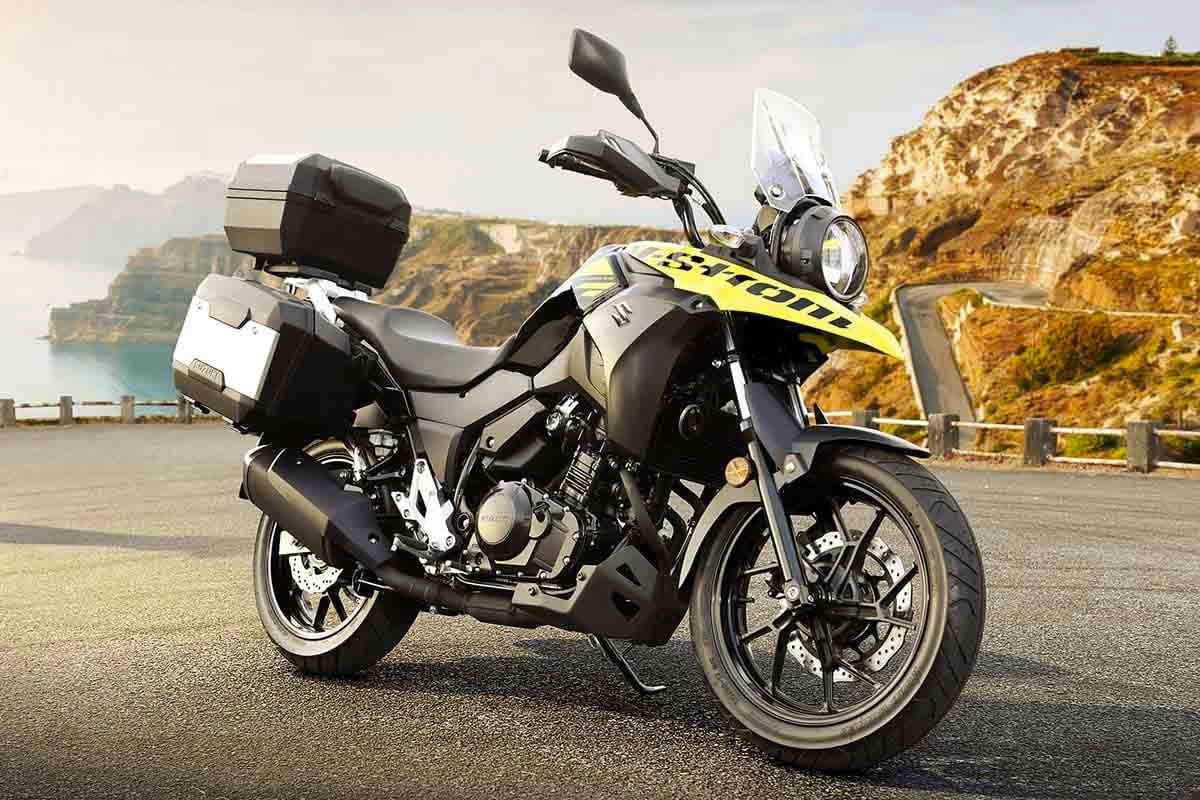
Visitors to the festival can also sample the entire V-Strom range for themselves, with test rides available over the course of the event. The KATANA – an evolution of the iconic 1981 machine that uses a 150hp version of the legendary GSX-R1000 K5 engine, housed in a lightweight aluminium chassis and tamed with a three-mode traction control system – will also be available for demo rides.
For more information on Suzuki’s adventure range, click here. To find out more about the new KATANA, click here.
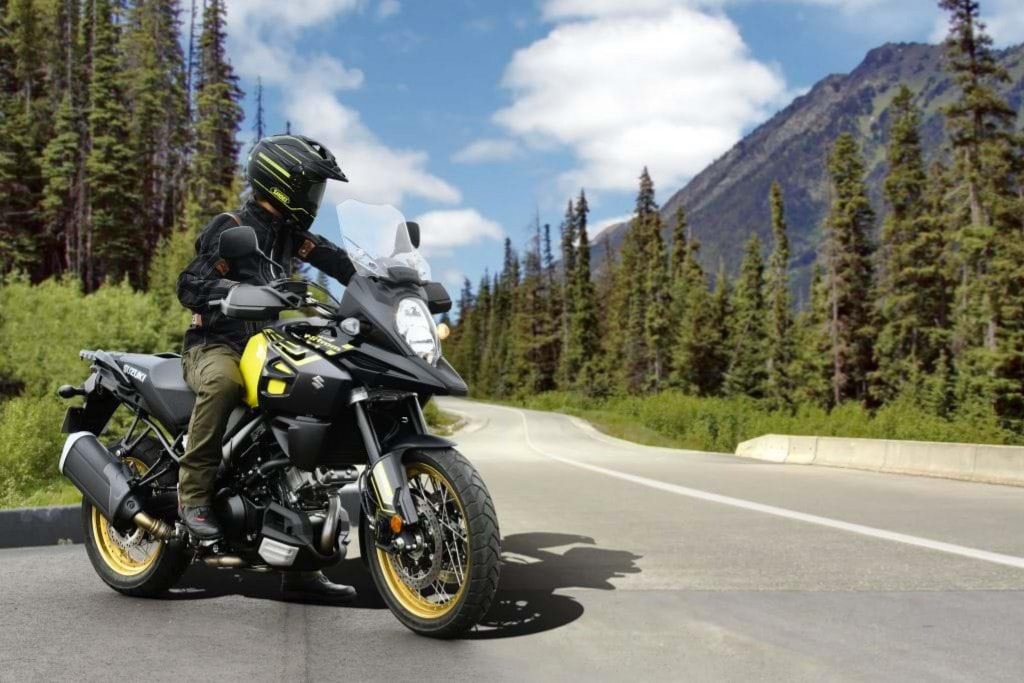
SUZUKI REVAMPS SPRING OFFER
Suzuki’s widely-regarded finance offer – which gives customers the ability to choose either a two, three, or four year agreement with an APR to match, plus the option of deciding between a PCP or Hire Purchase deal – will continue this spring, with new models now included in the campaign. Both the V-Strom 650 and V-Strom 1000, plus the XT and GT variants of both models, are now available as part of the offer. The award-winning V-Strom 650 uses Suzuki’s famed 645cc V-twin engine and features a two-stage traction control system (which can be turned off), plus easy-start and low rpm assist. Meanwhile the range-topping V-Strom 1000X GT comes fully-equipped with aluminium top box and panniers, plus tapered handlebar and lightweight spoke wheels.
The SV650X – the café racer-inspired version of the equally-popular SV650 – is now part of the offer, along with the GSX-S1000 and GSX-S1000F, GSX-S750 and learner-friendly GSX-S125, plus the Address scooter.
All new models from Suzuki come with a three-year warranty and one-year Suzuki Roadside Assistance. Each is also equipped with Datatag’s MASTER security system for added peace of mind.
For information on all of Suzuki’s offers, click here.
Minimum deposit £300. Address Hire Purchase finance only. Credit is available to UK residents aged 18 and over, subject to status. Suzuki Financial Services Limited, St William House, Tresillian Terrace, Cardiff, CF10 5BH.
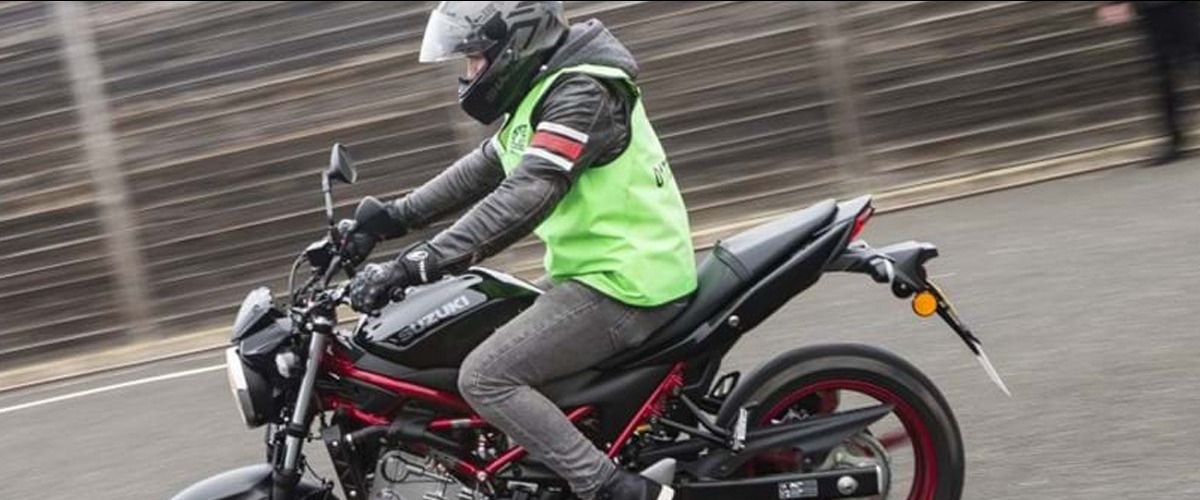
TEAM GB BMX STAR DECLAN BROOKS PASSES MOTORCYCLE TEST
Team GB athlete, freestyle BMX star, and Olympic hopeful Declan Brooks has swapped pedal power for horsepower, passing his motorcycle test using Suzuki’s SV650.
Brooks – who finished third in the FISE Chengdu BMX World Cup event in China last November – passed his CBT last year, as he took the first steps into gaining his motorcycle licence. Now, with nearly a year’s worth of experience under his belt, the 21-year-old has passed both his module one and module two assessments, thanks to Shires Motorcycle Training, and can finally remove the L-plates as spring arrives.
Declan Brooks, “I’m used to feeling nervous ahead of world championship competition, but it didn’t stop the apprehension for each part of the test, so it was a huge relief to be told I’d passed. I really enjoyed learning, doing my CBT, and getting some miles in on the GSX-S125 last year, but I was keen to keep going and go through my full test. I definitely enjoyed having more power on tap and a bigger bike with the SV, too. This has come at the perfect time as well; it’ll not be long until the clocks change and the weather warms up, and I’m now excited to get on the road and plan some rides this coming summer.”
Brooks is currently competing in world championship around the globe, with the aim of representing Team GB at the Tokyo 2020 Olympics, the first time freestyle BMX will be included in the games. He is also from a motorcycling family and background, his father racing before Declan got his first taste of a motocross bike at four.
He added, “I think having a bicycle and two-wheeled background definitely helped. Even though there are obviously massive differences, you’ve got a feel for balance, how to use your weight, things like that. My dad will be pleased too!”
Riding a GSX-S125 to pass his CBT and gain experience, Brooks will now use Suzuki’s user-friendly SV650. However, due to his age, the 74bhp machine uses a restricted ECU to bring it down to the 47bhp limit, available through authorised Suzuki dealerships.

NEW V-STROM 1050XT TOUR EDITION NOW AVAILABLE
Suzuki has launched a new variant of its V-Strom 1050, with a V-Strom 1050XT Tour packing extra capacity for adventure.
With an RRP of £12,799, the V-Strom 1050XT Tour comes equipped with black, three piece aluminium luggage as standard, equating to a saving of £370 over the purchase of the individual items.

The rugged aluminium top box and panniers add 112 litres of storage capacity, to a machine that already boasts practicality as standard thanks to a centre stand, hand guards, 12V socket and USB port, height-adjustable seat, and adjustable screen.
A comprehensive suite of electronics includes two modes of lean-angle sensitive ABS, a three-mode traction control system (that can be switched off), three engine power modes, cruise control, hill hold assist, and linked brakes that feature a slope-dependent and load-dependent, which optimise brake pressure to maintain control when braking downhill, or when equipped with luggage or a pillion.
Join the crew at the world famous Padgett´s Motorcycles, this Sunday, June 29th for the Demo event of 2014!
Padgett´s will be joined by the expert riding team from Suzuki GB to offer you the chance to try out a range on New Suzuki Motorcycles on the open road!
To book you chance to ride at the event, please call Padgett´s Motorcycles on 01924 478491 and Ken or Wayne will be happy to secure you the bike of your choice. It is important to ring ahead to avoid disappointment.
On offer to ride are;
- Suzuki GSR750
- Suzuki GW250 Inazuma
- Suzuki SFV650 Gladius
- Suzuki VZ1800
- Suzuki GSX1300R Hayabusa
- Suzuki GSXR1000
- Suzuki GSXR750 Yoshimura Special Edition
- Suzuki GSXR750
- Suzuki AN650 Burgman
- Suzuki DL1000 V Strom
- Suzuki DL650 V Strom
- Suzuki GSX1250FA
Demo rides are subject to license conditions, please call ahead on 01924 478491 to check and book your ride
The weather could not dampen the mood at Padgett´s Honda this past weekend.
The Honda Win Big Weekend proved a roaring success, with Padgett customers clamoring to get a chance to ride Honda´s latest VFR800, NC750 and CBR/CB650´s!
All the bikes were on demo, with plenty enjoying the sun on Sunday to go out and experience the latest bikes.
Many Honda T-shirts were won and our customers now await the announcement of who has won the latest CB650FA from Honda!
If you missed the weekend, and want to try the latest models for yourself please call 01924 437700 and book in your demo with Jack.
Please note terms and conditions apply to demo insurance, so please call ahead to book to avoid disappointment