
22YM HONDA CB500X
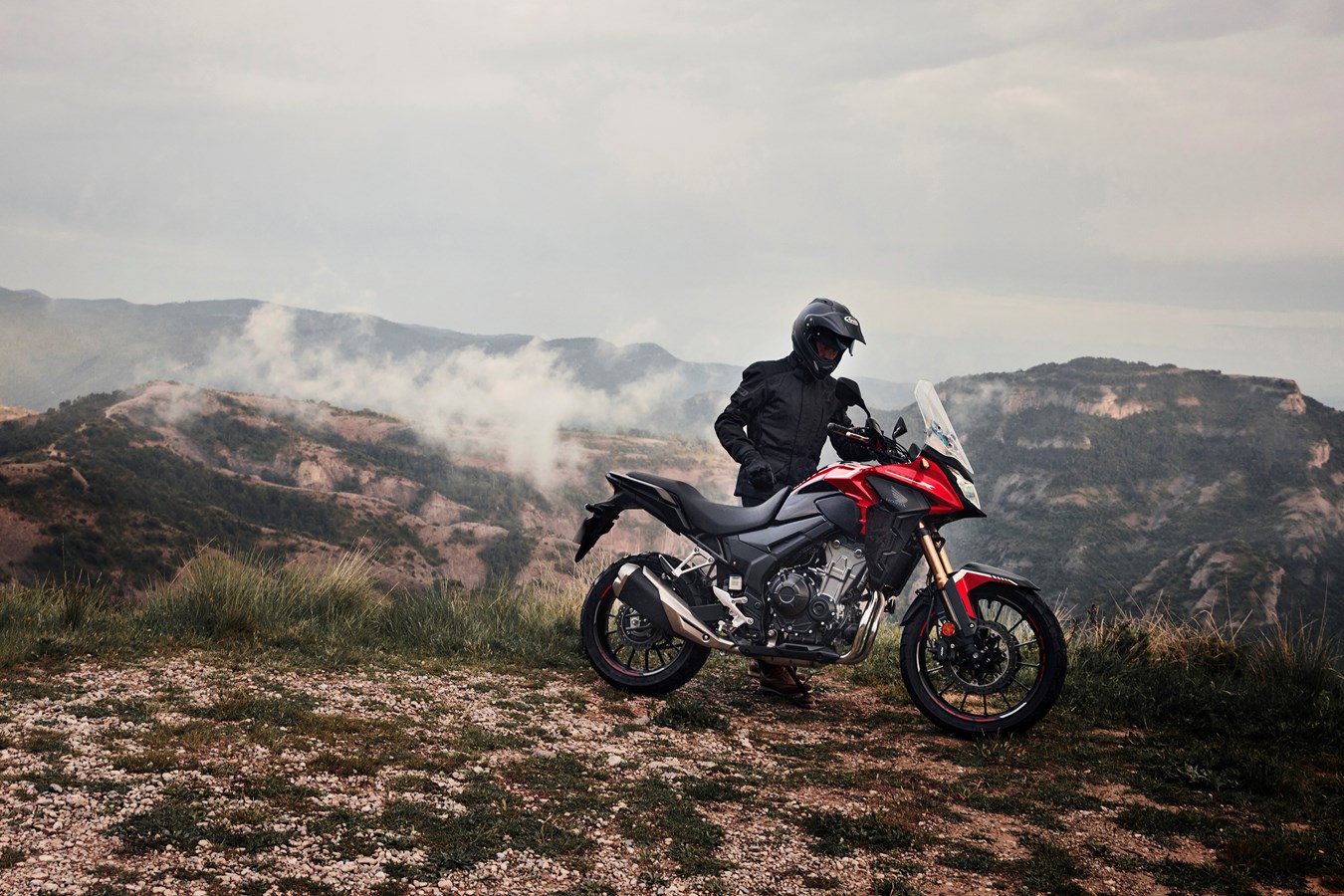
Model updates: Honda’s A2-compatible mini-adventurer receives major performance-focussed improvements led by Showa 41mm Separate Function Fork Big Piston (SFF-BP) USD forks, dual disc front brakes and radial-mount calipers. Handling is further improved by the new swingarm, which is lighter with more lateral flex. The rear shock has new settings to complement the new forks. A redesigned front wheel and lighter radiator save weight and new fuel injection settings improve engine character. More powerful headlight LEDs and front indicator position lights offer greater visibility.
Contents:
1 Introduction
2 Model overview
3 Key features
4 Accessories
5 Technical specifications
- Introduction
The CB500X – originally launched in 2013 alongside the naked CB500F and fully-faired CBR500R – brings crossover adventure style to Honda’s fun-focussed twin-cylinder ‘light middleweight’ trio. It is a motorcycle that, without fanfare, quietly gets on with the job of being supremely competent and adaptable for a wide variety of owners.
The CB500X’s usefulness is down to a straightforward equation – a perky, well-regarded twin-cylinder engine which produces real torque and drive from low rpm, and revs hard up top – plus a chassis that gives a supremely comfortable ride both around town and out on the open highway, all wrapped up in distinctive adventure styling.
It slips between the role of short-hop commuter to weekend tourer effortlessly. Long travel suspension irons out irregular road surfaces, wide handlebars provide leverage and the upright riding position offers both comfort and a wide field of view for the rider. In other words, the CB500X is an all-rounder in every sense of the term.
In 2016, a first upgrade saw the CB500X receive a larger fuel tank, more wind protection and a taller screen. It also gained LED lighting, spring preload-adjustable front forks and adjustable brake lever. Its 2019 evolution delivered more sophisticated adventure style, more engine performance and a number of chassis upgrades, ensuring that while the CB500X remained confident in its wide-ranging abilities, its ‘X’ factor was well and truly amplified. It gained EURO5 compliance in 2020.
Having proved its popularity over nearly a decade, for 2022 year model it receives high-quality front suspension in the form of Showa 41mm SFF-BP USD forks, plus dual front discs, lightweight swingarm, redesigned front wheel and other detail updates including a striking new colour and bold new graphics.
2. Model Overview
Alongside engine changes such as revised fuel injection settings and a new lighter radiator, the chassis benefits from the addition of Showa 41mm SFF-BP USD forks, dual Nissin radial mount two-piston calipers biting 296mm discs, light-weight wheels feature new thinner spokes and redesigned swingarm – for improved rider comfort and handling performance. Compared to the previous model, weight bias also moves fractionally forward for enhanced front tyre grip and feel. Styling is updated with a new front wheel and larger front mudguard.
As before, LCD instruments feature a Shift Up and Gear Position function. All lighting is LED, with optimised high/low headlight beam and addition of front indicator position lights.
The 22YM CB500X will be available in the following colour options:
Grand Prix Red
Matt Gunpowder Black Metallic
Pearl Organic Green **NEW for 2022**
3. Key Features
3.1 Chassis & Styling
- 41mm Showa Separate Function Fork Big Piston (SFF-BP) USD forks
- New dual 296mm discs matched to Nissin two-piston calipers
- New lighter weight front wheel and swingarm
- Revised headlight LEDs for improved high/low beam plus position lights
Light, strong and unchanged for the 2022 year model, the CB500X’s 35mm diameter steel diamond-tube mainframe has a tuned degree of yield that gives plenty of feedback to the rider as road surfaces change. The shape and position of the engine mounts, plus the frame’s rigidity balance, also reduce vibration.
Immediately obvious is a brand-new front end set-up. With the aim to heighten all-round handling performance the 41mm telescopic forks of the previous design have been replaced by spring preload-adjustable Showa 41mm Separate Function Fork Big Piston (SFF-BP) USD forks with 135mm axle travel (150mm cushion stroke), clamped by new top and bottom yokes. By dividing the functions – Big Piston pressure separation damper in one leg, spring mechanism in the other – reaction and ride quality are both improved.
The single-tube rear shock absorber (as found on larger capacity sports bikes) with its large-diameter piston and 135mm axle travel (60mm cushion stroke) ensures excellent response and temperature management; it features 5-stage preload adjustment with newly optimised spring rate and damping settings.
Handling is further improved by the redesigned, lighter swingarm. Now constructed from 2mm steel (rather than 2.3mm), it employs a hollow cross member and is stiffer rotationally, and also more flexible laterally to improve handling. A crisply redesigned chain guard completes the new look.
In line with the dynamic improvements to the chassis and suspension, the braking performance has also been improved. The single 310mm wave-pattern disc and two-piston caliper front brake of the previous design has been replaced by dual 296mm wave-pattern discs and axial mounted Nissin two-piston calipers. The introduction of the smaller discs not only keeps any additional weight gain to a minimum, but also reduces the required pressure on the lever when braking.
The redesigned 19-inch cast aluminium front wheel – lighter thanks to thinner spokes – reduces unsprung weight to aid turning ability. It’s crowned by a tough new mudguard design and heads a 17-inch rear wheel; trail-pattern tyres are sized 110/80-R19 front and 160/60-R17 rear. Weight bias has also been adjusted. with front/rear bias percentage of 48.7/51.3 compared to the previous 48/52. Kerb weight is 199kg. Wheelbase remains 1,445mm with rake and trail of 27.5°/108mm.
The CB500X wears an aggressive, ‘ready for the wild’ adventure style, with the long radiator shrouds and fairing giving a strong three-dimensional texture front to rear, linked by interlocking side covers and fuel tank. But this is a bike as much about function as form; high-pressure air flowing around the fairing and screen (with two available height settings – 1445mm and 1410mm) is managed to improve wind protection for the rider at highway speeds. The sharply-chiselled headlight is now even more piercing with extra-powerful LEDs, plus there’s added visibility from front indicator position lights.
A slim seat profile allows for free movement around the machine and aids easy ground reach. And to help manoeuvrability the steering angle is 38° from centred to full lock.
Gunmetal grey tapered steel handlebar elevate control further still. Seat height is 830mm and the upright riding position is very accommodating, while providing excellent visibility. Overall dimensions are 2155mm x 830mm x 1410mm, with 180mm ground clearance.
LCD instruments – set in a multi-surfaced and textured surround – feature a Gear Position and Shift Up indicator; this is set to a default 8,750rpm but can be adjusted in 250rpm increments between 5-8,750rpm.
The fuel tank holds 17.5L including reserve, and, combined with the engine’s excellent fuel economy of 3.6L/100km (27.8km/l) (WMTC mode), gives a range of 485km.
3.2 Engine
- Lively twin-cylinder powerplant delivers usable power and torque across the rev-range, plus sporty sound from its dual-exit muffler
- New PGM-FI settings improve torque feel and character
- New radiator design more stylish and lighter
- Assist/slipper clutch eases upshifts and manages downshifts
- Homologated for EURO5
The CB500X’s A2-licence friendly 471cc, 8-valve liquid-cooled parallel twin-cylinder layout offers a well-proportioned balance of physical size and willing, enjoyable power output, with an energetic, high-revving character and zappy top end. The 2019 upgrades created faster acceleration through a 4% boost in low-to-mid-range power and torque in the 3-7,000rpm range. It's very much an engine whose overall performance and character belie its relatively small capacity. Peak power of 35kW arrives at 8,600rpm, with 43Nm torque delivered at 6,500rpm.
Feeding the PGM-FI fuel injection is a more-or-less straight shot of airflow through the airbox and throttle bodies and for 2022, new settings improve torque feel and character without compromising performance. The exhaust muffler features dual exit pipes, giving a sporting edge to each pulse, and a rasping high-rpm howl. A new more aesthetically pleasing radiator design contributes a 92g weight saving, with no loss of cooling efficiency
Bore and stroke are set at 67mm x 66.8mm with compression ratio of 10.7:1; the crankshaft pins are phased at 180° and a primary couple-balancer sits behind the cylinders, close to the bike’s centre of gravity. The primary and balancer gears use scissor gears, reducing noise. The crank counterweight is specifically shaped for couple-balance and its light weight allows the engine to spin freely, with reduced inertia.
Acting as a stressed member, the engine complements the frame’s rigidity with four frame hangers on the cylinder head. Internally the cylinder head uses roller rocker arms; shim-type valve adjustment allows them to be light, for lower valve-spring load and reduced friction.
A silent (SV Chain) cam chain has the surface of its pins treated with Vanadium, reducing friction with increased protection against wear. Inlet valve diameter is 26.0mm with exhaust valve diameter of 21.5mm.
Piston shape is carefully designed to reduce piston ‘noise’ at high rpm. Friction is reduced by striations on the piston skirt (a finish that increases surface area, introducing gaps in which oil can flow for better lubrication). The ‘triangle’ proportion of crankshaft, main shaft and countershaft is efficiently compact. The crankcases uses centrifugally cast thin-walled sleeves; their internal design reduces the ‘pumping’ losses that can occur with a 180° phased firing order. A deep sump reduces oil movement under hard cornering and braking; oil capacity is 3.2L.The slick-changing six-speed gearbox is managed by an assist/slipper clutch.
4. Accessories
A range of Genuine Honda Accessories are available for the CB500X. They include:
Centre stand
Side wind deflectors
Knuckle guards
Heated grips
35L top box
Rear carrier
Pannier mounts
Pannier cases
Tubular fairing frames
Fog lights
Tank bag
Seat bag
Charging socket
Smoked screen
Wheel stripe
Tank pad
Cargo net
5. Technical Specifications
|
ENGINE |
|
|
Type |
Liquid-cooled, parallel twin |
|
Displacement |
471cc |
|
Bore and stroke |
67mm x 66.8mm |
|
Compression Ratio |
10.7: 1 |
|
Max. Power Output |
35kW @ 8,600rpm |
|
Max. Torque |
43Nm @ 6,500rpm |
|
Noise Level |
L-urban 74dB L-wot 76.7dB |
|
Oil Capacity |
3.2L |
|
FUEL SYSTEM |
|
|
Carburation |
PGM FI electronic fuel injection |
|
Fuel Tank Capacity |
17.5L (inc reserve) |
|
CO2 Emissions WMTC |
82 g/km |
|
Fuel Consumption (WMTC) |
3.6L/100km / 27.8km/l (WMTC mode) |
|
ELECTRICAL SYSTEM |
|
|
Battery Capacity |
12V 7.4AH |
|
ACG Output |
25A/2000rpm |
|
DRIVETRAIN |
|
|
Clutch Type |
Wet multiplate |
|
Transmission Type |
6 speed |
|
Final Drive |
Chain |
|
FRAME |
|
|
Type |
Steel diamond |
|
CHASSIS |
|
|
Dimensions (L´W´H) |
2155mm x 830mm x 1410mm (Low screen) 1445mm (High screen) |
|
Wheelbase |
1445mm |
|
Caster Angle |
27.5 degrees |
|
Trail |
108mm |
|
Seat Height |
830mm |
|
Ground Clearance |
180mm |
|
Kerb Weight |
199kg |
|
SUSPENSION |
|
|
Type Front |
Showa 41mm SFF-BP USD forks, pre-load adjustable |
|
Type Rear |
Prolink mono with 5 stage preload adjuster, steel hollow cross swingarm |
|
WHEELS |
|
|
Type Front |
Multi-spoke cast aluminium |
|
Type Rear |
Multi-spoke cast aluminium |
|
Rim Size Front |
19 X MT2.5 |
|
Rim Size Rear |
17 X MT4.5 |
|
Tyres Front |
110/80R19M/C (59H) |
|
Tyres Rear |
160/60R17M/C (69H) |
|
BRAKES |
|
|
ABS System Type |
2 channel |
|
Type Front |
Dual 296mm x 4mm disc with Nissin radial-mount two piston calipers |
|
Type Rear |
Single 240mm x 5mm disc with single piston caliper |
|
INSTRUMENTS & ELECTRICS |
|
|
Instruments |
LCD Meter with Speedometer, Bar Graph Tachometer, Dual Trip Meters, Fuel Level and Consumption Gauge, Clock, Water Temp, Gear position, Shift UP Indicator |
|
Headlight |
LED |
|
Taillight |
LED |
|
Security System |
HISS (Honda Intelligent Security System) |
All specifications are provisional and subject to change without notice.
# Please note that the figures provided are results obtained by Honda under standardised testing conditions prescribed by WMTC. Tests are conducted on a rolling road using a standard version of the vehicle with only one rider and no additional optional equipment. Actual fuel consumption may vary depending on how you ride, how you maintain your vehicle, weather, road conditions, tire pressure, installation of accessories, cargo, rider and passenger weight, and other factors.
22YM HONDA CB500F
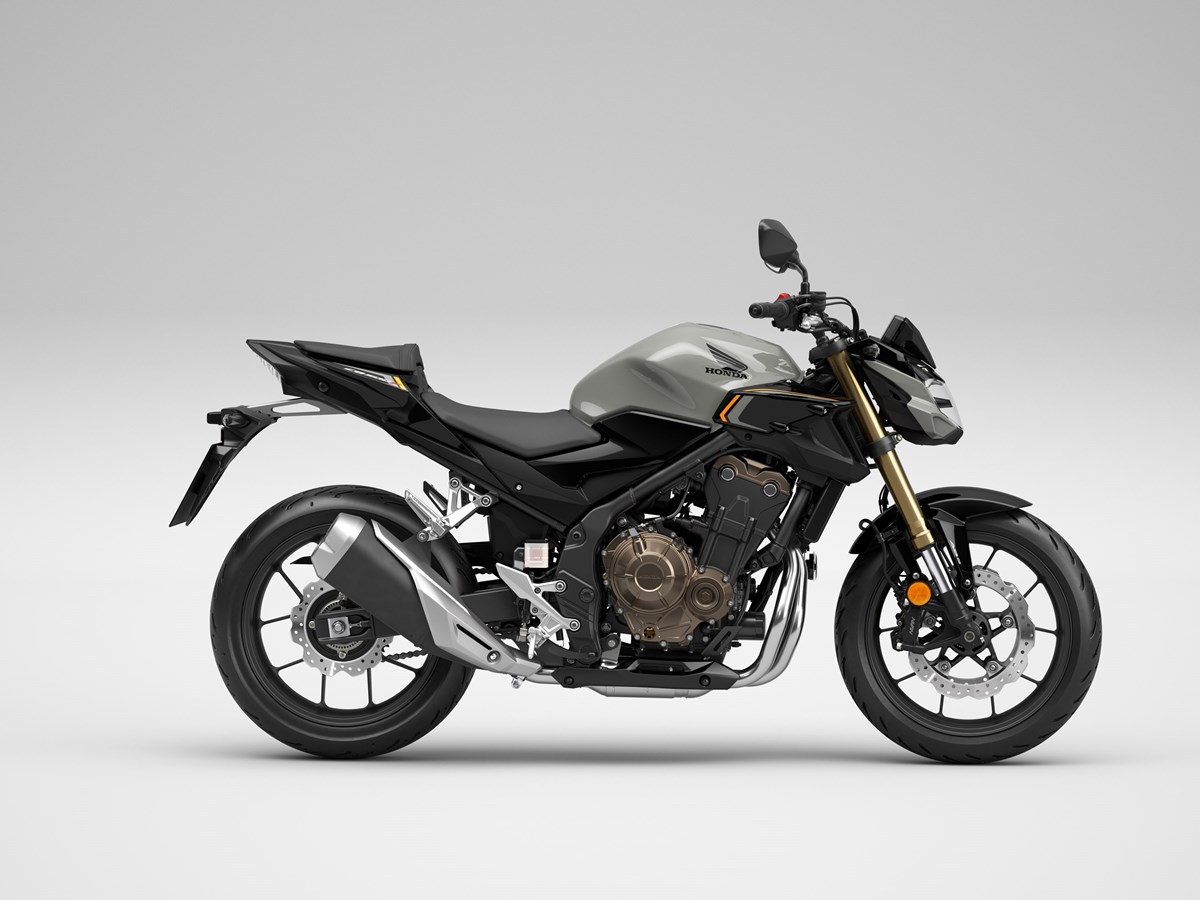
Model updates: Honda’s A2-compatible mini-streetfighter receives major performance-focussed improvements led by new Showa 41mm Separate Function Fork Big Piston (SFF-BP) USD forks, dual disc front brakes and radial-mount calipers. Front tyre grip is heightened with more forward weight bias; handling is further improved by the new swingarm, which is lighter with more lateral flex. The rear shock has new settings to complement the new forks. Redesigned wheels and a lighter radiator save more weight and new fuel injection settings improve engine character. More powerful headlight LEDs and front indicator position lights offer greater visibility.
Contents:
1 Introduction
2 Model overview
3 Key features
4 Accessories
5 Technical specifications
- Introduction
The naked CB500F – originally launched in 2013 alongside the adventure-styled CB500X and fully-faired CBR500R – has quietly proved that one of Honda’s tried-and-trusted formulas for building popular motorcycles has lost none of its relevance.
That formula? An entertaining twin-cylinder engine wrapped in a simple, lightweight, sporty chassis, which is as much fun for an experienced rider as it is for those still building their riding career. And while a 35kW peak power output makes it suitable for A2 licence holders, the CB500F offers so much more than ‘entry level’ performance.
While its compact dimensions and welcoming manners make it an easy machine to manage, ride and learn on, those same attributes also make it a genuine pleasure for those – whether stepping up from a 125 or coming down from a bigger machine – who want to explore just what it can do at the weekend. Sensible running costs, whatever the situation, add strongly to the appeal.
In 2019, the CB500F was redrawn with uncompromising lines that elevated its technical and mechanical aspects and in 2020 it was homologated for EURO5. Having proved its continued popularity, for 2022 it receives high-quality suspension in the form of Showa 41mm SFF-BP USD forks, dual front discs, new lightweight wheels and swingarm and other detail updates including three striking new colours.
2. Model Overview
Alongside engine changes such as revised fuel injection settings and a new lighter radiator, the chassis benefits from the addition of Showa 41mm SFF-BP USD forks, dual Nissin radial mount two-piston calipers biting 296mm discs, lighter-weight 5-spoke wheels and redesigned swingarm – for improved high-speed handling and braking. Weight bias also moves fractionally forward compared to the previous model, for enhanced front tyre grip and feel.
Styling is updated with a new front mudguard, inherited from the CB650R, and sporty aluminium footpegs are now also standard fit. As before, LCD instruments feature a Shift Up and Gear Position function. All lighting is LED, with optimised high/low headlight beam from the new headlight and position lights.
The 2022 CB500F will be available in the following colour options:
Grand Prix Red
Matt Axis Grey Metallic **NEW for 2022**
Pearl Smokey Gray **NEW for 2022**
Pearl Dusk Yellow **NEW for 2022**
3. Key Features
3.1 Chassis & Styling
- New 41mm Showa Separate Function Fork Big Piston (SFF-BP) USD forks
- New dual 296mm discs matched to Nissin radial mount two-piston calipers
- Lighter weight wheels and swingarm, plus aluminium footpegs
- More forward weight bias for enhanced front tyre grip
- Revised LEDs for the headlight for improved high/low beam
Light, strong and unchanged for 2022, the 35mm diameter steel diamond-tube mainframe has a tuned degree of yield that gives plenty of feedback to the rider as road surfaces change. The shape and position of the engine mounts, plus the frame’s rigidity balance, keep vibration to a minimum.
Immediately obvious is a brand-new front end set-up. With the aim to heighten sporty handling performance the 41mm telescopic forks of the previous design have been replaced by Showa 41mm Separate Function Fork Big Piston (SFF-BP) USD forks, clamped by new top and bottom yokes. By dividing the functions – Big Piston pressure separation damper in one leg, spring mechanism in the other – reaction and ride quality are both improved. The four-cylinder CB650R uses the exact same set-up.
In a further effort to improve the ride quality, the 2022 CB500F features new lighter wheels with 5 Y-shaped spokes rather than the 6 of the previous model. The front wheel width remains 3.5inch with a 120/70-ZR17 tyre and the rear 4.5inch with 160/60-ZR17 tyre.
A redesigned swingarm also shaves grams; it’s now constructed from 2mm steel (rather than 2.3mm) and employs a hollow cross member and crisply redesigned chain guard. Stiffer rotationally, the new swingarm is also more flexible laterally to improve handling. The single-tube rear shock absorber (as found on larger capacity sports bikes) with its large-diameter piston ensures excellent response and temperature management; it features 5-stage preload adjustment with spring rate and damping settings optimised to match the forks.
In line with the dynamic improvements to the chassis and suspension, the braking performance has also been improved. The single 320mm and two-piston caliper front brake from the previous model has been replaced by dual 296mm discs and Nissin radial-mount, two-piston calipers. The introduction of the smaller discs not only keeps any additional weight gain to a minimum, but also reduces the required pressure on the lever when braking.
The new CB500F’s kerb weight remains 189kg, but it places more weight on the front wheel than the previous model to promote more nimble handling and improve front end grip: front/rear bias percentage is now 49.7/50.3 (compared to 46.8/53.2). Wheelbase remains 1410mm with rake and trail of 25.5°/102mm.
The naked form exudes aggression. Led by the sharply-chiselled headlight – now even more piercing with extra-powerful LEDs and a new stronger cluster arrangement, plus high-visibility front indicator position lights – the machine’s stance is low-set and ready for action; the side shrouds interlock with the fuel tank and fully emphasize the engine, while the side covers and seat unit continue the theme of muscular angularity. The compact front mudguard is drawn directly from the CB650R.
Tapered handlebars offer intuitive feel and leverage. Seat height is low at 789mm, making the CB500F very easy to manage and its neutral riding position comfortably accommodates riders of any height. More purposeful-looking aluminium footpegs replace the previous rubberised parts; between the pair they save a further 104g. Overall dimensions are 2080mm x 800mm x 1060mm, with 145mm ground clearance.
The fuel tank holds 17.1L including reserve and combined with the engine’s excellent 3.5L/100km (28.6km/litre) fuel economy, gives a range of over 485km.
3.2 Engine
- Lively twin-cylinder powerplant delivers usable power and torque across the rev-range, plus sporty sound from its dual-exit muffler
- New PGM-FI settings improve torque feel and character
- New radiator design more stylish and lighter
- Assist/slipper clutch eases upshifts and manages downshifts
- Homologated for EURO5
The 2022 CB500F’s A2-licence friendly 471cc, 8-valve liquid-cooled parallel twin-cylinder layout offers a well-proportioned balance of physical size and willing, enjoyable power output, with an energetic, high-revving character and zappy top end. The 2019 upgrades created faster acceleration through a 4% boost in low-to-mid-range power and torque in the 3-7,000rpm range. It's very much an engine whose overall performance and character belie its relatively small capacity. Peak power of 35kW arrives at 8,600rpm, with 43Nm torque delivered at 6,500rpm.
Feeding the PGM-FI fuel injection is a more-or-less straight shot of airflow through the airbox and throttle bodies and for the 2022 year model, new settings improve torque feel and character without compromising performance. The exhaust muffler features dual exit pipes, giving a sporting edge to each pulse, and a rasping high-rpm howl. A new more aesthetically pleasing radiator design contributes a 100g weight saving, with no loss of cooling efficiency.
Bore and stroke are set at 67mm x 66.8mm and compression ratio is 10.7:1; the crankshaft pins are phased at 180° and a primary couple-balancer sits behind the cylinders, close to the bike’s centre of gravity. The primary and balancer gears use scissor gears, reducing noise. The crank counterweight is specifically shaped for couple-balance and its light weight allows the engine to spin freely, with reduced inertia.
Acting as a stressed member, the engine complements the frame’s rigidity with four frame hangers on the cylinder head. Internally the cylinder head uses roller rocker arms; shim-type valve adjustment allows them to be light, for lower valve-spring load and reduced friction.
A silent (SV Chain) cam chain has the surface of its pins treated with Vanadium, reducing friction with increased protection against wear. Inlet valve diameter is 26.0mm with exhaust valve diameter of 21.5mm.
Piston shape is carefully designed to reduce piston ‘noise’ at high rpm. Friction is reduced by striations on the piston skirt (a finish that increases surface area, introducing gaps in which oil can flow for better lubrication). The ‘triangle’ proportion of crankshaft, main shaft and countershaft is efficiently compact. The crankcases uses centrifugally cast thin-walled sleeves; their internal design reduces the ‘pumping’ losses that can occur with a 180° phased firing order. A deep sump reduces oil movement under hard cornering and braking; oil capacity is 3.2L.The slick-changing six-speed gearbox is managed by an assist/slipper clutch.
4. Accessories
A range of Genuine Honda Accessories are available for the CB500F. They include:
35L top box
Rear carrier
Tank bag
Seat bag
Smoke windscreen
Heated grips
12V/USB Type-C sockets
Seat cowl
Wheel stripes
Tank pad
Main stand
5. Technical Specifications
|
ENGINE |
|
|
Type |
Liquid-cooled 4 stroke, parallel twin |
|
Displacement |
471cc |
|
No of Valves per Cylinder |
4 |
|
Bore & Stroke |
67mm x 66.8mm |
|
Compression Ratio |
10.7: 1 |
|
Max. Power Output |
35kW @ 8600rpm |
|
Max. Torque |
43Nm @ 6500rpm |
|
Noise Level (dB) |
L-urban 74dB L-wot 76.4dB |
|
Oil Capacity |
3.2L |
|
FUEL SYSTEM |
|
|
Carburation |
PGM FI electronic fuel injection |
|
Fuel Tank Capacity |
17.1L (inc reserve) |
|
CO2 Emissions (WMTC) |
80 g/km |
|
Fuel Consumption (WMTC) |
3.5L/100km (28.6km/litre) |
|
ELECTRICAL SYSTEM |
|
|
Battery Capacity |
12V 7.4AH |
|
ACG Output |
23.4A/2000rpm |
|
DRIVETRAIN |
|
|
Clutch Type |
Wet multiplate, Assisted slipper clutch |
|
Transmission Type |
6 speed |
|
Final Drive |
Chain |
|
FRAME |
|
|
Type |
Steel diamond |
|
CHASSIS |
|
|
Dimensions (L´W´H) |
2080mm x 800mm x 1060mm |
|
Wheelbase |
1410mm |
|
Caster Angle |
25.5 degrees |
|
Trail |
102mm |
|
Seat Height |
789mm |
|
Ground Clearance |
145mm |
|
Kerb Weight |
189kg |
|
SUSPENSION |
|
|
Type Front |
Showa 41mm SFF-BP USD forks, pre-load adjustable |
|
Type Rear |
Prolink mono with 5 stage pre-load adjuster, Steel hollow cross swingarm |
|
WHEELS |
|
|
Type Front |
5Y-Spoke Cast Aluminium |
|
Type Rear |
5Y-Spoke Cast Aluminium |
|
Rim Size Front |
17 x MT3.5 |
|
Rim Size Rear |
17 x MT4.5 |
|
Tyres Front |
120/70ZR17M/C (58W) |
|
Tyres Rear |
160/60ZR17M/C (69W) |
|
BRAKES |
|
|
ABS System Type |
2-channel |
|
Type Front |
Dual 296mm x 4mm disc with Nissin radial-mount two piston calipers |
|
Type Rear |
Single 240mm x 5mm disc with single piston caliper |
|
INSTRUMENTS & ELECTRICS |
|
|
Instruments |
LCD Meter with Speedometer, Bar Graph Tachometer, Dual Trip Meters, Fuel Level and Consumption Gauge, Clock, Water Temp, Gear position, Shift UP Indicator |
|
Headlight |
LED |
|
Taillight |
LED |
|
Security System |
HISS (Honda Intelligent Security System) |
All specifications are provisional and subject to change without notice.
# Please note that the figures provided are results obtained by Honda under standardised testing conditions prescribed by WMTC. Tests are conducted on a rolling road using a standard version of the vehicle with only one rider and no additional optional equipment. Actual fuel consumption may vary depending on how you ride, how you maintain your vehicle, weather, road conditions, tire pressure, installation of accessories, cargo, rider and passenger weight, and other factors.
22YM HONDA CBR500R
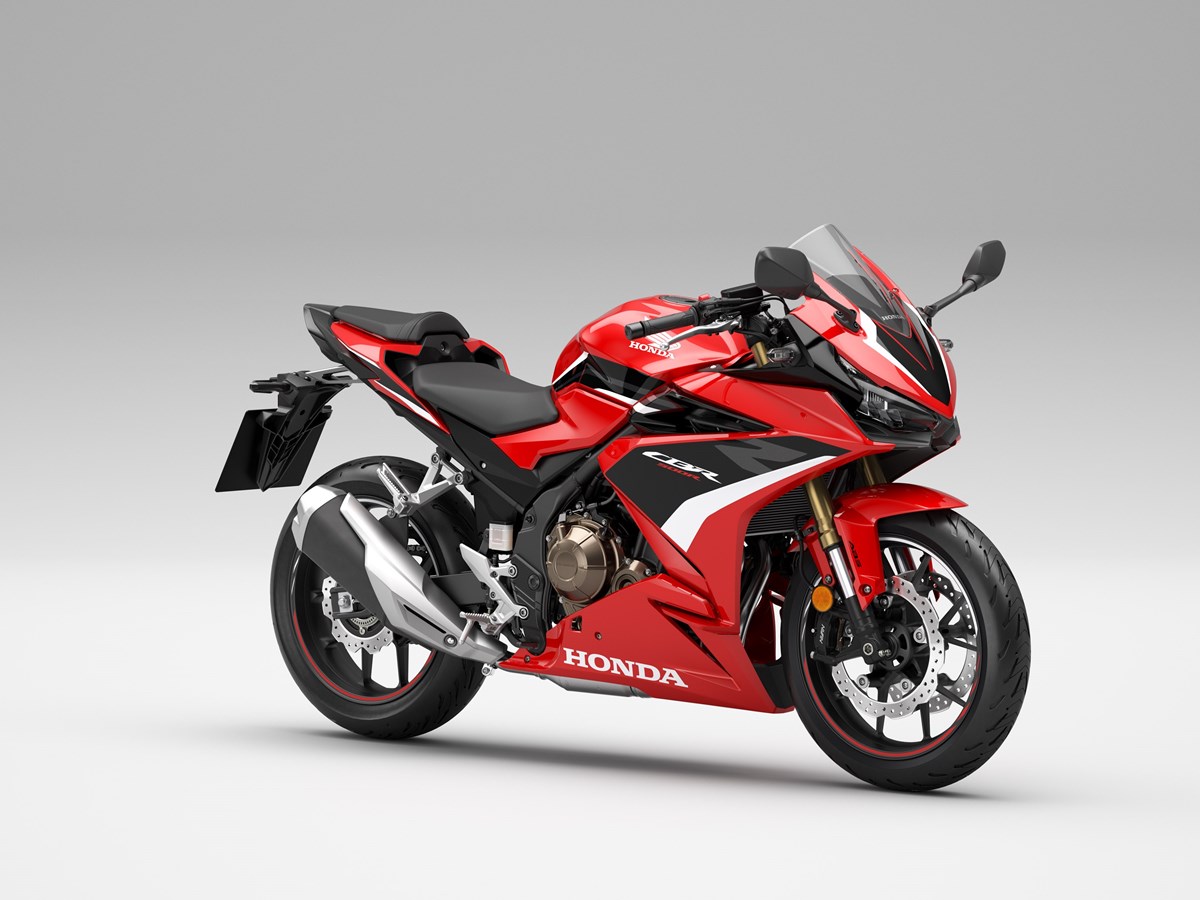
Model updates: Honda’s A2-compatible ‘pocket rocket’ receives major performance-focussed improvements led by Showa 41mm Separate Function Fork Big Piston (SFF-BP) USD forks, dual disc front brakes and radial-mount calipers. Front tyre grip is heightened with more forward weight bias; handling is further improved by the new swingarm, which is lighter with more lateral flex. The rear shock has new settings to complement the new forks. Redesigned wheels and a lighter radiator save more weight and new fuel injection settings improve engine character. More powerful headlight LEDs offer greater visibility.
Contents:
1 Introduction
2 Model overview
3 Key features
4 Technical specifications
- Introduction
Fast, frugal, affordable and – most importantly – fun, Honda’s fully-faired CBR500R, launched in 2013 alongside the naked CB500F and adventure-styled CB500X, injects a genuine sporting energy to its twin-cylinder ‘light middleweight’ trio.
Hugely popular with younger riders looking to move up from a smaller machine with more than 50% of owners under the age of 30, the CBR500R instils the excitement of sports bike ownership into every ride yet also delivers sensible running costs, making it a great bike to both commute through the working week and enjoy at the weekend.
In 2016 the CBR500R assumed sharper styling and LED lighting to go with updated front suspension; in 2019 it got an even more aggressive makeover, with a new form and riding position that outlined a keener sporting intent. Developments were also applied to the engine for stronger performance off the bottom, a distinctive surge through the rev range to the redline and more distinctive exhaust howl. It gained EURO5 compliance in 2020.
Having proved its undoubted star quality alongside its siblings, for its 2022 year model it receives a major suspension upgrade in the form of high-quality Showa 41mm SFF-BP USD forks, plus dual front discs, new lightweight wheels and swingarm and other detail updates including a striking new colour.
2. Model Overview
Alongside engine changes such as revised fuel injection settings and a new lighter radiator, the chassis benefits from the addition of Showa 41mm SFF-BP USD forks, dual Nissin radial mount two-piston calipers biting 296mm discs, lighter-weight 5-spoke wheels and redesigned swingarm – for improved high-speed handling and braking. Weight bias also moves fractionally forward for enhanced front tyre grip and feel.
Styling is updated with a new front mudguard, inherited from the CBR650R, and sporty aluminium footpegs are also now standard fit. As before, LCD instruments feature a Shift Up and Gear Position function and all lighting is premium LED; the new headlight, also inherited from the CBR650R, now spreads a broader beam.
The 2022 CBR500R will be available in the following colour options:
Grand Prix Red
Matt Gunpower Black Metallic **NEW for 2022**
3. Key Features
3.1 Chassis & Styling
- New 41mm Showa Separate Function Fork Big Piston (SFF-BP) USD forks
- New dual 296mm discs matched to Nissin radial mount two-piston calipers
- Lighter weight wheels and swingarm, plus aluminium footpegs
- Weight bias further forward for enhanced front end grip
- New headlight inherited from the CBR650R
Light, strong and unchanged for 2022 the 35mm diameter steel diamond-tube mainframe has a tuned degree of yield that gives plenty of feedback to the rider as road surfaces change. The shape and position of the engine mounts, plus the frame’s rigidity balance, also keep vibration to a minimum.
Immediately obvious is a brand-new front end set-up. With the aim to heighten sports handling performance the 41mm telescopic forks of the previous design have been replaced by Showa 41mm Separate Function Fork Big Piston (SFF-BP) USD forks, clamped by new top and bottom yokes. By dividing the functions – Big Piston pressure separation damper in one leg, spring mechanism in the other – reaction and ride quality are both improved. The four-cylinder CBR650R wears the exact same set-up.
In a further effort to improve the ride quality, the 22YM CBR500R features new lighter wheels with 5 Y-shaped spokes rather than the 6 of the previous model. The front wheel width remains 3.5inch with a 120/70-ZR17 tyre and the rear 4.5inch with 160/60-ZR17 tyre.
A redesigned swingarm also shaves grams; it’s now constructed from 2mm steel (rather than 2.3mm) and employs a hollow cross member and crisply redesigned chain guard. Stiffer rotationally, the new swingarm is also more flexible laterally to improve handling. The single-tube rear shock absorber (as found on larger capacity sports bikes) with its large-diameter piston ensures excellent response and temperature management; it features 5-stage preload adjustment with spring rate and damping settings optimised to match the forks.
In line with the dynamic improvements to the chassis and suspension, the braking performance has also been improved. The single 320mm and two-piston caliper front brake from the previous model has been replaced by dual 296mm discs and Nissin radial-mount, two-piston calipers. The introduction of the smaller discs not only keeps any additional weight gain to a minimum, but also reduces the required pressure on the lever when braking.
The new CBR500R weighs in at 192kg and places slightly more weight on the front wheel to promote more nimble handling and improve front end grip: front/rear bias percentage is now 50.7/49.3, compared to 50.1/49.9 of the previous version. Wheelbase remains 1410mm with rake and trail of 25.5°/102mm.
And nimble responsiveness is what the CBR500R is all about. The view forward from the cockpit is pure sports. The handlebars clip on beneath the top yoke and as a result the riding position is unmistakably aggressive; the fairing is also set low. Purposeful aluminium footpegs replace the previous rubberised parts; between the pair they save 104g and offer maximum support for more spirited riding. The compact front mudguard is drawn from the CBR650R.
New sharply-chiselled dual LED headlights, inherited from the CBR650R, stare menacingly ahead with a wider volume of light emission, matching by LED indicators. LCD instruments feature a Gear Position and Shift Up indicator; this is set to a default 8,750rpm but can be adjusted in 250rpm increments between 5-8,750rpm.
Seat height is low at 785mm, making the CBR500R very easy to manage and its riding position comfortably accommodates riders of any height. Overall dimensions are 2080mm x 760mm x 1145mm, with 130mm ground clearance.
The fuel tank holds 17.1L including reserve and combined with the engine’s excellent 3.5L/100km (28.6km/litre) fuel economy, gives a range of over 485km.
3.2 Engine
- Lively twin-cylinder powerplant delivers usable power and torque across the rev-range, plus sporty sound from its dual-exit muffler
- New PGM-FI settings improve torque feel and character
- New radiator design more stylish and lighter
- Assist/slipper clutch eases upshifts and manages downshifts
- Homologated for EURO5
The 22YM CBR500R’s A2-licence friendly 471cc, 8-valve liquid-cooled parallel twin-cylinder layout offers a well-proportioned balance of physical size and willing, enjoyable power output, with an energetic, high-revving character and zappy top end. The 2019 upgrades created faster acceleration through a 4% boost in low-to-mid-range power and torque in the 3-7,000rpm range. It's very much an engine whose overall performance and character belie its relatively small capacity. Peak power of 35kW arrives at 8,600rpm, with 43Nm torque delivered at 6,500rpm.
Feeding the PGM-FI fuel injection is a more-or-less straight shot of airflow through the airbox and throttle bodies and for the 2022 year model, new settings improve torque feel and character without compromising performance. The exhaust muffler features dual exit pipes, giving a sporting edge to each pulse, and a rasping high-rpm howl. A new more aesthetically pleasing radiator design contributes a 100g weight saving, with no loss of cooling efficiency.
Bore and stroke are set at 67mm x 66.8mm and compression ratio is 10.7:1; the crankshaft pins are phased at 180° and a primary couple-balancer sits behind the cylinders, close to the bike’s centre of gravity. The primary and balancer gears use scissor gears, reducing noise. The crank counterweight is specifically shaped for couple-balance and its light weight allows the engine to spin freely, with reduced inertia.
Acting as a stressed member, the engine complements the frame’s rigidity with four frame hangers on the cylinder head. Internally the cylinder head uses roller rocker arms; shim-type valve adjustment allows them to be light, for lower valve-spring load and reduced friction.
A silent (SV Chain) cam chain has the surface of its pins treated with Vanadium, reducing friction with increased protection against wear. Inlet valve diameter is 26.0mm with exhaust valve diameter of 21.5mm.
Piston shape is carefully designed to reduce piston ‘noise’ at high rpm. Friction is reduced by striations on the piston skirt (a finish that increases surface area, introducing gaps in which oil can flow for better lubrication). The ‘triangle’ proportion of crankshaft, main shaft and countershaft is efficiently compact. The crankcases uses centrifugally cast thin-walled sleeves; their internal design reduces the ‘pumping’ losses that can occur with a 180° phased firing order. A deep sump reduces oil movement under hard cornering and braking; oil capacity is 3.2L.The slick-changing six-speed gearbox is managed by an assist/slipper clutch.
4. Accessories
A range of Genuine Honda Accessories are available for the CBR500R. They include:
35L top box
Rear carrier
Tank bag
Seat bag
High smoke windscreen
Heated grips
12V/USB Type-C sockets
Seat Cowl
Wheel Stripes
Tank Pad
5. Technical Specifications
|
ENGINE |
|
|
Type |
Liquid-cooled 4 stroke, parallel twin |
|
Displacement |
471cc |
|
No of Valves per Cylinder |
4 |
|
Bore & Stroke |
67mm x 66.8mm |
|
Compression Ratio |
10.7: 1 |
|
Max. Power Output |
35kW @ 8600rpm |
|
Max. Torque |
43Nm @ 6500rpm |
|
Noise Level (dB) |
L-urban 74dB L-wot 76.4dB |
|
Oil Capacity |
3.2L |
|
FUEL SYSTEM |
|
|
Carburation |
PGM FI electronic fuel injection |
|
Fuel Tank Capacity |
17.1L (inc reserve) |
|
CO2 Emissions (WMTC) |
80 g/km |
|
Fuel Consumption (WMTC) |
3.5L/100km (28.6km/litre) |
|
ELECTRICAL SYSTEM |
|
|
Battery Capacity |
12V 7.4AH |
|
ACG Output |
23.4A/2000rpm |
|
DRIVETRAIN |
|
|
Clutch Type |
Wet multiplate, Assisted slipper clutch |
|
Transmission Type |
6 speed |
|
Final Drive |
Chain |
|
FRAME |
|
|
Type |
Steel diamond |
|
CHASSIS |
|
|
Dimensions (L´W´H) |
2080mm x 760mm x 1145mm |
|
Wheelbase |
1410mm |
|
Caster Angle |
25.5 degrees |
|
Trail |
102mm |
|
Seat Height |
785mm |
|
Ground Clearance |
130mm |
|
Kerb Weight |
192kg |
|
SUSPENSION |
|
|
Type Front |
Showa 41mm SFF-BP USD forks, pre-load adjustable |
|
Type Rear |
Prolink mono with 5 stage pre-load adjuster, Steel hollow cross swingarm |
|
WHEELS |
|
|
Type Front |
5Y-Spoke Cast Aluminium |
|
Type Rear |
5Y-Spoke Cast Aluminium |
|
Rim Size Front |
17 x MT3.5 |
|
Rim Size Rear |
17 x MT4.5 |
|
Tyres Front |
120/70ZR17M/C (58W) |
|
Tyres Rear |
160/60ZR17M/C (69W) |
|
BRAKES |
|
|
ABS System Type |
2-channel |
|
Type Front |
Dual 296mm x 4mm disc with Nissin radial-mount two piston calipers |
|
Type Rear |
Single 240mm x 5mm disc with single piston caliper |
|
INSTRUMENTS & ELECTRICS |
|
|
Instruments |
LCD Meter with Speedometer, Bar Graph Tachometer, Dual Trip Meters, Fuel Level and Consumption Gauge, Clock, Water Temp, Gear position, Shift Up Indicator |
|
Headlight |
LED |
|
Taillight |
LED |
|
Security System |
HISS (Honda Intelligent Security System) |
All specifications are provisional and subject to change without notice.
** Please note that the figures provided are results obtained by Honda under standardised testing conditions prescribed by WMTC. Tests are conducted on a rolling road using a standard version of the vehicle with only one rider and no additional optional equipment. Actual fuel consumption may vary depending on how you ride, how you maintain your vehicle, weather, road conditions, tire pressure, installation of accessories, cargo, rider and passenger weight, and other factors.
Honda’s trio of A2 licence-friendly 500cc machines receive strong performance-focused updates for 2022 year model
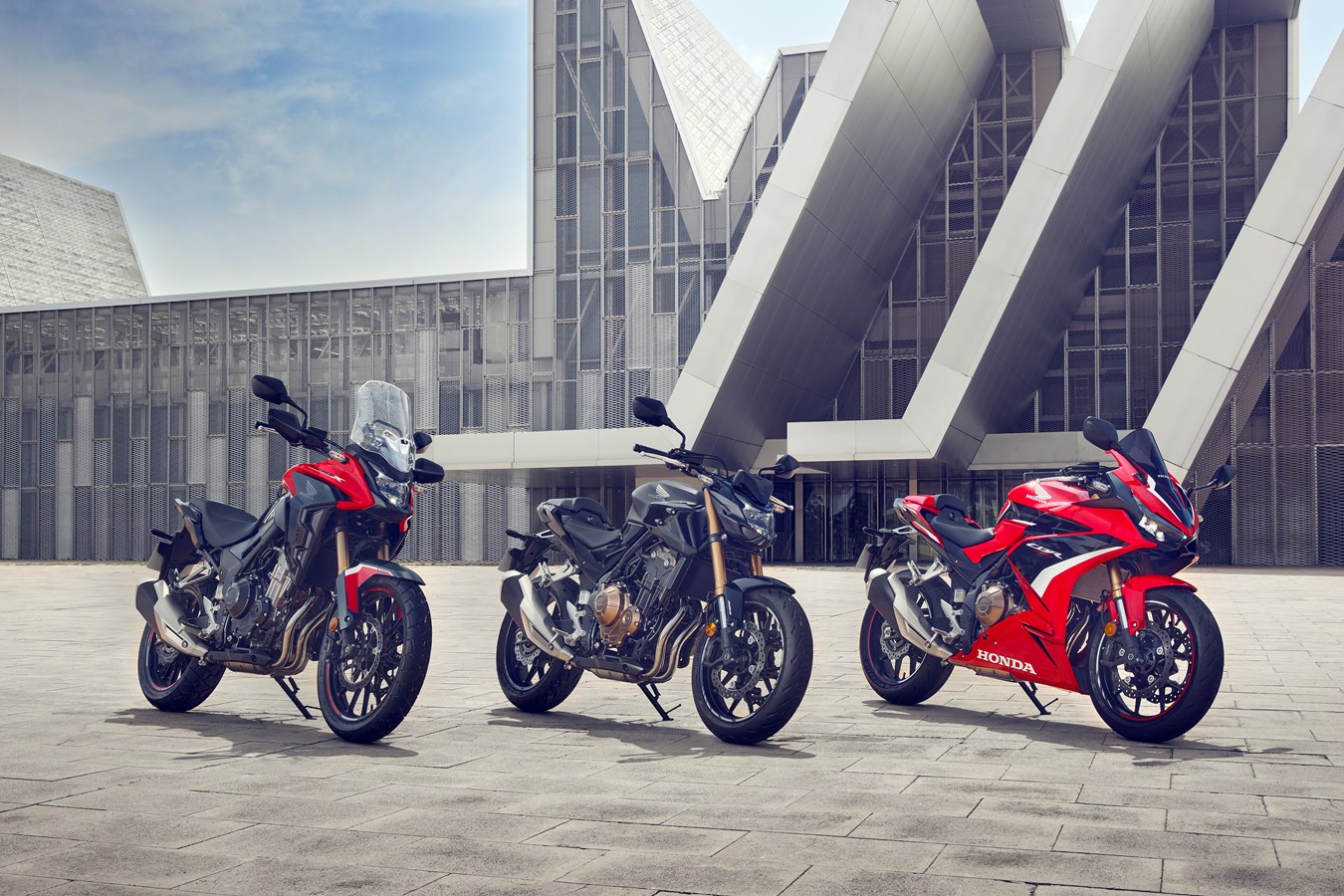
- Honda’s 500cc trio, the CB500F, CBR500R and CB500X all updated for 2022
- Chassis upgrades include Showa 41mm SFF-BP USD forks, a new lighter swingarm, lighter wheels and new dual 296mm front brake discs
- New fuel injection settings improve torque character and feel
- Updated styling with new colours and graphics
Honda’s hugely popular CB500F, CBR500R and CB500X trio all receive engine and chassis upgrades for their 2022 year model versions, further enhancing their broad appeal with new and experienced riders alike.
Inherited from the four cylinder CB650R and CBR650R middleweights, new Showa 41mm SFF-BP USD forks are the highlights of the new front end set up, delivering improved handling and ride quality. These are now matched to lighter Y spoke aluminum wheels on the CB500F and CBR500R, complete with new dual 296mm wavy front discs and radial mounted Nissin calipers. The adventure focused CB500X shares the same new brake and suspension updates as its siblings and also features longer front suspension travel and a lighter, larger 19in front wheel.
All three fun, frugal machines feature a new lighter swingarm, stiffer rotationally, but more flexible laterally to improve handling and cornering performance. The punchy 500cc engine at the heart of each machine still produces the maximum 35kW allowed for the A2 licence holder, but for 2022 it now features new PGM-FI settings to further enhance both torque feel and overall character.
For 2022 the naked CB500F gains three new vibrant colours: Pearl Smoky Gray, Mat Axis Gray Metallic and Pearl Dusk Yellow, while the sporty CBR500R will be available in new Mat Gunpowder Black Metallic, also benefitting from striking new graphics to highlight its racetrack heritage. The CB500X adventure machine receives two new colours for 2022: Mat Gunpowder Black Metallic and Pearl Organic Green. All three bikes will also be available in Honda’s classic Grand Prix Red colour scheme.
While their compact dimensions and welcoming manners make Honda’s 500cc trio easy machines to manage, ride and learn on, those same attributes also make them a genuine pleasure for those – whether stepping up from a 125, coming down from a bigger machine or returning to the market – who want to explore just what they can do at the weekend, whatever the type of ride they choose.
Honda have sold over 106,000 units of the CBs and CBR across Europe since their introduction in 2013. Each take their own place in a distinct world within Honda’s rich product line-up. The CB500F ‘roadster’ accounts for nearly half of the sales, the ‘race’ world representative CBR500R 18%, and the adventure world CB500X, 35% of the total.
Honda’s research of a representative sample of customers shows the breadth of appeal of the three machines across different rider demographics. Figures show that 45% of CB500F and 37% of CBR500R owners are new riders, with 45% and 60% respectively under the age of 34, illustrating how instrumental they have been in bringing new young riders to the world of two wheels.
Conversely, over 75% of CB500X owners are experienced riders, with a further 15% having been drawn back to motorcycling by the all-round appeal offered by the compact adventurer with its rugged styling, long travel suspension and upright riding position.

OLYMPIC MEDALIST DECLAN BROOKS VISITS SUZUKI GB
Tokyo Olympic medalist Declan Brooks visited Suzuki GB last week to meet the team, show off his medal, and collect his new SV650.
Brooks claimed bronze in the freestyle BMX at the 2020 Olympics, the first time the sport has been included in the Games, but when not performing backflips and bar spins in mid-air the 25-year-old can often be found swapping pedal power for horsepower.

After passing his test in 2019 but being confined to an A2 licence, Brooks was finally able to graduate to a full A licence earlier this summer, and last week arrived at Suzuki’s UK headquarters to swap his restricted SV650X for a full power SV650.
While on site, the Team GB athlete was warmly welcomed by Suzuki’s motorcycle division, and spent the morning recounting tales from the Olympic Games while posing for photos with the team.

He said afterwards, “It was great to get up to see everyone at Suzuki and to pick up the new bike. They laid on a bit of breakfast, which was nice, and it was good to chat about BMXing, the Olympics, and just talk bikes. I don’t think it matters if it has an engine or not, if you’re into two wheels then you can get into any type of bike sport, and they spent a lot of time asking about BMX, the sport, and how we do what we do.
“It was good to swap to the full power SV as well. I’ve had to spend a couple of years on the restricted one but obviously rode the unrestricted version for my test, and we went out for a bit of a ride after I’d picked it up as well. I definitely think I’m going to like having a bit more power and I'm looking forward to getting some miles in before the end of the summer.”

Suzuki GB head of motorcycle marketing, Ian Bland, added, “It’s not every day you get to hold an Olympic medal, so we’re very grateful for Declan for coming in and meeting the team and sharing his experiences. It’s an incredible achievement and one he should be proud of. It’s also great to see he enjoys bikes with an engine in the middle as well as pedals, and has now passed his test and is embarking on his own motorcycle journey.”

SCOTLAND'S FOUR CORNERS CHALLENGE FOR CHARITY
Gordon Stuart is no stranger to motorcycle endurance rides, having completed various challenges previously, from John O’Groats to Lands’ End in 2016, to crossing the Arctic Circle in 2018, all in aid of UK brain injury charity Cerebra and special care babies’ charity Tiny Lives. Originally, Gordon intended his next challenge to be much further afield, until the Covid-19 pandemic had other ideas. Forced to look closer to home, he settled on riding his V-Strom 650XT between the four corners of mainland Scotland: 800 miles – with less than 50 miles of motorway – in under 24 hours.
Continuing with tradition, Gordon would complete this ride to raise money for Tiny Lives, a Newcastle-based charity supporting the Neonatal Unit at the Royal Victoria Infirmary. The charity supports over 750 babies and their families annually, and aims to raise £250,000 a year to maintain this support. Gordon and his wife received this support on two occasions, for their daughter Isla born in 2014 and then again with son Hugo born in 2017, with both spending time on the Neonatal Unit following premature births.
“Tiny Lives holds a special place in my heart,” he explained, “and with this ride I wanted to raise money and give back as a way of saying thank you for their care.”

In the run up to completing the four corner challenge, Gordon prepared by riding in the evenings around Northumberland and doing day routes of a few hundred miles, with limited motorway use. The challenge would be Gordon’s first long trip on the V-Strom 650XT, the do-it-all middleweight adventure machine, equipped with Givi Outback Trekker panniers and camping equipment on the pillion seat.
But at midday on Friday 16 July, Gordon set off from the Mull of Galloway, the southernmost point in mainland Scotland.
“The Mull of Galloway was stunning,” Gordon described on reflection. “I was lucky to visit on a lovely morning where from the top of the hill, where a lighthouse sits, I could see the Lake District to the east, Isle of Man to the south and Northern Ireland to the west.
“From there I headed north into Dumfries and through to Galloway and Ayrshire, following the coast between Stranraer and Girvan, before turning northeast towards Glasgow and then onto Stirling, which I reached at around 15:00, and had a brief stop.
“The ride between Stranraer and Girvan along the southwest coast was unexpectedly fun; sweeping bends, large rolling hills, with the terrain of Argyll and the Isle of Arran in the distance across the water. This made me pleased I’d ridden a route that wouldn’t have been on the list.”

After Stirling, it was onto Perth and the motorway section of the ride, which took Gordon past the imposing 220ft National Wallace Monument to the north of Stirling. On this stretch of the ride on the M9, Gordon found his V-Strom was comfortably keeping up with the traffic despite being loaded up, admitting he, “wouldn’t want to do a tour like this on a different bike.”
From Perth, Gordon headed east to Dundee through rush hour before turning north towards Montrose, Aberdeen, and then onto Peterhead where he made his next pit stop at 19:00. While there, he visited the most easterly point in mainland Scotland at Keith Inch, part of the Port of Peterhead, utilising the 650's nimbleness in town when looking for the port. From Peterhead the route headed west towards Inverness where Gordon stopped again, briefly, at 22:00.
Once back on the road, Gordon turned north to follow the NC500 route up the North East Coast to Thurso, then onto Dunnet Head, the northernmost point in mainland Scotland. It was at this point that the temperature dropped but Gordon powered on assisted by his heated vest (and an Alan Partridge audiobook!), arriving there for a scheduled stop at 01:00.
“At Dunnet Head I had a much needed, 90-minute rest in my pop-up tent, which, weirdly, was one of the most normal experiences on the trip: I was no stranger to solo camping, but social-distancing and masks was still very much out of the ordinary.”
Following the closest thing he'd get to a good night's sleep, he headed south from Thurso to Inverness before moving south-westerly along Loch Ness to Fort Augustus, where he stopped briefly again at 07:30am, before continuing onto Fort William.

“Riding south from Thurso towards the NC500 coastal route at sunrise was a delight,” Gordon recounted. “The road rides high over the plains of Caithness with unspoiled views of the northwest Highlands in the distance. And the route following the Great Glen from Inverness down to Fort William is something to behold. Again, I was lucky to ride in nice weather and doing so early in the morning meant, apart from a few deer, I had the road to myself.”
At Fort William, Gordon headed west towards Mallaig before turning south into the Ardnamurchan peninsula. This brought him on to the home straight towards the finish line at the most westerly point of Scotland’s mainland, Ardnamurchan Lighthouse, where he arrived at 11:21am, 23 hours and 21 minutes after setting off.
“The A830 from Fort William to Lochailort via Glenfinnan – and its famous viaduct – was possibly one of the best roads I’ve ever ridden on a bike; sweeping bends, dips and peaks, it was like the best rollercoaster I’ve been on with good views of the road ahead, long lochs, and mountains to the side. Great fun.”
Gordon had done it: 800 miles, all four corners of Scotland in under 24 hours.
“I was absolutely shattered but it was an amazing feeling to have completed the challenge,” Gordon said on reflection. “I was a little bit emotional actually. It was been beautiful the whole time, and it was amazing knowing I had so many people behind me.
“The bike was really comfortable, and it handled the twisty A and B roads of Scotland sublimely and was really confidence-inspiring. You can just throw it into the corners, and you know it will come out the other side where you want it to, it’s just easy to ride. It just seems such a workhorse. You can pile it high with gear and it just doesn’t care.”
Despite this ride not being part of Gordon’s original plan, he was glad he was able to make something positive out of the Covid-19 pandemic. Looking ahead to his next adventure, Gordon hopes to complete a multi-country Arctic ride to Russia (with no-less than 13 border crossings) to complete his years long ambition of riding a motorcycle across the Arctic Circle.

BRAND NEW KATANA FUEL TANKS NOW IN STOCK ON VINTAGE PARTS PROGRAMME
Brand new, genuine Katana fuel tanks are now in stock and available on Suzuki’s Vintage Parts Programme, after the Japanese firm remanufactured a limited run.
With an RRP of £746.76 including VAT, the brand new fuel tanks fit GSX1100SD and GSX1000SZ Katanas and are finished in the glorious silver and adorned with the same red Suzuki lettering.

Suzuki GB aftersales co-ordinator Tim Davies, said, “We’re really excited to have these new Katana fuel tanks in stock, in the UK, and that the factory have been able to reproduce this limited run.
“No one needs me to point out how iconic the Katana is and how they’re still so sought after, and we see so many restorations or custom builds based on the bike. Of course, over time, bikes left to stand can suffer from all sorts of problems with stale fuel or water and moisture in the tank, so being able to replace it completely for a brand new, genuine item is a great thing to be able to do for a bike that is 40-years-old.”

Designed by Hans A. Muth and Target Design, the Katana was like nothing before it. It was a radical departure from current motorcycling fashion and was a sales success for Suzuki.
Other parts still available for the Katana include centre stands, brake and clutch levers, clock surrounds, sprocket covers, con-rods, pistons, and piston rings, an array of gaskets, valves, cotters, seals, and springs, and even the carburettor intakes pipe rubbers.
The new fuel tanks and other parts on the Vintage Parts Programme can be ordered through authorised Suzuki dealers.

CLASSIC SUZUKI SUNDAY FINALLY RETURNS TO THE SUPER SAUSAGE CAFÉ
After a year’s sabbatical following the Covid-19 pandemic, the Classic Suzuki Sunday is set to return the Super Sausage Café on 19 September.
Previous years’ events have seen packed crowds at the biker-friendly café off the A5 near Towcester, as Suzuki – through its popular Vintage Parts Programme – and Team Classic Suzuki display a range of 1970s, 80s, and 90s road and racing machinery.

Displayed at this year’s event will be the Team Classic Suzuki Katana endurance racer, which John Reynolds and Pete Boast raced to victory at Oschersleben. Sticking with the Katana theme, the outfit’s project Katana, based on world superbike underpinnings, will also feature.
Added exotica comes courtesy of a factory RGV250 racer from the 1997 Japanese championship, as ridden by Noriyasu Numata in its orange Rizla Suzuki livery.
Suzuki GB will also show off the GSX-R1100 and Bandit 600 rebuilt by apprentices on its Apprenticeship Programme, plus an RGV250 and the 1985 GSX-R750F restored at Motorcycle Live in 2015, as part of the model’s 30th anniversary celebrations.

Aftersales marketing co-ordinator, Tim Davies, said, “We are so incredibly happy that we’re able to put this event on again. It’s not far from Suzuki HQ and feels something like a home event, and after the year we had in 2020 we’re really excited to get back to the Super Sausage Café and bring our vintage fleet along with us. As well as the bikes we’re bringing, however, we are always keen to see what other people bring to the event, from GSX-Rs to GTs and everything in between. Traditionally there has always been a fantastic turnout, and being an outdoor event we’re hoping to see the bike park filled again this year.”
The Super Sausage Café can be found off the A5, between Towcester and Potterspury, Northampton, NN12 7QD.

SUZUKI'S MAGNIFICENT SEVEN ON DISPLAY AT MOTORCYCLE LIVE
With Motorcycle Live 2020 cancelled due to the global pandemic, Suzuki is celebrating its Grand Prix world titles a year later to make up for it. With Joan Mir winning last year’s MotoGP world championship for Team Suzuki Ecstar, Suzuki is marking his – and its other six – world championships at Motorcycle Live 2021.
Mir’s title-winning GSX-RR will be displayed in its resplendent anniversary livery, alongside Kenny Roberts Jr’s 2000 title-winning RGV500, Kevin Scwantz’s 1993 RGV500 in its famous Lucky Strike colours, Franco Uncini’s 1982 RG500, Marco Lucchinelli’s 1981 RG500, and Barry Sheene’s 1976 and 1977 world championship-winning machines.

Suzuki GB’s Tim Davies said, “Joan may have won last year’s championship but with the way of the world we never really got to celebrate it with fans and customers. So this year we’ve assembled all seven of our world title-winning Grand Prix machines for show-goers to see and look around, and it’s the first time ever all of these bikes will be displayed together.”

Away from the race bikes, Suzuki will display its current model lineup, including the newly-launched GSX-S1000GT, which blends sporting performance with touring practicality, thanks to a lightweight, agile chassis and a 152PS, superbike-derived engine, a comfortable riding position, and a suite of electronics that includes cruise control, traction control, a bidirectional quickshifter, selectable power modes, and smartphone connectivity all controlled through a colour TFT dash.

Also displayed for the first time will be the third generation Hayabusa, the latest iteration of the iconic hyperbike that gets the most comprehensive suite electronics of any Suzuki, ever, plus updated styling that remains faithful to the original and an engine that delivers turbine-like, creamy power throughout the rev range.
Other new-for-2021 models making their Motorcycle Live debut will be the GSX-S1000 naked and the A2-friendly GSX-S950, plus the refreshed Burgman 400.

From on-road to off it, the latest RM-Z450 motocross machine will feature, along with an SR75 Suzuki-prepared RM-Z250, while a DF350 marine engine and a KingQuad will even showcase Suzuki’s capabilities across its divisions.

From the Vintage Parts Programme stable, a GT250 EX7 that started life as one of Suzuki GB’s original press bikes will front a display of classic road and race bikes that will also include an original GSX-R750F and a 1999 Hayabusa, plus fan-favourite and three-time British Superbike champion John Reynolds will be present over the show’s two weekends.
Suzuki can be found on stand 3E15 in hall three.
For show information and tickets click here.
Honda’s iconic Africa Twin and Africa Twin Adventure Sport receive striking new looks and updates for 2022.
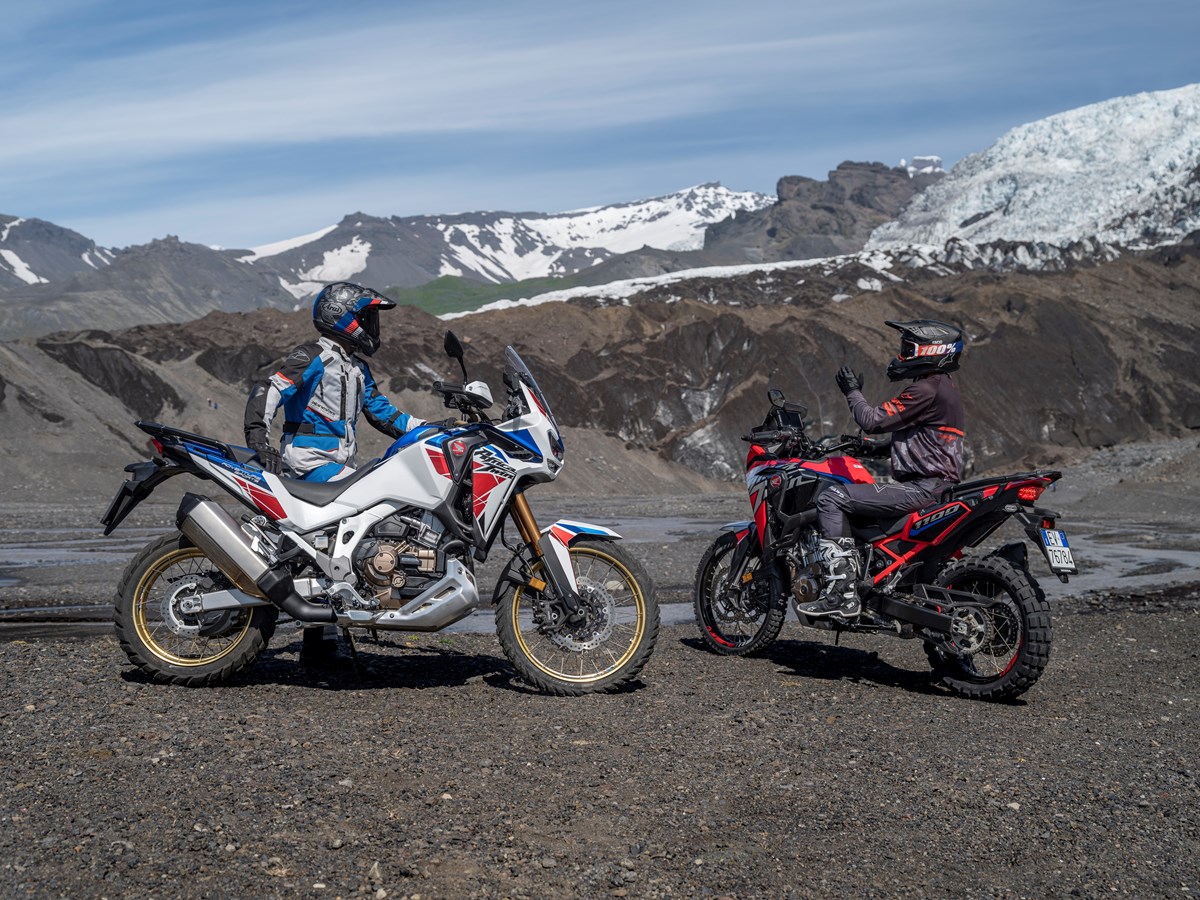
- Refined DCT settings for smoother handling in the first two gears
- CRF1100L Africa Twin features an aluminum rear carrier as standard
- New lower 5-way adjustable screen on the CRF1100L Africa Twin Adventure Sports improves visibility
- Striking new look with new ‘Big Logo’ and new ‘Cracked Terrain’ graphics on the Africa Twin and Africa Twin Adventure Sports respectively
Over three decades after first rolling into Europe, the Honda Africa Twin is a name that is still synonymous with history and adventure. For 2022 the CRF1100L Africa Twin and its continent- crossing sibling, the CRF1100L Africa Twin Adventure Sports, both feature new practical upgrades, refined Dual Clutch Transmission (DCT) settings and striking new looks.
For 2022 both the Africa Twin and Africa Twin Adventure Sports receive updates to further increase their daily practicality. The CRF1100L Africa Twin now features an aluminum rear carrier as standard, and the CRF1100L Africa Twin Adventure Sports benefits from a new 110mm lower 5-stage adjustable screen that improves visibility and doesn’t compromise on weather protection.
Both DCT versions of the Africa Twin and Africa Twin Adventure Sports are updated for 2022, with new refined settings to deliver even smoother handling in the first two gears from a standing start and at low speeds. Honda have sold over 200,000 DCT equipped motorcycles across Europe since the system was first introduced on the VFR1200F in 2009, a testament to its broad appeal and acceptance in the marketplace.
To complete the 2022 upgrades, both models receive striking new colour and graphic updates. The CRF1100L Africa Twin Adventure Sports features new ‘Cracked Terrain’ graphics and the
The CRF1100L Africa Twin now features a new ‘Big Logo’ design with revised colour schemes that feature all-new black aluminum side covers and a bold red rear subframe.
22YM CRF1100L AFRICA TWIN ADVENTURE SPORTS
Model updates: Updates for the 2022 year model of the continent-crossing ‘Adventure Sports’ version of Honda’s definitive full-sized adventurer include a shorter adjustable screen, striking new ‘Cracked Terrain’ graphics and updated DCT settings.
The fundamentals of the enduringly popular package remain: a lightweight chassis and torque-heavy 1084cc engine; a full electronics package using a six-axis Inertial Measurement Unit to manage riding modes and HSTC as well as Cornering ABS, Wheelie Control, Rear Lift Control, plus cornering detection functionality on the DCT version; standard fit cruise control, heated grips, USB port and ACC charger; a full colour 6.5-inch TFT touchscreen that incorporates Apple CarPlay®, Android Auto® and Bluetooth connectivity; dual LED headlights that feature Daytime Running Lights (DRL) technology and Cornering Lights; the option of Showa Electronically Equipped Ride Adjustment (Showa EERA™). And unmistakeable Africa Twin design and styling.
Contents:
1 Introduction
2 Model overview
3 Key features
4 Technical specifications
- Introduction
It’s been over three decades since the Honda XRV650 Africa Twin first rolled into Europe and while the motorcycle that now bears its name – launched in 2016 as the CRF1000L Africa Twin – was a brand-new motorcycle from the wheels up, it fully inherited the essence and spirit of what made the original so popular.
It was the balance between power and weight that was at the heart of the original bike’s appeal, just as it was for the new model. With its unique, athletic appearance, an enjoyable, usable engine and capable, comfortable chassis, the CRF1000L Africa Twin proved itself a true modern-day all-rounder and has been hugely popular with round-the-world adventurers, around-town commuters and weekend tourers alike.
2018 saw the Africa Twin, in both manual transmission and Dual Clutch Transmission (DCT) form, receive Throttle By Wire (TBW) control plus 4 riding modes, expanded Honda Selectable Torque Control (HSTC) options, as well as intake and exhaust development for improved engine response and sound. The platform also expanded: the Africa Twin Adventure Sports – with the same updates but featuring improved wind protection, greater tank range and longer-travel suspension – extended the machine even further into long-range off-road territory.
For 20YM, the introduction of a bigger capacity, longer stroke 1084cc engine marked another landmark in the evolution of the Africa Twin. The CRF1100L Africa Twin* itself was comprehensively redrawn with an aggressive, compact rally style and even sharper off-road focus. Meanwhile, the touring comfort, technology and ability of the CRF1100L Africa Twin Adventure Sports were also further enhanced – including the option of the cutting-edge Showa Electronically Equipped Ride Adjustment (Showa EERA™) suspension.
*See separate CRF1100L Africa Twin Press Kit.
2. Model Overview
The CRF1100L Africa Twin Adventure Sports shares the frame, engine and riding position of the off-road focussed CRF1100L Africa Twin, but has a role very much of its own: to offer riders real continent-crossing long-haul ability and practicality both on and off-road. This comes in the shape of a large 24.8L fuel tank, extensive wind protection (from both the fairing and fairing side panels), height-adjustable screen, large engine sump guard, aluminium rear carrier plus tubeless wheels and tyres. ACC charger and heated grips are also standard fit.
The 20YM change made it smaller, slimmer, lower and 5kg lighter than the previous 998cc model, and offered stronger performance with changes to the engine that produced 7% more peak power, 6% more peak torque and much greater strength everywhere in the rev-range. It was also Honda’s first EURO5 compliant engine. The frame too was completely revised and featured a new bolt-on aluminium subframe. The aluminium swingarm was based on that of the CRF450R moto-crosser.
At the centre of the Africa Twin Adventure Sports, a six-axis Inertial Measurement Unit (IMU) controls not only the 7-level HSTC but also 3-level Wheelie Control, Cornering ABS (with off-road setting), Rear Lift Control and DCT cornering detection. There are four default riding modes: URBAN, TOUR, GRAVEL and OFF-ROAD.
For optimum suspension damping front and rear the Africa Twin Adventure Sports is also available with Showa EERA™ as an option. Four default modes – SOFT, MID, HARD and OFF-ROAD – cover every type of riding situation, and there’s a USER mode for further fine-tuning. Rear spring preload can also be adjusted while stationary.
Tailored for complete control, the riding position features a slim-section seat and high-set handlebars. Dual LED Daytime Running Lights (DRL) feature three-stage Cornering Lights – that automatically adjust the field of illumination depending on the lean angle, giving optimum visibility, improving safety. Cruise control and heated grips are standard-fit. A full colour Multi Information Display (MID) 6.5-inch TFT touch screen brings immersive engagement with the machine’s systems, plus Apple CarPlay® and Bluetooth connectivity, with Android Auto® functionality introduced in early 2021.
For 22YM, the CRF1100L Africa Twin Adventure Sport now features refined Dual Clutch Transmission (DCT) settings for even smoother handling in 1st and 2nd gears, a new shorter adjustable screen, and striking new ‘Cracked Terrain’ graphics.
3. Key Features
3.1 Styling & Equipment
- Protective bodywork with a *new* shorter height-adjustable screen
- *New* ‘Cracked Terrain’ graphics
- 8L fuel tank, aluminium insert panels, rear rack and engine bash plate
- Daytime Running Lights (DRL) with Cornering Lights
- Cruise control, heated grips and ACC charger
- Multi Information Display (MID) 6.5-inch TFT touch screen
- Apple CarPlay® and Android Auto® allow use of a smartphone through the MID
Designed for the long-haul, the Africa Twin Adventure Sports has an extensive front fairing that for 22YM features a new 110mm shorter 5-level adjustable screen, improving visibility but still offering plenty of wind and weather protection. Sharing the 850-870mm seat height of the Africa Twin, the 1182mm handlebars give an upright, high-visibility riding position and comfortable control, whether standing or seated.
The tail section is extremely slim and the narrow seat is carefully contoured to allow easy back and forth movement as well as good ground reach. Holding 24.8L, the fuel tank offers a potential range of over 500km, thanks to fuel economy of 4.9L/100km (20.4km/L) MT and 4.8L/100km (20.8km/L) DCT (WMTC mode). A large engine sump guard and aluminium rear carrier are included in the specification.
Dual LED headlights are set high, delivering a penetrating beam and also feature Daytime Running Lights (DRL) that automatically adjust to ambient light intensity, improving safety, no matter the conditions. For additional security, the CRF1100L Africa Twin Adventure Sports features three-stage right/left Cornering Lights that use speed and lean angle (controlled by the IMU) to automatically adjust the area illuminated when cornering.
Large knuckle guards are standard.
The full colour Multi Information Display (MID) 6.5-inch TFT touch screen keeps the rider in control of all of the Africa Twin’s systems, with each of the riding modes selectable through the top left of the screen. The MID can also be customised to show various levels of information relative to the riding mode chosen and is easy to use even when wearing gloves.
It also incorporates Apple CarPlay® and Android Auto®, allowing use of a smartphone through the touchscreen. Navigation apps can also be accessed and displayed and via a Bluetooth helmet headset calls can be made or received. The smartphone itself plugs into a USB charging port on the right of the MID. Hands-free wireless Bluetooth connectivity is also an option and all control inputs are made from the left-hand switchgear.
The front and rear indicators have an Emergency Stop Signal function. When braking suddenly over 50kph the hazard lights flash to warn other road users a hard stop is in process. The indicators include an auto-cancel function; rather than using a simple timer, the system compares front and rear wheel speed difference and calculates when to cancel the indication relative to the situation. The auto-cancel feature can be switched off using the MID. Standard-fit cruise control eases long-distance highway travel.
The CRF1100L Africa Twin ‘Adventure Sports’ will be available in the following colours:
Pearl Glare White Tricolour
Matte Ballistic Black Metallic
New for 2022 is the new ‘Cracked Terrain’ design and revised colour schemes which now feature new all-black aluminium side covers and aluminium rear carrier.
3.2 Engine
- 1,084cc engine gives 75kW peak power and 105Nm peak torque
- In addition to extra capacity, the 20YM updates included a new cylinder head, valve timing and lift, throttle body and exhaust
- The variable Exhaust Control Valve (ECV) offers an engaging low-rpm sound and high-rpm performance
The SOHC 8-valve parallel-twin engine’s essential architecture remained unchanged for the 20YM update, but displacement increased to 1,084cc, up from 998cc. As a result, peak power increased from 70kW to 75kW @ 7,500rpm and peak torque from 99Nm to 105Nm @ 6,250rpm. Significantly, the obvious increase in both power and torque made itself felt from 2,500rpm all the way through to the redline.
To create the larger capacity, bore remained at 92mm but stroke was lengthened to 81.5mm (from 75.1mm) with a compression ratio of 10.1:1. Aluminium cylinder sleeves saved weight. Thanks to other detailed weight savings in the transmission and elsewhere, the manual transmission version of the 1084cc engine shaved 2.5kg from the previous 998cc power unit, and the DCT version 2.2kg. The cylinder head was also completely revised, and new 46mm throttle bodies introduced. The bore and cylinder pitches were aligned to create a smooth air intake profile, the ECU setting updated and injector angle modified to deliver a more direct spray into re-shaped twin-spark combustion chambers.
Other changes included optimised valve timing and increased inlet (from 9.2 to 10.1mm) and exhaust (from 8.6 to 9.3mm). To match and deal with the uprated intake efficiency and gas flow, the exhaust end-can featured a new variable Exhaust Control Valve (ECV) very similar to the unit fitted to the Fireblade. It offers enhanced engine performance and efficiency as it opens at higher rpm and gives a pleasing exhaust note ‘pulse’ at lower rpm.
The engine’s fundamentals remained unchanged. Honda’s SOHC Unicam valve train is a feature of the MX competition-specification CRF450R and the low-set position of the cast camshaft contributes to the compact nature of the cylinder head and entire engine package.
The 270° phased crankshaft and uneven firing interval create its distinctive ‘throb’.
The crankcases are split vertically; the water pump is housed efficiently within the clutch casing with a thermostat integrated into the cylinder head. Manual and DCT versions of the engine share common crankcases with only minor external differences; the water and oil pumps are both driven by the engine’s balancer shafts.
It’s a semi-dry sump design with in-tank lower crankcase oil storage. This allows a lower pan depth that keeps overall engine height low. As the pressure-fed pump is located within the tank where it delivers its oil from, there is no need for a pressure-feed passage. Secondary vibrations are neutralised by the mutually reciprocating motion of the pistons, while primary inertial and coupling vibrations are cancelled by the use of biaxial balance shafts.
The aluminium clutch centre and pressure plate use ‘assist’ cams to ease upshifts and ‘slipper’ cams for deceleration and downshifting; for 20YM the clutch diameter was reduced in size compared to the previous design, and spring tension reduced for lighter lever feel. The six-speed manual gearbox uses the same shift-cam design as found on the CRF450R to ensure positive changes. For 22YM, improved settings for the optional Quickshifter offer even smoother changes in the lower gears.
3.3 Engine & Chassis Management Electronics
- IMU-managed HSTC intervention levels have focus on off-road use
- Wheelie Control features 3 levels and IMU management
- Four riding modes: TOUR, URBAN, GRAVEL and OFF-ROAD
- Two USER modes allow for complete riding modes customisation
The Africa Twin Adventure Sports engine received the benefits of Throttle By Wire (TBW) control in 2018, allowing much finer management of engine output and character as well as expanded Honda Selectable Torque Control (HSTC) for rear tyre grip; for 2020 the system evolved to work in conjunction with a six-axis IMU*.
The electronics system offers 4 levels of power and 3 levels of engine braking. There are seven levels of HSTC with each level’s amount of intervention being optimised to work with real-time input (yaw/roll angle and rate) from the IMU. The spacing of the levels has been optimised to allowing the rider a finer choice of the amount of rear tyre slide for off-road riding. HSTC can also be turned off completely.
Wheelie Control is another feature that was introduced in 2020. Again, with the IMU measuring pitch angle and rate, and controlling engine torque via TBW, the rider can choose between 3 levels of input. Level 1 allows for intended wheel lift but suppresses any sudden movement. Level 3 stops any front wheel elevation and level 2 is mid-way between the two. Wheelie Control can also be turned off completely.
There are four default riding mode settings: TOUR, URBAN, GRAVEL and OFF-ROAD to cover most riding conditions and situations, plus two customisable USER settings. Even within the default riding modes, it’s possible to change some parameters – HSTC between levels 1-7 (plus off), Wheelie Control between levels 1-3 (plus off) and DCT S mode shift pattern levels 1-3.
TOUR employs the highest level of Power (1), for touring loaded with pillion and luggage plus mid-range Engine Braking (2) with active on-road Cornering ABS.
URBAN suits wide-ranging riding requirements and uses mid-level Power (2) and Engine Braking (2) with active on-road Cornering ABS.
GRAVEL delivers the lowest level of Power (4) and Engine Braking (3). Cornering ABS is active with an off-road setting; in this setting, the rear brake ABS cannot be switched off.
OFF-ROAD uses lower-mid level Power (3) and the lowest amount of Engine Braking (3). Cornering ABS is active with an off-road setting; the rear brake ABS can be switched off.
USER 1 & 2 modes offer the rider a choice of two distinct personalized setups – choosing between Power levels 1-4 and Engine Braking 1-3, plus HSTC, Wheelie Control and ABS (on-road/off-road) parameters. USER 1 starts out with level 2 Power and Engine Braking, USER 2 uses level 4 Power and 3 Engine Braking.
*See the Chassis section 3.5 of this press kit.
3.4 Dual Clutch Transmission
- ‘Easy and direct’ system offers super-fast gear changes in either Manual Transmission (MT) or Automatic D and S modes
- S mode (with 3 levels) revs higher and downshifts sooner than D, for more aggressive riding
- G switch improves rear wheel traction when off-road
- Incline detection adapts shift pattern depending on gradient
- IMU allows corning detection function for improved shift timings
- For 22YM, revised timings allow smoother handling at pull-away and in lower gears
Honda has sold over 200,000 DCT-equipped motorcycles across Europe since the system first appeared as an option on the VFR1200F in 2009. Testament to its acceptance in the marketplace, in 2020 DCT versions of the Africa Twin (including Adventure Sports version) accounted for 47% of the model’s sales.
The unique DCT system delivers consistent, super-fast seamless gear changes, and very quickly becomes second nature in use. It uses two clutches: one for start-up and 1st, 3rd and 5th gears: the other for 2nd, 4th and 6th, with the mainshaft for each clutch located inside the other for compact packaging.
Each clutch is independently controlled by its own electro-hydraulic circuit. When a gear change occurs, the system pre-selects the target gear using the clutch not currently in use. The first clutch is then electronically disengaged as, simultaneously, the second clutch engages.
The result is a consistent, fast and seamless gear change. Furthermore, as the twin clutches transfer drive from one gear to the next with minimal interruption of the drive to the rear wheel, any gear change shock and pitching of the machine is minimised, making the change feel direct as well as smooth.
The extra benefits of durability (as the gears cannot be damaged by missing a gear), impossibility of stalling, low stress urban riding, reduced rider fatigue and greater ability to focus on cornering lines and braking points add to DCT’s appeal.
Three modes of operation are available. MT mode gives full manual control, allowing the rider to shift with the handlebar trigger control buttons. Automatic D mode is ideal for city and highway riding, and achieves optimum fuel efficiency. Automatic S mode offers three levels of sportier riding, as the ECU lets the engine rev a little higher before shifting up, and shifts down sooner when decelerating for extra engine braking.
In either D or S mode, DCT offers immediate manual intervention if required – the rider simply selects the required gear using the up and down shift triggers on the left handlebar. At an appropriate time, DCT seamlessly reverts back to automatic mode, depending on throttle angle, vehicle speed and gear position.
DCT for the Africa Twin is also fully equipped to operate in an adventure environment, with off-road functionality enhanced by the G switch accessed via the TFT touch screen display. Activating the G switch in any riding mode improves the feel for available traction and machine control by reducing the amount of clutch slip during gear changes.
Further functionality for the DCT system comes in the form of incline detection, by means of which the gear shift pattern is adapted depending on the grade of an incline to provide optimum control.
A new feature for the CRF1100L Africa Twin’s DCT system for the change to the 1084cc model for 2020 was cornering detection. When the IMU recognises the bike is cornering, the system subtly adjusts the shifting programme for the most natural gear changes.
For 2022, the DCT settings have been further optimised in first and second gears to allow smoother handling from a standing start and at very low speeds.
3.5 Chassis
- Light frame, with bolt-on aluminium subframe and light rigid CRF450R-style swingarm for outstanding rear wheel traction and feel
- A six-axis Inertial Measurement Unit is housed in the centre of the machine
- Cornering ABS provides sure-footed feel and features an off-road setting
At the very heart of the Africa Twin Adventure Sports’ elevated on and off-road performance is a Bosch MM7.10 six-axis Inertial Measurement Unit (IMU) tucked away at the centre of the machine, that measures – in real-time – roll angle/rate, pitch angle/rate and yaw angle/rate. It manages rear wheel traction via TBW and HSTC, front braking grip through Cornering ABS, front wheel lift through Wheelie Control and also adds Rear Lift Control.
In conjunction with the addition of IMU control, for its 2020 evolution the strength and rigidity balance of the steel semi-double cradle frame was completely re-examined by Honda’s development engineers reinforcing its all-round on-road manners and boost off-road ability. Rigidity around the steering head was optimised to enhance feel for front end grip; the main spars were made slimmer and straighter and did away with the front cross pipe. A bolt-on aluminium subframe replaced the integral steel structure of the previous design to reduce width by 40mm to 195mm – crucial for easier ground reach. The lighter aluminium swingarm – taking its direction from the design used by the CRF450R – improved rigidity improves rear wheel traction and rider feel.
To tailor damping force front and rear – and spring preload to suit load and riding conditions – Showa Electronically Equipped Ride Adjustment™ (Showa EERA™) is an option on the Africa Twin Adventure Sports. Showa EERA™ adjusts damping force relative to riding mode selected and aims to deliver high-quality suspension reaction in diverse and opposite conditions – riding comfort at slower speeds and stability at higher speeds.
Input is gathered from stroke sensors plus Inertial Measurement Unit (IMU). There are three road settings: SOFT has the lowest damping force for smoothest reaction, versatile MID operates as an all-round setting with HARD, using the highest damping force through low-to-high stroke speed, designed for sportier riding.
There is an OFF-ROAD setting that gradually raises front fork damping force as stroke speed rises and uses higher damping settings for the rear shock.
Rear spring preload can be electronically adjusted while stationary, through four default settings; 1) riding solo, 2) riding solo with luggage, 3) riding two-up and 4) riding two-up with luggage. A USER option allows for fine-tuning of damping force front and rear and 24 points of rear spring preload.
The Africa Twin Adventure Sports is also available with standard Showa suspension. With stroke length of 230mm, the 45mm cartridge-type inverted front fork offers long-travel bump absorption and features revised internal settings to improve all-round performance. Rebound and compression damping are fully adjustable. A cast aluminium top yoke and forged bottom yoke – with a hollow aluminium stem shaft – clamp the fork legs with two bolts each top and bottom.
Matching the front suspension, the Showa rear shock delivers 220mm axle travel and features a 46mm cylinder and remote reservoir for stable damping control under extreme off-road riding conditions. Spring preload can be adjusted via a dial on the shock body; rebound and compression damping are also fully adjustable.
The swingarm pivot points’ inner plates use 600MPa high-strength steel and the upper cross tube that connects them acts as the rear shock upper mount (through a pillow-ball joint) improving feel for rear wheel traction.
The IMU takes in lean angle, deceleration (from front/rear wheel speed sensors) and incorporates the slip rate of the front and rear wheels to manage braking pressure through the ABS; likewise if it detects sudden rear wheel lift, it finely controls brake force to maintain stability. When stationary the rear ABS can be cancelled for off-road riding.
Compact two-piece radial-mount four-piston calipers work dual 310mm ‘wave’ floating discs through sintered pads. The rear 256mm ‘wave’ disc features hole punching and shaping. 21/18-inch front rear (stainless steel) spoked wheels wear 90/90-21 and 150/70-18 tyres. Block pattern tyres (Continental 90/90-21M/C 54S and 150/70B 18M/C 70Q, rated at 180km/h and 160km/h respectively) are approved for fitment.
Ground clearance is 250mm, with wheelbase of 1575mm and rake and trail of 27.5°/113mm. Wet weight is 238kg, with DCT at 248kg. The Showa EERATM adds a further 2kg in both Manual and DCT guises.
To make puncture repair easier when on tour the 21/18-inch front and rear (stainless steel) spoked wheels wear tubeless Bridgestone Battlax Adventurecross Tourer AX41T or Metzeler Karoo Street tyres, sized 90/90-21M/C 54H and 150/70R18 M/C 70H. Block pattern tyres (Continental 90/90-21M/C 54S and 150/70B 18M/C 70Q are also approved for fitment).
4 Accessories
The range of Honda Genuine Accessories for the Africa Twin Adventure Sports includes premium aluminium top box (42L) and panniers (37L left / 33L right) plus large plastic top box (58L) and panniers (40L left / 30L right), two seat heights (a lower 825-845mm and taller 870-895mm option), screen extender and deflector set, 4.5L tank bag, side tank pads, engine guards, radiator grill, side pipes and LED fog lights and centre stand.
Accessories are available in both a Super Pack and a Travel Pack for convenience.
5 Technical Specifications
|
ENGINE |
|
|
Type |
SOHC liquid-cooled 4-stroke 8-valve parallel twin with 270° crank and Uni-cam |
|
Displacement |
1084cc |
|
Bore & Stroke |
92mm x 81.5mm |
|
Compression Ratio |
10.1:1 |
|
Max. Power Output |
75kW at 7500rpm |
|
Max. Torque |
105Nm at 6250rpm |
|
Noise Level |
L-urban73.2dB, L-wot78.9dB – MT; |
|
Oil Capacity |
4.8/4.3 (5.2/4.7 DCT) |
|
FUEL SYSTEM |
|
|
Carburation |
PGM-FI |
|
Fuel Tank Capacity |
24.8L |
|
CO2 Emissions |
112g/km MT 110g/km DCT |
|
Fuel Consumption |
4.9L/100km (20.4km/L) MT 4.8L/100km (20.8km/L) DCT |
|
ELECTRICAL SYSTEM |
|
|
Starter |
Electric |
|
Battery Capacity |
12V-6Ah Li-ion battery (20hr) |
|
ACG Output |
0.49kW/5000rpm |
|
DRIVETRAIN |
|
|
Clutch Type |
Wet, multiplate with coil springs, aluminium cam assist and slipper clutch DCT – 2 wet multiplate clutches with coil springs |
|
Transmission Type |
6 speed manual (6 speed DCT) |
|
FRAME |
|
|
Type |
Semi double cradle |
|
CHASSIS |
|
|
Dimensions (L´W´H) |
2330mm x 960mm x 1490mm (1545mm with screen in uppermost position) |
|
Wheelbase |
1575mm |
|
Caster Angle |
27.5° |
|
Trail |
113mm |
|
Seat Height |
850/870mm (low seat option 825mm, high seat option 895mm) |
|
Ground Clearance |
250mm |
|
Kerb Weight |
238kg (DCT 248kg) With Showa EERATM 240kg MT (DCT 250kg) |
|
SUSPENSION |
|
|
Type Front |
Showa 45mm cartridge-type inverted telescopic fork with dial-style preload adjuster and damping adjustment, 230mm stroke
EERATM – Showa Telescopic inverted fork with an inner tube diameter of 45mm, and Showa EERATM with compression and rebound dumping adjustments, 230mm stroke
|
|
Type Rear |
Monoblock aluminium swing arm with Pro-Link with Showa gas-charged damper, hydraulic dial-style preload adjuster and rebound damping adjustments, 220 mm rear wheel travel.
EERATM – Monoblock aluminium swing arm with Pro-Link with Showa gas-charged damper, hydraulic remote control preload adjuster and electric control unit with compression and rebound damping adjustments, 220 mm rear wheel travel |
|
WHEELS |
|
|
Type Front |
21M/C x MT2.15 wire spoke with aluminium rim |
|
Type Rear |
18M/C x MT4.00 wire spoke with aluminium rim |
|
Rim Size Front |
21″ |
|
Rim Size Rear |
18″ |
|
Tyres Front |
90/90-21M/C 54H (tubeless type) Bridgestone Battlax Adventurecross Tourer AX41T |
|
Tyres Rear |
150/70R18M/C 70H (tubeless type) Bridgestone Battlax Adventurecross Tourer AX41T |
|
BRAKES |
|
|
ABS System Type |
2 channel with IMU |
|
Type Front |
310mm dual wave floating hydraulic disc with aluminium hub and radial fit 4-piston calipers and sintered metal pads |
|
Type Rear |
256mm wave hydraulic disc with single piston caliper and sintered metal pads. 2-Channel with rear ABS off mode. |
|
INSTRUMENTS & ELECTRICS |
|
|
Instruments |
LCD Meter, TFT 6.5inch touch panel multi information display |
|
Security System |
Immobiliser, security alarm (optional) |
|
Headlight |
LED |
|
Taillight |
LED |
|
Electrics |
Daytime running lights, Bluetooth audio and Apple CarPlay®, Android Auto®, USB socket, auto turn signal cancel, cruise control, emergency stop signal, IMU, HSTC, cornering lights, wheelie control |
** Please note that the figures provided are results obtained by Honda under standardised testing conditions prescribed by WMTC. Tests are conducted on a rolling road using a standard version of the vehicle with only one rider and no additional optional equipment. Actual fuel consumption may vary depending on how you ride, how you maintain your vehicle, weather, road conditions, tire pressure, installation of accessories, cargo, rider and passenger weight, and other factors.
22YM CRF1100L AFRICA TWIN
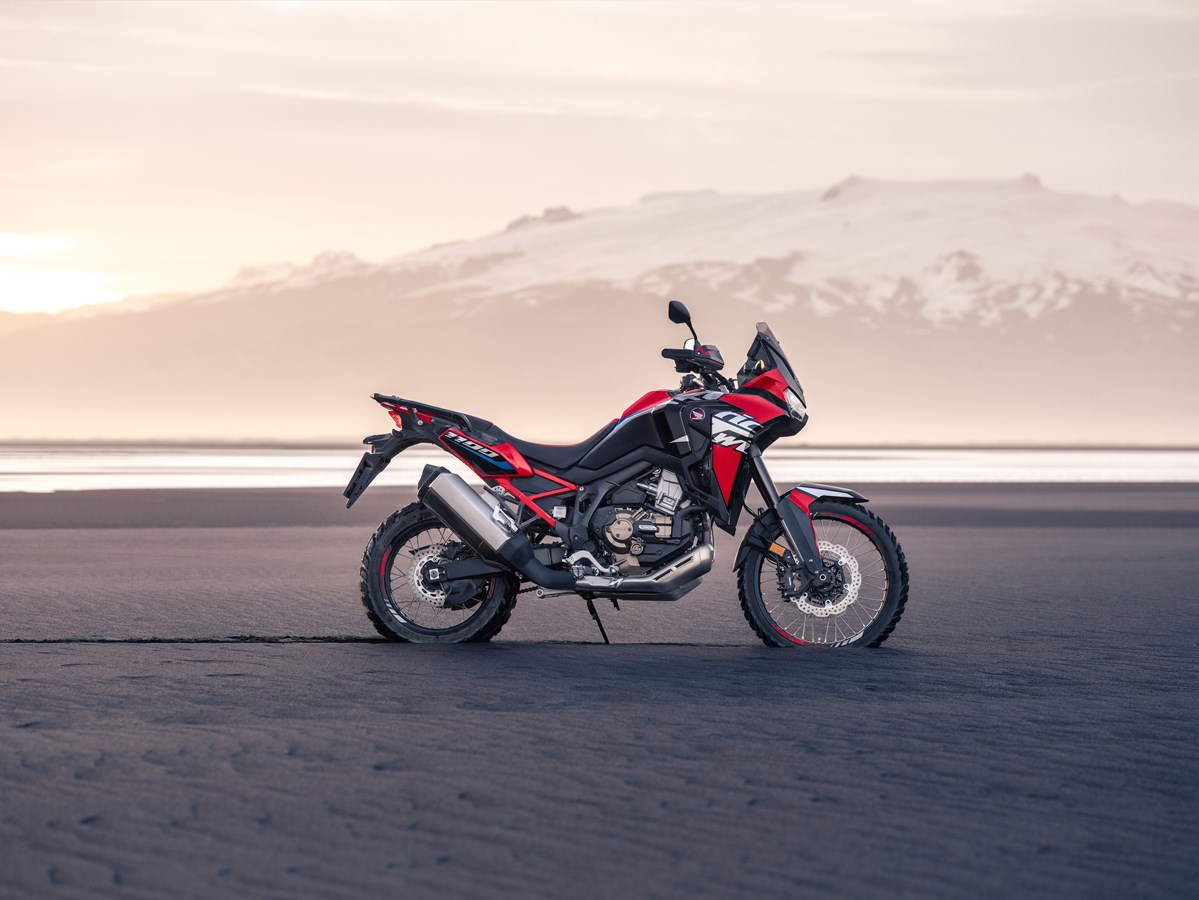
Model updates: Updates for the 2022 year model of Honda’s definitive full-sized adventurer include standard-fit rear carrier, new ‘Big Logo’ graphics and revised settings for the DCT version.
The fundamentals of the enduringly popular package remain: hard-edged off-road performance from an athletic, lightweight chassis with slim rally-style bodywork and characterful, torque-heavy 1084cc engine; a full electronics package using a six-axis Inertial Measurement Unit to manage riding modes and HSTC as well as Cornering ABS, Wheelie Control, Rear Lift Control, plus cornering detection functionality on the DCT version; USB port, standard fit cruise control; a full colour 6.5-inch TFT touchscreen that incorporates Apple CarPlay® and Bluetooth connectivity. And unmistakeable Africa Twin design and styling.
Contents:
1 Introduction
2 Model overview
3 Key features
4 Technical specifications
- Introduction
It’s been over three decades since the Honda XRV650 Africa Twin first rolled into Europe and while the motorcycle that now bears its name – launched in 2016 as the CRF1000L Africa Twin – was a brand-new machine from the wheels up, it fully inherited the essence and spirit of what made the original so popular.
It was the balance between power and weight that was at the heart of the original bike’s appeal, just as it was for the new model. With its unique, athletic appearance, an enjoyable, usable engine and capable, comfortable chassis, the CRF1000L Africa Twin proved itself a true modern-day all-rounder and has been hugely popular with round-the-world adventurers, around-town commuters and weekend tourers alike.
2018 saw the Africa Twin, in both manual transmission and Dual Clutch Transmission (DCT) form, receive Throttle By Wire (TBW) control plus 3 riding modes, expanded Honda Selectable Torque Control (HSTC) options, as well as intake and exhaust development for improved engine response and sound. The platform also expanded: the new Africa Twin Adventure Sports – with the same updates but featuring improved wind protection, greater tank range and longer-travel suspension – extended the machine even further into long-range territory.
For the 2020 year model, the introduction of a bigger capacity, longer stroke 1084cc engine marked another landmark in the evolution of the Africa Twin. The touring comfort, technology and ability of the CRF1100L Africa Twin Adventure Sports* were further enhanced – adding the option of Showa Electronically Equipped Ride Adjustment (SHOWA EERA™) and the CRF1100L Africa Twin itself was comprehensively redrawn with an aggressive, compact rally style and even sharper off-road focus. Alongside the increase in power and torque from the new engine, it was also significantly lighter – in keeping with the first principles set out all those years ago.
*See separate CRF1100L Africa Twin Adventure Sports Press Kit.
2. Model Overview
The 20YM CRF1100L Africa Twin came with a sharply-renewed focus on off-road core ability, that brought with it the look – and feel – of a true rally machine.
The 20YM change made it smaller, slimmer, lower and 4kg lighter than the previous 998cc model, and offered stronger performance with changes to the engine that produced 7% more peak power, 6% more peak torque and much greater strength everywhere in the rev-range. It was also Honda’s first EURO5 compliant engine. The frame too was completely revised and featured a new bolt-on aluminium subframe. The aluminium swingarm was based on that of the CRF450R moto-crosser.
At the centre of the Africa Twin Adventure Sports, a six-axis Inertial Measurement Unit (IMU) controls not only the 7-level HSTC but also 3-level Wheelie Control, Cornering ABS (with off-road setting), Rear Lift Control and DCT cornering detection. There are four default riding modes: URBAN, TOUR, GRAVEL and OFF-ROAD.
Tailored for complete control, the riding position features a slim-section seat and high-set handlebars. Dual LED Daytime Running Lights (DRL) give optimum visibility, improving safety. Cruise control is standard-fit. A full colour Multi Information Display (MID) 6.5-inch TFT touch screen brings immersive engagement with the machine’s systems, plus Apple CarPlay® and Bluetooth connectivity, with Android Auto® functionality introduced in early 2021.
For 2022, the CRF1100L Africa Twin now features refined Dual Clutch Transmission (DCT) settings for even smoother handling in 1st and second gears, standard fitment for the aluminium rear carrier, and striking ultra-modern ‘Big Logo’ graphics.
3. Key Features
3.1 Styling & Equipment
- Compact body style designed for off-road, with slim seat and high handlebars
- Multi Information Display (MID) 6.5-inch TFT touch screen
- Apple CarPlay® and Android Auto® allow use of a smartphone through the MID
- Bluetooth connectivity, Daytime Running Lights (DRL) and cruise control
- New ‘Big Logo’ graphics
Aggressive and compact. Two words that sum up the Africa Twin’s taut rally-style bodywork. And it’s for a reason – to work better off-road. The fixed screen is short to allow for easy scanning of the trail ahead and, with a seat height of 850-870mm, the high handlebars (increased by 22.5mm in height for 20YM) give an upright, high-visibility riding position and comfortable control, whether standing or seated. The tail section is extremely slim and the narrow seat carefully contoured to allow good ground reach and easy back and forth movement.
Dual LED headlights are set high, delivering a penetrating beam and also feature Daytime Running Lights (DRL) that automatically adjust to ambient light intensity, improving safety, no matter the conditions. Knuckle guards are standard.
The full colour Multi Information Display (MID) 6.5-inch TFT touch screen keeps the rider in control of all of the Africa Twin’s systems, with each of the riding modes selectable through the top left of the screen. The MID can also be customised to show various levels of information relative to the riding mode chosen and is easy to use even when wearing gloves.
It also incorporates Apple CarPlay® and Android Auto®, allowing use of a smartphone through the touchscreen. Navigation apps can also be accessed and displayed and via a Bluetooth helmet headset calls can be made or received. The smartphone itself plugs into a USB charging port on the right of the MID. Hands-free wireless Bluetooth connectivity is also an option and all control inputs are made from the left-hand switchgear.
The front and rear indicators have an Emergency Stop Signal function. When braking suddenly over 50kph the hazard lights flash to warn other road users a hard stop is in process. They also auto-cancel; rather than using a simple timer, the system compares front and rear wheel speed difference and calculates when to cancel the indication relative to the situation. The auto-cancel feature can be switched off using the MID. Standard-fit cruise control eases long-distance highway travel.
New for 2022 is the new ‘Big Logo’ design and revised colour schemes which now feature all-black aluminium side covers. An aluminium rear carrier is now also standard fit.
The CRF1100L Africa Twin will be available in the following colours:
Pearl Glare White Tricolour
Grand Prix Red
Matte Ballistic Black
3.2 Engine
- 1,084cc engine gives 75kW peak power and 105Nm peak torque
- In addition to extra capacity, the 20YM updates included a new cylinder head, valve timing and lift, throttle body and exhaust
- The variable Exhaust Control Valve (ECV) offers an engaging low-rpm sound and high-rpm performance
The SOHC 8-valve parallel-twin engine’s essential architecture remained unchanged for the 2020 update, but displacement increased to 1,084cc, up from 998cc. As a result, peak power increased from 70kW to 75kW @ 7,500rpm and peak torque from 99Nm to 105Nm @ 6,250rpm. Significantly, the obvious increase in both power and torque made itself felt from 2,500rpm all the way through to the redline.
To create the larger capacity, bore remained at 92mm but stroke was lengthened to 81.5mm (from 75.1mm) with a compression ratio of 10.1:1. Aluminium cylinder sleeves saved weight. Thanks to other detailed weight savings in the transmission and elsewhere, the manual transmission version of the 1084cc engine shaved 2.5kg from the previous 998cc power unit, and the DCT version 2.2kg. The cylinder head was also completely revised, and new 46mm throttle bodies introduced. The bore and cylinder pitches were aligned to create a smooth air intake profile, the ECU setting updated and injector angle modified to deliver a more direct spray into re-shaped twin-spark combustion chambers.
Other changes included optimised valve timing and increased inlet (from 9.2 to 10.1mm) and exhaust (from 8.6 to 9.3mm). To match and deal with the uprated intake efficiency and gas flow, the exhaust end-can of featured a new variable Exhaust Control Valve (ECV) very similar to the unit fitted to the Fireblade. It offers enhanced engine performance and efficiency as it opens at higher rpm and gives a pleasing exhaust note ‘pulse’ at lower rpm.
The engine’s fundamentals remained unchanged. Honda’s SOHC Unicam valve train is a feature of the MX competition-specification CRF450R and the low-set position of the cast camshaft contributes to the compact nature of the cylinder head and entire engine package.
The 270° phased crankshaft and uneven firing interval create its distinctive ‘throb’.
The crankcases are split vertically; the water pump is housed efficiently within the clutch casing with a thermostat integrated into the cylinder head. Manual and DCT versions of the engine share common crankcases with only minor external differences; the water and oil pumps are both driven by the engine’s balancer shafts.
It’s a semi-dry sump design with in-tank lower crankcase oil storage. This allows a lower pan depth that keeps overall engine height low. As the pressure-fed pump is located within the tank where it delivers its oil from, there is no need for a pressure-feed passage. Secondary vibrations are neutralised by the mutually reciprocating motion of the pistons, while primary inertial and coupling vibrations are cancelled by the use of biaxial balance shafts.
The aluminium clutch centre and pressure plate use ‘assist’ cams to ease upshifts and ‘slipper’ cams for deceleration and downshifting; the clutch diameter was reduced in size compared to the previous design, with reduced spring tension for lighter lever feel. The six-speed manual gearbox uses the same shift-cam design as found on the CRF450R to ensure positive changes. A quickshifter remains available as an optional extra.
3.3 Engine & Chassis Management Electronics
- IMU-managed HSTC intervention levels have focus on off-road use
- Wheelie Control features 3 levels and IMU management
- Four riding modes: TOUR, URBAN, GRAVEL and OFF-ROAD
- Two USER modes allow for complete riding modes customisation
The Africa Twin’s engine received the benefits of Throttle By Wire (TBW) control in 2018, allowing much finer management of engine output and character as well as expanded Honda Selectable Torque Control (HSTC) for rear tyre grip; for 2020 the system evolved to work in conjunction with a six-axis IMU*.
The electronics system offers 4 levels of power and 3 levels of engine braking. There are seven levels of HSTC with each level’s amount of intervention being optimised to work with real-time input (yaw/roll angle and rate) from the IMU. The spacing of the levels has been optimised to allowing the rider a finer choice of the amount of rear tyre slide for off-road riding. HSTC can also be turned off completely.
Wheelie Control is another feature that was introduced in 2020. Again, with the IMU measuring pitch angle and rate, and controlling engine torque via TBW, the rider can choose between 3 levels of input. Level 1 allows for intended wheel lift but suppresses any sudden movement. Level 3 stops any front wheel elevation and level 2 is mid-way between the two. Wheelie Control can also be turned off completely.
There are four default riding mode settings: TOUR, URBAN, GRAVEL and OFF-ROAD to cover most riding conditions and situations plus two customisable USER settings. Even within the default riding modes, it’s possible to change some parameters – HSTC between levels 1-7 (plus off), Wheelie Control between levels 1-3 (plus off) and DCT S mode shift pattern levels 1-3.
TOUR employs the highest level of Power (1), for touring loaded with pillion and luggage plus mid-range Engine Braking (2) with active on-road Cornering ABS.
URBAN suits wide-ranging riding requirements and uses mid-level Power (2) and Engine Braking (2) with active on-road Cornering ABS.
GRAVEL delivers the lowest level of Power (4) and Engine Braking (3). Cornering ABS is active with an off-road setting; in this setting, the rear brake ABS cannot be switched off.
OFF-ROAD uses lower-mid level Power (3) and the lowest amount of Engine Braking (3). Cornering ABS is active with an off-road setting; the rear brake ABS can be switched off.
USER 1 & 2 modes offer the rider a choice of two distinct personalized setups – choosing between Power levels 1-4 and Engine Braking 1-3, plus HSTC, Wheelie Control and ABS (on-road/off-road) parameters. USER 1 starts out with level 2 Power and Engine Braking, USER 2 uses level 4 Power and 3 Engine Braking.
*See the Chassis section 3.5 of this press kit.
3.4 Dual Clutch Transmission
- ‘Easy and direct’ system offers super-fast gear changes in either Manual Transmission (MT) or Automatic D and S modes
- S mode (with 3 levels) revs higher and downshifts sooner than D, for more aggressive riding
- G switch improves rear wheel traction when off-road
- Incline detection adapts shift pattern depending on gradient
- IMU allows corning detection function for improved shift timings
- For 22YM, revised timings allow smoother handling at pull-away and in lower gears
Honda has sold over 200,000 DCT-equipped motorcycles across Europe since the system first appeared as an option on the VFR1200F in 2009. Testament to its acceptance in the marketplace, in 2020 DCT versions of Africa Twin (including Adventure Sports version) accounted for 47% of the model’s sales.
The unique DCT system delivers consistent, super-fast seamless gear changes, and very quickly becomes second nature in use. It uses two clutches: one for start-up and 1st, 3rd and 5th gears: the other for 2nd, 4th and 6th, with the mainshaft for each clutch located inside the other for compact packaging.
Each clutch is independently controlled by its own electro-hydraulic circuit. When a gear change occurs, the system pre-selects the target gear using the clutch not currently in use. The first clutch is then electronically disengaged as, simultaneously, the second clutch engages.
The result is a consistent, fast and seamless gear change. Furthermore, as the twin clutches transfer drive from one gear to the next with minimal interruption of the drive to the rear wheel, any gear change shock and pitching of the machine is minimised, making the change feel direct as well as smooth.
The extra benefits of durability (as the gears cannot be damaged by missing a gear), impossibility of stalling, low stress urban riding, reduced rider fatigue and greater ability to focus on cornering lines and braking points add to DCT’s appeal.
Three modes of operation are available. MT mode gives full manual control, allowing the rider to shift with the handlebar trigger control buttons. Automatic D mode is ideal for city and highway riding, and achieves optimum fuel efficiency. Automatic S mode offers three levels of sportier riding, as the ECU lets the engine rev a little higher before shifting up, and shifts down sooner when decelerating for extra engine braking.
In either D or S mode, DCT offers immediate manual intervention if required – the rider simply selects the required gear using the up and down shift triggers on the left handlebar. At an appropriate time, DCT seamlessly reverts back to automatic mode, depending on throttle angle, vehicle speed and gear position.
DCT for the Africa Twin is also fully equipped to operate in an adventure environment, with off-road functionality enhanced by the G switch accessed via the TFT touch screen display. Activating the G switch in any riding mode improves the feel for available traction and machine control by reducing the amount of clutch slip during gear changes.
Further functionality for the DCT system comes in the form of incline detection, by means of which the gear shift pattern is adapted depending on the grade of an incline to provide optimum control.
A new feature for the CRF1100L Africa Twin’s DCT system for the change to the 1100cc model for 2020 was cornering detection. When the IMU recognises the bike is cornering, the system subtly adjusts the shifting programme for the most natural gear changes.
For 2022, the DCT settings have been further optimised in first and second gears to allow smoother handling from a standing start and at very low speeds.
3.5 Chassis
- Light frame, with bolt-on aluminium subframe and light rigid CRF450R-style swingarm for outstanding rear wheel traction and feel
- A six-axis Inertial Measurement Unit is housed in the centre of the machine
- Cornering ABS provides sure-footed feel and features an off-road setting
- Optimised damping and spring rates for the front and rear Showa suspension
At the very heart of the Africa Twin’s elevated on- and off-road performance is a Bosch MM7.10 six-axis Inertial Measurement Unit (IMU) tucked away at the centre of the machine, that measures – in real-time – roll angle/rate, pitch angle/rate and yaw angle/rate. It manages rear wheel traction via TBW and HSTC, front braking grip through Cornering ABS, front wheel lift through Wheelie Control and also adds Rear Lift Control.
In conjunction with the addition of IMU control, for its 2020 evolution the strength and rigidity balance of the steel semi-double cradle frame was completely re-examined by Honda’s development engineers to boost off-road ability – at the same time reinforcing its all-round on-road manners. Rigidity around the steering head was optimised to enhance feel for front end grip; the main spars were made slimmer and straighter and did away with the front cross pipe. A bolt-on aluminium subframe (finished in red) replaced the integral steel structure of the previous design to reduce width by 40mm to 195mm – crucial for easier ground reach. The lighter aluminium swingarm – taking its direction from the design used by the CRF450R – improved rigidity improves rear wheel traction and rider feel.
With stroke length of 230mm the 45mm Showa cartridge-type inverted front fork offers long-travel bump absorption and features revised internal settings to improve both on- and off-road performance. Rebound and compression damping are fully adjustable. A cast aluminium top yoke and forged bottom yoke – joined by hollow aluminium stem shaft – clamp the fork legs with two bolts each top and bottom.
Matching the front suspension, the Showa rear shock delivers 220mm axle travel and features a 46mm cylinder and remote reservoir for stable damping control under extreme off-road riding conditions. Spring preload can be adjusted via a dial on the shock body; rebound and compression damping are also fully adjustable.
The swingarm pivot points’ inner plates use 600MPa high-strength steel and the upper cross tube that connects them acts as the rear shock upper mount (through a pillow-ball joint) improving feel for rear wheel traction.
The IMU takes in lean angle, deceleration (from front/rear wheel speed sensors) and incorporates the slip rate of the front and rear wheels to manage braking pressure through the ABS; likewise if it detects sudden rear wheel lift, it finely controls brake force to maintain stability. When stationary the rear ABS can be cancelled for off-road riding.
Compact two-piece radial-mount four-piston calipers work dual 310mm ‘wave’ floating discs through sintered pads. The rear 256mm ‘wave’ disc features hole punching and shaping. 21/18-inch front rear (stainless steel) spoked wheels wear 90/90-21 and 150/70-18 tyres. Block pattern tyres (Continental 90/90-21M/C 54S and 150/70B 18M/C 70Q, rated at 180km/h and 160km/h respectively) are approved for fitment.
Ground clearance is 250mm, with wheelbase of 1574mm and rake and trail of 27° 30’/113mm. Wet weight is 229kg (DCT 240KG)
4 Accessories
The range of Honda Genuine Accessories for the Africa Twin includes premium (42L) aluminium top box and panniers plus large (58L) plastic top box and panniers, two seat heights (a lower 825-845mm and taller 870-895mm option), touring screen, radiator guards, engine guards and side pipes, knuckle guard extensions, heated grips and an ACC charging socket.
5 Technical Specifications
|
ENGINE |
|
|
Type |
SOHC Liquid-cooled 4-stroke 8-valve Parallel Twin with 270° crank and Uni-cam |
|
Displacement |
1084cc |
|
Bore x Stroke |
92mm x 81.5mm |
|
Compression Ratio |
10.1:1 |
|
Max. Power Output |
75kW at 7,500rpm |
|
Max. Torque |
105Nm at 6,250rpm |
|
Noise Level |
L-urban73.5dB, L-wot79.2dB – MT; |
|
Oil Capacity |
4.8/4.3 (5.2/4.7 DCT) |
|
FUEL SYSTEM |
|
|
Carburation |
PGM-FI |
|
Fuel Tank Capacity |
18.8L |
|
CO2 Emissions |
112g/km MT 110g/km DCT |
|
Fuel Consumption |
4.9L/100km (20.4km/L) MT 4.8L/100km (20.8km/L) DCT |
|
ELECTRICAL SYSTEM |
|
|
Starter |
Electric |
|
Battery Capacity |
12V-6Ah Li-ion BATTERY (20Hr) |
|
ACG Output |
0.49 kW / 5000rpm |
|
DRIVETRAIN |
|
|
Clutch Type |
Wet, multiplate with coil springs, aluminium cam assist and slipper clutch DCT – 2 wet multiplate clutches with coil springs |
|
Transmission Type |
6 Speed Manual (6 Speed DCT) |
|
Final Drive |
Semi Double Cradle |
|
FRAME |
|
|
Type |
Semi Double Cradle |
|
CHASSIS |
|
|
Dimensions (L´W´H) |
2,330mm x 960mm x 1,395mm |
|
Wheelbase |
1,575mm |
|
Caster Angle |
27.5° |
|
Trail |
113mm |
|
Seat Height |
850/870mm (low seat option 825mm, high seat option 895mm) |
|
Ground Clearance |
250mm |
|
Kerb Weight |
229kg (DCT 240kg) |
|
SUSPENSION |
|
|
Type Front |
Showa 45mm cartridge-type inverted telescopic fork with dial-style preload adjuster and DF adjustments, 230mm stroke. |
|
Type Rear |
Monoblock aluminium swing arm with Pro-Link with SHOWA gas-charged damper, hydraulic dial-style preload adjuster and rebound damping adjustments, 220 mm rear wheel travel. |
|
WHEELS |
|
|
Type Front |
21M/C x 2.15 wire spoke with aluminium rim |
|
Type Rear |
18M/C x 4.00 wire spoke with aluminium rim |
|
Rim Size Front |
21″ |
|
Rim Size Rear |
18″ |
|
Tyres Front |
90/90-21M/C 54H (tube type) (Bridgestone BATTLAX ADVENTURECROSS TOURER/ AX41T Metzler KAROO STREET) |
|
Tyres Rear |
150/70R18M/C 70H (tube type) (Bridgestone BATTLAX ADVENTURECROSS TOURER/ AX41T Metzler KAROO STREET) |
|
BRAKES |
|
|
ABS System Type |
2 channel with IMU |
|
Type Front |
310mm dual wave floating hydraulic disc with aluminium hub and radial fit 4-piston calipers and sintered metal pads |
|
Type Rear |
256mm wave hydraulic disc with single piston caliper and sintered metal pads. |
|
INSTRUMENTS & ELECTRICS |
|
|
Instruments |
LCD meter, TFT 6.5inch touch panel multi information display |
|
Security System |
Immobiliser, security alarm (optional) |
|
Headlight |
LED |
|
Taillight |
LED |
|
Electrics |
Daytime running lights, Bluetooth audio and Apple Carplay®, Android Auto®, USB Socket, auto turn signal cancel, cruise control, emergency stop signal, IMU, HSTC, wheelie control |
** Please note that the figures provided are results obtained by Honda under standardised testing conditions prescribed by WMTC. Tests are conducted on a rolling road using a standard version of the vehicle with only one rider and no additional optional equipment. Actual fuel consumption may vary depending on how you ride, how you maintain your vehicle, weather, road conditions, tire pressure, installation of accessories, cargo, rider and passenger weight, and other factors.

EURO5 GSX-R125 AND GSX-S125 ANNOUNCED
Suzuki has pulled the covers off its Euro5 GSX-R and GSX-S125 machines, with the new learner-friendly models available in dealerships next summer.
In 2022 the GSX-R125 – which has become the weapon of choice in the Freetech 125 Endurance Championship having won the title two seasons in a row – is available in the signature MotoGP blue with the bold, white SUZUKI graphic adorning the fairing, as well as a black and grey take on the trademark design, offset by red wheels.

The GSX-S125, which uses the same DOHC, free-revving single-cylinder engine as its fully-faired sibling, comes in a blue, black and silver, as well as a more subtle black and grey. A more eye-catching white and black with red decals and red wheels completes the set.

Both machines use a compact LCD dash and get Suzuki’s easy-start system. The GSX-R125 also features a keyless ignition system.
Pricing to be confirmed.

STANDARD PETROL IS CHANGING TO E10 – KNOW YOUR FUEL
Know Your Fuel. In the Summer of 2021, the standard petrol grade in the UK will be changing to E10. The introduction of E10 petrol will help reduce CO2 emissions associated with petrol vehicles.
The good news is, most motorcycles are also approved to use E10 petrol, but for those who like to keep their classics running, they should check compatibility just in case. For the few vehicles that need it, E5 will continue to be available at most larger forecourts in the ‘super’ grade. E10 contains up to 10% bioethanol.
The DfT have created the E10 Fuel Checker which enables riders to search for their PTW and check compatibility, prior to arrival at the pumps. Some PTWs made prior to 2011 will need to continue to use E5 petrol, which will remain available as the super grade petrol option at the pumps. Riders are being advised to use the super grade E5 option if there is any doubt in compatibility.

SAVE £500 ON THE SV650 THIS SUMMER
Suzuki has added the ever-popular SV650 to its Summer Savings campaign, with the V-twin middleweight now available with a £500 off test ride incentive.
It means the machine that arguably launched the booming middleweight naked market can be had for just £6,099.

The SV650 produces 73PS, is capable of averaging nearly 70mpg in every day riding conditions, and uses Suzuki’s easy start function and low RPM assist.
Owning an SV650 became almost a rite of passage for riders progressing from smaller, learner-friendly machines. Today it finds favour with new and experienced riders alike thanks to its manageability and fun, easy-to-ride nature.
Terms and conditions:
£500 test ride offer applies to purchases of a new SV650 only. The motorcycle must be purchased and registered between 16/07/2021 and 30/09/2021 to qualify. Offer may be extended or withdrawn at any time.

NEW WINTER OFFER ON SUZUKI TWINS
Suzuki has announced a new offer across its twins range – from its range-topping V-Strom 1050XT Tour to the popular SV650 – with 2.9% APR representative available over a three year agreement, with no deposit required and an additional £500 off test ride incentive.
Running from 1 December 2021 until the end of March 2022, the offer is available on both PCP and HP deals. The V-Strom 1050XT Tour is included in the offer, complete with three-piece aluminium luggage – as is the V-Strom 1050XT. Both machines use Suzuki’s proven 1037cc V-twin engine, boasting an abundance of torque in the low and midrange.

Models using the equally-famed 645cc V-twin, known for its free-revving character and reliability, are also included in the offer; both the V-Strom 650XT and V-Strom 650, plus the SV650 middleweight naked and its café racer-inspired stablemate, the SV650X.
The offer means the SV650, arguably the bike that spawned the current middleweight twins market, can be had with an RRP of just £6,099 after taking a test ride. And with no deposit required it removes the need to find a lump sum up front, while 2.9% APR ensures lower, manageable monthly repayments.

Or if you’re dreaming of adventure, taking a test-ride see’s the V-Strom 650’s RRP comes down to £7,499, and the V-Strom 1050XT Tour, with 112 litres of storage capacity in its aluminium luggage, is just £12,399.
And with plenty of stock available in dealerships, there’s even time to put one in the garage before Christmas.
Credit is subject to status and is only available to UK residents aged 18 and over. Suzuki Personal Contract Purchase (PCP) is only available through Suzuki Finance, a trading style of Suzuki Financial Services Limited. Registered office: St, William House, Tresillian Terrace, Cardiff, CF10 5BH.

SUZUKI INTRODUCES WHITE HAYABUSA FOR 2022
Suzuki has added a white version of the new Hayabusa to its range for 2022, which joins the existing black and orange and matt silver and red versions launched this year.
With an RRP of £16,499, the third generation of the legendary hyperbike gets Suzuki’s most advanced suite of electronics ever, with 10 lean angle-sensitive traction control modes, lean angle-sensitive ABS, three power modes, a bi-directional quickshifter, cruise control and a speed limiter, and three stages of launch control, all controlled via easy-to-use switchgear and managed through a neat colour TFT display, nestled between two analogue dials reminiscent of the original Hayabusa’s clocks.

A heavily redesigned engine – including new pistons, conrods, crankshaft, and camshaft – specifically aimed at producing enhanced performance in the lower to mid rev ranges making it the fastest-launching Hayabusa yet with more cumulative torque than its predecessor. All this is wrapped in sharper, more angular bodywork that nonetheless is immediately recognisable as Hayabusa, taking heavy design cues from the original.
The new pearl brilliant white Hayabusa, with its chrome trim and subtle metallic matt stellar blue accents, is available in dealerships now.

SUZUKI RANKED TOP AUTOMOTIVE BRAND IN CUSTOMER SATISFACTION INDEX
Suzuki has ranked highest in the automotive sector in the most recent UK customer satisfaction index, compiled by the Institute of Customer Service.
Over 45,000 responses were received as part of the survey, and Suzuki not only ranked as the highest automotive brand, but ranked joint third in the overall standings.

Jo Causon, CEO of The Institute of Customer Service, said, “In this challenging period for the automotive industry is it clear that some businesses have managed to maintain services and respond to changes in their customers’ circumstances and needs well. Suzuki’s continued strong showing in the UKCSI is encouraging and the organisations that best support their customers through these times – by reassuring, engaging and providing appropriate advice – will be best placed to thrive as we come out of this crisis.”
Nobuo Suyama, managing director of Suzuki GB, said, “We are very proud of our achievement to be in first position in the automotive sector, particularly in the continued challenging times we all face. Continuing to evolve the Suzuki customer experience remains a core focus for us and the ongoing efforts of our staff and dealers has again really paid off.”

SUZUKI SUMMER SAVINGS ARE HERE
Suzuki has announced three summer saving deals, running until the end of September and covering much of the on-road range.
Worth exploring
Available across the V-Strom 1050XT and V-Strom 1050XT Tour, plus the V-Strom 650 and V-Strom 650XT, the 'worth exploring' offer combines a lower rate of finance – 3.9% APR representative – available on either a PCP or HP deal over three years with £500 worth of free accessories.
The V-Strom accessory catalogues includes three-piece aluminium luggage – which is comes as standard fitment on the V-Strom 1050XT Tour – heated grips, touring screens, engine bars, and sump guards.
The V-Strom 1050XTs boast a 1037cc V-twin engine delivering 107PS and bags of torque, plus three selectable engine maps, traction control with three modes, lean angle-sensitive ABS with two modes, linked brakes with slope and load-dependent control and hill hold, and cruise control. There's also low RPM assist and Suzuki's easy start system. Practicality comes from a height-adjustable seat and screen, 12V socket and USB port, centre stand, hand guards, and spoked wheels.
The V-Strom 650 uses Suzuki’s proven 645cc V-twin engine, packed with character and a broad spread of usable torque, and also features a traction control system, low RPM assist, and the easy start system.
Terms and Conditions: £500 towards Suzuki Genuine Accessories. Offer applies to purchases of a new V-Strom 1050XT Tour, V-Strom 1050XT, V-Strom 650 and V-Strom 650XT only. The motorcycle must be purchased and registered between 01/07/2021 and 30/09/2021 to qualify. Offer may be extended or withdrawn at any time. HP and PCP Finance offer applies to purchases of the V-Strom 1050XT Tour, V-Strom 1050XT, V-Strom 650 and V-Strom 650XT only from a participating Suzuki Dealership. Purchase and registration of your chosen motorcycle must take place between 01/07/2021 and 30/09/2021. Offer may be extended or withdrawn at any time. Minimum deposit required: £500. Credit is subject to status, UK residents aged 18 and over. Suzuki Financial Services Ltd, St. William House, Tresillian Terrace, Cardiff, CF10 5BH.

To get your pulse racing
A similar three-year, 3.9% APR representative offer – also on PCP or HP – is available on the GSX-R1000R, including the limited edition 100th anniversary model, and the GSX-S750. This time the deal is sweetened with a £500 off test ride incentive.
A 200PS motor sits at the heart of the GSX-R1000R, which inherits the same variable valve timing system as the MotoGP world championship-winning GSX-RR. It uses a comprehensive suite of performance enhancing electronics – including a quickshifter and autoblipper, launch control, lean angle-sensitive traction control and ABS. There are also three power modes, easy start, and low RPM assist.
The GSX-S750 uses a 749cc inline-four cylinder that started life in the iconic GSX-R750 and delivers a smooth, linear power delivery, and gets traction control, low RPM assist, and Suzuki easy start, all wrapped in an agile chassis and sharp, streetfighter styling.
Terms and Conditions: £500 test ride offer applies to purchases of a new GSX-R1000R and GSX-S750 only. The motorcycle must be purchased and registered between 01/07/2021 and 30/09/2021 to qualify. Offer may be extended or withdrawn at any time. HP and PCP Finance offer applies to purchases of the GSX-R1000R and GSX-S750 from a participating Suzuki Dealership. Purchase and registration of your chosen motorcycle must take place between 01/07/2021 and 30/09/2021. Offer may be extended or withdrawn at any time. Minimum deposit required: £500. Credit is subject to status, UK residents aged 18 and over. Suzuki Financial Services Ltd, St. William House, Tresillian Terrace, Cardiff, CF10 5BH.

Hand crafted just for you
The third summer saving offer from Suzuki this season is the continuation of the 0% APR representative deal available on the Katana.
Requiring a minimum deposit of £500, customers can enjoy the Katana over a three-year HP deal with no interest payable. And being a HP deal, there is no final balloon payment.
The fresh take on the iconic machine from the 80s uses a torque-rich, 999cc inline-four cylinder engine – kept in check with a three-mode traction control system – a twin-spar aluminium chassis and superbike-derived swingarm. This is all packed in angular, aggressively styled bodywork that also remains unmistakably Katana.
For more information on Suzuki's offers click here.
Terms and Conditions: HP Finance offer applies to purchases of the KATANA only purchased from a participating Suzuki Dealership. Purchase and registration of your chosen motorcycle must take place between 01/07/2021 and 30/09/2021. Offer may be extended or withdrawn at any time. Minimum deposit required: £500. Credit is subject to status, UK residents aged 18 and over. Suzuki Financial Services Ltd, St. William House, Tresillian Terrace, Cardiff, CF10 5BH.

NEW COLOUR AVAILABLE FOR GSX-S750
Suzuki has released a fresh new colour option on its popular GSX-S750.
A clean and crisp new white version is enhanced with a vibrant, fluro yellow bellypan, while black GSX tank decals, headlight surround, and wheels help it maintain a compact, aggressive, streetfighter stance.
Powered by the engine from one of the most iconic sportsbikes of all time – the GSX-R750 – the GSX-S750 delivers smooth, linear power and features traction control, low RPM assist, and Suzuki’s easy start function.
It comes with an RRP of just £7,999 but is currently available with a £500 off, test ride incentive and a lower than usual rate of finance at 3.9% APR representative on either a three-year PCP deal or a three-year hire purchase agreement.
£500 test ride offer applies to purchases of a new GSX-R1000R and GSX-S750 only. The motorcycle must be purchased and registered between 01/07/2021 and 30/09/2021 to qualify. Offer may be extended or withdrawn at any time. HP and PCP Finance offer applies to purchases of the GSX-R1000R and GSX-S750 from a participating Suzuki Dealership. Purchase and registration of your chosen motorcycle must take place between 01/07/2021 and 30/09/2021. Offer may be extended or withdrawn at any time. Minimum deposit required: £500. Credit is subject to status, UK residents aged 18 and over. Suzuki Financial Services Ltd, St. William House, Tresillian Terrace, Cardiff, CF10 5BH.
Radical customs showcase the Dual Personality of the Honda CMX1100 Rebel
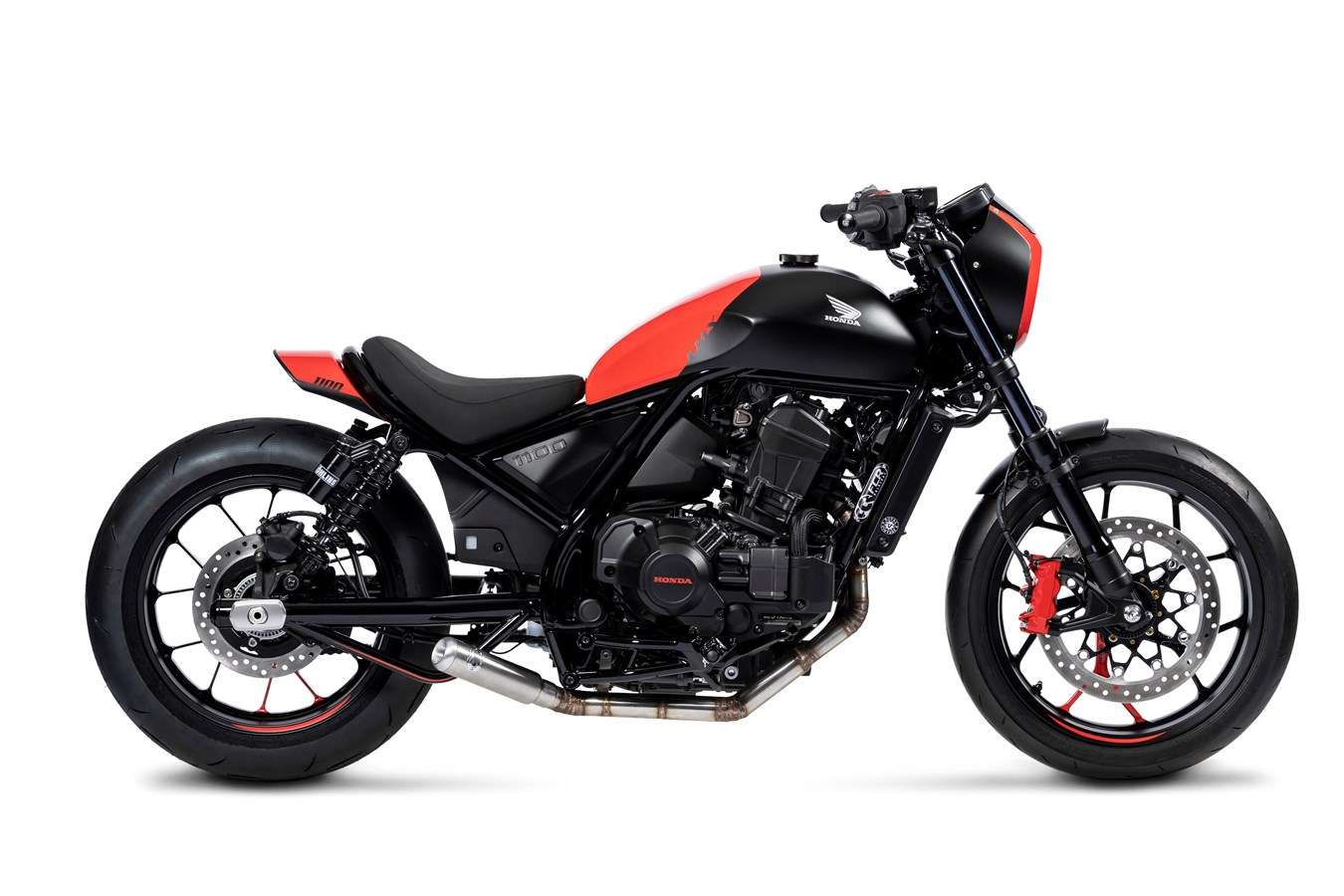
- Two custom CMX1100 Rebels originally scheduled to appear at the Wheels & Waves festival
- The CMX ‘Sport’ adds an aggressive racing edge while maintaining usability
- The CMX ‘Bobber’ heightens the classic minimalism with classy detailing
- Built in collaboration with French custom house FCR Original
Honda Motor Europe are celebrating the dual personality of the CMX1100 Rebel, the new big sibling to the CMX500 (Europe’s second best-selling custom motorcycle in 2020), with two radical builds by French custom house ‘FCR Original’. Both projects were originally scheduled to appear alongside ten dealer-built custom CB650Rs at this year’s Wheels and Waves festival in Biarritz.
The CMX ‘Sport’ and CMX ‘Bobber’ have been designed to appeal to different sensibilities, but both clearly show the custom potential of the CMX1100 Rebel that is hiding just under the skin.
CMX SPORT – “This one is for sport, but to ride every day.”
FCR Original wanted to highlight the practical and playful side of the Rebel, but make it more sporty, muscular and aggressive. They were also inspired by the mechanical beauty and performance of the DCT, which is so good for daily use by riders of all ages. After roughing out sketches of the finished bike, the team went to work. A swingarm modification allowed fitment of a pair of black Öhlins rear shocks, as well as 17-inch CB500F rear wheel and Dunlop D212 190/55-ZR17 tyre. The front mudguard is scratch-built and 25mm lower; oversize handlebars add leverage while the speedo has been moved to the top yoke.
Stunning in its simplicity, the bodywork is result of a complete 3D scan and consists of custom polyester-carbon fuel tank (with aluminium filler) and rear seat unit with LED lighting and Alcantara seat. Hand-built footrests add a racing feel while the red/black paint and detailing pays subtle homage to classic Honda imagery. The engine is stock, but breathes through an FCR Original stainless steel exhaust.
CMX BOBBER – “Reinforcing the custom spirit while maintaining a fun, playful character…”
Inspired by the ‘elemental’ design of the CMX1100 Rebel, this interpretation has a more custom feel, pushing it even further toward the bobber style. The swingarm and suspension are stock, but lowered 25mm at the front while custom-built black-spoke wheels wear fat Bridgestone tyres.
Building on the bobber vibe are aluminium handlebars, leather seat with perforated leather ribbing, simple aluminium front mudguard (with Mirrachrome finish) and painted headlight surround. Mini-Bates FCR Original LED indicators tuck neatly away and like the CMX Sport a 3D scan produced the custom polyester-carbon fuel tank – with Mirrachrome/blue satin finish – and aluminium filler. A ceramic-coated FCR Original exhaust is the finishing touch, highlighting the mechanical beauty of the bike.
22YM HONDA SUPER CUB 125
Model updates: After its welcome return to European streets in 2018 as the Super Cub 125, the world’s best-selling motor vehicle gains EURO5 compliance for 2021 with a new, more powerful and efficient air-cooled engine. A pillion pad and footpegs are now standard-fit, while new suspension settings improve ride comfort.
Contents:
1 Introduction
2 Model overview
3 Key features
4 Super Cub facts
4 Technical specifications
- Introduction
The very first Super Cub C100 was introduced in 1958, Honda’s 10th year of existence. Created by Soichiro Honda and his long-time business partner Takeo Fujisawa, its stated aim was straightforward: ‘to provide the joy of playing a useful part in people’s lives’.
Nearly 60 years later, in 2017, the 100 millionth Super Cub was built, cementing its status as the most popular motor vehicle the world has ever seen. Along the way the Super Cub’s simple attributes of unique styling, reliability, frugality and sheer usability have never gone out of fashion. And it has quietly achieved exactly what Soichiro and Takeo wanted: to get people mobile and keep them mobile.
Up to late 2018 the Super Cub series had only been available in Japan, where it has long been popular with business users including the Japanese Post Office, and in South East Asia, where it retains an important role in people’s lives as private transport. Well aware of the number of urban European riders – across a wide range of age demographics – who look for credible retro-inspired machinery and head-turning style, Honda unveiled the Super Cub 125 in 2018 as a modern evolution of the legendary name, marking a new chapter in its long history.
For the 2022 year model, the Super Cub 125 receives further advances for its European audience. The timeless look is unchanged, but a brand-new EURO5-compliant engine and host of improvements drive it on, just as Soichiro and Takeo would have wanted.
2. Model Overview
A new air-cooled SOHC engine design, with ECU setting, intake and exhaust to match, gains the Super Cub 125 EURO5 compliance. It produces slightly more power, and is more efficient, returning fuel economy of 1.5 litres/100km (WMTC mode). The ACG output is also uprated.
The classic styling is unchanged, and standard-fit pillion seat and footpegs are now added. Revised spring rates for front and rear suspension smooth the ride on rougher city streets.
3. Key Features
3.1 Engine
- Completely new engine is smoother, more powerful and more efficient
- Revised ECU settings, intake and exhaust for EURO5 compliance
- Alternating Current Generator (ACG) gains uprated output
Efficient and durable, the Super Cub 125’s new 124cc air-cooled engine combines the bottom-end (with re-designed crankcases) of the current Japanese-market C110 with the SOHC two-valve cylinder head and top-end of the latest MSX Grom. Bore is set at 50mm, stroke at 63.1mm with compression ratio of 10.0:1. Peak power of 7.2kW (a 0.1kW increase) arrives @ 7,500rpm, with peak torque of 10.4Nm @ 6,250rpm.
Smoothing airflow on the clean side, the new airbox, designed to match the new engine, is smaller and combines with the new connecting tube and new injector position to improve driveability.
The outward appearance of the muffler – one of the many elements of the Super Cub’s ‘mythology’ – stays the same while the internals are re-worked; two catalysers were in place on the previous engine but, with the gain in combustion efficiency for EURO5 compliance, a single, more efficient catalyser is used. The ECU has new programming to maximise performance and efficiency and the Alternating Current Generator (ACG) output increased.
The gearbox remains a 4-speed unit (with neutral at the bottom) and – in true Super Cub tradition – is operated via ‘automatic’ centrifugal clutch, without the need for a clutch lever. At standstill the rider simply selects the gear required with the left hand foot lever and, as the throttle is opened, the clutch operates automatically and does so through each ratio change, up or down. Final drive ratio is 2.50 with 14T drive and 35T driven sprockets. A helical primary gear reduces ‘mechanical’ noise.
The Super Cub C125 engine returns amazing fuel economy – 1.5litres/100km (66.7km/l) (WMTC mode) giving a range of approx. 250km from the 3.7 litre fuel tank.
3.2 Styling & Chassis
- Evocative styling unchanged; pillion pad and footpegs now standard-fit
- New springs for fork and rear shock absorbers improve ride quality
- As before, all lighting is LED and Smart Key operation comes as standard
The Super Cub 125’s time-tested, evocative styling – defined instantly by the leg-guards and fully enclosed mechanical parts – remains unchanged, and is a design with one word in mind: ‘universality’. In other words, it has to be easy for a wide range of people to use. A key part of this ethos is the laid-forward ‘S-shaped silhouette’ which runs from the step-through space to rear mudguard, making access on and off easy. New for the 2022 year model is the addition of a pillion seat and foot pegs as standard equipment.
Also instantly recognisable as Super Cub is the ‘unit’ steering, which unifies the separate elements – forks, handlebars and leg shields – into one cohesive whole. On the original machine the handlebars, shaped to be like the wings of a bird, were a tactile and welcoming sales point and the modern day Super Cub C125 with its forged, tapered handlebar wrapped in curvaceous moulded resin incorporating the switchgear and instruments, pays loyal homage to the original.
The grips are placed in a natural, easy-to-hold position and complement the straight-backed riding position, which gives excellent all-round visibility. Aiding comfort, the seat uses thick, high-density urethane foam. It is also cut back on both sides up front, helping ground reach.
All lighting is contemporary LED while the instruments highlight the depth of the overall design with two lenses separated by dual chrome rings. The outer ring houses the sweep of the analogue speedometer’s needle plus warning lights; the inner an understated digital display.
A modern finishing touch is the Honda Smart Key which also controls the immobiliser as an extra theft deterrent, and is equipped with an ‘answer back’ function whereby the indicators will ‘blink’ at the push of a button to make finding the vehicle easy in busy parking areas. And, with a nod to its forebears (and underlining its place in Honda’s history) a historical 3D ‘Classic Wing’ logo crowns the Smart Key fob.
Fun, easy handling has always been another Super Cub strength. To this end, the tubular steel ‘backbone’ frame has a rigidity balance carefully tuned around the headstock and between the engine mounting points, to optimise performance for the 124cc engine; the redesigned engine crankcases have new mounting hangers. Both handlebars and seat are rubber mounted and the footpegs also feature rubber inserts.
Rake and trail are set at 26.5°/71mm with wheelbase of 1,245mm. Wet weight is 110kg. 100mm travel telescopic forks feature new springs improving control; the twin rear shocks (matched to body colour) also use new springs and bump-stop material for a smoother ride on bumpy roads, while elegant 17-inch die-cast aluminium wheels (with machined rims and spokes) add stability and steering precision. Tubeless tyres are fitted, sized 70/90-17 front and 80/90-17 rear.
A 220mm front disc brake and single-piston caliper are matched by a 110mm rear drum.
4. Super Cub facts
Unsurprisingly, over six decades of production, the Super Cub has some remarkable stories and achievements behind it. Here are just fifteen:
- The first prototype wasn’t drawn out on paper, but using a clay model, into which Mr. Honda himself had strong input, using some ideas from a fact-finding trip to Europe in 1956.
- The first 1958 Super Cub C100’s low-floor backbone frame (for easy step-through), large leg shields (for protection from dust from unpaved roads), fully ‘enclosed’ bodywork (to hide the engine and harnesses), seagull-inspired handlebar shape and sky-inspired blue fairing laid down a universal template for decades to come.
- The size 17 inch wheels (relatively large in order to handle Japan’s uneven road surfaces) were designed and made exclusively for the Super Cub.
- It has always used a four stroke engine – even from its first 1958 incarnation.
- It had to avoid the need for a clutch lever so a delivery rider could ride one-handed with a stack of Soba noodle boxes on his left shoulder.
- Honda’s Suzuka factory was built in 1960 to help meet the demand for the hit product.
- The Super Cub has been produced in 16 factories across 15 different countries, and sold in 160 different countries.
- The Super Cub went on sale in the USA in 1959, with a sticker price of just $295. It took west coast surfing youth by storm and paved the way for much bigger things for Honda in America.
- The first European production of Super Cub started in Honda Belgium (the second ‘overseas’ factory to product the vehicle).
- It also starred in the ‘You meet the nicest people on a Honda’ ad campaign that changed the American perception of motorcycles away from being vehicles associated mainly with ‘biker gangs’.
- The Beach Boys made it even more famous in 1964 with their song ‘My Little Honda’.
- Also introduced to South Asia in 1964 the Super Cub became prized family transport that neatly dealt with the overwhelming traffic of the ever-growing major cities.
- The Japanese Patent Office awarded it a 3D trademark registration in 2014, recognising its shape and design as an iconic Honda product, and making it the first vehicle to achieve this status.
- Original sales were projected to be possibly 30,000 a month, which was amazing at the time as total motorcycle production in Japan was around 40,000 units a month, but something of an underestimate in the end.
- In typical, low-key Super Cub way on October 29th, 2017 a commemorative ceremony was held at Honda’s Kumamoto factory to mark worldwide production of 100 million units.
5. Technical specification
|
ENGINE |
|
|
Type |
Air-cooled SOHC 4-stroke 2-valve |
|
Displacement |
124cc |
|
Bore x Stroke |
50 x 63.1mm |
|
Compression Ratio |
10.0:1 |
|
Max. Power Output |
7.2kW @ 7,500rpm |
|
Max. Torque |
10.4Nm @ 6,250rpm |
|
Oil Capacity |
1.1 litres |
|
FUEL SYSTEM |
|
|
Carburation |
PGM-FI electronic fuel injection |
|
Fuel Tank Capacity |
3.7 litres |
|
Fuel Consumption |
1.5L / 100km (WMTC mode) |
|
ELECTRICAL SYSTEM |
|
|
Battery |
12V-3.5AH |
|
DRIVETRAIN |
|
|
Clutch Type |
Wet multi plate clutch and automatic centrifugal clutch |
|
Transmission Type |
4 speed |
|
FRAME |
|
|
Type |
Mono-backbone steel frame |
|
CHASSIS |
|
|
Dimensions (LxWxH) |
1,915 x 720 x 1,000mm |
|
Wheelbase |
1,245mm |
|
Caster Angle |
26.5° |
|
Trail |
71mm |
|
Seat Height |
780mm |
|
Ground Clearance |
125mm |
|
Kerb Weight |
110kg |
|
SUSPENSION |
|
|
Type Front |
26mm telescopic fork |
|
Type Rear |
Twin shock |
|
WHEELS |
|
|
Type Front |
Cast aluminium |
|
Type Rear |
Cast aluminium |
|
Tyres Front |
70/90-17M/C 38P |
|
Tyres Rear |
80/90-17M/C 50P |
|
BRAKES |
|
|
ABS type |
Single Channel ABS |
|
Type Front |
Single 220 mm hydraulic disc |
|
Type Rear |
110mm drum brake |
|
LIGHTING |
|
|
Headlight |
LED |
|
Taillight |
LED |
All specifications are provisional and subject to change without notice
Please note that the figures provided are results obtained by Honda under standardised testing conditions prescribed by WMTC. Tests are conducted on a rolling road using a standard version of the vehicle with only one rider and no additional optional equipment. Actual fuel consumption may vary depending on how you ride, how you maintain your vehicle, weather, road conditions, tire pressure, installation of accessories, cargo, rider and passenger weight, and other factors.

AKRAPOVIC SLIP-ON SILENCERS NOW AVAILABLE FOR NEW HAYABUSA
Suzuki GB has announced limited availability of new Akrapovic slip-on silencers for it’s 2021 Hayabusa.
Just 20 are currently available from authorised Suzuki dealerships, with the aftermarket exhausts reducing weight by a total of 4kg and boosting power by 2kW, as well as enhancing the Hayabusa’s soundtrack.

The titanium silencers – which feature classy, laser-etched Akrapovic and Hayabusa logos – are capped with a carbon fibre tip, while the heat shield is also carbon fibre.
Akrapovic also supplies its exhaust-making expertise to Suzuki’s MotoGP team.
A pair of Akrapovic exhausts for the new Hayabusa come with an RRP of £2876.05 and either a three-year warranty when fitted at point of sale, or two-year warranty if fitted later. If fitted at the point of purchase they can also be included in any finance agreement, spreading the cost over monthly repayments.

Other accessories available for the new Hayabusa include the pillion seat cowl – which completes the iconic silhouette – a stylised seat, heated grips, and billet brake and clutch levers.

SUZUKI ANNOUNCES NEW A2-FRIENDLY GSX-S950
Suzuki has announced details of a new A2 licence-friendly GSX-S950, which is available from August and features the ability to be restricted to 35kW to comply with A2 licence regulations. The GSX-S950 will represent a new proposition in the market, providing a ‘big bike’ experience at a restricted output for new riders, before becoming an ideal stepping stone to more powerful machines once derestricted.
Based on the GSX-S1000 platform – and using the same torque-laden inline-four cylinder engine – the GSX-S950 produces 95PS in standard trim, with restrictor kits readily available to ensure it conforms to the A2 licence category. However, despite a reduced peak power compared to its GSX-S1000 sibling, the 950 still makes use of the donor engine’s creamy midrange to produce 92 Nm of peak torque, with the same slip and assist clutch aiding smoother downshifts and slicker upshifts under hard acceleration.

The motor is also wrapped in the same twin-spar aluminium frame and uses the same superbike-derived swingarm and rear shock, but to help achieve a lower RRP – and therefore making it an even more accessible package – it uses 43mm KYB front forks. Other chassis changes include the use of Tokico front brake calipers and straight ‘bars, while the bespoke Dunlop Roadsport 2 tyres, 19-litre fuel tank, and new seat remain.
An electronics package comprises a three-mode traction control system that adds a safety net, while convenience comes from Suzuki’s low RPM assist feature and easy start function. The ride-by-wire throttle from the GSX-S1000 is carried over.

Bodywork replicates the new, aggressive, and angular styling of the GSX-S1000, with the same stacked LED headlights front and centre. The taillight is also full LED.
Available in August, the GSX-S950 comes in a striking white and red, a matt black, plus a metallic triton blue, all adorned with the visually different 950 logo on the radiator shrouds.

GSX-S750 ON NEWGSX-R1000R AND GSX-S750 ON NEW3% APR REPRESENTATIVE FINANCE
Suzuki’s GSX-R1000R superbike and GSX-S750 naked are both now available on a new, lower than usual rate of finance, with 3% APR representative on offer over three years, across both PCP and hire purchase agreements.
With a 200PS motor inheriting the same variable valve timing system as the MotoGP world championship-winning GSX-RR racer, a comprehensive suite of performance enhancing electronics – including a quickshifter and autoblipper, launch control, lean angle-sensitive traction control and ABS – the GSX-R1000R won the 2019 National Superstock 1000 championship and has won races in domestic superbike championships the world over.

The GSX-S750 uses a 749cc inline-four cylinder that started life in the iconic GSX-R750 and delivers a smooth, linear power delivery, and gets traction control, low RPM assist, and Suzuki easy start, all wrapped in an agile chassis and sharp, streetfighter styling.

Terms and Conditions: This is lower than our standard rate. HP and PCP Finance offer applies to purchases of the GSX-R1000R 100th Anniversary Edition, GSX-R1000R and GSX-S750 purchased from a participating Suzuki Dealership. Purchase and registration of your chosen motorcycle must take place between 21/05/2021 and 30/06/2021. Offer may be extended or withdrawn at any time. Minimum deposit required: £300. Credit is subject to status, UK residents aged 18 and over. Suzuki Financial Services Ltd, St. William House, Tresillian Terrace, Cardiff, CF10 5BH.

SUZUKI READY FOR ADVENTURE BIKE RIDER FESTIVAL
Suzuki is ready for the return of shows and events this summer, kicking off with the Adventure Bike Rider Festival on 24-27 June.
After the postponement of last year’s festival, Suzuki is bringing a fleet of display and demo machines to this year’s event, including the V-Strom 1050, 1050XT, and 1050XT Tour, the newest additions to Suzuki’s adventure bike stable.Using a more powerful version of Suzuki’s famed 1037cc V-twin, the XT adds a comprehensive suite of advanced electronics over the traction control and variable power modes on the base model, while three piece aluminium luggage features on the Tour edition.

The venerable and ever-popular V-Strom 650 and V-Strom 650XT will also be available to try, plus the newly-launched GSX-S1000. Displayed alongside the V-Strom range will be the RM-Z250 and Arenacross championship-wining RM-Z450 motocross machines and the third generation Hayabusa. For retro fans Suzuki will also show off a DR800S; the series of machines responsible for the adventure bike beak.


TEAM CLASSIC SUZUKI UNVEILS LOCKDOWN PROJECT BUILD
After a year or more with very limited racing activity, Team Classic Suzuki has unveiled its lockdown project build; a Katana based around a 2008 GSX-R1000 world superbike machine.
History already exists between Team Classic Suzuki and the Katana. After building a racing version at Motorcycle Live, Team Classic Suzuki raced a Katana in the European Classic Endurance Championship, scoring a class win at Oschersleben.

This time, Team Classic Suzuki has turned its hand to a road-going Katana project.
At the heart is a 2008 world superbike-spec engine from an Alstare GSX-R1000, fully refreshed by Team Classic Suzuki’s Nathan Colombi. Putting out around 200bhp at the rear wheel, it breathes through Alstare world superbike headers, mated to a Racefit link pipe and end can. Cooling comes from a factory radiator and oil cooler, with aluminium water and oil pipes. To keep things manageable, electronics comes as a Yoshimura EM Pro kit.

The package is housed in an Alstare world superbike frame, though dimensions are the same as the road-going GSX-R1000 K8. There’s a custom, over-sized swingarm and bespoke subframe from Alpha Performance Fabrications, both designed to facilitate a twin shock setup that pays homage to the original Katana. Suspension comes courtesy of Öhlins.
Dymag CH3 wheels also maintain a classic look, and are the same wheels found in Team Classic Suzuki’s XR69 replica machines. Mounted to them are Brembo discs, with calipers and pads also from the Italian firm. The rear caliper slots discreetly in between the swingarm and wheel for a cleaner look to the rear end. New aluminium rear sets were designed in-house.

Also cleaning up the rear end is slim LED tail light fitted to a seat unit that started life as a Team Classic Suzuki racing item, before being modified to fit the factory world superbike fuel tank. The nose cone is a new, old stock Katana unit, available from Suzuki’s Vintage Parts Programme, which has been widened by one inch and modified to fit. Moulds from the nose and seat unit were used to create carbon panels that add a finishing touch. Fixtures and fittings come courtesy of Racefastener.
A new seat from Italian supplier Race Seats is finished with a Katana logo, the traditional red Suzuki logo of original Katanas still adorns the tank, while a Team Classic Suzuki logo completes the seat unit, again in the traditional red.


£500 OF FREE ACCESSORIES WHEN BUYING A NEW V-STROM 650
Suzuki is giving buyers of its V-Strom 650 and V-Strom 650XT machines £500 worth of free genuine accessories, until the end of June.
This is in addition to Suzuki's current 3, 3, 3 offer, which allows customers, with just a £300 deposit, to choose from a three-year HP or PCP deal at just 3% APR representative, lower than its standard rate.

Customers can opt to put their £500 towards a variety of accessories, from luggage – including top boxes, panniers, and tank bags – to protective components such bash plates and engine bars or styling items such as graphics kits and touring screens.
The V-Strom 650 uses Suzuki's proven 645cc V-twin engine, packed with character and a broad spread of usable torque, and features traction control, low RPM assist, and Suzuki's easy start system.
THE ‘RC30 FOREVER’ REPLACEMENT PARTS SCHEME COMES TO EUROPE
- ‘RC30 Forever’ scheme comes to Europe, having launched in Japan in 2020
- Approximately 150 genuine parts will be available for the legendary RC30, for order through the Honda dealer network
- Parts will be produced using newly-made moulds
- Parts list created following meetings between Honda and well-established owners’ clubs in Japan and Europe
- The VFR750R (RC30) was first launched in 1987 in accordance with World Superbike homologation rules
Honda will be bringing the ‘RC30 Forever’ genuine replacement parts scheme to Europe following its successful introduction in Japan last year.
Honda started the ‘RC30 Forever’ programme after meetings with well-established RC30 owners’ clubs in Japan and Europe, during which the owners expressed their strong desire to keep these iconic bikes on the road and in the best condition by using genuine Honda spare parts. The key focus of the programme is keeping these owners riding safely and with confidence.
Under the scheme, Honda produces approximately 150 genuine replacement parts for the RC30 that cover the engine, chassis, bodywork and electronics. These have been chosen based on owners’ requests and the experience of experts within Honda’s R&D and manufacturing facilities.
Parts will be available to order through dealerships across Europe from May* 2021.
Background to the ‘RC30 Forever’ scheme
At the beginning of the ‘RC30 Forever’ project, an investigation through the RC30 archives undertaken in 2017 revealed that none of the original wooden models or moulds for the RC30 had been retained. It was clear that the original drawings would be needed to move the project forward. Like all motorcycles produced at the time, the manufacture of the RC30 was based on 2D hand-drawn wireframe blueprints, from which models and moulds were created. Compared with modern methods of 3D computer modelling and digital drawings, these blueprints contain far fewer specific details, which complicated the reproduction of the new parts.
The blueprints available were digitised, enlarged to a 1:1 scale and compared with existing parts borrowed from the remaining RC30s within the Honda family and owners’ clubs to ensure their accuracy. Despite this, there were still clear and obvious gaps in the detailed information needed to produce the quality of parts required for the scheme. To ensure the parts met these very high standards, it was vital to involve the original team members, many of whom were in their 60s, to share their knowhow, passion and experience when the project team re-created the new wooden models and moulds from scratch.
It is this combination of tangible elements like new digitised drawings and available parts, with longstanding unquantifiable factors like the experience of returning members of the Honda family, that ultimately led to the successful creation of the scheme in Japan.
The VFR750R (RC30)
The legendary RC30 was first revealed at the Tokyo Motor Show in 1987, making its way to Europe in 1988. Limited to approximately 5,000 units worldwide, it was created to comply with the homologation rules required to compete in the newly formed World Superbike Championship.
Hand-built in the Hamamatsu factory, the RC30 was powered by a liquid-cooled 748cc 90° V4 and featured cutting edge race technology of the time – an approach unheard of hitherto. Honda’s development engineers made maximum use of exotic materials like carbon fibre, Kevlar and magnesium throughout the bike. The engine featured titanium connecting rods and a slipper clutch, that worked together with the tall race machine-style gearing. Wheels and brakes featured quick release mountings and the suspension was fully adjustable front and back. The bike prominently featured an unmistakable single-sided Pro-arm swingarm designed to help with rapid rear wheel changes during races.
The legacy of the RC30 was cemented when it won the World Superbike Championship in both 1988 and 1989 with Fred Merkel. It also notched up victories in multiple national and international races, including wins on the Isle of Man in the hands of celebrated riders like Joey Dunlop, Carl Fogarty, Steve Hislop and Philip McCallen.
* Sales start will vary depending on the part, and any updates will be added to the Honda website. Sales will be subject to limited stock availability for all parts.
2022 HONDA CRF450R
Model updates: After a major evolutionary leap in 21YM the CRF450R receives further refinements for 22YM, offering smoother drivability from new ECU settings, plus a re-valve for the Showa suspension to improve damping balance between front and rear. The frame remains unchanged, and is the exact same frame used on the CRF450RW piloted to back-to-back MXGP World Championships by Tim Gajser in 2019 and 2020.
Contents:
1 Introduction
2 Model overview
3 Key features
4 Technical specifications
- Introduction
The Honda CRF450R has been the benchmark motocrosser since its introduction in 2002. Its package has always aimed to offer its rider – whether amateur enthusiast or pro-racer – total control through balance and agility. Plus, of course, it’s built with the quality, durability and longevity that Honda has long been famed for.
And it’s a race bike that has constantly evolved. In 17YM, under a development concept of ‘ABSOLUTE HOLESHOT!’, Europe’s favourite open-class MX machine was given a ground-up redesign, with completely new chassis and a major top end power boost from a brand-new engine. Standard-fit electric start was a convenient addition in 18YM and, for 19YM, an HRC-developed cylinder head upped power and torque considerably; HRC launch control was also added. For 20YM the CRF450R gained Honda Selectable Torque Control (HSTC).
Aside from the wheels and fundamental engine architecture, for 21YM the CRF450R was effectively a totally new machine, drawing heavily on developments from the 2019 MX GP championship-winning CRF450RW. And, while the 2020 MXGP championship was a challenge for a variety of reasons, Gajser and HRC secured the title for a second year in a row at the 18th round in Trentino, Italy in November 2020.
Backed up by this continued proof of its top level racing pedigree, the 22YM CRF450R features further refinements to engine and suspension. And it remains, at its core, an HRC racer it is possible to buy.
2. Model Overview
The redesigned 21YM CRF450R was based on the development theme of ‘RAZOR-SHARP CORNERING’, centred around stronger low/mid-range torque, ultra-accurate handling and rider-friendly ergonomics. The new (2kg lighter) frame and swingarm’s rigidity balance were combined with a tighter chassis geometry and heightened ground clearance to target peak cornering performance. HRC’s engine knowhow delivered strong low- to mid-range torque and the revised decompressor system gave more consistent off-the-bottom driveability. A new hydraulic clutch and comprehensive electronics package ensured that the new bike’s ergonomics made it easier for the rider to go consistently fast throughout a race – helping not only MXGP riders but also MX enthusiasts of all ability levels to constantly post optimal lap times.
Building on these solid fundamentals from the new 21YM model, for 22YM the CRF450R receives an ECU update boosting drive plus extensive re-valve of the front and rear Showa suspension, elevating damping performance.
3. Key Features
3.1 Chassis
- For 22YM, firmer suspension damping creates more balanced suspension performance
- HRC input running through frame, swingarm, rigidity balance and geometry combines for outstanding cornering ability and ease of use, lap after lap
- Compact narrow plastics aid rider freedom
For 22YM the CRF450R’s chassis is unchanged aside from internal adjustments to the front and rear Showa suspension. The aim for the 22YM evolution is to deliver noticeably improved ‘hold up’ – raising the compression damping ride height of the stroke both front and rear in use – optimising balance between the front and rear of the machine.
The Showa 49mm USD coil spring AF2 fork is based on the ‘factory’ unit supplied to MX race teams in the Japanese championship. Through the 21YM update the fork received 5mm more stroke, to 310mm, and increased rigidity for its axle clamps. For 22YM the low-speed shim-stack has been re-valved to generate firmer settings for both compression and rebound damping. Oil volume reduces 8cc to 380cc; there are now 13 adjustment positions (rather than 15) for rebound with 15 for compression, as before.
A complete re-valve of the Showa MKE AF2 rear shock’s low-mid- and high-speed shim stack delivers a firmer overall setting for compression damping. There are now 11 adjustment positions for rebound (from the 8 of the previous iteration) and 6 for high and low-speed compression (from 12). Oil volume increases 1cc to 422cc.
The 21YM evolutionary leap saw the cycle parts and ergonomics greatly improved. Thanks to narrower main spars the weight of the main frame was reduced by 700g, while the redesigned subframe also saved 320g. The chassis dynamic was also new; with torsional rigidity maintained, lateral rigidity reduced 20% to increase corner speed, traction and steering accuracy. Both top and bottom yokes were redesigned for greater flex, for quicker steering and improved feel, and the aluminium Pro-Link swingarm given a rigidity balance tuned to match the frame.
To aid movement around the machine the seat was made shorter, lighter and 10mm lower at the rear compared to the previous design. It was also made easier to remove and install, and maintenance was simplified with only four 8mm bolts securing the bodywork each side.
Designed with Computational Flow Dynamics (CFD) for maximum through-flow of air, the radiator shrouds are constructed from one piece of plastic and include a lower vent while the radiator grills are optimised for airflow. The titanium fuel tank holds 6.3L.
Standard-fit, lightweight Renthal Fatbar flex for optimal comfort; the top yoke features two handlebar-holder locations for moving the handlebar rearward and forward by 26mm. When the holder is turned 180°, the handlebar can be moved an additional 10mm from the base position, resulting in four unique riding positions.
Up front, the twin-piston brake caliper employs 30 and 27mm diameter pistons and 260mm wave-pattern disc; along with low-expansion rate brake hose it gives both a strong feel and consistent staying power. The single-piston rear caliper is matched to a 240mm wave-pattern disc.
DID aluminium rims, with directly attached spoke pattern layout are finished in black; the front is a 21 x 1.6in, the rear a 19 x 2.15in. The rear wheel was made both stronger and lighter for 21YM and Dunlop’s MX33F/MX33 soft-terrain tyres are fitted as standard equipment.
Rake and trail remain at 27.1°/114mm with 1481mm wheelbase and 336mm ground clearance. Dry weight is 105.8kg.
The striking all-red graphic treatment complements the 22YM CRF450R’s aggressive lines.
3.2 Engine
- Revised ECU mapping for 22YM enhances smoother power delivery
- Hydraulic clutch gives consistent and light lever feel
- Decompressor system delivers improved stall resistance
22YM sees the 449.7cc four-valve Unicam engine unchanged, except for updated ECU mapping further promotes linear throttle control enhancing the boost that it received in 21YM.
Those changes for 21YM were very significant. An increase (up to 0.6kW) in peak power above 5,000rpm – accompanied by a stronger low-rpm torque feel – was the result of an extra 1.8L volume (to 4.1L) on the ‘clean’ side. The injector angle, too went from 30° to 60°, spraying fuel all the way back to the butterfly to improve intake efficiency, cooling of the charge and all-important throttle feel. The decompression system was also new: its counterweight moved from the right of the camshaft to the left, giving more stable operation at low rpm with increased stall-resistance.
The biggest change was to the twin exhaust ports: like the CBR1000RR-R Fireblade their exit became oval rather than round in shape for improved efficiency. The downpipe was also tucked in 74mm closer to the centre line while the single muffler featured twin resonators to reduce noise while boosting power.
Drawn directly from Gajser’s bike was the 8-plate hydraulic clutch. This gives outstanding control and feel at the lever as well as delivering consistent lever clearance under arduous riding conditions. Slippage was also reduced by 85% at peak power.
Bore and stroke is set at 96 x 62.1mm with compression ratio of 13.5:1. A gear position sensor allows the use of three specific ignition maps for 1st and 2nd, 3rd and 4th, and 5th. Rock-solid reliability has always been a big factor in the CRF450R’s success and a 5-hole piston oil jet and dual 12mm drum scavenge pump manage all-important lubrication.
3.3 Electronics
- Honda Selectable Torque Control (HSTC) with 3 riding modes (plus OFF)
- HRC Launch Control offers 3 start options
- Engine Mode Select Button (EMSB) features 3 maps to adjust output character
- HRC Setting tool tailors Aggressive and Smooth modes
The CRF450R’s HSTC works to minimise rear wheel spin (thus wasted forward drive) and maximise traction. It doesn’t use a wheel speed sensor, and critically maintains feel at the throttle while managing power; ignition timing is retarded and the PGM-FI controlled when the rate of change of rpm is detected to have gone over a set amount.
The three Modes differ in drive management level for different riding conditions:
Mode 1 intervenes most lightly, and after the longest time – useful for reducing wheelspin and maintaining control in tight corners.
Mode 3 has the system intervene more quickly and strongly, and is therefore useful in more slippery, muddy conditions.
Mode 2 naturally offers a mid-point between 1 and 3 in terms of speed and strength of intervention.
The Launch Control indicator, EFI warning, HSTC and EMSB mode button, and LED indicator are sited on the left handlebar. Pressing and holding the HSTC button for 0.5s will cycle the system to the next mode, with a green LED indication – 1 blink for Mode 1, 2 for Mode 2 and 3 for Mode 3 – to confirm selection.
The HSTC system can also be switched off completely. When the engine is turned on, the system uses the last-selected setting.
HRC Launch Control gives any rider the best option for a strong start and also has 3 modes to choose from:
Level 3 – 8,250rpm, muddy conditions/novice.
Level 2 – 8,500rpm, dry conditions/standard.
Level 1 – 9,500rpm, dry conditions/expert.
Activating HRC Launch Control is easy: to turn on, pull in the clutch and push the Start button on the right. The purple LED will blink once for Level 1 selection. Push the Start button again, for 0.5s or longer, and the LED will blink twice for Level 2. Repeat the process and the LED will blink 3 times, indicating that Level 3 has been chosen.
The Engine Mode Select Button (EMSB) alters the engine’s character and three maps are available to suit riding conditions or rider preference:
Mode 1 – Standard.
Mode 2 – Smooth.
Mode 3 – Aggressive.
The LED also displays mode selected, but with a blue light.
The HRC Setting Tool can deliver an ECU map with a much more easy-going Smooth mode, with gentler throttle response for less experienced riders. It can also inject Aggressive mode with a hyper-sensitive throttle reaction and engine response for race conditions.
4. Technical Specifications
|
ENGINE |
|
|
Type |
Liquid-cooled 4-stroke single cylinder uni-cam |
|
Displacement |
449.7cc |
|
Bore ' Stroke |
96.0mm x 62.1mm |
|
Compression Ratio |
13.5 : 1 |
|
FUEL SYSTEM |
|
|
Carburation |
Fuel injection |
|
Fuel Tank Capacity |
6.3 litres |
|
ELECTRICAL SYSTEM |
|
|
Ignition |
Digital CDI |
|
Starter |
Self-Starter |
|
DRIVETRAIN |
|
|
Clutch Type |
Wet type multi-plate |
|
Transmission Type |
Constant mesh, 5-speed,manual |
|
Final Drive |
Chain |
|
FRAME |
|
|
Type |
Aluminium twin tube |
|
CHASSIS |
|
|
Dimensions (L'W'H) |
2,182 x 827 x 1,267mm |
|
Wheelbase |
1,481mm |
|
Caster Angle |
27.1° |
|
Trail |
114mm |
|
Seat Height |
965mm |
|
Ground Clearance |
336mm |
|
Weight |
Dry 105.8kg – wet 110.6kg |
|
SUSPENSION |
|
|
Type Front |
Showa 49mm USD fork |
|
Type Rear |
Showa monoshock using Honda Pro-Link |
|
WHEELS |
|
|
Type Front |
Aluminium, spoke |
|
Type Rear |
Aluminium, spoke |
|
Tyres Front |
80/100-21-51M Dunlop MX33F |
|
Tyres Rear |
120/80-19-63M Dunlop MX33 |
|
BRAKES |
|
|
Front |
Single 260mm disk |
|
Rear |
Single 240mm disk |
All specifications are provisional and subject to change without notice
Please note that the figures provided are results obtained by Honda under standardised testing conditions prescribed by WMTC. Tests are conducted on a rolling road using a standard version of the vehicle with only one rider and no additional optional equipment. Actual fuel consumption may vary depending on how you ride, how you maintain your vehicle, weather, road conditions, tire pressure, installation of accessories, cargo, rider and passenger weight, and other factors.